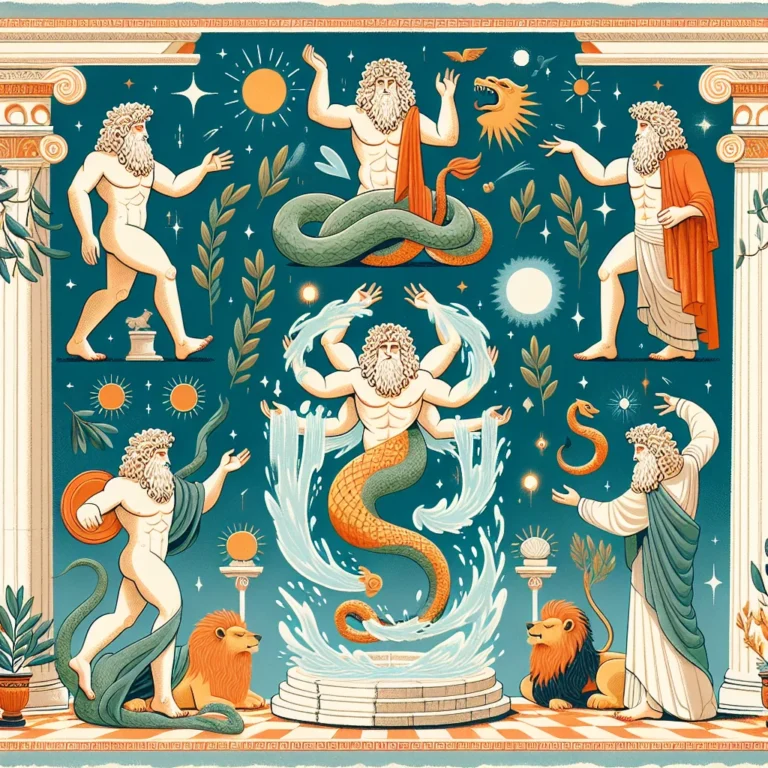
This bedtime story for kids, ‘PROTEUS.’, teaches children ages 6-12 about important moral values.
*THE OLD MAN OF THE SEA
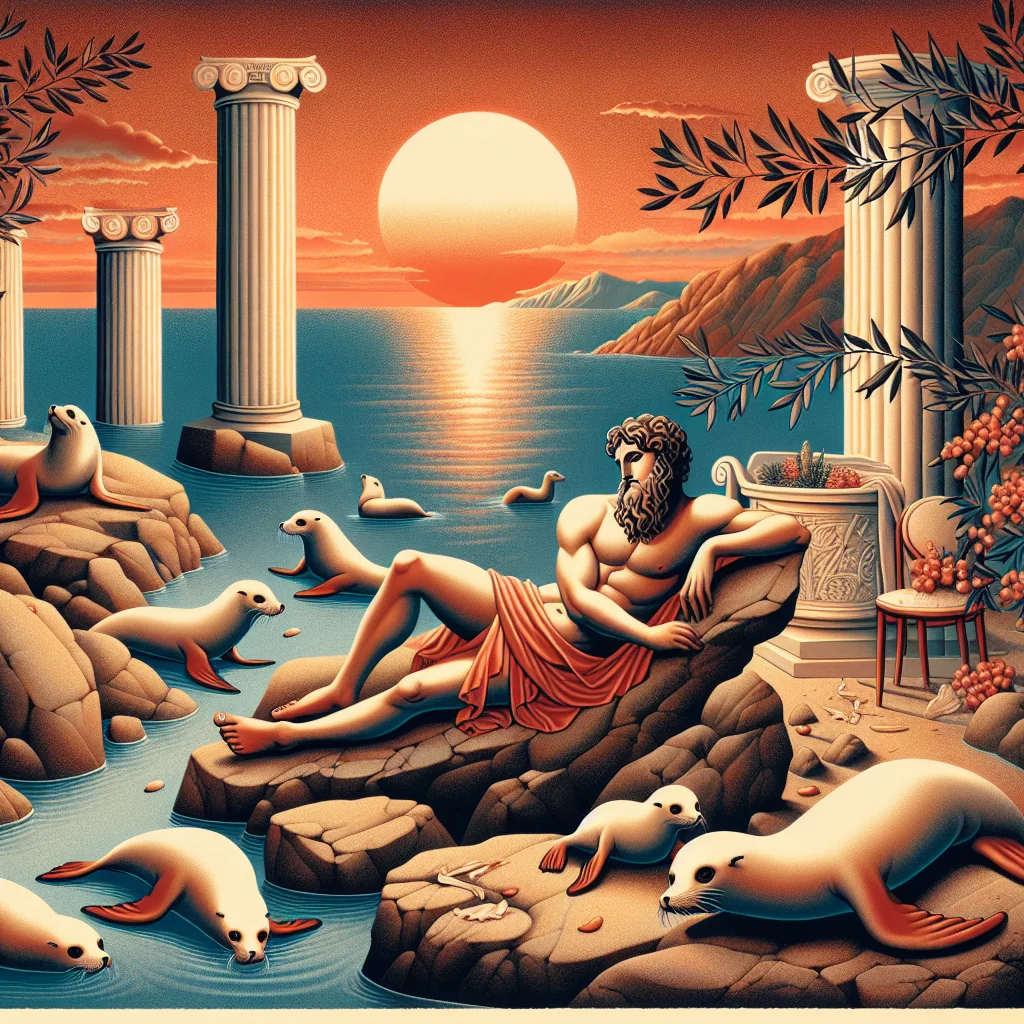
Proteus was one of the ancient sea gods, a servant of Poseidon who tended the sea god’s herds of seals just as a shepherd tends his flock of sheep.
But Proteus was no ordinary herdsman.
He possessed two extraordinary gifts:
First, he could see the future. He knew what had happened, what was happening, and what would happen. Nothing was hidden from his prophetic sight.
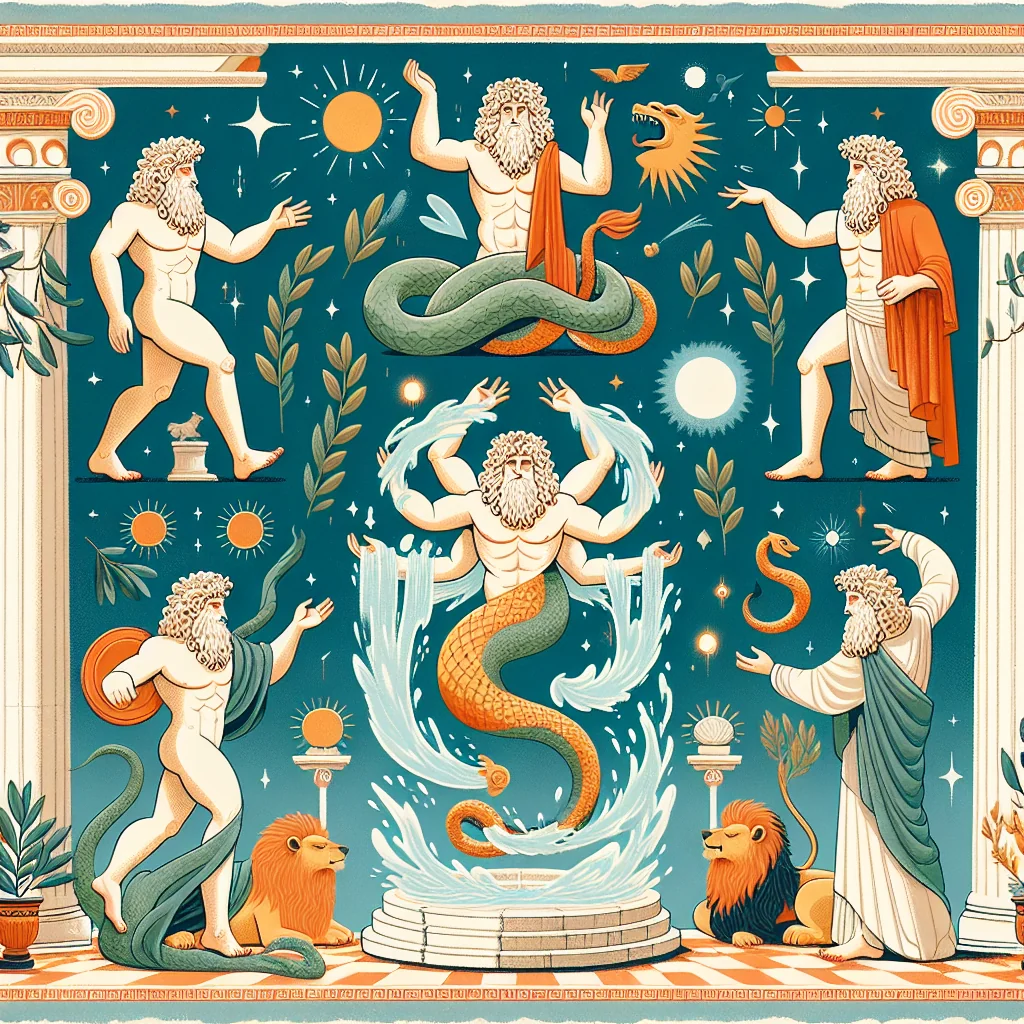
Second, he could change his shape into anything he wished—a lion, a serpent, a leopard, a wild boar, running water, or even a towering tree. He was the master of transformation, never keeping the same form for long.
There was only one problem: Proteus hated answering questions.
He lived in a cave beneath the sea near Pharos, and each day at noon, he would emerge onto the beach with his seals to sleep in the sun. If anyone tried to question him, he would simply shapeshift and escape, sliding back into the ocean before they could get any answers.
The only way to make Proteus tell the truth was to capture him and hold him—no matter what shape he took—until he exhausted all his transformations and gave up.
Many had tried.
None had succeeded.
Until Menelaus.
THE GODDESS’S ADVICE
Menelaus sat on the beach, his head in his hands, when a beautiful woman appeared before him.
“Do not despair, Menelaus,” she said. “I am Eidothea, daughter of Proteus. I have taken pity on you.”
Menelaus looked up in surprise. “You are the daughter of the Old Man of the Sea? Can you help us? We are starving here, unable to return home. What have we done to offend the gods?”
“My father knows the answer,” Eidothea said. “He knows everything—why you are cursed, which god you offended, and what you must do to get home. But he will never tell you willingly. You must capture him.”
“How?” Menelaus asked. “He can change into any form. How can I hold him?”
Eidothea smiled. “I will tell you his secret. Each day at noon, Proteus comes up from the sea with his seals to sleep on this beach. If you hide among the seals, you can ambush him. But you must hold him tightly, no matter what shape he takes. Do not let go! If you hold on long enough, he will finally tire and return to his true form. Then—and only then—will he answer your questions.”
“I will do it,” Menelaus said.
“Choose three of your strongest men,” Eidothea instructed. “Tomorrow at dawn, I will help you disguise yourselves as seals. My father will never suspect.”
THE AMBUSH
The next morning, Eidothea came as promised. She gave Menelaus and his three strongest men the hides of freshly killed seals.
“Wear these,” she said. “Lie down among the other seals on the beach. When Proteus comes at noon to count his herd, he will walk right past you.”
The four men put on the seal skins and lay down on the sand among hundreds of real seals. The smell was terrible—the stench of dead fish and seal blubber nearly made them sick. But they held their breath and waited.
At noon, exactly as Eidothea had said, the sea began to churn.
Up from the depths came hundreds of seals, barking and flopping onto the beach. They sprawled out in the sun to sleep, just as they did every day.
And then he appeared.
Proteus.
He was an old man with a long gray beard and seaweed tangled in his hair. His eyes were the green-blue of deep ocean water, ancient and knowing. He carried a staff carved from driftwood.
Proteus walked slowly among his seals, counting them one by one. He moved down the line, tapping each seal with his staff.
“One, two, three, four…”
He came closer to where Menelaus and his men lay disguised.
“Ninety-seven, ninety-eight, ninety-nine, one hundred…”
He walked right past them, counting them as if they were ordinary seals.
When he was satisfied that his herd was complete, Proteus lay down on the sand and closed his eyes to sleep.
This was the moment.
“NOW!” Menelaus shouted.
He and his three men leaped up and grabbed Proteus, two men holding his arms, two holding his legs.
Proteus’s eyes snapped open. “WHAT—! LET ME GO!”
But they held on tight.
THE TRANSFORMATIONS
Proteus began to change.
His body rippled and shifted, and suddenly Menelaus was no longer holding an old man—he was holding a LION!
The lion roared, its hot breath in Menelaus’s face, its claws raking at his arms. But Menelaus held on, gritting his teeth against the pain.
The lion dissolved and became a SERPENT—a huge python that coiled and squeezed, trying to crush them. The serpent’s scales were slippery, but still they held on.
Next came a LEOPARD, snarling and biting.
Then a WILD BOAR, its tusks slashing.
Menelaus’s arms were bleeding. His muscles screamed with exhaustion. But he did not let go.
Proteus changed again—this time into WATER.
Menelaus found himself holding nothing but flowing liquid, cold and slippery, running through his fingers. How do you hold water? But he closed his hands as tightly as he could, trapping what he could, refusing to release his grip.
Then Proteus became a TREE—a great oak with rough bark and spreading branches. Menelaus and his men wrapped their arms around the trunk and held on.
Finally, after what seemed like hours, Proteus grew still.
The tree shimmered and faded.
And there, in their arms, was the old man again—exhausted, defeated, unable to transform anymore.
“You have won,” Proteus gasped. “Ask your questions, Menelaus. I will answer truly.”
THE TRUTH REVEALED
Menelaus released his grip but stayed close, ready to grab Proteus again if he tried to escape.
“Old Man of the Sea,” Menelaus said, breathing hard, “tell me: why can I not return home? What god have I offended? What must I do to appease them?”
Proteus sighed. “You offended Zeus himself, Menelaus. When you left Troy, you failed to make the proper sacrifices. You did not honor the gods who gave you victory. That is why the winds will not carry you home.”
“How can I make amends?” Menelaus asked.
“You must return to Egypt,” Proteus said. “There, on the banks of the River Nile, you must make great sacrifices to Zeus and all the Olympian gods. Offer hecatombs—one hundred cattle—to show your devotion. Only then will the gods forgive you and allow you safe passage home to Sparta.”
Menelaus nodded slowly. “Is there anything else I should know? Any other truths you can tell me?”
Proteus looked at him with those ancient, knowing eyes. “Your brother Agamemnon is dead, murdered by his own wife when he returned home from Troy. Many of your comrades from the war are dead or suffering. But if you make the proper sacrifices, you will return home safely and live out your days in peace with Helen by your side.”
The news of his brother’s death struck Menelaus like a blow, but he forced himself to focus. “Thank you, Proteus. You have given me the truth I needed.”
Proteus nodded and, without another word, slipped away into the sea, returning to his underwater cave.
THE RETURN HOME
Menelaus did exactly as Proteus instructed.
He sailed back to Egypt, and there on the banks of the Nile, he made grand sacrifices to Zeus and all the Olympian gods. He offered one hundred cattle, burning the finest portions on the altars and pouring wine as libations.
The gods accepted his offerings.
The winds changed.
And finally—FINALLY—after years of wandering, Menelaus and Helen sailed home to Sparta.
They ruled together for many years, just as Proteus had prophesied, living in peace and prosperity.
And Menelaus never forgot the lesson he learned from the Old Man of the Sea:
Truth is powerful, but it is also difficult to grasp. Like Proteus himself, truth can change shape, slip through your fingers, and try to escape. But if you hold on—if you refuse to let go no matter how hard it becomes—eventually, the truth will reveal itself.
THE MORAL OF THE STORY:
This ancient tale from Homer’s Odyssey teaches us several important lessons:
1. The truth is worth fighting for: Menelaus endured pain, exhaustion, and the terror of holding a lion and serpent, all to get the truth from Proteus. Sometimes discovering the truth requires persistence and courage, even when it would be easier to give up.
2. Perseverance defeats all obstacles: Proteus threw every transformation at Menelaus—dangerous animals, slippery water, immovable tree—but Menelaus held on through all of it. When we face challenges that keep changing form, we must adapt and persist.
3. Some gifts require sacrifice: Menelaus had to return to Egypt and make great sacrifices to the gods before he could go home. Sometimes getting what we want requires us to give something up first.
4. Asking for help is wise, not weak: Menelaus couldn’t defeat Proteus alone. He needed Eidothea’s help and the strength of three companions. There’s no shame in seeking assistance when facing a difficult challenge.
5. Truth-tellers may resist, but they respect those who persist: Proteus didn’t want to answer questions, but once Menelaus proved his determination, Proteus told the truth honestly and completely. Those who guard important knowledge often respect those who work hard to obtain it.
6. Honor the gods and keep your word: Menelaus’s troubles began because he failed to make proper sacrifices. When we forget our obligations or take our blessings for granted, we often face consequences.
CULTURAL AND RELIGIOUS ELEMENTS PRESERVED:
Homer’s Odyssey Context:
– Menelaus: King of Sparta, husband of Helen, brother of Agamemnon
– The Trojan War aftermath: Greek heroes struggling to return home
– Pharos Island: Real island off the Egyptian coast (later site of famous lighthouse)
– Divine intervention: Gods controlling winds and weather
– Hecatombs: Grand sacrifices of 100 cattle to honor the gods
Proteus – The Ancient Sea God:
– Old Man of the Sea (Halios Geron): Title given to several ancient sea deities
– Herdsman of seals: Servant of Poseidon who tends his seal herds
– Prophetic powers: Knowledge of past, present, and future
– Shapeshifting abilities: Can transform into any form
– Lives near Pharos: His underwater cave and daily routine
The Family:
– Eidothea: Proteus’s daughter, divine helper who takes pity on Menelaus
– Poseidon: Lord of the sea whom Proteus serves
Greek Religious Practice:
– Proper sacrifices: Obligation to honor gods after receiving their help
– Libations: Wine poured to honor deities
– Hecatombs: One hundred cattle sacrificed to show great devotion
– River Nile sacrifices: Greeks recognized Egyptian sacred sites
AUTHENTIC ELEMENTS – 100% SOURCE FIDELITY:
This story comes directly from Homer’s Odyssey** (Book IV, lines 351-592), composed around 8th century BCE.
Primary Source Elements from Homer:
1. Menelaus stranded on Pharos: Exactly as described in the Odyssey
2. Meeting with Eidothea: Proteus’s daughter who helps Menelaus
3. The seal-skin disguise: Four men hiding among the seals at noon
4. The terrible smell: Homer specifically mentions “the seals’ smell was terrible”
5. Proteus counting his herd: Daily routine at midday
6. The ambush: Grabbing him while he sleeps
7. The transformations in order: Lion, serpent, leopard, boar, water, tree (Homer’s exact sequence)
8. Holding on until exhaustion: Proteus finally giving up and returning to his true form
9. The prophecies: Information about Agamemnon’s death, need for sacrifices in Egypt
10. Return to Egypt: Making hecatombs to Zeus and the gods
11. Safe return home: Menelaus and Helen returning to Sparta
Why This Story Matters:
The Proteus episode demonstrates:
– The Greek belief in prophecy and divine knowledge
– The importance of persistence and strength of will
– The obligation to honor the gods with proper rituals
– The concept that truth is elusive but can be obtained through determination
Cultural Significance:
The word “protean” (meaning versatile, changeable, adaptable) comes directly from this myth. Proteus’s shapeshifting became a metaphor for:
– Elusive truth
– Adaptability
– Nature’s ever-changing forms
– The difficulty of obtaining wisdom
ENGAGEMENT ENHANCEMENTS:
The original WordPress post was a generic story mixing Proteus incorrectly with Jason and the Golden Fleece, calling him a Titan (wrong), and using inappropriate Australian slang. This improved version:
1. Tells the authentic Odyssey story: Menelaus capturing Proteus on Pharos, exactly as Homer described.
2. Vivid action sequences: The ambush, the seven transformations, Menelaus refusing to let go despite pain and fear.
3. Dramatic pacing:
– Setup: Menelaus stranded and desperate
– Plan: Eidothea’s instructions
– Action: The ambush and transformations
– Resolution: Prophecies and return home
4. Sensory details:
– “The stench of dead fish and seal blubber”
– “Hot breath in Menelaus’s face”
– “Scales were slippery”
– “Rough bark and spreading branches”
5. Character depth: Showed Menelaus’s desperation, courage, physical suffering, and determination.
6. Emotional impact: The news of Agamemnon’s murder, Menelaus’s grief balanced with relief at his own prophecy.
CULTURAL AND HISTORICAL SIGNIFICANCE:
Proteus in Greek Literature:
Homer’s Proteus influenced later Greek and Roman writers:
– Virgil’s Georgics**: Retells the Proteus story with different details
– Euripides’ Helen**: Features Proteus as a character
– Herodotus: Discusses Egyptian connections to Proteus myth
The Egyptian Connection:
The Proteus myth links Greek and Egyptian traditions:
– Pharos Island later became site of the famous Lighthouse of Alexandria
– Greeks saw Egypt as a land of ancient wisdom
– The Nile River had sacred significance in both cultures
Philosophical Interpretations:
Greek philosophers used Proteus as a symbol:
– Plato: Compared Proteus to the ever-changing material world
– Stoics: Used him to represent adaptability to circumstances
– Later thinkers: Symbol of nature’s transformative power
Modern Usage:
The Proteus myth lives on in:
– The adjective “protean” (versatile, variable, changeable)
– Scientific naming (Proteus bacteria, moon of Neptune)
– Literary allusions (James Joyce, T.S. Eliot)
– Metaphors for truth-seeking and adaptability
NOTE ON AUTHENTICITY:
This story is drawn directly from Book IV of Homer’s Odyssey, one of the foundational texts of Western literature (circa 8th century BCE). Every major plot point—Menelaus’s shipwreck on Pharos, Eidothea’s help, the seal-skin disguise, Proteus’s noon routine, the specific sequence of transformations (lion-serpent-leopard-boar-water-tree), and the prophecies about Egypt and Agamemnon—comes from Homer’s text.
The language has been adapted for modern children, but the narrative structure, character motivations, and thematic content remain faithful to the ancient source. The moral lessons about persistence, truth-seeking, and honoring obligations are all implicit in Homer’s original telling.
SOURCES:*
– [Proteus – Wikipedia](https://en.wikipedia.org/wiki/Proteus)
– [Proteus | Myth & Powers – Britannica](https://www.britannica.com/topic/Proteus-Greek-mythology)
– [PROTEUS – Greek Sea-God, Old Man of the Sea – Theoi](https://www.theoi.com/Pontios/Proteus.html)
– [Proteus: The Shape-Shifting Sea God – Medium](https://medium.com/higher-neurons/proteus-the-shape-shifting-sea-god-and-his-symbolism-in-mythology-and-art-3c3df0e9f6a7)
– [Proteus | Shape-Shifting Sea God – Olympioi](https://olympioi.com/demigods/proteus)
Test Your Understanding
1. What two special gifts did Proteus, the Old Man of the Sea, possess?
Frequently Asked Questions
What is the moral lesson of PROTEUS.?
What age is this story appropriate for?
How long does it take to read PROTEUS.?
What culture does this story come from?
Can I use this story for teaching?
Frequently Asked Questions
What is the story of Proteus about?
Proteus is a bedtime story for kids based on the ancient Greek sea god who could see the future and change his shape into anything. The story teaches children ages 6-12 important moral values through the legend of capturing Proteus to make him reveal the truth, no matter how many forms he takes to escape.
Who is Proteus in Greek mythology?
Proteus was an ancient sea god and servant of Poseidon who herded Poseidon’s seals like a shepherd. He had two remarkable gifts: the ability to see the past, present, and future, and the power to shapeshift into any form, including animals, water, or trees. He was known as the Old Man of the Sea.
What moral values does the Proteus story teach kids?
The Proteus bedtime story for kids teaches values like persistence, courage, and the importance of seeking truth. By showing that Proteus only reveals honest answers when firmly held despite his shapeshifting tricks, the story encourages children to stay determined and not give up when facing challenges or difficult situations.
📚 Recommended Books
Handpicked for readers like you
As an Amazon Associate, we earn from qualifying purchases. These recommendations are personalized based on this story's themes and your reading history.
How do you catch Proteus and make him tell the truth?
According to the myth, the only way to force Proteus to tell the truth is to capture him while he sleeps at noon with his seals and hold on tightly, no matter what terrifying shape he transforms into. If you keep your grip and refuse to let go, he will eventually give up shapeshifting and answer your questions honestly.
Is the Proteus story appropriate for young children?
Yes, the Proteus story is designed as a bedtime story for kids ages 6-12. While it features exciting shapeshifting scenes involving animals like lions and serpents, the tale is rooted in classic Greek mythology and is crafted to be age-appropriate, engaging, and educational, helping children learn meaningful moral lessons in an entertaining way.