

‘EOS (Aurora).’ is an educational moral story perfect for bedtime reading with children ages 6-12.
Far to the west, on the island of Ææa, stood the most beautiful palace in all the world.
Flowery meadows surrounded it, stretching as far as the eye could see. Velvety lawns rolled gently down to the shore. In the gardens, nymphs and other immortal beings danced and twirled in graceful patterns, while sweet music floated on the air.
This was the home of Eos, the goddess of the Dawn.
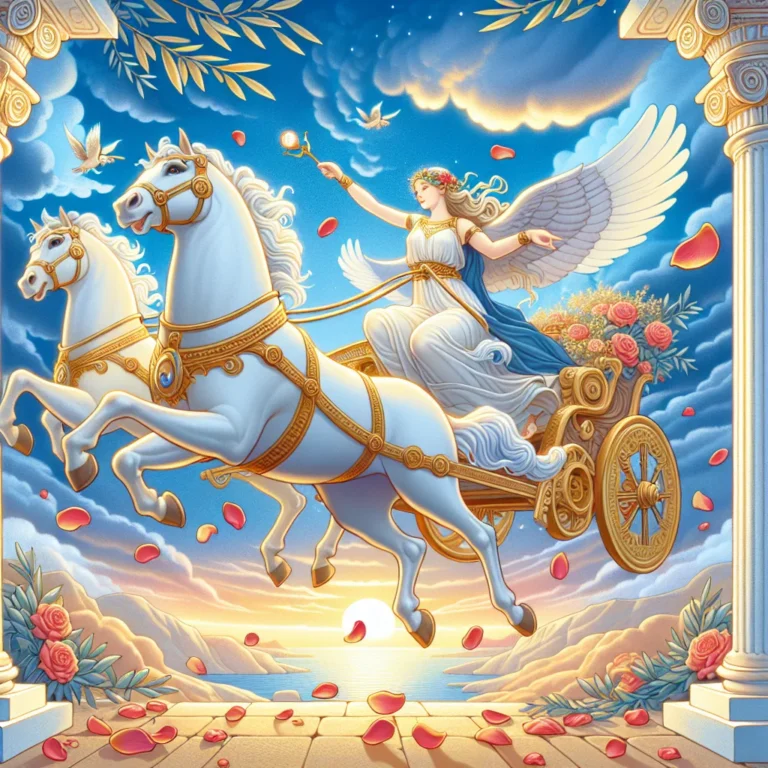
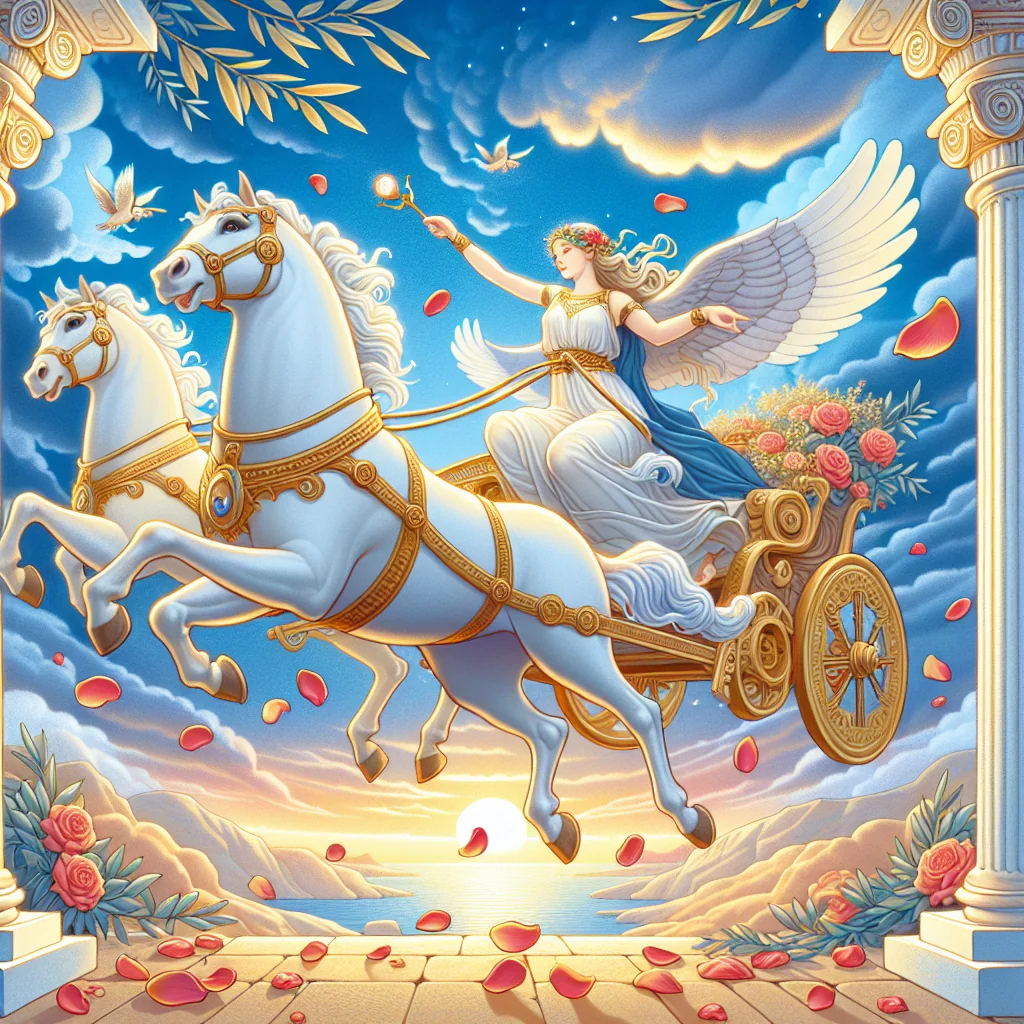
Every morning before the break of day, Eos would wake in her magnificent palace. She would wrap herself in the rich folds of her violet-tinged mantle and go to the stables where her two horses waited—Lampetus and Phaethon, as swift and strong as the wind itself.
Eos herself would yoke the horses to her glorious chariot. Then, with active cheerfulness, she would drive across the vast horizon to open the gates of heaven.
For Eos had an important job: she announced the coming of her brother Helios, the god of the sun.
As she passed through the sky, the tender plants and flowers below, revived by the morning dew, would lift their heads to welcome her. “Good morning, Eos!” they seemed to whisper.
Eos was beautiful beyond measure. She had rosy arms and rosy fingers that painted the clouds pink and gold. Large wings grew from her shoulders, covered in feathers that changed color like an oil slick on water—now purple, now orange, now pink, now gold. A bright star shone on her forehead, and she carried a torch in her hand to light the way through the last moments of darkness.
Each morning, Eos drove her chariot to herald the dawn.
Each evening, she drove again to bring the gentle twilight.
And so the days and nights flowed on, peaceful and eternal.
* * *
Eos’s first marriage had been to Astraeus, a mighty Titan. Together they had children: Heosphorus, the beautiful evening star who twinkled at dusk, and the Winds—the North Wind and the South Wind and the East Wind and the West Wind—who blew across the world bringing weather and change.
But that marriage had been long ago.
One day, as Eos drove her chariot over the land of Troy, she looked down and saw the most handsome young man she had ever laid eyes upon.
His name was Tithonus, and he was the son of Laomedon, the king of Troy. His beauty was unrivaled—his face was perfect, his form was strong and graceful, his smile could light up the darkest room.
Eos felt her heart swell with love/” title=”More stories about love”>love.
She came down from the sky and spoke with Tithonus. The young prince was just as kind as he was beautiful, and before long, Eos and Tithonus fell deeply in love.
They were married in a grand ceremony, with all the gods and mortals celebrating together.
* * *
But as the months turned to years, Eos began to worry.
She was immortal—she would live forever, never changing, never aging.
But Tithonus was mortal. One day, he would grow old. One day, he would die.
The thought of losing her beloved husband filled Eos with such sadness that she could barely stand it.
“I will go to Zeus,” she decided. “I will ask the king of the gods for help.”
Eos flew to Mount Olympus and knelt before Zeus’s throne.
“Great Zeus,” she pleaded, “I love Tithonus more than anything in the world. Please, I beg you—grant him immortality so that we may be together forever!”
Zeus looked at the goddess of the Dawn and saw the love shining in her eyes. His heart was moved.
“Very well,” said Zeus. “I grant Tithonus the gift of immortality. He shall never die.”
“Oh, thank you!” cried Eos, and she rushed home to tell Tithonus the wonderful news.
* * *
At first, everything was perfect.
Tithonus was immortal now. He and Eos were happy together, day after day, year after year.
But then… something began to change.
Eos, being a goddess, stayed exactly the same. Her skin remained smooth and radiant. Her wings kept their shimmering, ever-changing colors. Her smile was as bright as ever.
But Tithonus was aging.
Lines appeared around his eyes. His hair turned from black to gray to white. His strong shoulders grew stooped. His graceful walk became a shuffle.
Year after year, Tithonus grew older and older.
His beauty—the unrivaled beauty that had first won Eos’s heart—faded away like morning mist in the sunshine.
Eos watched in growing horror as her husband became old and decrepit. She tried to love him as she had before, but she found herself disgusted by his wrinkled skin, his feeble movements, his weak voice.
Finally, unable to bear the sight of him any longer, Eos shut Tithonus away in a chamber in the palace.
* * *
Alone in his room, Tithonus continued to age.
His body shrank and withered. His strength left him entirely. Soon there was almost nothing left of him but his voice—and even that had faded to a weak, feeble quaver that trembled and shook.
“Please,” Tithonus begged through the locked door. “Please, let me die. This existence is too cheerless, too miserable. I don’t want to live like this anymore.”
But it was impossible.
Zeus had granted him immortality. Tithonus could never, ever die.
He was trapped in his old, broken body forever.
When Eos finally heard his pitiful cries, her heart filled with shame and pity. What had she done? In her eagerness to keep Tithonus with her forever, she had forgotten something terribly important.
She had asked Zeus for immortality.
But she had forgotten to ask for eternal youth.
“I’m so sorry,” Eos whispered, tears running down her rosy cheeks. “I didn’t think. I didn’t understand. Let me try to help you now.”
Eos could not take away Tithonus’s immortality—that was Zeus’s gift, and only Zeus could undo it. But she could use her own divine power to change Tithonus’s form.
She opened the chamber door. Inside, Tithonus sat hunched and tiny, still trying to speak with his weak, quavering voice.
Eos touched him gently.
There was a flash of rosy light.
And where the old man had been, there now sat a small, brown grasshopper.
The grasshopper hopped to the windowsill and chirped—a monotonous, ceaseless sound that went on and on and on.
“I’m sorry I forgot,” Eos said sadly, watching the grasshopper. “I’m sorry I wasn’t more careful with my wish.”
The grasshopper just kept chirping, as grasshoppers do—all voice and very little else, making the same sound over and over, not unlike the meaningless babble of extreme old age.
Eos returned to her duties, driving her chariot across the sky each dawn and each twilight.
But now, whenever she heard a grasshopper’s endless chirping in the grass below, she remembered Tithonus.
And she remembered the lesson she had learned too late: when you make a wish, you must be very, very careful to think of everything—not just what you want, but what might happen if your wish comes true.
MORAL LESSONS:
– Think carefully before making wishes—consider all consequences
– Love should cherish the whole person, not just outer beauty
– Immortality without youth is a curse, not a blessing
– Be specific and thoughtful with important requests
Test Your Understanding
1. What was Eos the goddess of in Greek mythology?
Frequently Asked Questions
What is the moral lesson of EOS (Aurora).?
What age is this story appropriate for?
How long does it take to read EOS (Aurora).?
What culture does this story come from?
Can I use this story for teaching?
Frequently Asked Questions
What is the story of EOS Aurora about?
EOS Aurora is an educational moral bedtime story about Eos, the Greek goddess of the Dawn. It follows her daily journey across the sky in her chariot, announcing the arrival of her brother Helios, the sun god. The story is written for children ages 6 to 12 and blends mythology with gentle moral lessons.
Who is Eos the goddess of the Dawn?
Eos is the ancient Greek goddess of the Dawn. She lives in a beautiful palace on the island of Ææa, drives a chariot pulled by two powerful horses named Lampetus and Phaethon, and paints the sky pink and gold each morning. She is the sister of Helios, the sun god, and announces his arrival every day.
Is this EOS Aurora story suitable for young children?
Yes, EOS Aurora is specifically written for children ages 6 to 12, making it ideal for bedtime reading. The language is vivid and imaginative without being scary, and the story carries educational and moral value, introducing kids to Greek mythology in a gentle, accessible way.
📚 Recommended Books
Handpicked for readers like you
As an Amazon Associate, we earn from qualifying purchases. These recommendations are personalized based on this story's themes and your reading history.
What age group is this bedtime story recommended for?
This bedtime story is recommended for children aged 6 to 12. It uses rich, descriptive language that sparks imagination while remaining easy enough for younger readers to follow along. Parents and caregivers can read it aloud as a soothing and educational end-of-day routine.
What moral lesson does the EOS Aurora story teach?
While the full moral unfolds throughout the story, EOS Aurora introduces themes of duty, purpose, and the beauty of consistency — Eos faithfully performs her role every single morning with cheerfulness and dedication. It gently shows children the value of responsibility and finding joy in the work you are meant to do.
