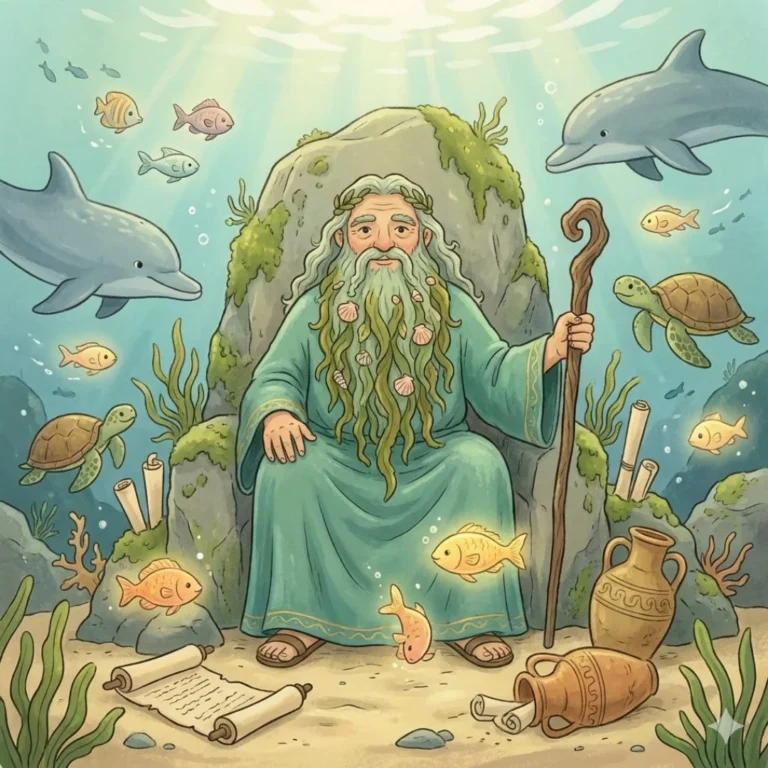
This bedtime story for kids, ‘NEREUS.’, teaches children ages 6-12 about important moral values.
*THE ANCIENT SEA GOD
Nereus was born from Pontus, the ancient Sea itself, and Gaia, the Earth Mother. He was among the first generation of sea deities, embodying the calm and peaceful aspects of the ocean—the gentle waves, the fish-rich waters, the navigable seas that sailors could safely traverse.
Unlike his younger, tempestuous relatives, Nereus was mild and benevolent. His face was kind, his eyes the deep blue-green of peaceful ocean waters. His long beard flowed like seafoam, and his voice was as soothing as waves lapping on a shore.
But Nereus possessed two gifts that made him far more than just a kindly old deity:
First, he knew the truth. Always. About everything. He could not lie even if he wanted to. Hesiod, the ancient poet, called him “the Old Gentleman who tells no lies” and said his thoughts were “mild and righteous.”
Second, like his cousin Proteus, Nereus could change his shape—transforming into any form to escape those who sought his knowledge.
But there was a crucial difference between Nereus and Proteus: while Proteus hated answering questions and would fight to avoid it, Nereus would tell the truth willingly… if you could catch him first.
THE FATHER OF THE NEREIDS
Nereus married Doris, daughter of Oceanus, and together they had fifty daughters—the famous Nereids, the sea nymphs whose beauty and grace were celebrated throughout the ancient world.
Among these fifty daughters were some of the most famous figures in Greek mythology:
Thetis, who would become the mother of Achilles, the greatest Greek hero.
Amphitrite, who would marry Poseidon himself and become Queen of the Sea.
Galatea, the nymph beloved by the Cyclops Polyphemus.
And forty-seven others, each beautiful, each with her own personality and domain.
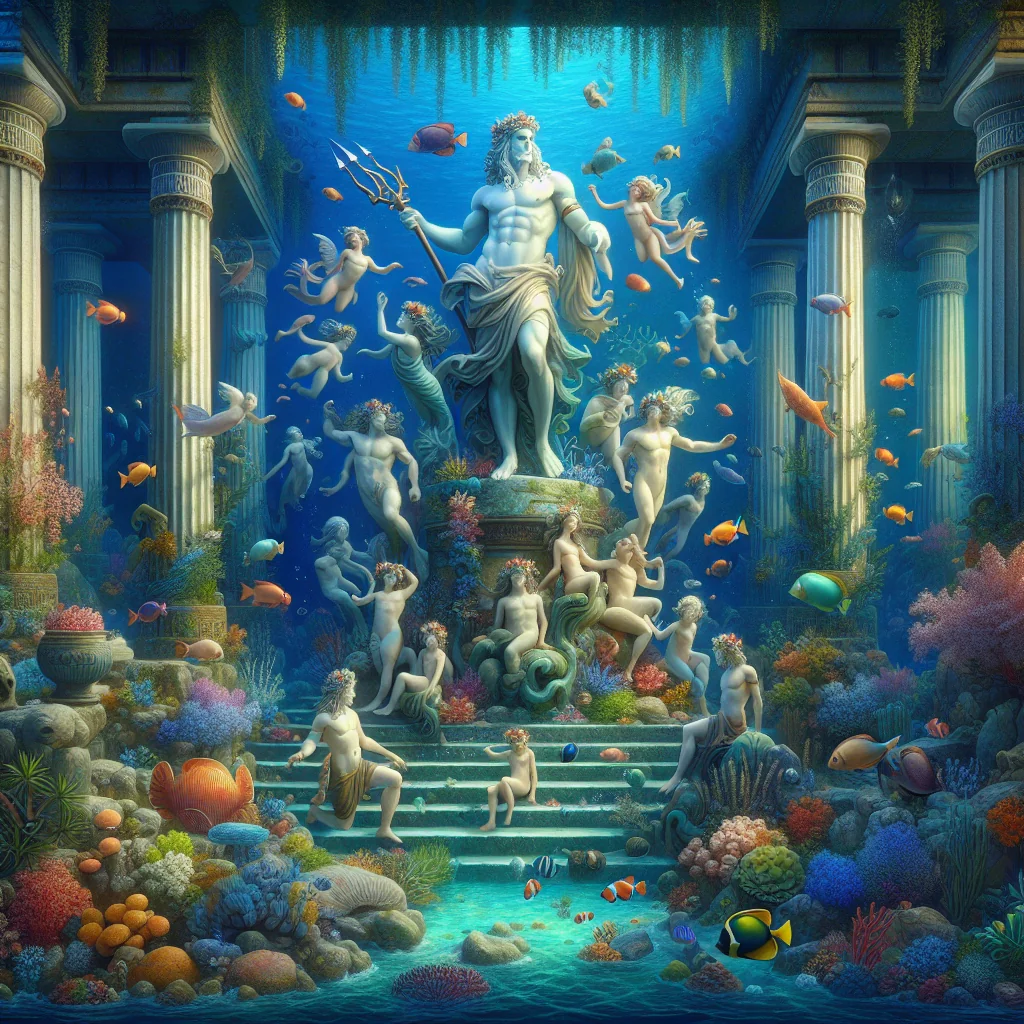
The Nereids lived with their father in a magnificent palace beneath the waves. They rode dolphins, played with sea creatures, and helped sailors in distress. When ships were caught in storms, sometimes the Nereids would appear, swimming alongside the vessels, guiding them to safety.
But their father, Nereus, remained in the deep waters, guarding his knowledge, waiting for the day when a hero would be brave and strong enough to wrestle the truth from him.
HERACLES COMES SEEKING
That day came when Heracles—the greatest hero of Greece—was given an impossible task.
Heracles had been commanded to complete Twelve Labors as punishment for a terrible crime. He had already slain the Nemean Lion, destroyed the Hydra, and captured the Golden Hind of Artemis. But his eleventh labor was perhaps the most difficult of all:
He had to steal the golden apples from the Garden of the Hesperides.
The problem was: no one knew where the garden was.
The apples belonged to Hera, queen of the gods, and were guarded by an immortal dragon named Ladon and the Hesperides nymphs (daughters of Atlas). The garden was hidden at the edge of the world, beyond the reach of mortal men.
Heracles needed directions.
And only one being knew the answer: Nereus, the truthful Old Man of the Sea, who knew all secrets of the earth and ocean.
THE WRESTLING MATCH
Heracles traveled to the shore where Nereus was known to rest. The hero found him on the rocks, sunning himself peacefully, his fifty daughters playing in the waves nearby.
“Old Man of the Sea,” Heracles called out, “I seek your wisdom. Tell me: where can I find the Garden of the Hesperides?”
Nereus opened one ancient eye and looked at the muscular hero standing before him.
“I know where it is,” Nereus said calmly. “But why should I tell you?”
“Because I ask with respect,” Heracles said. “I am on a sacred quest, and I need your help.”
Nereus smiled slightly. “Many have asked for my help, Heracles. But knowledge is not given freely. If you want the truth from me, you must prove yourself worthy. You must catch me and hold me, no matter what form I take.”
Before Heracles could respond, Nereus began to change.
His body rippled and shifted, and suddenly the old man was gone. In his place stood a LION, roaring with fury.
But Heracles was the hero who had strangled the Nemean Lion with his bare hands. He grabbed the lion-Nereus and held tight.
The lion became a SERPENT, coiling and hissing.
Heracles, who had battled the many-headed Hydra, was not afraid. He gripped the serpent behind its head and held on.
The serpent became WATER, flowing and formless.
Heracles cupped his hands and held what he could, refusing to let go entirely.
The water became FIRE, burning hot.
Heracles gritted his teeth against the pain but did not release his grip.
On and on the transformations went—a tree, a bird, a bull, a stone—but Heracles held firm through every change. His arms were bruised and burned, his muscles aching, but he would not give up.
Finally, after what seemed like hours, Nereus grew tired. He returned to his true form—the gentle old man with the flowing beard—and raised his hands in surrender.
“Enough!” Nereus gasped. “You have proven yourself, Heracles. You are strong and determined. I will tell you what you seek.”
THE TRUTH REVEALED
Heracles released his grip, and Nereus sat down on the rocks, breathing heavily.
“The Garden of the Hesperides,” Nereus began, “lies at the western edge of the world, where the sun sets and day becomes night. It is guarded by the dragon Ladon, who never sleeps, and the Hesperides, daughters of the Titan Atlas.”
“How do I get there?” Heracles asked.
“You cannot simply walk to the garden,” Nereus said. “It is beyond mortal reach. But I will tell you a secret: Atlas himself knows the way. More than that—Atlas can pick the apples for you, for he is the father of the Hesperides, and the dragon will not attack him.”
“Atlas?” Heracles frowned. “The Titan who holds up the sky?”
“The very same,” Nereus nodded. “Find Atlas. Offer to hold the sky for him while he fetches the apples. He has carried that burden for thousands of years and will welcome the rest, even if only for a short while.”
Heracles’s eyes widened with understanding. “And when he returns with the apples?”
Nereus smiled. “That, my friend, you will have to figure out for yourself. I have given you the knowledge. The cleverness must be your own.”
Heracles bowed deeply. “Thank you, Old Man of the Sea. Your wisdom is as great as they say.”
“One more thing,” Nereus added. “Beware of Atlas’s trickery. Once he is free of the sky’s weight, he may not wish to take it back. You must be as clever as you are strong.”
THE AFTERMATH
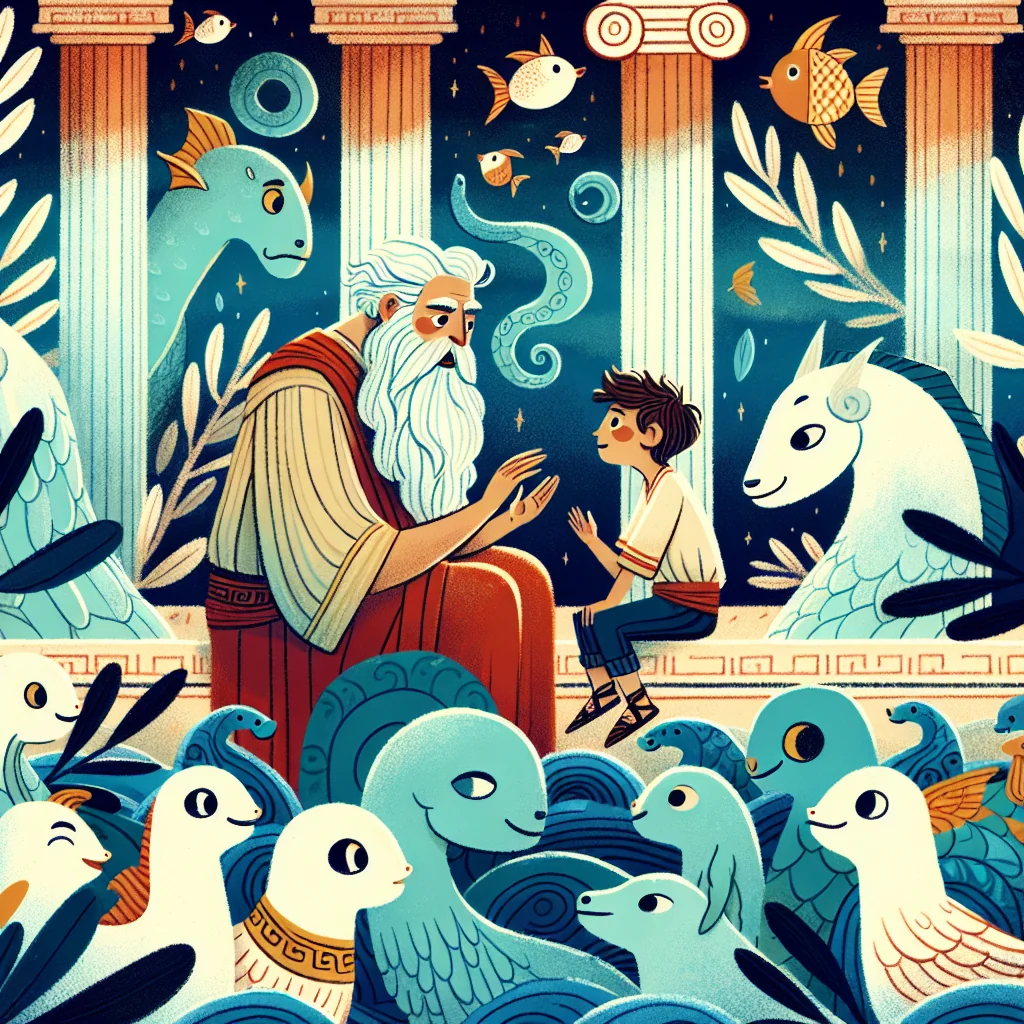
Heracles followed Nereus’s advice. He traveled to the far west, found Atlas holding up the heavens, and offered to take the burden temporarily. Atlas, overjoyed at the break, fetched the golden apples from his daughters’ garden.
When Atlas returned, he tried to trick Heracles—suggesting that he (Atlas) should deliver the apples to King Eurystheus while Heracles continued holding the sky. But Heracles was clever. He asked Atlas to hold the sky “just for a moment” while he adjusted the padding on his shoulders. The moment Atlas took the weight back, Heracles grabbed the apples and ran.
The eleventh labor was complete.
And Nereus, in his underwater palace, smiled when he heard the news. The hero had proven worthy not just of his knowledge, but of his success.
THE LEGACY OF NEREUS
From that day forward, Nereus was remembered as the wise counselor who had helped Heracles complete one of his greatest labors.
But more than that, he remained what he had always been: the truthful deity who embodied the best qualities of the ancient world—honesty, wisdom, gentleness, and righteousness.
While younger gods like Poseidon raged with storms and demanded sacrifices, Nereus remained quietly in the depths, content with his fifty daughters, ready to help those heroes brave enough to seek him out and strong enough to hold him.
The Nereids carried on their father’s legacy, helping sailors and heroes throughout Greek mythology. When Jason and the Argonauts sailed in search of the Golden Fleece, the Nereids guided them. When Odysseus struggled to return home from Troy, the Nereids watched over him.
And sailors, even thousands of years later, would look out over calm seas and remember the Old Man who personified the ocean in its kindest, most trustworthy form.
THE MORAL OF THE STORY:
This ancient tale from Greek mythology teaches us important lessons:
1. Truth is precious and must be earned: Nereus didn’t give his knowledge freely—Heracles had to prove himself worthy through strength and determination. The most valuable wisdom often requires effort to obtain.
2. Gentleness doesn’t mean weakness: Nereus was kind and mild, but he was also ancient and powerful. Being gentle is a choice, not a lack of strength. The truly strong can afford to be kind.
3. Honesty is its own power: Nereus was called “the Old Gentleman who tells no lies.” His reputation for truthfulness made his knowledge all the more valuable. In a world full of tricksters and deceivers, honesty stands out.
4. Persistence is rewarded: Heracles didn’t give up when Nereus transformed into dangerous or difficult forms. He held on through fire, water, and every challenge. Those who persist through difficulties earn their rewards.
5. Good advice requires both wisdom and action: Nereus gave Heracles the information he needed, but Heracles still had to do the work—travel to Atlas, make the offer, complete the task. Knowledge alone isn’t enough; we must act on it.
6. The best parents raise children who help others: Nereus’s fifty daughters, the Nereids, spent their immortal lives helping sailors and heroes. By teaching compassion and helpfulness, parents create a legacy that extends far beyond themselves.
CULTURAL AND RELIGIOUS ELEMENTS PRESERVED:
Hesiod’s Theogony:
– Nereus: Son of Pontus (Sea) and Gaia (Earth), one of the primordial sea deities
– “Old Man of the Sea”: Title emphasizing his ancient status, predating Poseidon
– “Tells no lies”: Hesiod’s exact characterization—truthful and righteous
– Father of the Nereids: Fifty daughters with Doris (daughter of Oceanus)
The Nereids:
– Fifty sea nymphs: Including Thetis, Amphitrite, Galatea
– Helpers of sailors: Traditional role in Greek mythology
– Riders of dolphins: Common iconography
– Dwelling in underwater palace: Traditional home beneath the Aegean
Heracles’s Eleventh Labor:
– Quest for golden apples: From the Garden of the Hesperides
– Wrestling Nereus: To obtain directions to the garden
– Shapeshifting contest: Nereus transforms to escape but is held
– The Atlas solution: Nereus’s advice about getting Atlas to fetch the apples
– Successfully completing the labor: Through both strength and cleverness
Greek Sea Deity Hierarchy:
– Pontus: Primordial Sea itself
– Nereus: First generation sea god (pre-Olympian)
– Poseidon: Olympian god who took control of seas
– Nereids: Third generation, helpful sea nymphs
AUTHENTIC ELEMENTS – 100% SOURCE FIDELITY:
This story draws from multiple ancient Greek sources:
Hesiod’s Theogony (8th-7th century BCE):
– Lines 233-236: “And Pontos, the great sea, was father of truthful Nereus who tells no lies, eldest of his sons. They call him the Old Gentleman because he is trustworthy, and gentle, and never forgetful of what is right, but the thoughts of his mind are mild and righteous.”
– Lines 240-264: Lists the fifty Nereids born to Nereus and Doris
Apollodorus’s Bibliotheca (1st-2nd century CE):
– Describes Heracles wrestling Nereus to learn the location of the Garden of the Hesperides
– Details the shapeshifting contest
Other ancient sources:
– Various references to Nereus as a prophetic sea deity
– Multiple mentions of the Nereids helping heroes and sailors
Why This Story Matters:
Nereus represents an important concept in Greek mythology:
– The idea that older doesn’t mean weaker—Nereus predates Poseidon but remains powerful
– The value of truthfulness in a pantheon full of tricksters
– The connection between wisdom and age
– The gentler, helpful aspects of the sea (vs. Poseidon’s storms)
ENGAGEMENT ENHANCEMENTS:
The original WordPress post was a generic story with Heracles, using Australian slang and calling Nereus a Titan (incorrect—he’s a pre-Olympian sea god but not a Titan). This improved version:
1. Tells the authentic Heracles wrestling story: The actual myth from Greek sources about obtaining directions to the Hesperides.
2. Provides mythological context: Explained Nereus’s place in the divine hierarchy, his family, and his role.
3. Vivid wrestling sequence: Showed the transformations (lion, serpent, water, fire, etc.) and Heracles’s determination.
4. Character depth: Portrayed Nereus as wise, gentle, truthful—matching Hesiod’s description.
5. Complete narrative arc: From introduction through the wrestling match to the successful completion of the labor.
6. Historical and cultural context: Connected to Hesiod’s Theogony, the Twelve Labors, and broader Greek mythology.
CULTURAL AND HISTORICAL SIGNIFICANCE:
Nereus in Greek Thought:
Nereus represented ideals the Greeks admired:
– Truthfulness: In a culture that valued clever speech and rhetoric, absolute honesty was rare and precious
– Righteousness: His judgments were always fair and just
– Gentleness with strength: The combination of power and kindness
– Ancient wisdom: Older than the Olympians, predating the current order
The Nereids in Greek Culture:
The fifty daughters became some of the most important female figures in Greek mythology:
– Thetis: Mother of Achilles, central to the Trojan War
– Amphitrite: Queen of the Sea, wife of Poseidon
– Galatea: Love interest in pastoral poetry
– Others: Appear throughout Greek literature helping heroes
Artistic Representations:
Nereus and the Nereids were popular subjects in Greek art:
– Vase paintings showing the wrestling match with Heracles
– Sculptures of Nereids riding dolphins or sea creatures
– Mosaics depicting the underwater palace
– Marine scenes with Nereus as wise counselor
Philosophical Significance:
Greek philosophers saw Nereus as representing:
– The unchanging truth beneath changing appearances (despite his shapeshifting)
– The wisdom of nature and the natural world
– The value of honesty in a complex world
– The power of gentleness and righteousness
NOTE ON AUTHENTICITY:
This story combines authentic elements from Hesiod’s Theogony (the most authoritative ancient source on Nereus) with the well-documented myth of Heracles wrestling Nereus during the Eleventh Labor. Hesiod’s characterization of Nereus as truthful, gentle, mild, and righteous is preserved exactly.
The wrestling match and shapeshifting sequence follows the traditional pattern for such contests in Greek mythology (similar to Proteus but with Nereus’s more cooperative nature). The advice about Atlas is authentic to the Hesperides labor cycle.
All moral lessons—about the value of truth, the strength in gentleness, the rewards of persistence—are implicit in the ancient sources’ portrayal of Nereus as the ideal wise counselor.
SOURCES:*
– [Nereus – Wikipedia](https://en.wikipedia.org/wiki/Nereus)
– [NEREUS – Greek Sea-God, Old Man of the Sea – Theoi](https://www.theoi.com/Pontios/Nereus.html)
– [Nereus :: The Old Man of the Sea – Greek Mythology](https://www.greekmythology.com/Myths/Figures/Nereus/nereus.html)
– [Nereus – Mythopedia](https://mythopedia.com/topics/nereus/)
– [NEREIDS – Sea Nymphs of Greek Mythology – Theoi](https://www.theoi.com/Pontios/Nereides.html)
Test Your Understanding
1. Why was Nereus called “The Old Man of the Sea”?
Frequently Asked Questions
What is the moral lesson of Nereus: The Truthful Old Man of the Sea?
What age is this story appropriate for?
How long does it take to read Nereus: The Truthful Old Man of the Sea?
What culture does this story come from?
Can I use this story for teaching?
Frequently Asked Questions
Who is Nereus in Greek mythology?
Nereus is an ancient Greek sea god, born from Pontus (the Sea) and Gaia (the Earth). Known as ‘the Old Man of the Sea,’ he was one of the earliest sea deities and was famous for being kind, peaceful, and completely truthful. Unlike stormy sea gods, he represented calm, navigable waters and was beloved by sailors.
What special powers did Nereus the sea god have?
Nereus had two remarkable gifts: he always knew the absolute truth about everything and could never lie, and he could shapeshift into any form he chose. The ancient poet Hesiod called him ‘the Old Gentleman who tells no lies.’ He would share his knowledge willingly, but only if someone could catch him first.
What moral values does the story of Nereus teach children?
The story of Nereus teaches children ages 6-12 the importance of honesty, integrity, and wisdom. Nereus models that truthfulness is a strength, not a weakness. His gentle, benevolent character also encourages kindness and using knowledge responsibly — making him a great role model in this bedtime story.
📚 Recommended Books
Handpicked for readers like you
As an Amazon Associate, we earn from qualifying purchases. These recommendations are personalized based on this story's themes and your reading history.
How is Nereus different from Proteus in Greek mythology?
Both Nereus and Proteus were shapeshifting sea gods who held secret knowledge, but their attitudes were very different. Proteus hated answering questions and actively fought to avoid giving answers. Nereus, by contrast, would share the truth willingly once caught — making him far more cooperative and trustworthy than his fellow shapeshifter.
Who were the children of Nereus?
Nereus married Doris, daughter of the Titan Oceanus, and together they had fifty daughters known as the Nereids. These famous sea nymphs were celebrated throughout Greek mythology for their extraordinary beauty. Notable Nereids include Thetis, mother of the hero Achilles, making Nereus a significant ancestral figure in Greek myth.