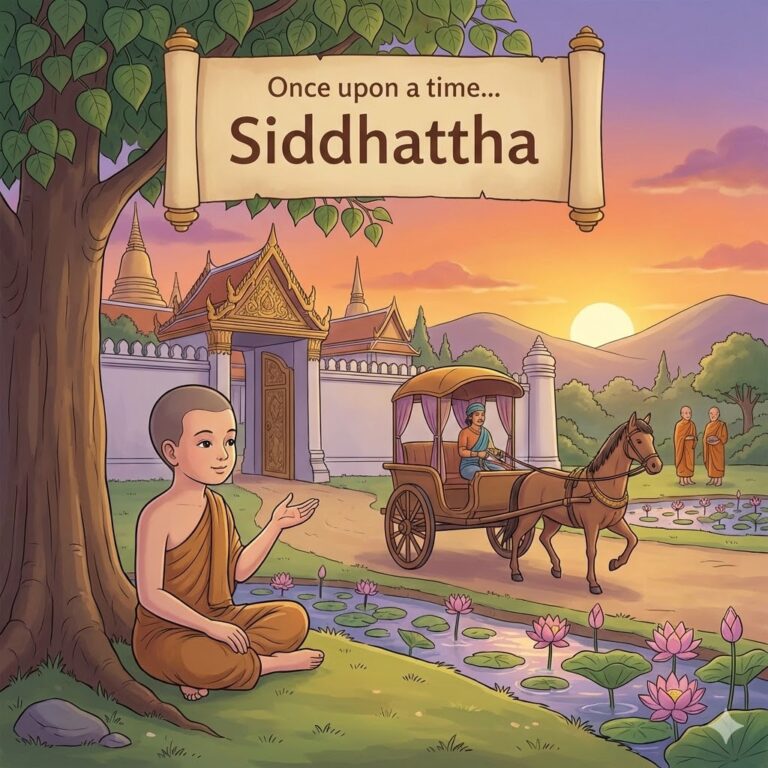
‘The Prince Who Chose a simple Life’ is an educational moral story perfect for bedtime reading with children ages 6-12.
CHAPTER ONE: THE GREAT LEAVING
The palace of Kapilavatthu glittered like a jewel in the morning sun. Its towers reached toward the heavens, its gardens bloomed with flowers from every corner of the kingdom, and its halls echoed with music and laughter.
But on this morning, the most beautiful room in the palace stood empty.
Prince Siddhartha was gone.
He had left in the deepest part of the night, after one final look at his sleeping wife Yasodhara and their infant son Rahula. He had traded his silk robes for the simple saffron garments of a wandering ascetic, and he had cut off his long, royal hair with a single stroke of his sword.
Now, as dawn painted the sky in shades of rose and gold, Siddhartha stood at a crossroads many miles from the only home he had ever known.
In his hand, he held a simple clay bowl—the only possession he would carry on his journey. Behind him lay everything a person could want: wealth, power, luxury, and the love of his family. Before him lay the unknown.
“Channa,” he said to his faithful charioteer, who had driven him through the night, “you must go back now.”
Channa’s eyes were red from crying. “But my prince—”
“I am no longer a prince,” Siddhartha said gently. “I am simply a seeker now. Take my royal garments back to my father. Tell him that I have not left out of ingratitude, but because there is something I must find—something that cannot be found inside palace walls.”
“What will you seek, my lord?” Channa asked.
Siddhartha looked toward the horizon, where the sun was rising over distant mountains.
“The answer to suffering,” he said. “Why do people grow old? Why do they become sick? Why must everyone die? And is there a way to find peace in the midst of all this pain?”
He placed his hand on Channa’s shoulder. “Tell my father I will not rest until I find these answers. And tell my son… tell Rahula that one day, I hope to give him something more precious than any kingdom.”
With that, Siddhartha turned and walked toward the rising sun, his bare feet leaving prints in the dust of the road.
* * *
CHAPTER TWO: THE CITY OF WONDERS
After many days of walking, Siddhartha came to the great city of Rajagaha, capital of the kingdom of Magadha. It was the busiest, loudest, most colorful place he had ever seen.
Merchants shouted their wares in the marketplace. Children ran through the streets playing games. Elephants bearing silk-draped passengers swayed past ox-carts loaded with grain. The smell of spices and cooking fires filled the air.
Siddhartha walked through it all with his clay bowl held before him, accepting whatever food people chose to give. This was the way of wandering holy men—they owned nothing and depended on the kindness of others for their daily bread.
What surprised Siddhartha was how people looked at him.
A young mother stopped mid-step and stared. “Look at that holy man,” she whispered to her children. “See how he walks—as straight as a king, as calm as still water.”
An old merchant put down his goods and watched Siddhartha pass. “I have seen many wanderers,” he murmured to his neighbor, “but never one who shines with such an inner light.”
A little girl tugged at her father’s hand. “Papa, why does that man look so happy when he has nothing?”
Soon, a crowd began to follow Siddhartha through the streets. They watched him accept a small portion of rice here, a piece of fruit there, always with a gentle smile and a word of thanks. They watched him share what he received with beggars even poorer than himself.
“Who is this remarkable person?” the people asked one another. “Where does he come from? What is his secret?”
Word of the mysterious stranger reached the royal palace.
* * *
CHAPTER THREE: THE KING’S CURIOSITY
King Bimbisara of Magadha was a young ruler, not much older than Siddhartha himself. He was known as a wise and just king, always seeking to learn new things and to understand his people better.
“A wanderer, you say?” the king asked his messenger. “And the people follow him through the streets?”
“Yes, Your Majesty. There is something about him—the way he carries himself, the light in his eyes. The people say he walks like a king, yet he owns nothing but a clay bowl.”
Bimbisara was intrigued. “Find out where he goes to rest. I must meet this man.”
The messenger returned with news that the stranger had been seen climbing Pandava Hill at the edge of the city, where he sat beneath a large banyan tree to meditate.
King Bimbisara gathered his finest advisors and dressed in his most magnificent robes. He placed his golden crown upon his head and mounted his royal elephant. If he was going to meet a man who walked like a king, he would appear as a king himself.
The procession wound through the city and up the rocky path to Pandava Hill. There, exactly as the messenger had described, sat a young man in simple saffron robes, his eyes half-closed in peaceful meditation.
King Bimbisara dismounted and approached slowly, not wanting to disturb the stranger’s contemplation.
Siddhartha opened his eyes.
For a long moment, the two young men simply looked at each other—one dressed in silk and gold, the other in rough cloth; one surrounded by servants and soldiers, the other utterly alone; one carrying the weight of a kingdom, the other carrying only a clay bowl.
“Welcome, O King,” Siddhartha said quietly. “Please, sit with me.”
* * *
CHAPTER FOUR: THE OFFER OF POWER
King Bimbisara had never before sat on the ground. But something in the stranger’s calm gaze made him forget his royal dignity. He lowered himself onto the grass, arranging his elaborate robes as best he could.
“I have heard much about you, wanderer,” the king began. “The people speak of your noble bearing, your gentle manner, your inner radiance. Tell me—who are you? From what kingdom do you come?”
“I come from Kapilavatthu,” Siddhartha replied. “My father is King Suddhodana of the Sakya clan.”
Bimbisara’s eyes widened. “You are a prince!”
“I was a prince,” Siddhartha corrected gently. “Now I am simply a seeker of truth.”
The king was silent for a moment, trying to understand. Why would a prince leave behind everything—his palace, his family, his future throne—to beg for food and sleep under trees?
“Noble Siddhartha,” Bimbisara said finally, “I see that your hands were meant for great things, not for holding a beggar’s bowl. I see that your spirit was born to lead, not to wander homeless on the roads.”
He leaned forward earnestly. “Come and share my kingdom with me! I will give you armies to command, cities to govern, treasure houses filled with gold. Together, we could build an empire unlike any the world has seen!”
Siddhartha listened patiently, his expression unchanged.
“A good ruler needs both power and wisdom,” Bimbisara continued. “You clearly have the wisdom of ages in your eyes. Let me provide the power. Think of all the good we could do—all the people we could help!”
* * *
CHAPTER FIVE: THE WISDOM OF LETTING GO
When the king finished speaking, Siddhartha was quiet for a long time. The wind rustled the leaves of the banyan tree, and somewhere in the distance, a bird sang its evening song.
“O King,” Siddhartha finally said, “your words are generous and kind. It is true that great good can be done with wealth and power. But it is also true that great harm can come from clinging too tightly to these things.”
He picked up his clay bowl and held it in both hands.
“Look at this bowl,” he said. “It is empty, yet it can receive. It has no value, yet it sustains my life. It binds me to nothing, yet through it, I am connected to every person who shares their food with me.”
Bimbisara looked at the simple bowl, trying to understand.
“I once had palaces full of beautiful things,” Siddhartha continued. “I had servants to attend my every need, musicians to entertain me, gardens where I could walk for hours without seeing the same flower twice. Yet in the midst of all that abundance, I was not at peace.”
“Why not?” the king asked softly.
“Because I knew that none of it would last,” Siddhartha replied. “The flowers would wilt. The musicians would grow old and die. Even the palace itself would one day crumble to dust. And I realized that if happiness depends on things that don’t last, then happiness itself cannot last.”
He smiled at the young king. “What I seek now is a happiness that cannot be taken away. A peace that remains even when everything else is lost. And this, O King, cannot be found in palaces or treasure houses. It must be found within.”
* * *
CHAPTER SIX: TWO PATHS
King Bimbisara sat very still, absorbing Siddhartha’s words. Part of him wanted to argue—surely a powerful king could do more good than a homeless wanderer! But another part of him recognized the truth in what Siddhartha said.
“I think I understand,” the king said slowly. “You are not rejecting power because you are afraid of it. You are letting it go because you have found something you believe is more valuable.”
“Yes,” Siddhartha nodded. “And I believe that when I find what I am seeking, I will be able to help far more people than any king ever could. Not by giving them gold or land, but by showing them the path to their own inner peace.”
Bimbisara rose and bowed respectfully to the man he now recognized as a great soul.
“I will not try to convince you further,” the king said. “Your path is clear to you, even if I cannot fully see it myself. But I ask one thing: if you find what you are seeking, please return to Rajagaha. Share your wisdom with me and my people.”
Siddhartha smiled warmly. “You have my word, O King. When I have found the answers I seek, I will return.”
The two young men stood facing each other in the golden light of sunset—one a ruler of men, the other a seeker of truth. Different paths, yet both walking toward something greater than themselves.
“Until we meet again,” Bimbisara said.
“Until we meet again,” Siddhartha replied.
And so the king descended the hill and returned to his palace, while Siddhartha remained beneath the banyan tree, his heart filled with quiet certainty that he was exactly where he needed to be.
* * *
CHAPTER SEVEN: THE PROMISE FULFILLED
Years passed. Siddhartha wandered many roads, studied with many teachers, and faced many trials. There were times of hardship, times of doubt, and times when the answers seemed further away than ever.
But he never gave up.
And one night, sitting beneath a different tree in a place called Bodh Gaya, everything became clear. The suffering he had wondered about, the peace he had sought—he understood it all at last. From that moment on, he was no longer Siddhartha the seeker.
He was the Buddha—the Awakened One.
True to his promise, the Buddha eventually returned to Rajagaha. King Bimbisara, now older and wiser himself, went out to meet him with joy in his heart.
“You found it,” the king said, tears streaming down his face. “I can see it in your eyes.”
“Yes,” the Buddha replied. “And now I have come to share it with you, as I promised.”
The Buddha taught in Rajagaha for many years, and King Bimbisara became one of his most devoted followers. The king learned that he didn’t have to give up his throne to find peace—he could rule with wisdom and compassion, holding his power lightly, always remembering that true happiness comes from within.
And the Buddha’s teachings spread across the land, helping countless people find the peace that Siddhartha had first glimpsed on that morning long ago, when a prince walked away from everything to find something no palace could contain.
The happiness that cannot be taken away.
The peace that remains even when everything else is lost.
The light that shines from within.
Moral Lessons
- True happiness comes from kindness, wisdom, and inner peace, not just from riches or power.
Test Your Understanding
1. What did Prince Siddhartha give up when he left the palace?
2. What was Siddhartha seeking when he left the palace?
3. What did King Bimbisara offer Siddhartha?
4. Why did Siddhartha refuse King Bimbisara’s offer?
5. What did Siddhartha eventually become after finding what he sought?
6. What is the main moral lesson of this story?
Frequently Asked Questions
What is the moral lesson of The Prince Who Chose a Simple Life?
What age is this story appropriate for?
How long does it take to read The Prince Who Chose a Simple Life?
What culture does this story come from?
Can I use this story for teaching?
Frequently Asked Questions
Who was the Prince Who Chose a Simple Life?
The prince was Siddhartha, who lived in the palace of Kapilavatthu with his wife Yasodhara and baby son Rahula. He was a wealthy royal who had everything a person could want – luxury, power, and a loving family – but chose to leave it all behind to seek a different path.
Why did Prince Siddhartha leave his palace and family?
Prince Siddhartha left his comfortable palace life because he was searching for deeper meaning and understanding. Despite having wealth, power, and love, he felt called to explore life beyond material possessions and discover truths that couldn’t be found within palace walls.
Is this a good bedtime story for kids?
Yes, this is an excellent bedtime story for kids ages 6-12. It teaches valuable lessons about finding meaning beyond material things while being age-appropriate and engaging. The story encourages children to think about what truly matters in life through an adventurous tale.
📚 Recommended Books
Handpicked for readers like you
As an Amazon Associate, we earn from qualifying purchases. These recommendations are personalized based on this story's themes and your reading history.
What moral lesson does this story teach children?
This moral story for children teaches that happiness doesn’t come from wealth or possessions alone. It shows kids the importance of following your values, being true to yourself, and understanding that sometimes the most meaningful path isn’t the easiest or most comfortable one.
What age group is this educational story suitable for?
This educational story for kids is perfect for ages 6-12. The language and concepts are accessible to young readers while dealing with meaningful themes. Parents can use it to start conversations about values, choices, and what makes life truly fulfilling.