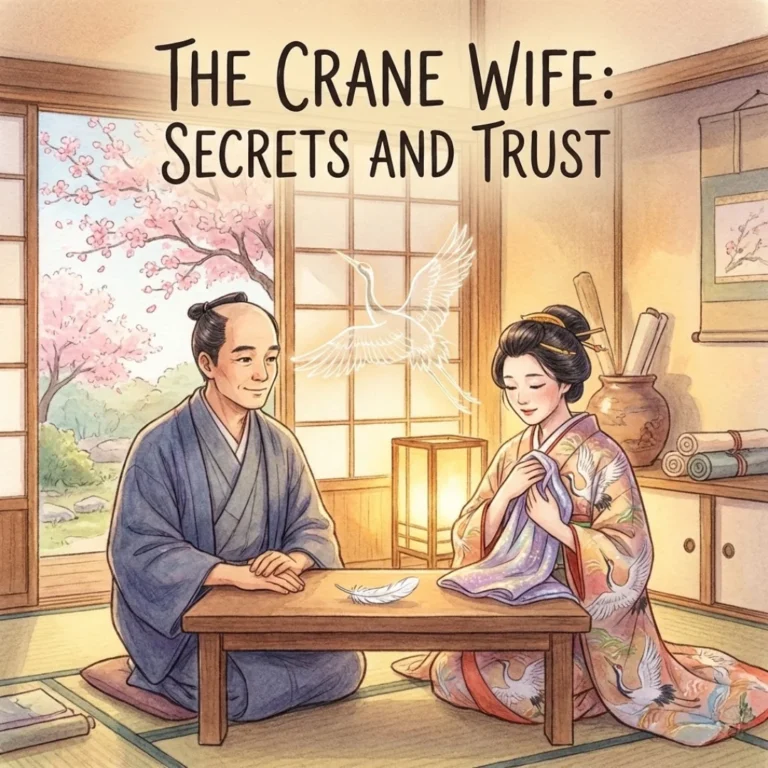
Yohei lived alone in a small house at the edge of the village, where winter winds swept down from the mountains like invisible rivers. He was poor, but his heart was as warm as summer sunshine.
One snowy evening, as the sky turned purple and gold, Yohei heard a strange sound—a cry that seemed to come from everywhere and nowhere at once. Following the sound through the white drifts, he found a magnificent crane tangled in a hunter’s trap. The bird’s feathers shimmered like moonlight on water.
“Don’t be afraid,” Yohei whispered, kneeling in the snow. “I’ll help you.”
The crane’s dark eyes watched him as he carefully freed its leg. For a moment, bird and man looked at each other, and Yohei felt something he couldn’t explain—like two stars recognizing each other across the vast night sky.
The crane spread its wings—so wide they seemed to embrace the whole world—and flew away into the twilight.
That night, Yohei sat by his small fire, warming his hands and thinking about the beautiful bird. A knock echoed through his quiet house.
At the door stood a young woman he had never seen before. Snowflakes sparkled in her dark hair like tiny diamonds. Her eyes were gentle and mysterious.
“I am lost in the storm,” she said softly. “May I stay until morning?”
Yohei welcomed her inside, sharing his simple meal of rice and vegetables. They talked late into the night, and her voice reminded him of wind singing through bamboo forests. When she laughed, it sounded like water flowing over smooth stones.
Morning came, but she did not leave. Days passed like leaves floating down a stream. Her name was Tsuru, and somehow, Yohei’s small house felt like home when she was there.
“Will you marry me?” Yohei asked one evening, surprising himself with his courage.
Tsuru smiled, and the whole room seemed brighter. “Yes,” she said. “But I must ask one thing. I have a secret gift—I can weave cloth more beautiful than any you have ever seen. If I weave for you, you must never, ever watch me work. Can you promise this?”
Yohei agreed, though he didn’t understand why such a strange promise was necessary.
That night, Tsuru went into the back room and closed the door. Yohei heard the gentle rhythm of the loom—click-clack, click-clack—like a heartbeat, like waves on a distant shore, like the universe breathing.
Three days passed. Yohei brought food and water to the door, but Tsuru did not come out. He worried, but he had made a promise.
On the fourth morning, the door opened. Tsuru emerged, looking pale and tired, but her eyes sparkled with joy. In her arms lay cloth so magnificent that Yohei gasped—it shimmered with every color imaginable, and some colors he had never seen before. Looking at it felt like looking at a sunset, a rainbow, and the Milky Way all at once.
“Take this to the city,” Tsuru said. “It will bring a good price.”
She was right. The cloth sold for enough gold to fill Yohei’s pockets and keep them comfortable for months. They were happy together, sharing meals, walking through the village, watching seasons change like pages in a beautiful book.
But winter came again, and their money ran low.
“I will weave once more,” Tsuru said, her voice quiet as falling snow.
Again she entered the room. Again the loom sang its mysterious song. This time, Yohei noticed something troubling—Tsuru had grown even thinner, as if weaving took something from her, piece by piece.
On the second day, Yohei’s curiosity grew like a seed in his heart. What did she do in there? How did she create such impossible beauty? Just one quick look couldn’t hurt, could it?
The universe holds many mysteries—some we should explore, and some we should honor with our trust.
Yohei’s hand touched the door. His promise whispered in his mind like wind through leaves, but curiosity pushed harder. Very slowly, he slid the door open just a crack.
What he saw made his heart stop.
Instead of Tsuru, a magnificent crane stood at the loom. With her beak, she pulled feathers from her own body—each one a thread of shimmering beauty—and wove them into cloth. The crane’s eyes were Tsuru’s eyes, filled with love and sadness and the deep wisdom of the sky.
The crane turned and saw him watching.
In that moment, Yohei understood everything. The bird he had saved, the woman he had married, the mysterious gift—all were one. And he had broken his promise.
Tsuru transformed back into a woman, tears streaming down her face like rain.
“I am the crane you saved,” she said, her voice breaking like thin ice. “I wanted to repay your kindness and share my life with you. But my true form is something you could never see and let me stay. Some magic only lives in mystery. Some love requires trust without understanding.”
“Please,” Yohei begged, his own tears falling. “I’m sorry. I understand now. Please stay.”
But Tsuru shook her head. “A promise broken is like a mirror shattered. Even if you glue the pieces back together, the cracks remain.”
She walked outside into the cold air. Before Yohei’s eyes, she transformed into the magnificent crane once more. She spread her wings—those same wings he had freed from the trap—and looked at him one last time.
Then she flew up into the endless sky, becoming smaller and smaller until she was just a speck, then a memory, then a lesson written on Yohei’s heart.
Yohei stood in the snow, watching the empty sky, understanding too late that some treasures are held not by grasping, but by honoring the boundaries they need to exist.
The cloth she had woven remained, beautiful and precious. But Yohei would have traded all the gold in the world for one more day of trust, one more chance to honor the mystery that made their love possible.
Some questions are more valuable than their answers. Some secrets are gifts, not barriers. And the deepest love sometimes means accepting what we cannot fully understand.
Frequently Asked Questions
What is the moral lesson of The Crane Wife: Secrets and Trust?
What age is this story appropriate for?
How long does it take to read The Crane Wife: Secrets and Trust?
What culture does this story come from?
Can I use this story for teaching?
Frequently Asked Questions
What is the story of The Crane Wife about?
The Crane Wife is a classic Japanese folktale about trust and secrets. It follows Yohei, a kind but poor man who rescues an injured crane. A mysterious woman soon arrives at his door, and their relationship explores themes of compassion, loyalty, and the consequences of breaking someone’s trust.
What lesson does The Crane Wife teach children?
The Crane Wife teaches that trust is fragile and must be respected. It shows children that kindness should be given freely, that secrets deserve to be honored, and that curiosity or greed can destroy even the most beautiful relationships. It’s a gentle but powerful moral story about love and boundaries.
Is The Crane Wife a traditional Japanese folktale?
Yes, The Crane Wife, known in Japanese as ‘Tsuru no Ongaeshi,’ is a beloved traditional Japanese folktale. It has been retold for generations and remains one of Japan’s most recognized moral stories, often shared with children to illustrate the values of gratitude, honesty, and trust.
📚 Recommended Books
Handpicked for readers like you
As an Amazon Associate, we earn from qualifying purchases. These recommendations are personalized based on this story's themes and your reading history.
Why does the crane transform into a woman in the story?
In The Crane Wife legend, the crane transforms into a woman to repay Yohei’s act of kindness after he frees her from a trap. This magical transformation represents gratitude and devotion, and is central to the story’s exploration of secrets — she hides her true identity to live among humans.
What age group is The Crane Wife story suitable for?
The Crane Wife is suitable for children aged 5 and up, though its deeper themes of trust and secrets resonate most with kids aged 7 to 12. Parents and teachers often use it as a read-aloud to spark conversations about kindness, keeping promises, and the emotional impact of broken trust.