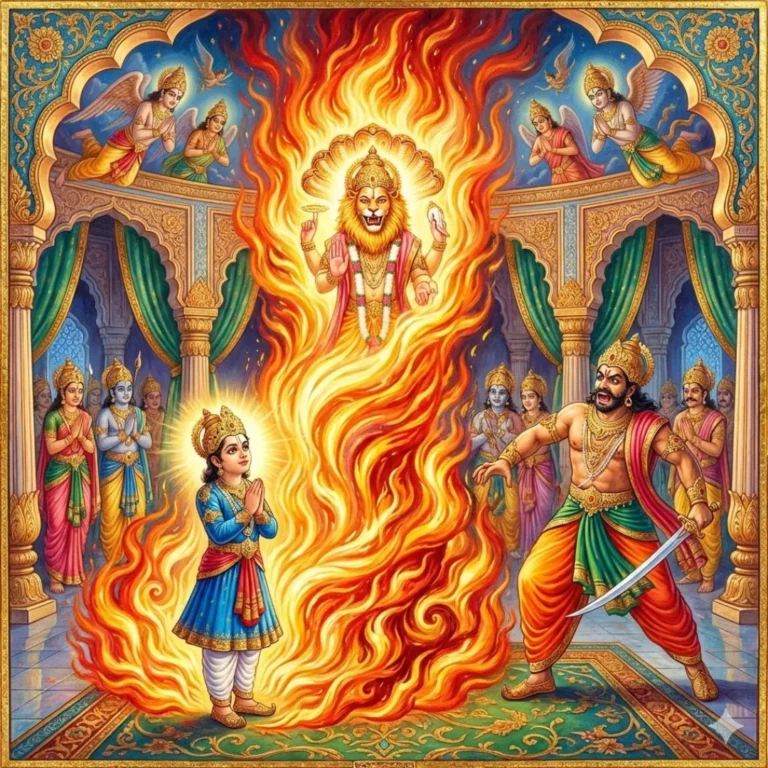
Young Prahlada refuses to worship his tyrannical father, King Hiranyakashipu, because he sees divinity in all things. Despite many attempts on his life, the boy’s faith protects him. When the king strikes a pillar to disprove Prahlada’s beliefs, the divine emerges as Narasimha, teaching that truth and devotion are stronger than any earthly power.
In a palace that touched the clouds, where golden towers caught the morning sun and marble halls echoed with the footsteps of power, there lived a boy named Prahlada. His father, Hiranyakashipu, ruled the three worlds with an iron fist, but the boy carried something his father could never understand—a heart filled with quiet devotion.
The king had conquered death itself, or so he believed. He could not be killed by man or beast, inside or outside, day or night, on earth or in sky. With such power came pride that grew like shadows at sunset, stretching across everything until darkness seemed eternal.
“I am god!” Hiranyakashipu would thunder from his throne, his voice shaking the palace walls. “All must bow before me—the mountains, the rivers, the very stars themselves!”
But in a small garden where jasmine flowers bloomed and butterflies danced like scattered prayers, young Prahlada would sit quietly, watching the world breathe. He saw divinity everywhere—in the dewdrop clinging to a lotus petal, in the ant carrying food to its family, in the gentle wind that bent the tall grass but never broke it.
“Father,” Prahlada said one morning, his voice soft as dawn, “I cannot worship only you.”
The great hall fell silent. Ministers froze mid-bow. Even the flames in the oil lamps seemed to hold their breath.
Hiranyakashipu’s eyes blazed like two dark suns. “What did you say, boy?”
Prahlada stood small but steady, like a single candle that refuses to flicker in the storm. “You are powerful, Father. You are strong and mighty. But the divine lives in everything—in you, in me, in the smallest seed waiting to become a tree. How can I worship only you when I see the sacred everywhere?”
The king’s fury was terrible to behold. He loved his son, yes, but pride is a hungry thing that devours even love. “Then you will learn,” he growled, “what happens to those who defy a god.”
They threw Prahlada from the highest cliff, where eagles nested among clouds and the earth below seemed no bigger than a child’s toy. But as the boy fell through the air, his heart remained calm, trusting in that great presence he felt in all things. The ground rose to meet him soft as a mother’s embrace, and he walked away without a scratch.
“Try again,” commanded the king, his voice tight with anger and something else—fear, perhaps, that his power might not be absolute after all.
Wild elephants, trained for war, trumpeted and charged at the small boy. Their footsteps shook the earth like thunder. But Prahlada closed his eyes and whispered a prayer, and the elephants stopped as if an invisible hand had touched their great heads. They knelt before the boy, recognizing something ancient and gentle in his presence.
Fire came next—roaring flames that consumed everything they touched. The heat was intense, the smoke thick as night. Yet Prahlada sat in the center of the blaze as peacefully as if he rested in a garden, and the flames bent away from him like flowers turning toward the sun.
Snakes with venom that could kill with a single drop. Poison mixed in his food. Sorcerers who chanted spells dark as moonless nights. But nothing could harm the boy who carried faith like a shield made of morning light.
With each failure, Hiranyakashipu’s rage grew hotter and his confusion deeper. How could a small boy survive what would kill the mightiest warrior? How could such gentle words—”the divine is everywhere”—hold more power than all his armies?
One evening, as the sun painted the sky in colors of gold and amber, the king summoned Prahlada to the great hall. The boy came quietly, his bare feet whispering across the cool marble floor.
“Tell me, you stubborn child,” Hiranyakashipu demanded, pointing to a massive pillar that held up the palace roof. The pillar was carved with images of the king’s victories, scenes of conquest and glory. “You say your Vishnu is everywhere. Is he in this pillar?”
Prahlada looked at the pillar, and then at his father. In his young eyes shone something that was not defiance, not pride, but simple truth.
“Yes, Father,” he said softly. “He is in the pillar. He is in the walls. He is in you and in me. He is in every breath we take and every word we speak.”
“Then I shall destroy him!” roared the king. He raised his great mace, muscles straining, and struck the pillar with all the fury of one who has conquered kingdoms but never conquered himself.
The sound was like the world cracking open.
Cracks spread across the pillar like lightning frozen in stone. Light poured from those cracks—not the warm gold of sunset, but something brighter, fiercer, impossible to look upon directly. The pillar split apart, and from within emerged a form that was neither man nor beast, neither one thing nor another.
Narasimha stood before them—half human, half lion, with eyes that held both fury and justice. His mane blazed like the sun at noon. His claws gleamed sharp as truth. He was the answer to an impossible puzzle, the form that could defeat one who could not be defeated.
For it was now twilight—neither day nor night. And Narasimha stood at the threshold—neither inside the palace nor outside. He placed the king across his lap—neither on earth nor in sky. And he used his claws—neither weapon nor bare hands.
Every condition of the boon that had made Hiranyakashipu invincible was satisfied, and yet broken. The king who had thought himself above all law learned in his final moments that pride, no matter how mighty, must eventually bow before truth.
When it was over, Narasimha’s fury still burned like a forest fire. The gods themselves trembled, afraid to approach. But Prahlada walked forward calmly, his small hand reaching out without fear.
“My lord,” the boy said gently, “you have protected dharma. You have shown that no power can stand against righteousness. But now, please, let your anger cool like the evening breeze that follows the hot day.”
The fierce lion-man looked down at the child, and something in those ancient eyes softened. Here was one who had faced death without flinching, not because he was brave, but because he understood something profound—that the body may fall, but the spirit that connects all living things is eternal.
Narasimha’s breathing slowed. The flames in his eyes dimmed to the warm glow of a hearth fire. He placed his great paw on Prahlada’s head in blessing.
“You are young,” Narasimha said, his voice now gentle as distant thunder, “but you understand what the old and powerful forget. The divine is not in the palace towers or the conquered kingdoms. It lives in the honest heart, in the truth spoken softly, in the faith that does not waver.”
Prahlada became king after his father, but he ruled differently. His palace gates stood open to all—the poor and the rich, the weak and the strong. He planted gardens where children could play and elders could rest in shade. He taught that true power lies not in making others fear you, but in helping them find peace.
Years later, when Prahlada was old and his hair had turned silver as moonlight, children would gather around him in those same gardens where he had played as a boy.
“Tell us again, grandfather,” they would ask, “about the pillar and the lion.”
And Prahlada would smile, watching butterflies dance among the jasmine flowers, and say, “The divine is not in grand temples alone, little ones, though temples are beautiful. It is not only in sacred texts, though wisdom is precious. The divine lives in the kindness you show to a lost puppy, in the patience you practice when learning is hard, in the forgiveness you offer when someone hurts you. Look for it everywhere—in sunrise and sunset, in your friend’s laughter, in your own beating heart—and you will never be alone.”
The children would nod, though perhaps they didn’t fully understand. But they remembered the feeling of those words, the way they settled in their hearts like seeds waiting for the right moment to bloom. And as they grew, they carried that teaching forward, a gentle light passed from one hand to another, from one generation to the next.
For this is the great secret that Prahlada understood even as a small boy facing an angry king: Faith is not about fear or obedience. It is about seeing the sacred thread that connects all living things, the divine presence that flows through everything like water through a river. When you see that, when you truly see it, nothing—not even death itself—can make you afraid.
And in that garden where Prahlada once sat as a child, the jasmine flowers continue to bloom, their sweet fragrance reminding all who pass by that truth is stronger than tyranny, that gentleness can overcome rage, and that the divine light shines brightest in the simplest, most honest hearts.
Test Your Understanding
1What made King Hiranyakashipu believe he was invincible?
2Why did Prahlada refuse to worship only his father?
3What happened when Hiranyakashipu tried to harm Prahlada?
4Who or what was Narasimha?
5What is the main lesson Prahlada teaches at the end of the story?
Frequently Asked Questions
What is the moral lesson of Prahlada and the Pillar of Fire?
What age is this story appropriate for?
How long does it take to read Prahlada and the Pillar of Fire?
What culture does this story come from?
Can I use this story for teaching?
Frequently Asked Questions
What is the story of Prahlada and the Pillar of Fire about?
The story of Prahlada and the Pillar of Fire is about a young boy named Prahlada whose unwavering devotion to the divine protects him from his tyrannical father, King Hiranyakashipu. When the king strikes a pillar to challenge his son’s faith, the god Narasimha emerges, proving that true devotion and truth are more powerful than any earthly ruler.
Who is Prahlada in Hindu mythology?
Prahlada is a beloved figure in Hindu mythology, known as the devoted son of the demon king Hiranyakashipu. Despite being born into a royal family that rejected the gods, Prahlada maintained deep faith and saw divinity in all things. His story is celebrated as a powerful example of devotion triumphing over tyranny and arrogance.
Why couldn’t Hiranyakashipu be killed in the Prahlada story?
Hiranyakashipu had been granted a powerful boon that protected him from death by man or beast, inside or outside, during day or night, on earth or in the sky. This made him believe he was invincible and even godlike. However, the god Narasimha found a way to defeat him that worked around every condition of this boon.
📚 Recommended Books
Handpicked for readers like you
As an Amazon Associate, we earn from qualifying purchases. These recommendations are personalized based on this story's themes and your reading history.
What lesson does the Prahlada and the Pillar of Fire story teach children?
The story teaches children that genuine faith and inner devotion are stronger than fear, power, or pride. It shows that truth cannot be suppressed, no matter how powerful the opposition. Prahlada’s courage in standing by his beliefs, even when threatened by his own father, encourages kids to stay true to their values.
Who is Narasimha and what role does he play in the Prahlada story?
Narasimha is a divine being in Hindu mythology, depicted as half-man and half-lion. In the Prahlada story, Narasimha emerges from a pillar when the king strikes it to disprove his son’s belief that the divine is everywhere. His appearance fulfills Prahlada’s faith and demonstrates that the divine truly exists in all things.