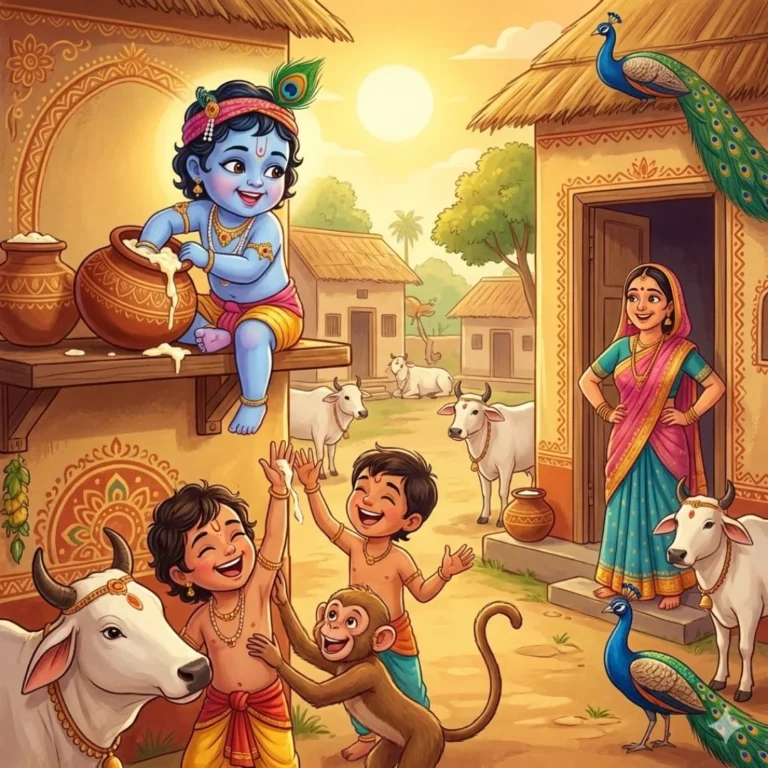
Young Krishna loves butter and delights in stealing it from village homes with his friends. When his mother Yashoda tries to tie him to a grinding stone as punishment, no rope is long enough—until Krishna, out of love for his mother, allows himself to be caught, teaching that true love means honoring the bonds that bind us.
In the village of Vrindavan, where the morning mist rose from the Yamuna River like the earth’s own breath, there lived a child who made all the mothers smile even when they shook their heads. His name was Krishna.
Krishna was not just any child. When he laughed, it was as if the sun had decided to live in a small boy’s chest. When he ran through the dusty lanes, even the peacocks would stop to watch. But what Krishna loved most in all the world—more than flying kites, more than playing his flute by the river—was butter.
Every morning, Krishna’s mother Yashoda would sit in the courtyard and churn fresh butter. She would pull the rope that made the wooden churner spin round and round in the clay pot, singing ancient songs while the cream slowly turned to gold. The sound—thump, thump, thump—was like a heartbeat. Krishna would sit nearby, watching with eyes as dark and deep as forest pools.
“Mother,” he would say, “that butter smells like all the good things in the world mixed together.”
Yashoda would smile and give him a small piece. But Krishna wanted more. Not because he was greedy, but because butter seemed to him like captured sunshine, like the taste of happiness itself.
One morning, when the village was still wrapped in sleep, Krishna whispered to his friend Balarama, “Let us go find butter while everyone dreams.”
“But that would be stealing,” Balarama said, though he was already standing up.
“Is it stealing,” Krishna asked with a grin, “if we are only teaching the butter where it truly wants to go?”
The two boys crept through the village like morning shadows. They knew which houses had the ripest butter hanging in clay pots from the ceiling beams. The village mothers were wise—they hung the pots high, far from small hands. But they had not counted on Krishna’s cleverness.
Krishna and his friends would form a ladder of children, one standing on another’s shoulders, swaying like a young tree in the wind. The highest boy would reach up, his fingers just touching the cool bottom of the pot. With careful hands, they would lower it down, and everyone would share the creamy treasure.
But butter, as you know, is a thing that leaves evidence. It gleams on fingers and mouths. It has a way of getting into hair and on cheeks.
Soon the village mothers came to Yashoda, their eyes both angry and amused.
“Your Krishna broke into my kitchen!” said one.
“He ate all my butter and fed the rest to his monkey friends!” said another.
“I caught him red-handed—or should I say, butter-handed!” laughed a third, despite her frustration.
Yashoda sighed. She loved her son more than her own breath, but she could not let him think that rules meant nothing. That evening, when Krishna came home with butter still gleaming on his chin, she tried to look stern.
“Krishna, the mothers are complaining. Why do you steal their butter?”
Krishna’s eyes grew wide and innocent as lotus flowers. “Mother, why would I steal butter? You give me plenty. Perhaps the pots are just falling down on their own. Perhaps the butter is lonely and comes to find me.”
Yashoda tried not to smile. “Do not play word-games with me, little one. I am your mother, and I know mischief when I see it smiling at me.”
For a moment, Krishna looked down, and Yashoda thought she saw something in his expression—something old and wise and not quite childlike. Then he looked up again, and he was simply her small son.
“I am sorry, Mother,” he said softly. “Butter just tastes better when it is shared with friends.”
The next day, Yashoda decided to teach Krishna a lesson. She caught him with his hand deep in the butter pot, his face a picture of pure joy. Butter dripped from his fingers like rain.
“That is enough!” she declared. “You will not run wild anymore. I am going to tie you to this grinding stone until you learn to behave!”
She brought a rope and began to tie it around Krishna’s waist. But something strange happened. The rope was too short—just by two finger-widths. Yashoda frowned and tied another rope to it. Still too short. She tied another rope, and another, and another. Soon she had used every rope in the house, and still they would not quite reach around Krishna’s small waist.
Yashoda was exhausted. Sweat ran down her face. Her arms ached. Yet she would not give up, for a mother’s love is more stubborn than stone.
Krishna watched his mother with eyes full of tenderness. He saw how hard she tried, how much she loved him, how desperately she wanted to teach him right from wrong. And in that moment, because he loved her more than butter, more than mischief, more than freedom itself, Krishna let the magic go.
The rope fit.
Yashoda tied him firmly to the heavy grinding stone and stood back, panting. “Now you will stay here and think about what you have done!”
But as she walked away, her heart felt strange. For just a moment, in her exhaustion, she had seen something impossible—the whole universe reflected in her son’s eyes. Mountains and rivers, stars and sky, gods and demons, all spinning in those dark depths. Then it was gone, and he was just a small boy tied to a stone.
Later that day, the village mothers came to visit Krishna. They found him sitting patiently beside the grinding stone, not complaining, not crying. They brought him water and pieces of fruit. They told him stories and sang him songs. For even though he had stolen their butter, they loved him. How could they not? When Krishna smiled, sadness forgot how to exist.
“Why did you let yourself be caught?” one old grandmother asked him gently.
“Because,” Krishna said, looking toward his house where Yashoda was cooking dinner, “sometimes love means letting ourselves be tied to the things that tie us. My mother needed to catch me more than I needed to be free.”
The grandmother nodded, though she did not fully understand. None of them did. How could they know that the small boy tied to their grinding stone was the same spirit that spun the stars in the sky? How could they guess that he had chosen to be small, to be caught, to be loved in the simple way a mother loves a son?
That evening, Yashoda untied Krishna and held him close. “You are a strange child,” she whispered into his dark hair. “Sometimes I think you are teaching me more than I am teaching you.”
Krishna snuggled into her arms. “Then we are both good students, Mother.”
From that day forward, Krishna still stole butter from time to time. It was his nature, as much as the river’s nature is to flow. But he was more careful, and he always made sure to leave a little extra for the village mothers. And they, for their part, began to hang their butter pots a little lower than necessary, and to look away at certain times of the morning.
For they had learned something too: that sometimes the greatest joys in life are the small rebellions, the sweet thefts, the butter shared with friends in the early light of day. And that love, real love, is not about controlling what we cherish, but about letting it be free—even when freedom means messy faces and empty butter pots and small boys who tie themselves to grinding stones because their mothers’ hearts need the comfort of catching them.
In Vrindavan, where the morning mist still rises from the river like the earth’s own breath, the mothers still tell this story. They tell it while churning butter, while raising their own children, while learning that the greatest wisdom often comes dressed in mischief, wearing a smile that could melt the butter of the world.
Test Your Understanding
1Why did Krishna love butter so much?
2What happened when Yashoda tried to tie Krishna to the grinding stone?
3Why did Krishna finally allow himself to be tied up?
4How did the village mothers react to Krishna stealing their butter?
5What did Krishna and the village mothers learn by the end of the story?
Frequently Asked Questions
What is the moral lesson of The Butter Thief: Krishna’s Childhood Pranks?
What age is this story appropriate for?
How long does it take to read The Butter Thief: Krishna’s Childhood Pranks?
What culture does this story come from?
Can I use this story for teaching?
Frequently Asked Questions
Why is Krishna called the butter thief?
Krishna earned the nickname ‘butter thief’ because as a young child in Vrindavan, he constantly sneaked into village homes with his friends to steal freshly churned butter. His love for butter was legendary, and despite being caught repeatedly, he continued his playful mischief, making him one of Hinduism’s most beloved and relatable childhood figures.
What is the story of Krishna’s childhood pranks about?
Krishna’s childhood pranks story follows young Krishna stealing butter from village homes and his mother Yashoda attempting to punish him by tying him to a grinding stone. Miraculously, no rope is ever long enough—until Krishna willingly allows himself to be caught out of love for his mother, revealing a deep spiritual lesson about love and devotion.
What moral lesson do Krishna’s butter stealing pranks teach children?
The story teaches that true love means honoring the bonds we share with those who care for us. Krishna, despite his divine power, chose to submit to his mother’s love, showing children that respecting and cherishing family relationships is a sign of strength, not weakness.
📚 Recommended Books
Handpicked for readers like you
As an Amazon Associate, we earn from qualifying purchases. These recommendations are personalized based on this story's themes and your reading history.
Who is Yashoda in the Krishna butter thief story?
Yashoda is Krishna’s devoted foster mother in Vrindavan. In the story, she churns fresh butter every morning and lovingly tries to discipline young Krishna for his mischievous stealing. Her unconditional love for Krishna is central to the tale, representing the pure bond between a mother and child.
Is the butter thief story from Hindu mythology suitable for young kids?
Yes, the Krishna butter thief story is a wonderful tale for young children. It uses playful, relatable childhood behavior—sneaking sweets—to gently introduce themes of love, family bonds, and doing the right thing. The story’s warm, humorous tone makes it engaging while still delivering a meaningful moral lesson.