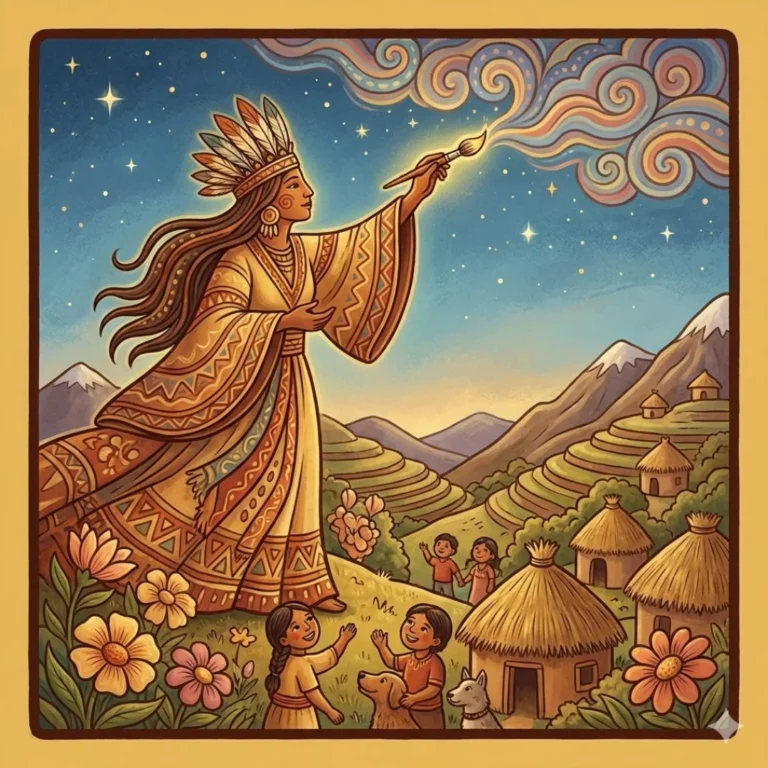
This bedtime story for kids, ‘The Goddess Who Painted the Sky’, teaches children ages 6-12 about important moral values.
The Goddess Who Painted the Sky
Every morning, when the world was still cloaked in darkness, a magical moment would begin. High above the sleeping earth, in a magnificent palace floating on the western horizon, a beautiful goddess named Eos would wake from her dreams.
Her palace was unlike any on earth—surrounded by meadows where flowers bloomed in colors that hadn’t yet been named, where nymphs and spirits danced to music that sounded like wind chimes mixed with distant waterfalls. The grass was softer than clouds, and the air sparkled with possibilities.
Eos herself was breathtaking. She had rosy-pink arms and fingers that glowed like the first light of morning. Great wings sprouted from her shoulders, their feathers shifting through every color of dawn—violet, rose, gold, and coral. A silver star shone on her forehead, and she carried a golden torch that never went out.
“Time to wake the world,” Eos whispered to herself each morning, wrapping her violet mantle around her shoulders. The fabric shimmered like twilight sky, and when she moved, it left trails of color in the air.
She walked to her stable where two magnificent horses waited—Lampetus and Phaethon, whose coats gleamed like polished bronze and whose manes flowed like liquid sunlight. Eos hitched them to her chariot herself, for this was her sacred duty, and she would never ask another to do it.
“Are you ready, my friends?” she asked, stroking their warm necks. They whinnied in response, pawing the air with eagerness.
With a crack of golden reins, Eos launched her chariot into the sky. She raced across the vast horizon, her torch held high, painting the darkness with streaks of pink and gold and orange. Below, flowers began to lift their closed petals. Birds stirred in their nests. The morning dew, like tiny diamonds, appeared on every blade of grass and leaf.
“Good morning, little ones!” Eos called to the awakening plants. “Here comes my brother Helios with his sun. Are you ready?”
The flowers seemed to nod yes, turning their faces toward the brightening east.
This was Eos’s gift to the world—she was the herald of day, the one who prepared everything for the sun god’s arrival. And at night, after Helios finished his journey, Eos would race across the sky again, this time painting twilight instead of dawn, bidding the world goodnight with purple and indigo hues.
But Eos had a secret sadness in her heart.
Long ago, she had fallen deeply in love with a mortal prince named Tithonus. He was the most beautiful man she had ever seen, with kind eyes and a laugh that reminded her of morning songbirds. Eos loved him so much that she couldn’t bear the thought of him dying, as all mortals must.
“Please, mighty Zeus,” she had begged the king of gods. “Grant Tithonus immortality so he can stay with me forever!”
Zeus, moved by her tears, had agreed. “Very well. He shall never die.”
Eos had been overjoyed. She and Tithonus spent centuries together, watching countless dawns from her palace, dancing in the flower meadows, sharing stories and laughter.
But Eos, in her desperate wish, had forgotten something crucial. She had asked for immortality—for Tithonus to never die—but she hadn’t asked for eternal youth.
Slowly, year by year, Tithonus began to age. His dark hair turned silver, then white. His smooth face wrinkled. His strong body grew weak and bent. While Eos remained forever young and beautiful, Tithonus became an old, old man.
At first, Eos didn’t care. “I love you for who you are, not how you look,” she insisted, helping him walk through the gardens.
But Tithonus grew older still. His voice became a feeble whisper. He could barely move. The beautiful prince had become so frail that he was little more than a voice in a still body, unable to enjoy the eternal life that had been granted to him.
“I am so tired,” Tithonus whispered one day, tears running down his ancient cheeks. “This is not living. This is not the gift I thought it would be. Please, let me die.”
But that was the one thing Eos couldn’t do. Zeus’s gift couldn’t be undone. Tithonus would live forever, growing older and more miserable every year.
Eos’s heart broke. She had meant to give him the greatest gift, but instead, she had trapped him in an eternal prison of old age.
“I’m so sorry,” she wept, holding his trembling hand. “I should have been wiser. I should have thought more carefully about my wish.”
Then, in her sadness, Eos had an idea. If she couldn’t give Tithonus death, perhaps she could give him a different kind of life—one where he could be free and small and simple, without the burden of endless aging.
Using all her divine power, Eos transformed Tithonus into a grasshopper. In an instant, the old, tired man became a tiny green creature with long jumping legs and delicate wings.
The grasshopper chirped—a sound like his old voice, but happier now, unburdened.
“Are you happy now?” Eos asked gently, holding out her finger. The grasshopper jumped onto it and chirped again, louder this time, as if to say yes.
And so Tithonus remained, a grasshopper who lived in Eos’s meadow, chirping his endless song. Some say you can still hear him in the early morning, his voice joining the chorus of dawn, singing alongside the goddess who loved him so much that she gave him two lives—even if the first had been a mistake.
Every morning after that, as Eos drove her chariot across the sky, painting the world with dawn’s colors, she listened for Tithonus’s cheerful chirping. It reminded her of an important lesson: that wishes must be made carefully, that love alone is not enough without wisdom, and that sometimes the greatest gift is not living forever, but living well.
And when children hear grasshoppers singing in the morning, they’re hearing Tithonus’s song—a reminder that even mistakes made from love can find a kind of happiness in the end.
Frequently Asked Questions
What is the moral lesson of The Goddess Who Painted the Sky?
What age is this story appropriate for?
How long does it take to read The Goddess Who Painted the Sky?
What culture does this story come from?
Can I use this story for teaching?
Frequently Asked Questions
What is ‘The Goddess Who Painted the Sky’ bedtime story about?
It’s a magical bedtime story about Eos, a beautiful goddess who paints the sky with the colors of dawn each morning. The story blends Greek mythology with important moral values, making it perfect for children ages 6 to 12 who love fantasy and adventure at bedtime.
What age group is ‘The Goddess Who Painted the Sky’ suitable for?
This bedtime story is designed for children ages 6 to 12. The imaginative language and mythology-inspired characters are engaging enough for older kids while remaining accessible and soothing for younger readers or listeners at bedtime.
What moral values does this bedtime story for kids teach?
The story is crafted to teach children important moral values through the journey of Eos, the dawn goddess. While specific lessons unfold throughout the tale, themes typically include responsibility, dedication, and the beauty of bringing light and hope to others every single day.
📚 Recommended Books
Handpicked for readers like you
As an Amazon Associate, we earn from qualifying purchases. These recommendations are personalized based on this story's themes and your reading history.
Who is Eos in this children’s story?
Eos is a breathtaking goddess with rosy-pink glowing arms, colorful wings, and a silver star on her forehead. She lives in a floating palace on the western horizon and rides a chariot pulled by two magnificent horses each morning to paint the sky with the colors of dawn.
Is this bedtime story based on Greek mythology?
Yes, the story draws inspiration from Greek mythology. Eos is the Greek goddess of the dawn, and her horses Lampetus and Phaethon are rooted in ancient myths. The story reimagines these mythological elements in a child-friendly, imaginative way perfect for a soothing bedtime read.