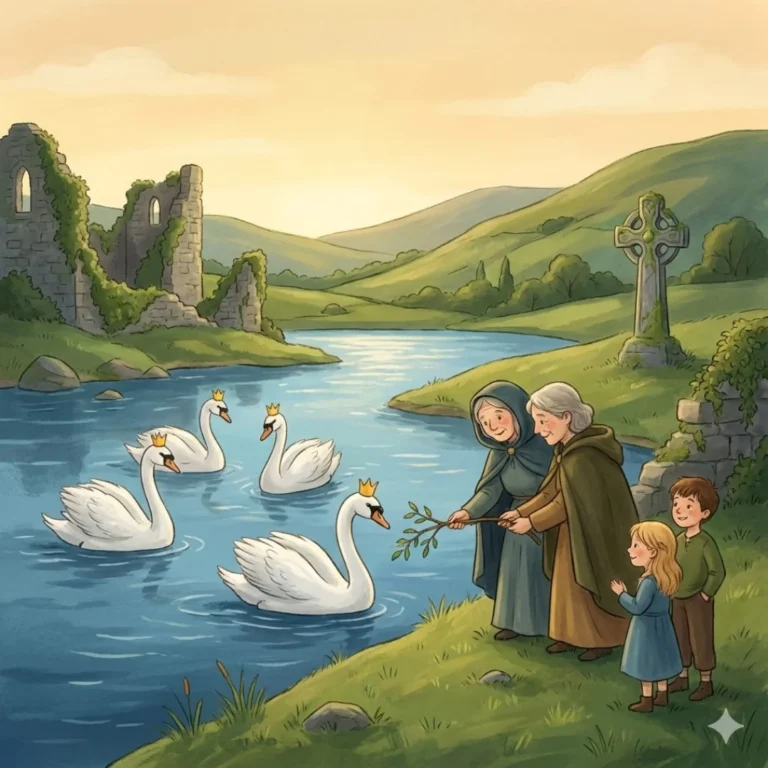
This moral story for children ages 6-12 combines entertainment with important values.
The Swan Children of Lir
In ancient Ireland, when mist still clung to green hills each morning and castles stood proud against gray skies, there lived a powerful king named Lir. His greatest treasures were not his lands or gold, but his four beloved children.
Fionnuala was the eldest, with hair like spun gold and eyes as blue as the summer sky. Her three younger brothers – Aodh, Fiachra, and Conn – followed her everywhere, for she was both sister and second mother to them. Together, the four children filled their father’s halls with laughter and songs so beautiful that travelers would journey for days just to hear them sing.
When their mother died, King Lir’s heart shattered like glass. For months, he could barely smile. His children were his only joy.
Eventually, Lir married again, hoping to give his children a new mother. His bride was Aoife, a beautiful woman with raven-black hair and a proud bearing. At first, she seemed kind and loving. But as months passed, a terrible jealousy grew in her heart like a poisonous vine.
“Lir loves his children more than me,” she thought bitterly. “His eyes light up when they sing, but barely notice me at all.”
One bright spring morning, Aoife announced cheerfully, “Children, let us go swimming in Lake Derravaragh! The water will be so refreshing on this warm day.”
The children eagerly agreed, never suspecting the darkness in Aoife’s heart. They traveled in a grand chariot across rolling green hills covered with purple heather and yellow gorse flowers that smelled sweet in the sunshine.
When they reached the crystal-clear lake, surrounded by ancient oak trees and singing birds, the children laughed with delight. They splashed into the cool water, their happy voices echoing across the peaceful landscape.
But as they swam, Aoife drew out a wand of dark magic she had kept hidden. Her hands trembled, but jealousy had made her heart cold.
“By the power of ancient magic,” she cried out in a terrible voice, “I command these children to become swans!”
Instantly, a blinding light flashed. When it faded, four beautiful white swans floated on the water where the children had been. They still had their human minds and voices, but their bodies were transformed.
“What have you done to us?” Fionnuala cried, her voice now coming from a swan’s beak but still achingly beautiful.
For just a moment, Aoife’s heart felt a pang of regret. But the spell was cast and could not be undone. “You shall remain swans for nine hundred years,” she declared, her voice shaking. “Three hundred years on this lake, three hundred on the Sea of Moyle, and three hundred on the waters of Irrus Domnann.”
“Please,” Fionnuala begged, “at least let us keep our voices and our thoughts!”
Even in her jealousy, Aoife was not completely heartless. “That, I grant you,” she whispered, and vanished.
When King Lir discovered what Aoife had done, his grief and rage were terrible to behold. He banished her from Ireland forever, and she was never seen again. Then, with tears streaming down his weathered face, Lir came to live beside the lake to be near his swan children.
The swan children sang songs of such beauty that people came from every corner of Ireland to hear them. Their melodies told stories of love and loss, of hope and courage, of family bonds that could never be broken.
King Lir grew old beside the lake. His beard turned white, and his back bent with age. When he finally passed away peacefully one autumn evening, the swan children sang a farewell so beautiful that flowers bloomed out of season in sorrow.
Three hundred years passed. Seasons changed a thousand times. Kings rose and fell. The swan children sang on, keeping each other company through countless dawns and sunsets.
Finally, it was time to fly to the Sea of Moyle, the cold, stormy waters between Ireland and Scotland. Here, there were no gentle lakes or peaceful shores. Fierce winds howled, and massive waves crashed with terrible force.
Many times, violent storms separated the siblings. Rain pelted them like tiny arrows, and winds tried to tear them apart.
“Stay close!” Fionnuala would call through the roaring tempest. During the worst storms, she would spread her wings and gather her three brothers beneath them, protecting them with her own body from the freezing rain and brutal winds. “We are together. Together, we can endure anything.”
And they did endure. Three hundred more years passed in that harsh, cold sea.
At last, they flew to their final destination: the western waters of Irrus Domnann. But the Ireland they returned to had changed beyond recognition. The old castles had crumbled. New faiths had come to the land. No one remembered the swan children’s story anymore.
They were utterly alone, four swans in a world that had forgotten them.
One day, a kind Christian monk named Kemoc was walking along the shore when he heard the most extraordinary sound: swans singing hymns in perfect human voices!
Amazed, he approached them, and Fionnuala told him their entire story – nine hundred years of curse and courage.
Tears rolled down Kemoc’s gentle face. “I will care for you until your curse is broken,” he promised, building a small shelter by the water where he could watch over them.
Not long after, word spread throughout Ireland that a king from the north had fallen in love with a princess from the south. When they announced their wedding, everyone rejoiced – but no one more than the swan children, for this was the sign that their curse would end!
The princess, hearing tales of the singing swans, demanded they be brought to her wedding as a gift. As soon as the swans were brought to the wedding ceremony, a brilliant light filled the air.
The curse broke!
But nine hundred years had passed. When the four swans transformed back to human form, they were ancient – nine hundred years old. Their golden hair had turned snow white, and their skin was wrinkled like old parchment.
Kemoc quickly baptized them as they had requested. And as he spoke the sacred words, something wonderful happened: all the centuries of sorrow and loneliness lifted from their hearts like morning mist rising from a lake.
“We are together at the end,” Fionnuala whispered to her brothers, her voice still beautiful even in old age, “as we were at the beginning.”
The four children of Lir smiled at each other one last time, and then, peacefully, they passed from this world, finally free.
The people of Ireland never forgot the swan children. Their story was told beside warm fires on cold nights, passed down through countless generations as a reminder that love and family are stronger than any curse, that courage and patience can carry us through the darkest times, and that staying together gives us the strength to endure anything.
Frequently Asked Questions
What is the moral lesson of The Swan Children of Lir?
What age is this story appropriate for?
How long does it take to read The Swan Children of Lir?
What culture does this story come from?
Can I use this story for teaching?
Frequently Asked Questions
What is the story of the Swan Children of Lir about?
The Swan Children of Lir is an ancient Irish legend about a king named Lir whose four children are transformed into swans by their jealous stepmother Aoife. It’s a moral story for children ages 6-12 that explores themes of love, jealousy, loyalty, and resilience through magical storytelling.
What age group is the Swan Children of Lir story suitable for?
The Swan Children of Lir is written for children ages 6 to 12. It combines entertaining fantasy elements like magic and castles with important moral values, making it a great read-aloud story for parents or an independent read for older children in that age range.
What moral lessons does the Swan Children of Lir teach kids?
The story teaches children about the dangers of jealousy, the importance of family love, and the power of staying strong through hardship. It also touches on themes of loyalty and resilience, showing how Lir’s children endure their curse with courage and togetherness.
📚 Recommended Books
Handpicked for readers like you
As an Amazon Associate, we earn from qualifying purchases. These recommendations are personalized based on this story's themes and your reading history.
Is the Swan Children of Lir a real Irish myth?
Yes, the Children of Lir is one of the most beloved myths from ancient Irish folklore, part of the Irish Mythological Cycle. It has been retold for centuries and remains a cornerstone of Celtic storytelling tradition, often used to introduce children to Irish cultural heritage.
Why did Aoife turn the children of Lir into swans?
Aoife, King Lir’s second wife, grew intensely jealous of the deep love Lir had for his four children. Feeling that they overshadowed her in his affections, her jealousy consumed her, leading her to use magic to transform the children into swans in a cruel act of revenge.