Share this engaging bedtime story with kids ages 6-12 to teach valuable life lessons.
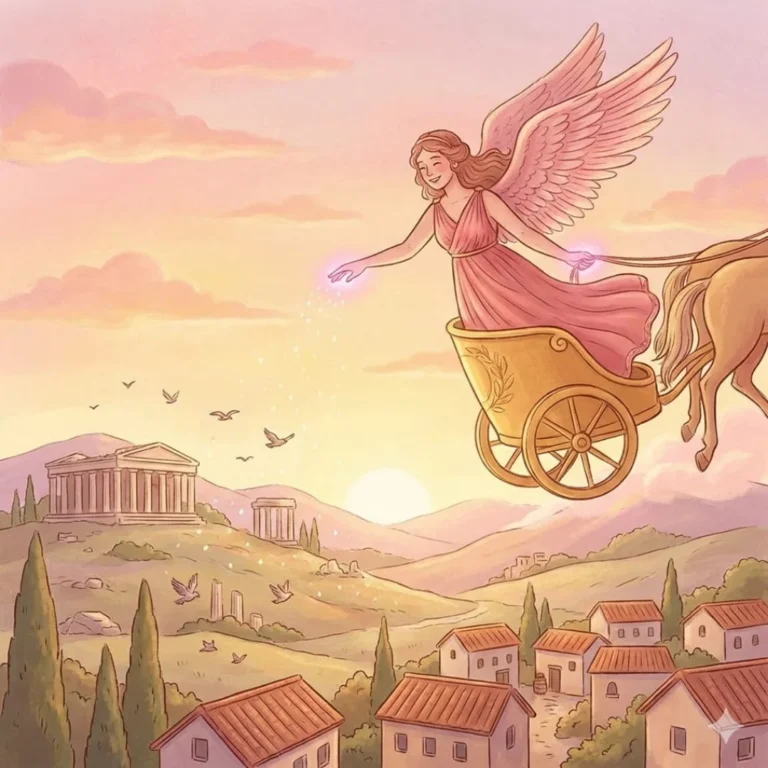
Once upon a time, in a realm where the sky kissed the sea in a magnificent ballet of colors, lived Eos, the Dawn. She was as cherished by the early Greeks as her brother Helios, the illustrious Sun. Eos possessed a magical chariot, akin to Helios’, which she guided across the vast horizon each morning and evening. With every journey, she painted the sky in hues of pink and orange, heralding the day’s arrival and its gentle departure.
Eos was not just the embodiment of the rosy morn but also of twilight’s serene embrace. Her palace, a grand edifice, stood in the west on a mystical island called Ææa. It was enveloped by meadows bursting with vibrant flowers and lush, velvet-like lawns. Here, nymphs and other immortal beings danced gracefully, accompanied by sweet, lilting melodies that filled the air.
Eos herself was a vision of beauty. Poets often described her as a maiden with rosy arms and delicate fingers, adorned with large wings that shimmered in ever-changing hues. A star sparkled on her forehead, and she carried a torch that illuminated the path for her brother, the sun-god. Draped in the rich folds of her violet-tinged mantle, she rose before dawn each day, yoking her two spirited horses, Lampetus and Phaethon, to her glorious chariot.
One particular morning, as Eos prepared to greet the day, she noticed a storm gathering on the horizon. Her heart trembled with concern. “My loyal steeds,” she murmured, her voice tinged with unease, “we must brace ourselves for the tempest ahead.”
Lampetus and Phaethon snorted, their hooves pawing the ground with determination. Together, they soared into the sky, and Eos unfurled the gates of heaven, allowing the first rays of sunlight to cascade through. The winds howled around them, but Eos held firm, her heart pounding with adrenaline. The storm raged, threatening to tear her chariot asunder, and for a moment, fear gripped her. But with a deep breath and unwavering resolve, she guided her steeds through the chaos, her spirit as indomitable as the dawn she heralded.
As she passed, tender plants and flowers, revived by the morning dew, lifted their heads to greet her. Their petals glistened like jewels in the soft light. The world awoke with a gentle sigh, grateful for the new day Eos had bestowed, despite the storm’s fury.
One fateful day, as Eos descended from the sky, her eyes fell upon a striking figure who captivated her heart. It was Tithonus, son of Laomedon, the king of Troy. His beauty was unparalleled, and Eos felt her heart flutter, a warmth spreading through her chest.
“Fair Eos,” Tithonus called, his voice as warm and inviting as the sun. “Your presence brightens the world even before your brother Helios rises.”
Eos blushed, her cheeks mirroring the pink hues of the dawn she painted. “And your words warm my heart, dear Tithonus,” she replied, her eyes sparkling with affection.
Their encounters became frequent, and soon, Eos found herself deeply in love with Tithonus. Fearing the day they might be separated by death, she sought the favor of Zeus, the king of the gods.
“Great Zeus,” she implored, her voice earnest and filled with hope. “Grant Tithonus the gift of immortality, so we may be together forever.”
Zeus, with a thoughtful nod, agreed. “Immortality he shall have,” he declared, his voice resonating like thunder across the heavens.
Eos was overjoyed, and she and Tithonus spent many blissful years together. Yet, in her excitement, Eos had overlooked one crucial detail—she had not asked for eternal youth for her beloved. As time passed, Tithonus began to age. His once vibrant features grew lined and weary, his movements slow and labored.
“Eos,” Tithonus said one day, his voice now a frail whisper. “Why do the years weigh so heavily on me, while you remain as radiant as ever?”
Eos, her heart heavy with regret, took his hands in hers. “Oh, Tithonus,” she sighed, tears glistening in her eyes like dew on morning grass. “I wished for you to live forever, but I forgot to ask for your youth to remain.”
As Tithonus continued to age, he grew weary of his endless existence. His once strong voice faded to a weak quaver, and he longed for release from his unending days.
“Eos,” he pleaded one evening as twilight descended. “I can bear this no longer. Let me rest.”
Eos, her heart aching with love and pity, embraced him gently. “I cannot grant you death, my dear Tithonus,” she said softly. “But I can offer you a different kind of freedom.”
Summoning her divine powers, Eos transformed Tithonus into a grasshopper. As the change swept over him, Tithonus felt himself grow lighter, his burdens lifted. He chirped, a sound as constant as the babble of old age, echoing through the fields where he now resided.
Eos watched him, a mix of sadness and relief washing over her. Though they could no longer be together as before, she visited him often, her presence a comforting warmth in his new life.
And so, the world continued to turn, with Eos painting the skies each day, her heart forever touched by the love she had known. As the dawn broke and the twilight descended, her chariot rode across the heavens, a symbol of hope and renewal for all who looked up to the sky.
And somewhere, in a meadow filled with flowers, a little grasshopper chirped, his voice a testament to a love that transcended time and form, echoing with the promise of new beginnings.
Frequently Asked Questions
What is the moral lesson of Eos: The Rosy-Fingered Dawn?
What age is this story appropriate for?
How long does it take to read Eos: The Rosy-Fingered Dawn?
What culture does this story come from?
Can I use this story for teaching?
Frequently Asked Questions
Who is Eos the goddess of dawn in Greek mythology?
Eos is the ancient Greek goddess of dawn who painted the sky pink and orange each morning with her magical chariot. She was sister to Helios, the sun god, and was described as a beautiful maiden with rosy arms, large shimmering wings, and a star on her forehead. She lived in a grand palace on the mystical island of Ææa.
What life lessons can kids learn from the story of Eos the rosy-fingered dawn?
The story of Eos teaches children valuable lessons about responsibility, consistency, and the beauty of nature. Like Eos faithfully guiding her chariot every morning and evening, kids learn the importance of showing up and fulfilling their duties. The tale also encourages appreciation for the natural world and the magical transitions between day and night.
What were the names of Eos’s horses that pulled her chariot?
Eos’s two spirited horses were named Lampetus and Phaethon. She yoked them to her glorious chariot each day before dawn, riding across the horizon to herald the arrival of morning and light the path for her brother, the sun god Helios.
📚 Recommended Books
Handpicked for readers like you
As an Amazon Associate, we earn from qualifying purchases. These recommendations are personalized based on this story's themes and your reading history.
Why was Eos called rosy-fingered dawn?
Eos was called rosy-fingered dawn because ancient Greek poets described her as having rosy arms and delicate fingers that symbolized the soft pink and orange colors she painted across the sky each morning. This poetic imagery beautifully captured how the first light of dawn gradually spreads across the horizon in warm, rosy hues.
What age group is the Eos dawn story suitable for?
The story of Eos: The Rosy-Fingered Dawn is designed as a bedtime story for children ages 6 to 12. It blends Greek mythology with meaningful life lessons in language that is engaging and accessible for early readers while still being rich and imaginative enough to captivate older kids.