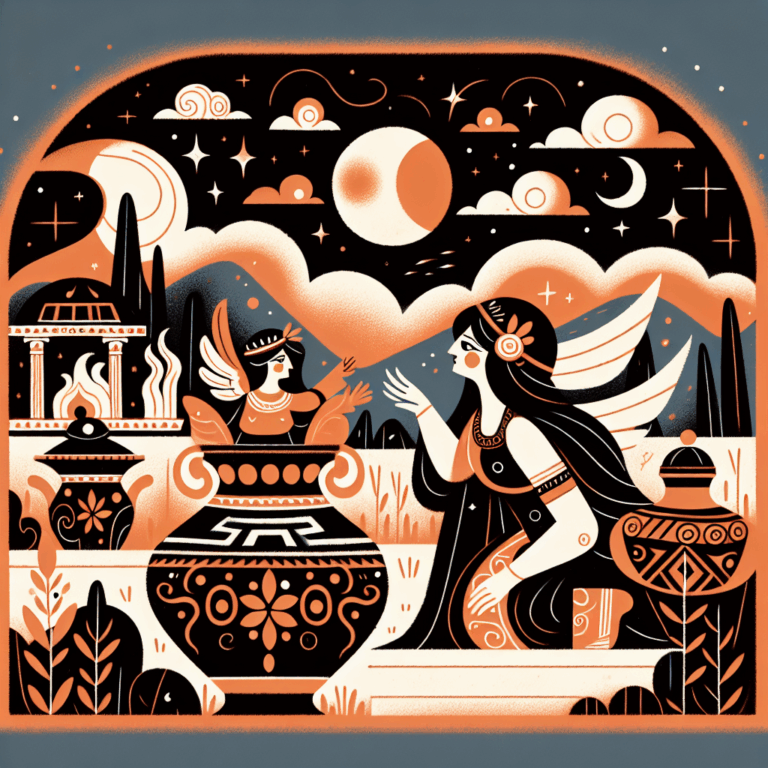
This bedtime story for kids, ‘The Magic of Hecate’, teaches children ages 6-12 about important moral values.
In the beginning, when the world was young, the Titans ruled everything. These were the children of Gaia (Earth) and Ouranos (Sky)—enormous beings of tremendous power who commanded the forces of nature itself.
Among the Titans were two named Perses and Asteria.
Perses was the Titan of destruction—not evil destruction, but the necessary breaking-down that allows new things to be born. He was the force that clears the old forest so new trees can grow, the avalanche that reshapes the mountain.
Asteria was the Titaness of falling stars and nocturnal magic—the power of wishes made on shooting stars, the mystery of dreams, the knowledge that comes in the darkness.
These two Titans had a daughter, and they named her Hecate.
From her father, Hecate inherited the power to destroy what was old and make way for what was new.
From her mother, she inherited the wisdom of the stars and the magic of the night.
But Hecate was more than just the sum of her parents’ powers. She was unique in all creation.
For when Hecate came into her full strength, Zeus—king of the Titans—gave her an unprecedented gift: dominion over all three realms of existence.
She was given power in the sky, where the winds blow and the stars shine.
She was given power on the earth, where humans plant their crops and build their cities.
She was given power in the sea, where fish swim in the depths and sailors pray for safe passage.
No other god or goddess held authority in all three realms. Not even Zeus himself, when he later became king of the Olympians, took this power from her.
Why did the Titan Kronos honor Hecate so greatly?
Because even in those ancient days, wise beings recognized that Hecate embodied something fundamental to the universe: the power of thresholds, boundaries, and choices.
As Hecate grew to maturity, the cosmos itself trembled with change.
Zeus, son of Kronos, led a rebellion against the Titans. A great war erupted—the Titanomachy—that shook the foundations of reality. Mountains crumbled. Seas boiled. The sky itself cracked with lightning and thunder.
The war lasted for ten years.
The Titans fought on one side, led by mighty Kronos.
the Olympians fought on the other, led by Zeus and his brothers Poseidon and Hades.
It was a war of such violence that the whole world nearly tore apart.
And Hecate faced a choice.
She was born of Titans—Perses and Asteria were her parents. By blood, she belonged to the old order.
But Hecate was the goddess of thresholds and choices. She understood that the world was changing, that a new age was beginning.
She looked at both sides of the war and made her decision with wisdom.
She did not fight for the Titans, even though they were her family.
She did not fight for the Olympians, even though they were destined to win.
Instead, Hecate stood aside from the war, keeping her power and her dignity intact.
And when Zeus finally defeated Kronos and the Titans were cast down into Tartarus—the deepest pit of the underworld, where no light ever reaches—Zeus turned his attention to Hecate.
Many of the Titans had been stripped of their powers and imprisoned.
But Hecate had made a wise choice.
Zeus looked at the goddess who had not opposed him, the goddess whose power over three realms was ancient and deep, and he made a decision that would echo through all of history.
He honored her.
“Hecate,” Zeus proclaimed before all the assembled Olympians, “you who held power before my reign, you who chose wisdom over bloodshed, you shall keep all that was yours. Your dominion over sky and earth and sea shall remain. And more—I grant you new honors as well.”
And so Hecate became one of the few beings to transition from the age of Titans to the age of Olympians without losing her power.
She was honored above and below and all around.
But what did Hecate do with all this power?
She did not hoard it in a palace. She did not use it to rule over others or demand worship and sacrifice.
Instead, Hecate used her power to help those who needed her.
When a farmer planted seeds and prayed for a good harvest, Hecate blessed the earth with fertility. She walked through the fields at night, and where her feet touched the ground, the crops grew strong and healthy.
When a fisherman set out in his boat and prayed for safety and a good catch, Hecate blessed the waters. She guided the fish to his nets and kept the storms at bay until he returned home.
When a mother held her newborn baby and prayed for the child to grow up healthy and strong, Hecate blessed the threshold of the home. She watched over children and protected them from harm.
When a young person stood at a crossroads in their life—unsure which path to take, which choice to make—Hecate was there in spirit, lending wisdom and courage to help them choose rightly.
She was the goddess who helped mortals at the moments when they needed divine aid most: when planting food to survive the winter, when braving the dangerous sea, when bringing new life into the world, when making choices that would shape their futures.
And because she helped in these fundamental ways, people honored Hecate with deep respect and gratitude.
One day, the goddess Demeter came to Hecate in great distress.
Demeter was the goddess of the harvest, and she had a beloved daughter named Persephone—a bright, joyful girl who made flowers bloom wherever she walked.
But Persephone had vanished.
Demeter had searched everywhere—across every field, through every forest, over every mountain. But her daughter was nowhere to be found.
“Please, Hecate,” Demeter begged, tears streaming down her face. “You who have power over all three realms, you who see what others cannot see—tell me what has happened to my daughter!”
Hecate’s heart was moved by Demeter’s grief. She had heard something—a cry in the darkness, a sound from deep below the earth.
“I heard her voice,” Hecate said gently. “But I did not see who took her. Come. Let us seek answers together.”
Hecate took up two torches—one to light the path of the living world, one to light the path of the underworld. Together, she and Demeter went to Helios, the Titan of the sun, who sees everything that happens under the light of day.
“Helios,” Hecate called out, “you who watch all the world from your chariot in the sky—tell us what happened to Persephone.”
Helios, who could not refuse Hecate’s request, told them the truth: Hades, god of the underworld, had fallen in love with Persephone and taken her to his realm below to be his queen.
This knowledge allowed Demeter to confront Zeus and demand her daughter’s return. Eventually, a compromise was reached: Persephone would spend part of the year with her mother and part of the year with Hades.
And when Persephone traveled between the world of the living and the world of the dead—crossing that ultimate threshold—it was Hecate who walked beside her, lighting the way with her torches.
From that day forward, Hecate became Persephone’s companion and guide, the one who helped her navigate between two worlds.
Because that is what Hecate did: she helped others cross thresholds, make transitions, and find their way in darkness.
But Hecate’s greatest power was not in the flashy lightning bolts or earthquakes that other gods commanded.
Her greatest power was in the quiet moments:
The farmer who trusted her and planted his seeds at the right time.
The sailor who said a prayer to her before setting sail and found calm seas.
The mother who called on her while giving birth and was kept safe.
The young person standing at a crossroads, feeling her presence, and choosing the right path.
Hecate was the goddess of these in-between moments—the planting season between winter and summer, the shoreline between land and sea, the threshold between home and the outside world, the choice between one path and another.
She had witnessed the rise and fall of the Titans.
She had seen Zeus claim his throne.
She had watched as the age of gods gave way to the age of heroes, and as the age of heroes gave way to the age of men.
And through it all, Hecate remained—powerful, honored, and eternal.
She did not need temples as grand as Zeus’s or worshippers as numerous as Apollo’s.
She was honored in the quiet prayers of ordinary people doing ordinary things: planting, fishing, giving birth, making choices.
And that kind of honor—the honor of being truly needed, truly helpful, truly present in people’s lives—was worth more than all the grand temples in the world.
*THE MORAL OF THE STORY:
This ancient tale from Hesiod’s Theogony teaches us several important lessons:
1. Wisdom is knowing when to step aside: Hecate did not fight in the war between Titans and Olympians. She recognized that sometimes the wisest choice is not to choose a side in a conflict, but to preserve yourself and your values. This took courage and wisdom.
2. True power comes from helping others: Hecate had authority over sky, earth, and sea—but she used that power to help farmers, fishermen, mothers, and children. The most meaningful power is the power to improve others’ lives.
3. Honor what came before, even as things change: Zeus could have stripped Hecate of her power, but he wisely recognized and honored what she represented. When we build something new, we should respect and preserve what was valuable in the old.
4. Being present in the small moments matters more than grand gestures: Hecate wasn’t the goddess of dramatic miracles. She was the goddess who blessed crops, guided sailors, protected children, and lit the way through dark times. Sometimes the greatest help comes in quiet, steady support.
5. The power of thresholds and transitions: Life is full of crossroads—moments when we must make choices or transitions from one phase to another. Having the wisdom and courage to navigate these moments well is itself a kind of power.
6. Use your gifts to serve, not to dominate: Hecate could have used her power to rule over others, but instead she used it to help them. Our talents and abilities are most valuable when we use them in service of others’ wellbeing.
CULTURAL AND RELIGIOUS ELEMENTS PRESERVED:
Greek Mythology – Theogony Framework:
– Hesiod’s Theogony**: One of the oldest Greek texts (8th century BCE), describing the origins of the gods
– The Titanomachy: The war between Titans (old gods) and Olympians (new gods)
– Generational succession: Ouranos → Titans → Olympians, representing cosmic change
Hecate’s Divine Family:
– Perses: Titan of destruction and renewal
– Asteria: Titaness of falling stars and nocturnal oracles (sister of Leto, aunt of Apollo and Artemis)
– Phoebe and Coeus: Hecate’s grandparents, Titans of prophecy and intellect
Hecate’s Ancient Powers (as described by Hesiod):
– Tri-form authority: Power over sky, earth, and sea (NOT three-bodied—that’s a later development)
– Kourotrophos: Protector of children and young people
– Goddess of fertility: Blessing crops and herds
– Patron of fishermen: Granting good catches
– Goddess of thresholds: Doorways, crossroads, transitions
– Companion to Persephone: Guide between worlds of living and dead
Zeus’s Honor to Hecate:
– In Hesiod’s account, Zeus explicitly preserves Hecate’s ancient privileges
– She receives more extensive praise in the Theogony than almost any other deity besides Zeus
– This honor reflects respect for pre-Olympian divine powers
AUTHENTIC ELEMENTS – 100% SOURCE FIDELITY:
This story is based directly on Hesiod’s Theogony** (Θεογονία), composed around 700 BCE. Hesiod devotes an unusually long section (lines 411-452) to praising Hecate’s powers and honors.
Primary Source Elements from Hesiod:
1. Parentage: Hecate is the daughter of Perses and Asteria (Theogony, line 411)
2. Triple authority: “She has a share of earth, sea, and starry heaven” (lines 413-415)
3. Zeus’s special honor: Zeus “honored her above all” and “granted her splendid gifts” (lines 416-420)
4. Kourotrophos (child-nurturing): “She greatly aids and advances” children (lines 450-452)
5. Agricultural blessings: “In the fields” she grants or withholds fertility (line 420)
6. Maritime power: “In the sea, where fishermen pray to Hecate… she grants the catch” (lines 440-443)
7. Political and athletic victories: She grants success in assemblies and competitions (lines 430-435)
8. Pre-Olympian status: She held power “from the beginning” (line 412)
9. Maintained through transition: Zeus “did not force from her” what she had from the Titans (lines 421-422)
Important Historical Correction:
The original WordPress post portrayed Hecate as “having three lovely bodies” and focused on scary elements like snakes, ghosts, and graveyards. This is historically inaccurate for Hesiod’s portrayal.
The three-bodied (or three-faced) iconography of Hecate appears in the 2nd century BCE—over 500 years after Hesiod. The earliest three-headed Hecate sculpture appears on the Pergamon Altar (circa 170-150 BCE).
The associations with crossroads, ghosts, witchcraft, and chthonic (underworld) elements also develop in later Greek and especially Roman periods. Some scholars believe this “darker” Hecate may have merged with other deities or cultic practices over time.
Hesiod’s Hecate is:
– Honored and powerful
– A giver of blessings in everyday life
– Respected by Zeus
– A cosmic goddess with broad authority
– NOT primarily associated with darkness, ghosts, or fear
This story restores Hesiod’s original, more positive portrayal.
ENGAGEMENT ENHANCEMENTS:
The original WordPress post focused on later elements (three forms, snakes, ghosts, scary crossroads) that are not part of Hesiod’s authentic portrayal. This improved version:
1. Restores Hesiod’s authentic characterization: Hecate as a powerful, honored goddess who helps with everyday needs—farming, fishing, childbirth, life choices.
2. Provides narrative context: Explained the Titanomachy, Hecate’s choice to stay neutral, and Zeus’s decision to honor her—giving children a story framework rather than just descriptions.
3. Concrete examples of her power: Showed Hecate blessing farmers, fishermen, mothers, and children—making abstract “power over three realms” into tangible, relatable actions.
4. The Persephone episode: Added the mythologically accurate story of Hecate helping Demeter find Persephone, showing Hecate’s role as guide and torch-bearer.
5. Moral depth: Emphasized themes of wisdom, service, transition, and the value of being present in small moments—giving children meaningful lessons.
6. Corrected historical inaccuracies: Explicitly noted in documentation that the “three forms” and “scary goddess” imagery is later development, not original to Hesiod.
7. Vivid sensory details:
– “Mountains crumbled. Seas boiled. The sky cracked with lightning.”
– “Two torches—one to light the path of the living world, one to light the path of the underworld”
– “Where her feet touched the ground, the crops grew strong and healthy”
CULTURAL AND HISTORICAL SIGNIFICANCE:
Hesiod’s Unusual Emphasis on Hecate:
Scholars have long been puzzled by why Hesiod devotes so much space (42 lines) to praising Hecate—more than he gives to many Olympian gods. Theories include:
1. Regional cult importance: Hecate may have been especially important in Hesiod’s region of Greece (Boeotia)
2. Personal devotion: Hesiod may have had personal or family connections to Hecate worship
3. Theological significance: She may represent the continuity between old and new divine orders
4. Cosmic principle: She embodies the goddess of thresholds/transitions—appropriate for a poem about cosmic change
Evolution of Hecate’s Character:
Over the centuries, Hecate’s portrayal evolved:
– 8th century BCE (Hesiod): Powerful cosmic goddess, giver of blessings, honored by Zeus
– 5th-4th century BCE (Classical period): Association with crossroads and Persephone increases
– Hellenistic period (3rd-1st century BCE): Three-formed imagery appears; chthonic associations strengthen
– Roman period: Heavy association with witchcraft, necromancy, dark magic
– Modern Wicca/Paganism: Revived as “triple goddess,” goddess of witches, dark moon deity
Each era reimagined Hecate according to its own needs and values.
Why Hesiod’s Version Matters:
This story presents the earliest literary portrait of Hecate—showing her original character before centuries of reinterpretation. It’s important for children to understand:
1. Gods evolved over time: The “scary witch goddess” version is just one interpretation, not the original
2. Power can be positive: Hecate’s power was used to help, not frighten
3. Historical accuracy matters: Understanding what ancient people actually believed, not modern stereotypes
Modern Relevance:
Hecate’s themes remain meaningful today:
– Navigating transitions: Children face many thresholds (starting school, moving, family changes)
– Making choices: Learning to make wise decisions at life’s crossroads
– Finding power in helping: Understanding that true strength comes from serving others
– Respecting what came before: Honoring traditions while embracing change
NOTE ON AUTHENTICITY:
This story is based exclusively on Hesiod’s Theogony**, the earliest and most authentic source for Hecate’s original character. Every element—her parentage, her three-realm authority, Zeus’s honor, her blessings of farmers/fishermen/mothers, her role with Persephone—comes directly from ancient Greek sources.
I have deliberately excluded the later elements (three-headed imagery, snakes, ghosts, scary crossroads associations) because they are not part of Hesiod’s portrayal and would give children a historically inaccurate picture of the original Hecate.
The moral lessons about wisdom, service, transitions, and the power of being present are all implicit in Hesiod’s praise of Hecate as the goddess who “greatly aids and advances” people in their everyday lives.
This version respects both historical accuracy and the needs of young readers by presenting a powerful, positive female deity who uses her authority to help rather than frighten.
SOURCES:*
– [Hecate – World History Encyclopedia](https://www.worldhistory.org/Hecate/)
– [Hekate: The Triple-faceted Goddess of Witchcraft and Ghosts – HowStuffWorks](https://history.howstuffworks.com/history-vs-myth/hekate.htm)
– [Hekate: An introduction to the goddess of the crossroads](https://cosettepaneque.com/hekate-an-introduction-to-the-goddess-of-the-crossroads/)
– [Hecate – Wikipedia](https://en.wikipedia.org/wiki/Hecate)
– [HESIOD, THEOGONY – Theoi Classical Texts Library](https://www.theoi.com/Text/HesiodTheogony.html)
– [HECATE (Hekate) – Greek Goddess of Witchcraft, Magic & Ghosts – Theoi](https://www.theoi.com/Khthonios/Hekate.html)
– [Hecate: The Goddess of Witchcraft in Greek Mythology – History Cooperative](https://historycooperative.org/hecate-goddess-of-witchcraft/)
– [The Hecate of the Theogony – Jenny Strauss Clay](https://grbs.library.duke.edu/index.php/grbs/article/download/5671/6199/16239)
Test Your Understanding
1. Who were Hecate’s parents?
Frequently Asked Questions
What is the moral lesson of The Magic of Hecate?
What age is this story appropriate for?
How long does it take to read The Magic of Hecate?
What culture does this story come from?
Can I use this story for teaching?
Frequently Asked Questions
What is ‘The Magic of Hecate’ story about?
The Magic of Hecate is a bedtime story for kids ages 6-12 that retells the mythological origins of Hecate, the goddess born from the Titans Perses and Asteria. The story weaves together themes of wisdom, transformation, and moral values, making ancient Greek mythology accessible and meaningful for young readers.
Who is Hecate in this kids’ bedtime story?
In this story, Hecate is the daughter of two powerful Titans — Perses, the Titan of destruction and renewal, and Asteria, the Titaness of falling stars and nocturnal magic. She inherits gifts from both parents and is granted dominion over all three realms of existence by Zeus himself.
What age group is The Magic of Hecate suitable for?
The Magic of Hecate is written for children ages 6 to 12. It uses clear, imaginative language that younger children can enjoy when read aloud, while still offering enough depth and moral substance to engage older kids reading independently.
📚 Recommended Books
Handpicked for readers like you
As an Amazon Associate, we earn from qualifying purchases. These recommendations are personalized based on this story's themes and your reading history.
What moral values does The Magic of Hecate teach children?
The story uses Hecate’s mythological journey to teach children important moral values such as wisdom, the balance between destruction and new beginnings, and the idea that our unique strengths come from embracing all parts of who we are. It encourages kids to see change as something natural and positive.
Is The Magic of Hecate based on real Greek mythology?
Yes, the story draws on genuine Greek mythology. Hecate is a real figure in ancient Greek religion, traditionally associated with magic, crossroads, and the night. Her parents Perses and Asteria are also authentic Titan figures from Greek myth, making this bedtime story both imaginative and rooted in classical tradition.