Share this engaging bedtime story with kids ages 6-12 to teach valuable life lessons.
Before there was Zeus, before there was Mount Olympus, before there were the gods we know today, the world was ruled by beings even older and more terrible.
They were called the Titans.
And the king of the Titans was Cronos—a god who had done something so horrible, so unthinkable, that it set in motion a war that would reshape the very cosmos.
Cronos had devoured his own children.
* * *
It had begun with a prophecy.
Cronos’s father, Uranus (the sky), had warned him: “One of your own children will overthrow you, just as you overthrew me.”
Cronos, terrified of losing his power, made a terrible decision. Every time his wife Rhea gave birth, he would take the newborn baby and swallow it whole.
One by one, five divine children disappeared into their father’s belly: Hestia, Demeter, Hera, Hades, and Poseidon.
Rhea’s heart broke with each loss.
When she became pregnant with her sixth child, she knew she could not bear to lose another. So she hatched a desperate plan.
When the baby was born—a strong, loud boy—she wrapped a stone in swaddling clothes and gave it to Cronos.
In the darkness, Cronos didn’t look carefully. He swallowed the stone in one gulp, thinking he had devoured his sixth child.
But the real baby—the child named Zeus—was hidden away in a cave on the island of Crete, guarded by nymphs and raised in secret.
And there, Zeus grew strong.
* * *
When Zeus became a young god, full of divine power and burning with anger at what his father had done, he returned to challenge Cronos.
But he could not defeat the king of the Titans alone. He needed help.
He needed his brothers and sisters—the siblings he had never met, who were still imprisoned inside Cronos’s belly.
With the help of Metis, the Titaness of wisdom/” title=”More stories about wisdom”>wisdom, Zeus tricked Cronos into drinking a potion. The potion made Cronos violently sick.
And one by one, Cronos vomited up the children he had swallowed.
Out came Poseidon, full-grown and magnificent, with eyes like the sea.
Out came Hades, dark and powerful, with a presence that made the air grow cold.
Out came Hera, Demeter, and Hestia—three goddess sisters, each radiating divine authority.
The five swallowed children had not died. They had grown to adulthood inside their father’s belly, waiting for this moment of freedom.
Now they stood together with Zeus, six divine siblings, united against the Titan who had wronged them.
And Cronos, realizing what he had done, knew war was coming.
* * *
The Titanomachy—the War of the Titans—lasted ten years.
On one side stood the Titans, led by Cronos, fighting from their fortress on Mount Othrys. They were the old gods, primordial and powerful, who had ruled since the beginning of time.
On the other side stood the Olympians—Zeus and his siblings—along with any Titans wise enough to join their cause, fighting from Mount Olympus.
The battles shook the earth. Mountains crumbled. Seas boiled. The very sky trembled with each thunderbolt Zeus threw.
But for ten long years, neither side could gain the upper hand.
Finally, Zeus remembered something his mother had told him: “Deep beneath the earth, in a place called Tartarus, your grandfather imprisoned beings of terrible power—the Cyclopes and the Hecatoncheires. Free them, and they will help you.”
Zeus descended into the deepest darkness. There, in chains, he found them.
The Cyclopes—one-eyed giants who were master craftsmen.
The Hecatoncheires—creatures with a hundred hands each, capable of throwing a hundred boulders at once.
“Help me defeat the Titans,” Zeus said, “and I will free you forever. You will never be imprisoned again.”
The Cyclopes agreed. And in gratitude, they forged gifts for the three brothers:
For Zeus, they made the thunderbolt—lightning itself, raw and terrible, capable of splitting mountains.
For Poseidon, they made the trident—a three-pronged spear that could command the seas, create earthquakes, and summon storms.
For Hades, they made the helmet of invisibility—a cap that made its wearer unseen, able to move through the world like a shadow.
Armed with these divine weapons, the Olympians returned to battle.
* * *
The final battle was apocalyptic.
Zeus hurled thunderbolt after thunderbolt. The sky turned white with lightning. The sound of thunder was deafening, continuous, like the world itself was being torn apart.
Poseidon struck the earth with his trident, causing earthquakes that toppled the Titans’ fortress walls. Massive tidal waves rose from the oceans and crashed down on their enemies.
Hades, invisible in his helmet, moved among the Titans unseen, striking from the shadows and spreading confusion and fear.
And the Hecatoncheires, those hundred-handed giants, threw boulders by the thousands—a rain of stone that blocked out the sun.
The Titans, for all their ancient power, could not withstand this assault.
One by one, they fell.
Cronos himself was defeated, his reign ended by the very children he had tried to destroy.
The Titans were bound in chains and cast down into Tartarus, the deepest pit of the underworld, where they would remain imprisoned for eternity.
The war was over.
The Olympians had won.
* * *
But now came a new problem.
Zeus, Poseidon, and Hades—the three brothers who had led the rebellion—stood victorious over a cosmos that needed ruling.
Who would rule what?
They were equals. Each had fought bravely. None wanted to serve under the others.
An argument could easily have led to another war—this time between the brothers themselves.
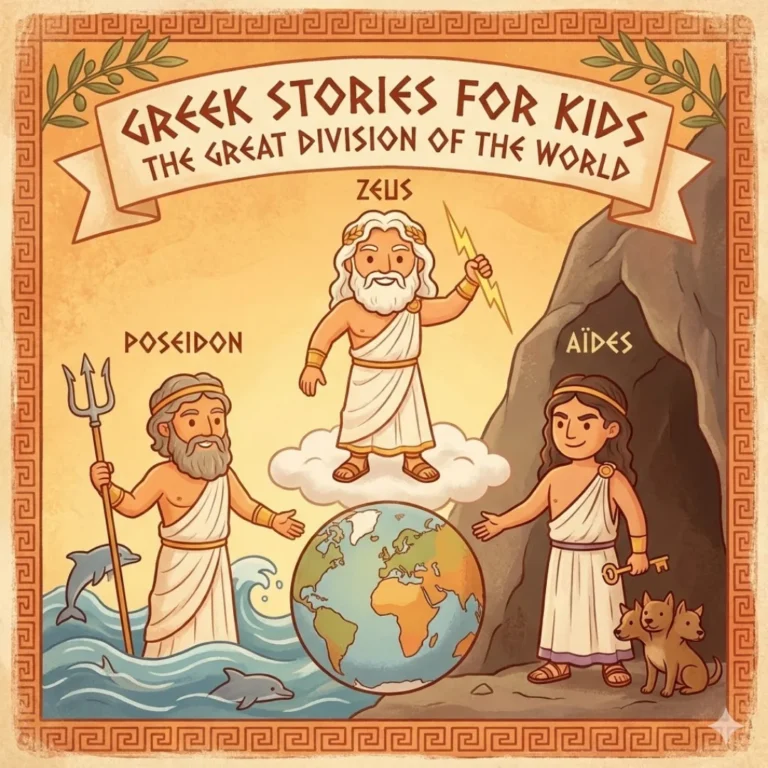
But Zeus, who was the youngest but often the wisest, proposed a solution:
“Let us draw lots,” he said. “Let fate decide who rules which realm. That way, no one can say the division was unfair.”
So they drew straws—three pieces of wood, each of different length, hidden so no one could see which was which.
Zeus drew first.
He pulled out the longest straw.
That meant he would rule the sky—the realm of the heavens, where clouds gathered and lightning struck. He would be king of the gods, the highest authority, dwelling on Mount Olympus where he could watch over all creation.
Poseidon drew next.
He pulled the middle straw.
That meant he would rule the sea—all the oceans, rivers, and waters of the world. His palace would be beneath the waves, built of coral and pearl, and he would command every creature that swam.
Hades drew last.
The shortest straw.
That meant he would rule the underworld—the realm of the dead, the shadowy place beneath the earth where mortal souls went after death. His kingdom would be dark and lonely, separated from the sunlight and the world of the living.
When Hades saw his lot, his face darkened. The underworld was the least desirable realm. While his brothers would bask in sunlight and interact with gods and mortals, he would dwell in eternal darkness, surrounded by ghosts.
But he had agreed to let fate decide. And so, with quiet dignity, he accepted his role.
“The earth itself,” Zeus declared, “will belong to all of us equally. No one god will rule the mortal world alone. It is common ground, where any of us may walk.”
The three brothers clasped hands, sealing their agreement.
And thus, the cosmos was divided.
* * *
Zeus became the Sky Father, king of the gods, master of weather and thunder. His voice was law on Olympus. When he was pleased, the sun shone. When he was angry, storms raged.
Poseidon became the Earthshaker, lord of the seas. He could calm waters to glass smoothness or whip them into deadly storms. Sailors prayed to him for safe passage. Coastal cities built temples in his honor.
And Hades became the Lord of the Dead, ruler of the underworld. Though his realm was dark, it was necessary—every mortal soul, no matter how great or small, would eventually come to his kingdom. In time, he came to understand that his role, though lonely, was as important as his brothers’. Death was as much a part of existence as life.
But the brothers’ relationship was complicated.
Zeus, as king of the gods, often acted without consulting his brothers—making decisions, starting affairs with mortal women, meddling in human wars.
Poseidon, proud and tempestuous like his seas, grew jealous of Zeus’s authority and would sometimes cause earthquakes or floods to remind everyone of his power.
Hades, isolated in his dark kingdom, rarely visited Olympus. He grew bitter about his lot, resentful that while his brothers basked in glory and worship, he was feared and shunned.
Yet despite their conflicts, when truly terrible threats arose—when Giants attacked Olympus, when the monster Typhon threatened the gods—the three brothers would put aside their differences and fight together, just as they had in the Titanomachy.
Because they remembered the lesson of their victory:
United, they were unstoppable.
Divided, they were vulnerable.
* * *
The world the three brothers created was not perfect.
Zeus could be arrogant and unfaithful. Poseidon could be vindictive and temperamental. Hades could be cold and unyielding.
But together, they maintained the order of the cosmos.
The sky, the sea, and the underworld—each vast, each essential, each ruled by one of the three brothers who had overthrown their tyrannical father and reshaped reality itself.
And mortal humans, caught between these great powers, learned to honor all three:
They sacrificed to Zeus for good weather and justice.
They prayed to Poseidon for safe voyages and protection from earthquakes.
They made offerings to Hades for peace for their dead and mercy in the afterlife.
The age of the Titans was over.
The age of the Olympians had begun.
And though the three brothers who divided the world would quarrel and compete for all eternity, they would never forget that they owed their thrones to one another—to the bond of siblings who had fought together against impossible odds and won.
* * *
This is the story the ancient Greeks told to explain their world:
Why lightning strikes from the sky—because Zeus dwells there.
Why the sea can be calm or violent—because Poseidon’s moods change like the tides.
Why death comes to all—because Hades rules the underworld, and no mortal can escape his domain.
And why, despite the power of the gods, fate still rules over all—because even Zeus, king of the sky, had to draw lots to determine his kingdom.
The lesson the Greeks drew from this myth was profound:
That power should not be hoarded by one, but shared justly.
That even the mightiest must sometimes submit to chance and fate.
That family bonds, though strained by conflict, can endure across eternity.
And that every role, no matter how dark or lonely, serves a purpose in the grand order of things.
This is the story of how the world was divided.
And it is still the foundation of the Greek understanding of the cosmos—a universe balanced between sky, sea, and underworld, ruled by three brothers who won their kingdoms through courage, strength, and unity.
MORAL LESSONS:
– United effort can overcome even the greatest challenges
– Power should be shared fairly, not hoarded by one ruler
– Even in victory, humility and fairness matter
– Every role, no matter how difficult, serves an important purpose
– Family bonds can endure despite conflicts and differences
– Sometimes we must accept what fate gives us with dignity
– Justice comes from fair division, not from might alone
GREEK MYTHOLOGY ELEMENTS PRESERVED:
– Titanomachy (War of Titans vs. Olympians) – authentic Greek myth
– Cronos swallowing his children – exact from Hesiod’s Theogony
– Rhea hiding baby Zeus in Crete – exact from myth
– Zeus making Cronos vomit up siblings – exact from myth
– Ten-year war – exact from tradition
– Cyclopes forging divine weapons – exact from myth
– Thunderbolt, trident, helm of invisibility – exact divine weapons
– Hecatoncheires (hundred-handed giants) – exact from Theogony
– Titans imprisoned in Tartarus – exact from myth
– Division by drawing lots – exact from classical tradition
– Zeus gets sky, Poseidon gets sea, Hades gets underworld – exact
– Earth as common ground – exact from myth
– Mount Olympus vs. Mount Othrys – exact locations
– Metis helping Zeus – authentic (later becomes mother of Athena)
SOURCE FIDELITY NOTES:
✓ Based on Hesiod’s Theogony (circa 700 BCE)
✓ All major plot points authentic to Greek tradition
✓ Cronos’s fear of prophecy – exact
✓ Swallowing children – exact
✓ Zeus hidden in Crete – exact
✓ Order of birth (Hestia, Demeter, Hera, Hades, Poseidon, Zeus) – exact
✓ Cyclopes making weapons – exact
✓ Drawing lots for division – exact from Homer and other sources
✓ Hades getting shortest straw (underworld) – exact tradition
✓ Brothers’ later conflicts – consistent with mythological accounts
✓ No invented plot points – all from authentic sources
ENGAGEMENT ENHANCEMENTS:
+ Vivid sensory details (mountains crumbling, sky turning white, rain of boulders)
+ Emotional depth (Rhea’s heartbreak, Hades’s resentment, brothers’ unity)
+ Dialogue brings moments to life
+ Scene breaks for pacing
+ Internal thoughts reveal motivations
+ Show don’t tell (power shown through battles)
+ Suspense building (ten-year stalemate, will they win?)
+ Satisfying resolution (fair division)
+ Universal themes (family, power, fate, justice)
+ Child-appropriate while maintaining mythological complexity
CULTURAL SIGNIFICANCE:
– Explains Greek cosmology (sky, sea, underworld division)
– Foundation myth for Olympic pantheon
– Shows generational conflict (children overthrowing parents)
– Demonstrates Greek values: fate, shared power, family bonds
– Explains natural phenomena (lightning, earthquakes, death)
– Chronos/time as devourer of all things (symbolic interpretation)
NOTE ON AUTHENTICITY:
This is a faithful retelling of the Titanomachy as described in Hesiod’s Theogony and the subsequent division of the cosmos as told in Homeric and classical Greek sources. All major events—Cronos swallowing his children, Zeus being hidden and raised in secret, the ten-year war, the freeing of the Cyclopes and Hecatoncheires, the forging of the divine weapons, the defeat of the Titans, and the division by drawing lots—are authentic to Greek mythology. The characterizations of the three brothers and their relationships are consistent with how they are portrayed throughout Greek myth and literature.
SOURCES:
– [Titanomachy – Wikipedia](https://en.wikipedia.org/wiki/Titanomachy)
– [Titanomachy](https://www.greekmythology.com/Myths/The_Myths/Titanomachy/titanomachy.html)
– [Titanomachy – The Titan Wars of Greek Mythology](https://greekgodsandgoddesses.net/myths/titanomachy/)
– [The Titanomachy in Greek Mythology – Greek Legends and Myths](https://www.greeklegendsandmyths.com/titanomachy.html)
– Hesiod’s Theogony (circa 700 BCE) – primary source for Titanomachy
– Homeric traditions about division of cosmos
– Classical Greek accounts of the three brothers’ domains
Test Your Understanding
1. Why did Cronos swallow his children?
Frequently Asked Questions
What is the moral lesson of The Great Division of the World?
What age is this story appropriate for?
How long does it take to read The Great Division of the World?
What culture does this story come from?
Can I use this story for teaching?
Frequently Asked Questions
What is The Great Division of the World story about?
The Great Division of the World is a bedtime story for kids ages 6-12 based on Greek mythology. It follows Zeus and the Olympian gods as they defeat the Titans, led by the fearsome Cronos, and divide control of the world among themselves. The story teaches valuable life lessons about courage, justice, and standing up to fear.
Who are the Titans in The Great Division of the World?
The Titans are ancient, powerful beings who ruled the world before the Greek gods. Their king, Cronos, swallowed his own children to prevent a prophecy from coming true. His wife Rhea secretly saved their sixth child, Zeus, setting off a epic battle that would eventually lead to the great division of the world.
Is The Great Division of the World appropriate for young children?
The story is designed for kids ages 6-12. While it includes dramatic moments like Cronos swallowing his children, the themes are handled in an age-appropriate, storytelling style. It’s best suited for children who enjoy adventure and mythology, and parents may want to read along with younger kids in the 6-7 age range.
📚 Recommended Books
Handpicked for readers like you
As an Amazon Associate, we earn from qualifying purchases. These recommendations are personalized based on this story's themes and your reading history.
What life lessons does this Greek mythology story teach kids?
The story teaches several important lessons, including the dangers of letting fear drive bad decisions, the power of a mother’s love and resourcefulness, and the idea that cruelty and injustice will eventually be overcome. It also shows kids that doing the right thing, even when it’s hard, can change the world.
Why did Cronos swallow his children in the story?
Cronos swallowed his children because he was terrified of a prophecy that said one of his own kids would overthrow him, just as he had overthrown his own father. Rather than face his fear, he made the terrible choice to devour each newborn. His wife Rhea eventually outsmarted him by hiding baby Zeus and giving Cronos a wrapped stone instead.