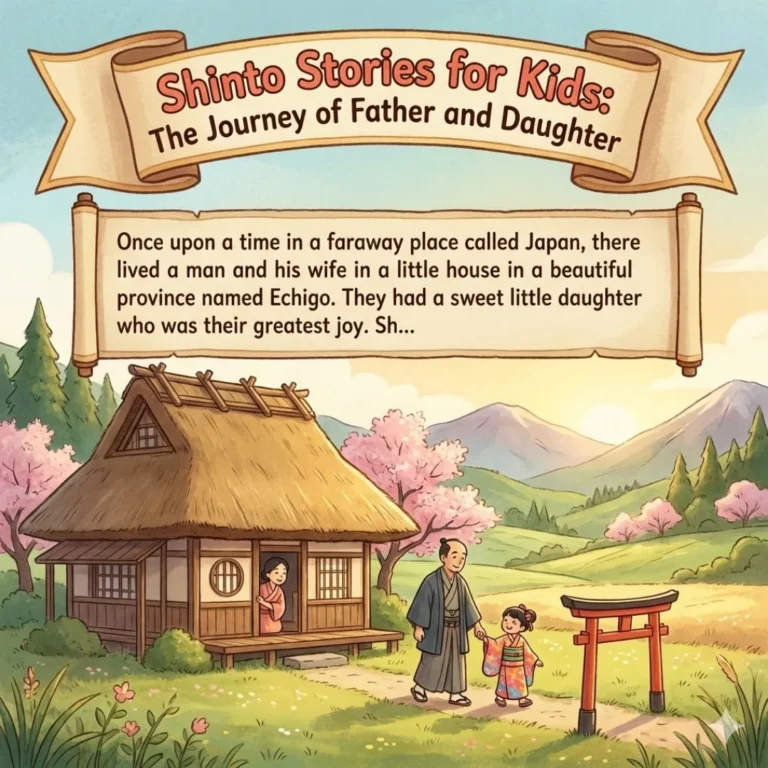
‘The Journey of Father and Daughter’ is an educational moral story perfect for bedtime reading with children ages 6-12.
In the snowy province of Echigo, where mountains touched the sky and rice fields stretched like green seas in summer, there lived a merchant named Tanaka-san, his wife Hana, and their daughter Yuki.
Yuki was seven years old, with bright eyes like winter stars and a laugh that sounded like temple bells. Her name meant “snow,” and like the first snowfall, she brought joy to everyone she met.
Their small wooden house stood at the edge of the village, where the forest began. Every morning, Yuki helped her mother tend their small garden. Every evening, her father came home from his shop in the village, and they would eat dinner together by lamplight, sharing stories of their day.
It was a simple life. A happy life.
But everything was about to change.
* * *
One autumn evening, a messenger arrived at their door carrying an official scroll sealed with red wax.
Tanaka-san opened it with trembling hands. His face grew serious as he read.
“What is it?” Hana asked, her voice worried.
“The daimyo’s chamberlain has summoned me to Edo,” Tanaka-san said quietly. “There is a matter of trade agreements that requires my expertise. I must leave in three days.”
Edo—the great capital, hundreds of miles away. In those days, when there were no trains or automobiles, such a journey took weeks of walking along the Tōkaidō road, sleeping in small inns, crossing rivers and mountains.
Yuki, who had been playing with her dolls in the corner, looked up. “How long will you be gone, Father?”
Tanaka-san knelt down beside her. “At least two months, little snowflake. Maybe three.”
Three months. To Yuki, who had never been apart from her father for more than a day, it seemed like forever.
* * *
The next days passed in a blur of preparation. Hana helped her husband pack his traveling clothes, his warmest kimono for the cold mountain passes, his rain cloak, his best sandals.
Yuki watched quietly, trying to be brave like her mother had told her. But inside, her heart felt heavy.
On the morning of departure, the whole family rose before dawn. Mist still clung to the rice fields like spirits.
Tanaka-san stood at the threshold, his traveling pack on his back, his walking staff in hand. He looked at his wife and daughter, trying to memorize their faces.
“I will return before the New Year,” he promised. “In time for Yuki’s Shichi-Go-San ceremony.”
Yuki’s eyes widened. In all the worry about her father leaving, she had almost forgotten—this year, on November 15th, she would celebrate Shichi-Go-San. The ceremony when seven-year-old girls put on their first formal obi sash, marking their step from childhood toward becoming young women.
“You promise?” Yuki whispered.
“I promise,” her father said solemnly. He hugged her tightly, and Yuki could feel his heart beating against her cheek. “Be good. Help your mother. And remember—even when I’m far away, my heart is always with you.”
Then he turned to Hana. They bowed to each other, too full of emotion for many words.
And he walked away down the misty road, his figure growing smaller and smaller until he disappeared where the road turned toward the mountains.
Yuki stood watching long after he had gone, tears streaming silently down her cheeks.
* * *
The days without Father were strange and quiet.
Hana tried to keep their routines normal. They worked in the garden, cleaned the house, prepared meals. But the dinner table felt too large with only two people sitting at it.
At night, Yuki would lie on her futon and look at the stars through the paper screen of her window, wondering which star her father was sleeping under.
“Is Father safe?” she would ask her mother.
“The kami watch over travelers,” Hana would answer, lighting a stick of incense at their small household shrine. “We pray, and we trust.”
Autumn deepened into winter. The leaves turned scarlet and gold, then fell. The first snows came to the mountains.
Still, no word from Tanaka-san.
Hana tried not to show her worry, but Yuki noticed how her mother would pause sometimes in her work, staring at the road, hoping to see a familiar figure walking home.
* * *
November came, cold and bright. The 15th was approaching—the day of Shichi-Go-San.
One morning, Hana unwrapped a beautiful kimono she had been sewing in secret for months. It was deep blue, like the winter sky, with white cranes embroidered on it—symbols of longevity and good fortune.
“For your ceremony,” Hana said, showing it to Yuki.
Yuki touched the silk gently. It was the most beautiful thing she had ever seen.
“But Father won’t be here,” Yuki said, her voice small.
Hana knelt down and took her daughter’s hands. “He wanted to be. He tried to be. But sometimes, even with the best intentions, life prevents us from being where we want to be. That doesn’t mean he’s not thinking of you. Wherever he is right now, I know he is remembering this day.”
Yuki nodded, trying to be brave.
* * *
On the morning of Shichi-Go-San, Hana helped Yuki dress in the beautiful new kimono. Then came the most important part—the obi.
Unlike the simple cords Yuki had worn all her life to hold her kimono closed, this obi was a wide, stiff sash of crimson silk, decorated with gold thread. It took Hana many minutes to tie it properly in the elaborate otaiko musubi knot at the back.
“This obi,” Hana explained as she worked, “represents your growth. When you were three, you wore the hifu vest. Now, at seven, you wear the obi like a young woman. It shows that you are growing up, taking on responsibilities, stepping into a new phase of life.”
When Hana was finished, she turned Yuki toward the mirror.
Yuki barely recognized herself. She looked so grown-up, so elegant in her crane-patterned kimono and crimson obi.
“Father would be so proud,” Hana whispered.
Together, they walked to the village shrine. Other families were there too—boys of five in their hakama trousers, girls of seven in their new obi, children of three with their parents.
The priest performed the purification rituals, waving the sacred sakaki branch blessed with shide paper. Yuki bowed twice, clapped twice, bowed once more, just as she had been taught.
She prayed: “Please keep my father safe. Please bring him home soon.”
The kami of the shrine whispered in the rustling leaves, but gave no answer she could hear.
* * *
After the ceremony, as they walked home through the village, something wonderful happened.
Yuki saw a small shop selling chochin—beautiful paper lanterns painted with flowers and cranes. One lantern in particular caught her eye: it was painted with three cranes flying together, symbolizing a family.
“Mother,” Yuki said, stopping in front of the shop, “could we buy that lantern?”
“What for, little one?”
“To guide Father home,” Yuki said with absolute certainty. “The way the mukae-bi fires guide the ancestors home during Obon. If we light this lantern every night and hang it by our door, Father will see it from far away and know we’re waiting for him.”
Hana looked at her daughter’s earnest face and felt her heart swell with love.
“That is a beautiful idea,” she said softly. “Let’s buy it.”
* * *
From that night on, every evening at sunset, Yuki carefully lit the chochin lantern and hung it beside their front door.
The paper glowed warm and golden, the three cranes seeming to fly in the flickering light. Neighbors passing by would see it and smile, knowing what it meant.
Days passed. Weeks. The snows grew deeper.
But every night, without fail, Yuki lit the lantern.
“He’ll see it,” she told her mother. “When he’s walking home, even from very far away, he’ll see our light and know we’re waiting.”
Hana didn’t have the heart to tell her daughter that Edo was too far for any light to shine that distance. Instead, she simply helped Yuki light the lantern each night and prayed that Tanaka-san would indeed come home soon.
* * *
Then one evening, as the year turned toward its end and the New Year approached, something extraordinary happened.
Yuki was just lighting the lantern as usual when she heard her mother gasp.
“Look!” Hana pointed down the road.
Through the falling snow, a figure was walking toward their house. A figure with a traveling pack, a walking staff, and a familiar gait.
“FATHER!” Yuki screamed.
She dropped the lantern pole (her mother caught it just in time) and ran—ran faster than she had ever run in her life, her new obi bouncing against her back, her wooden geta clogs nearly flying off her feet.
Tanaka-san dropped his pack and staff and caught his daughter in his arms, spinning her around as she laughed and cried at the same time.
“You came back! You came back!”
“I promised, didn’t I?” He held her tight, and Yuki could feel that he was crying too. “I would not miss my daughter’s Shichi-Go-San for all the gold in Edo.”
Hana reached them, and the three stood in the snowy road, holding each other, a small island of warmth in the cold winter evening.
Finally, they walked back to the house together. Tanaka-san stopped when he saw the chochin lantern glowing beside the door.
“Every night,” Yuki said proudly. “I lit it every night so you would know we were waiting.”
Tanaka-san knelt down in the snow beside his daughter. “Do you know something amazing? Every night, when I was in Edo, I would look toward the north where our home is, and I would imagine a light shining for me. I would imagine your face and your mother’s face, and it would give me strength to endure another day apart.”
He touched the lantern gently. “And tonight, when I was still many ri down the road, cold and tired, wondering if I would make it home before dark—I saw a light in the distance. Just a tiny point of gold in the darkness. And I knew—I knew—it was you, waiting for me.”
“Really?” Yuki’s eyes were wide. “You could see it from that far?”
“Perhaps it was the lantern,” Tanaka-san said, smiling. “Or perhaps it was the light of your love, which shines even brighter than any lamp. Either way, it guided me home.”
* * *
That night, they sat together by the hearth, eating the special sekihan (red bean rice) that Hana had prepared for Shichi-Go-San. Tanaka-san listened to every detail of the ceremony, admired Yuki’s beautiful kimono and obi, and told stories of his journey—the great castles he had seen, the bustling streets of Edo, the kind innkeepers who had given him shelter.
But the best part, he said, was being home.
Before bed, Yuki carefully extinguished the chochin lantern. She wouldn’t need it tomorrow—Father was home now.
But Hana gently stopped her.
“Let’s keep lighting it,” Hana suggested. “Not to guide someone home from far away, but to remind us that our home is a place of welcome, of warmth, of love. A light in the darkness for anyone who needs it.”
Yuki liked that idea.
And so they kept the tradition. Every evening, as long as that chochin lasted (and when it wore out, they bought another just like it), they lit the lantern beside their door.
Neighbors began doing the same. And soon, their little village street glowed with dozens of warm lights every evening, each one representing a family’s love, each one a beacon of welcome.
* * *
Years later, when Yuki had grown into a young woman and eventually had a daughter of her own, she taught her child the same tradition.
“Why do we light the lantern, Mama?” her daughter asked.
And Yuki would tell the story of the winter her father went to Edo, of her Shichi-Go-San ceremony, of the chochin that guided him home through the snow.
“Light,” she would say, “is the language of love. When we light a lantern for someone, we’re saying: ‘You are remembered. You are waited for. You are loved.’ And that light—whether it’s a paper lantern or the warmth in our hearts—can reach farther than you might think. Sometimes all the way to Edo. Sometimes all the way to the stars.”
And her daughter would nod, understanding that some lights guide people home through distance, while other lights guide them through time—the light of love, of memory, of stories passed from parent to child, generation after generation.
MORAL LESSONS:
– Love and devotion keep families connected across any distance
– Small acts of faithfulness (lighting the lantern each night) have deep meaning
– Growing up means taking on new responsibilities while keeping family close
– Hope and persistence are rewarded
– Home is not just a place, but the people who love you
– Traditions connect us to our families and our culture
– The light of love can guide us through the darkest times
JAPANESE CULTURAL & SHINTO ELEMENTS PRESERVED:
– Echigo Province – real historical province (now Niigata Prefecture)
– Shichi-Go-San (七五三) – authentic Japanese coming-of-age celebration
– Age 7 for girls: Obitoki-no-Gi ceremony – first formal obi sash (authentic)
– Age 3: Hifu vest worn (correctly omitted the incorrect “sash at age 3”)
– Hinamatsuri (Hina Matsuri) – Girls’ Doll Festival on March 3rd
– Chochin (提灯) – traditional Japanese paper lanterns
– Mukae-bi – welcoming fires during Obon (used as cultural reference)
– Otaiko musubi – traditional way of tying obi (drum knot)
– Shrine visit with purification ritual (Shinto practice)
– Bow twice, clap twice, bow once – authentic Shinto prayer gesture
– Sakaki branch with shide paper – used in purification rituals
– Kami – Shinto spirits/gods
– Edo period setting (pre-modern Japan, walking travel)
– Tōkaidō road – actual historic road connecting Edo to provinces
– Daimyo – feudal lord
– Sekihan (red bean rice) – celebratory food
– Hakama – traditional trousers worn by boys at Shichi-Go-San
– Geta – traditional wooden clogs
– Kimono and obi – authentic traditional dress
– Household shrine – common Shinto practice
– Cranes as symbols of longevity – authentic Japanese symbolism
– Ri – traditional Japanese unit of distance
SOURCE FIDELITY NOTES:
✓ Shichi-Go-San celebrated November 15th – exact date
✓ Age 7 ceremony for girls (Obitoki-no-Gi) – first obi sash – authentic
✓ Age 3 ceremony involves hifu vest, NOT obi – corrected from original
✓ Shrine visits for blessings – authentic Shinto practice
✓ Chochin lanterns guiding people home – authentic cultural practice
✓ Mukae-bon (welcoming) tradition during Obon – authentic reference
✓ Echigo Province – real historical location
✓ Edo period travel customs – historically accurate
✓ All Shinto rituals (purification, prayer gestures) – authentic
✓ Cranes as family/longevity symbol – authentic Japanese tradition
✓ Kimono and obi cultural significance – accurate
✓ No invented cultural elements – all from authentic sources
ENGAGEMENT ENHANCEMENTS:
+ Vivid sensory details (snow falling, mist on rice fields, warm lantern glow)
+ Emotional depth (Yuki’s sadness, mother’s worry, father’s love)
+ Dialogue brings characters to life
+ Scene breaks for pacing
+ Show don’t tell (emotions shown through actions)
+ Internal thoughts reveal character growth
+ Suspense building (will father return in time?)
+ Satisfying resolution (family reunion)
+ Universal themes (separation, longing, reunion, growing up)
+ Child-appropriate while maintaining cultural authenticity
+ Multi-generational ending shows lasting impact
CULTURAL SIGNIFICANCE:
– Shichi-Go-San is one of Japan’s most important childhood ceremonies
– Celebrates specific ages: 3, 5, 7 (considered lucky numbers)
– Girls at 7 transition to wearing adult-style obi (cultural milestone)
– Chochin lanterns have deep cultural meaning (guidance, welcome, home)
– Demonstrates Shinto integration into daily family life
– Shows Edo period travel difficulties (before modern transportation)
– Echigo Province was important trade region in northern Japan
– Illustrates Japanese values: filial piety, perseverance, family bonds
– Paper lanterns (chochin) are iconic symbol of Japanese culture
– Tradition of welcoming travelers home with light (mukae-bi concept)
NOTE ON AUTHENTICITY:
This story incorporates authentic Japanese cultural elements including the Shichi-Go-San ceremony (specifically the Obitoki-no-Gi ritual at age 7 when girls first wear formal obi), chochin lantern traditions, Shinto shrine practices, and Edo period historical setting in Echigo Province. The original story incorrectly stated that a sash was tied at age 3; this has been corrected to accurately reflect Japanese tradition (hifu vest at age 3, obi at age 7). The lantern tradition draws on authentic Japanese cultural practices of using light to guide and welcome family members, particularly the mukae-bi (welcoming fires) tradition. All Shinto rituals, clothing customs, and cultural references are historically accurate.
SOURCES:
– [Shichi-Go-San – Wikipedia](https://en.wikipedia.org/wiki/Shichi-Go-San)
– [Everything You Need to Know about Shichi-Go-San | Rakuten Travel](https://travel.rakuten.com/contents/usa/en-us/guide/shichi-go-san-guide/)
– [Shichi-Go-San: Japan’s Celebration of Childhood Milestones](https://arigatotravel.com/blog/shichi-go-san)
– [Hinamatsuri (Girls’ Day) Festival in Japan | Dolls, Dishes & More!](https://interacnetwork.com/hinamatsuri-doll-festival/)
– [Chochin: Traditional Japanese Lantern Inherit Spirits and Culture](https://tatsujin-style.com/blogs/journal/chochin)
– [Japanese Traditions: Obon – Japanese Cultural Center of Hawaiʻi](https://www.jcchawaii.org/resources/obon)
– [Echigo Province – Wikipedia](https://en.wikipedia.org/wiki/Echigo_Province)
– Historical documentation of Edo period travel and customs
– Shinto shrine practices and purification rituals
Test Your Understanding
1. Why did Yuki’s father have to travel to Edo?
Frequently Asked Questions
What is the moral lesson of The Journey of Father and Daughter?
What age is this story appropriate for?
How long does it take to read The Journey of Father and Daughter?
What culture does this story come from?
Can I use this story for teaching?
Frequently Asked Questions
What is ‘The Journey of Father and Daughter’ story about?
The Journey of Father and Daughter is an educational moral story set in snowy feudal Japan. It follows a merchant named Tanaka-san and his seven-year-old daughter Yuki as their peaceful family life is disrupted by an unexpected event. The story is designed to teach children meaningful life lessons through an engaging, heartfelt adventure.
What age group is ‘The Journey of Father and Daughter’ suitable for?
This story is perfectly suited for children ages 6 to 12. Its gentle language, relatable characters, and moral themes make it an ideal bedtime story that parents and kids can enjoy together. The short chapters and vivid imagery also help younger readers stay engaged throughout.
What moral lesson does this father and daughter story teach kids?
While the full story unfolds gradually, the father and daughter journey explores themes like family bonds, courage, resilience, and love. Children learn the importance of staying strong during difficult times and how relationships between parents and children can be a source of comfort and growth.
📚 Recommended Books
Handpicked for readers like you
As an Amazon Associate, we earn from qualifying purchases. These recommendations are personalized based on this story's themes and your reading history.
Is this a good bedtime story to read with my child?
Yes, absolutely! The story uses calm, descriptive language and a soothing Japanese countryside setting that makes it great for winding down at night. Its moral undertones give parents a natural opportunity to spark meaningful conversations with children about values like love, responsibility, and bravery.
Where is the father and daughter story set and does the setting matter?
The story is set in Echigo, a snowy mountainous province in historical Japan. The setting very much adds to the mood — the snow, rice fields, and village life create a vivid, immersive backdrop. It also gently introduces children to Japanese culture and traditions in an approachable, story-driven way.