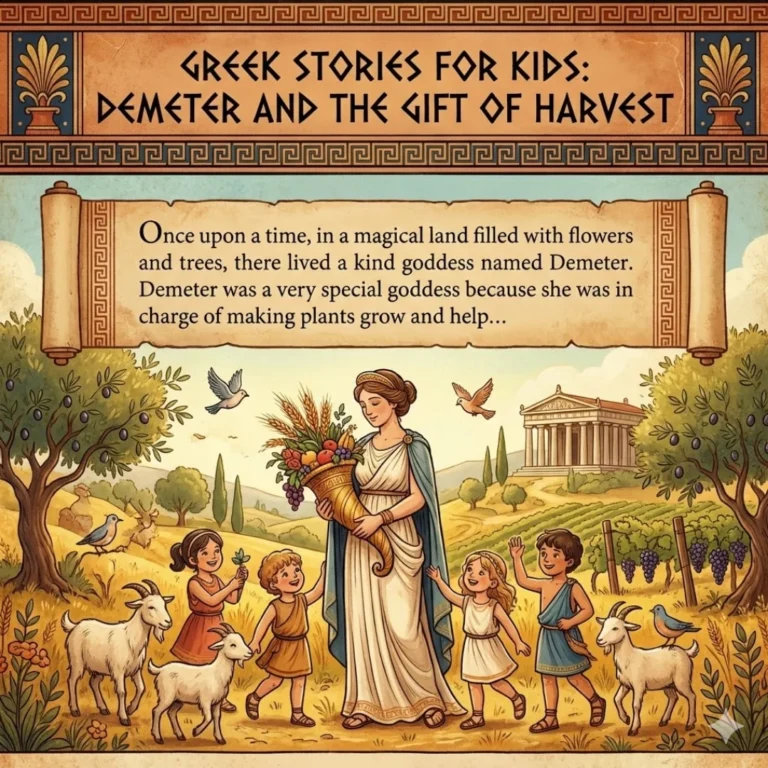
This moral story for children ages 6-12 combines entertainment with important values.
Long ago, when the world was young and the gods still walked among mortals, there was no winter.
The earth was eternally green. Flowers bloomed year-round. Trees always bore fruit. Fields of golden grain rippled endlessly in warm breezes. Every day was a day of harvest, a day of plenty.
This eternal spring was the gift of Demeter, the great goddess of the harvest, agriculture, and the fertility of the earth.
Demeter was one of the twelve Olympians, sister to mighty Zeus himself. She wore robes the color of ripe wheat, and in her hands she carried a torch to light the way for growing things, and sheaves of grain to feed all who hungered.
But more than her power or her beauty, Demeter was known for one thing above all else:
Her love for her daughter.
* * *
Persephone was the daughter of Demeter and Zeus. She was as lovely as springtime itself, with eyes like new leaves and laughter like the song of meadowlarks. Her very presence made flowers bloom more brightly.
She was innocent and kind, beloved by all who knew her. And to Demeter, she was everything.
Mother and daughter were inseparable. Together they walked through fields and forests, encouraging plants to grow, blessing farmers with abundant crops, and filling the world with the joy of new life.
Wherever Persephone danced, wildflowers sprang up beneath her feet. Wherever Demeter smiled, the grain grew tall and golden.
The world was perfect.
But perfection, like eternal spring, cannot last forever.
* * *
Deep beneath the earth, in a realm of shadows and whispers, ruled Hades—god of the underworld, lord of the dead.
His kingdom was vast and dark, filled with the souls of those who had passed from life. He was powerful, wealthy beyond measure (for all the precious metals and gems of the earth belonged to him), and utterly, desperately lonely.
The dead made poor company. They were only shades, pale echoes of who they had been in life. Hades yearned for something more—for warmth, for light, for life itself.
One day, he rose to the surface world on his black chariot, pulled by four night-black horses. And there, in a meadow in Sicily—that sun-blessed island where flowers grew most abundantly—he saw her.
Persephone.
She was gathering flowers with her companions, laughing as she wove them into crowns. The sunlight caught her hair. Her joy was radiant, infectious, beautiful.
And Hades, lord of the dead, fell instantly in love.
He knew that Demeter would never consent to let her precious daughter live in the dark underworld. He knew that Persephone herself, who loved the sunshine and growing things, would never willingly leave the world above.
So Hades did something terrible.
He asked Zeus—king of the gods, brother to both Hades and Demeter—for permission to take Persephone as his bride.
And Zeus, thinking only of alliances and power, agreed.
He gave no thought to Demeter’s feelings. He gave no thought to Persephone’s wishes.
He simply said yes.
* * *
The earth opened.
It happened in an instant. One moment, Persephone was reaching for a beautiful narcissus flower—white and fragrant, unlike any she had ever seen. The next, the ground beneath her feet split open with a terrible sound, and from the chasm rose Hades in his black chariot.
Before Persephone could scream, before her companions could react, Hades seized her around the waist and pulled her into the chariot.
“Wait!” Persephone cried. “Mother! Help me! MOTHER!”
But the earth closed above them, swallowing the chariot, the horses, the god, and the girl.
And Persephone was gone.
* * *
Demeter heard her daughter’s cry—that single, terrible scream—from far away.
She came running, her heart pounding with fear, calling her daughter’s name.
“Persephone! PERSEPHONE!”
But there was no answer. Only the meadow, the flowers, and the eerie silence.
The other girls who had been with Persephone were too frightened to speak. They had seen the earth open and close, had seen the god of the underworld take their friend, but they could barely believe it themselves.
Demeter searched frantically. She called and called until her voice was hoarse. She looked in every grove, every cave, every shadowed place.
But Persephone was nowhere to be found.
For nine days and nine nights, Demeter wandered the earth, refusing to eat, refusing to sleep, refusing to rest. Her torch burned endlessly, lighting her desperate search through darkness and day.
She asked every god, every mortal, every creature she met: “Have you seen my daughter?”
But no one would tell her the truth. Even those who knew—even Zeus himself—remained silent.
On the tenth day, Hecate, the goddess of magic and crossroads, came to Demeter with news.
“I heard your daughter’s cry,” Hecate said gently. “But I did not see who took her. Go to Helios, the sun god. His all-seeing eyes miss nothing. He will know.”
Demeter went to Helios, and at last, she learned the truth.
“Your daughter is in the underworld,” Helios told her. “Hades has taken her to be his bride. And Zeus, I am sorry to say, gave his permission.”
* * *
The grief that filled Demeter’s heart was so vast, so terrible, that the entire earth felt it.
She was not just sad. She was furious. Betrayed by her own brother. Robbed of her beloved daughter by a god who cared nothing for her consent or Persephone’s happiness.
Demeter vowed that she would not return to Olympus. She would not resume her duties as goddess of the harvest.
Not until her daughter was returned to her.
She disguised herself as an old woman and wandered among mortals, grieving.
And as Demeter grieved, the earth began to die.
The crops withered in the fields, turning brown and dry. Trees that had always borne fruit stood bare and skeletal. Flowers wilted and fell. The grass turned yellow and cracked.
No seed would sprout. No plant would grow.
For the first time since the world began, famine came to the earth.
People prayed to the gods for help. They offered sacrifices, begged for mercy. But still nothing grew.
Mothers watched their children grow thin with hunger. Old people wasted away. Even the animals began to starve, for there was no grass, no grain, nothing to eat.
The entire world was dying.
* * *
Finally, Zeus could ignore the crisis no longer. If the mortals all died, there would be no one left to worship the gods, to offer sacrifices, to build temples.
He sent messenger after messenger to Demeter, pleading with her to restore the earth’s fertility.
But Demeter’s answer was always the same:
“Return my daughter, and the earth will bloom again. Until then, let it wither.”
Zeus was in a terrible position. He had given his word to Hades. But he could not allow all mortal life to end.
At last, he sent Hermes, the messenger god, down to the underworld with a command:
“Hades, brother, you must return Persephone to her mother. The earth is dying, and only Demeter can save it.”
* * *
In the realm of the dead, Persephone sat on a throne of black stone, a crown of dark jewels upon her head.
She was queen of the underworld now. But she was not happy.
She had refused to eat. She had refused to smile. She had refused to accept her fate.
Every day, she thought of her mother, of the sunshine, of the flowers and the fields.
Hades, for all his power, could not make her love him. He could only watch her fade, like a flower torn from the earth.
When Hermes arrived with Zeus’s command, Hades knew he had no choice but to obey.
But Hades was clever. And he had one last trick.
“Of course,” he said. “Persephone may return to her mother.”
He turned to Persephone, and his voice was gentle—almost sad.
“You are free to go, my queen. I will not keep you here against your will any longer.”
Persephone’s heart leaped with joy. “Truly? I can go home?”
“Truly,” Hades said. “But before you leave, let me offer you a parting gift. You have eaten nothing in all your time here. At least take this pomegranate for your journey. You must be hungry.”
Persephone hesitated. She knew it was dangerous to eat food from the underworld—knew that it could bind you to this realm forever.
But she was so hungry. And she was going home. What harm could a few seeds do?
She took the pomegranate.
She ate six seeds. Just six—sweet and ruby-red and bursting with flavor.
Hades smiled. It was not a cruel smile, but a knowing one.
And Persephone realized, too late, what she had done.
* * *
When Persephone emerged from the underworld, Demeter was waiting.
Mother and daughter ran to each other and embraced, weeping with joy and relief. Demeter held her daughter as if she would never let go again.
“My child,” Demeter whispered. “My precious child. You’re home.”
But their reunion was interrupted by Hades, emerging from the shadows.
“She is home,” he said quietly. “But not forever.”
Demeter’s eyes blazed with fury. “What do you mean?”
“She ate food from the underworld,” Hades said. “Six pomegranate seeds. The law is ancient and unbreakable: any who eat in the realm of the dead must return there.”
Demeter looked at her daughter in horror. “Is this true?”
Persephone, tears streaming down her face, nodded.
The joy of their reunion shattered like glass.
* * *
Once again, the gods gathered to decide Persephone’s fate.
Demeter argued passionately that Persephone had been tricked, that she should not be bound by Hades’ deception.
Hades argued that the law was the law, and Persephone belonged to him.
Zeus, caught between his brother and his sister, sought a compromise.
“Persephone ate six seeds,” he decreed. “For each seed, she must spend one month in the underworld with Hades as his queen. The remaining six months of the year, she may live with her mother in the world above.”
Neither Demeter nor Hades was entirely happy with this decision.
But both accepted it.
And so the world changed forever.
* * *
Now, for six months of every year, Persephone descends to the underworld to rule beside Hades as queen of the dead.
During those months, Demeter grieves for her absent daughter. In her sorrow, she withdraws her blessings from the earth. The leaves fall from the trees. The flowers wither and die. The cold comes, and the world grows dark.
This is autumn. This is winter.
But then, when the six months end, Persephone rises from the underworld and returns to her mother’s arms.
And Demeter, in her joy, causes the earth to bloom again. Flowers burst from the ground. Trees unfurl new leaves. Birds sing. The sun grows warm.
This is spring. This is summer.
The cycle repeats, year after year, eternal and unchanging.
This is why we have seasons.
Not because the earth tilts or the sun moves (though mortals would later learn those truths as well), but because a mother loves her daughter so much that when they are apart, the whole world mourns.
And when they are reunited, the whole world celebrates.
* * *
The ancient Greeks honored this story in sacred mysteries at Eleusis, where Demeter was especially revered.
They understood the lesson of the myth:
That life and death are woven together, inseparable.
That joy and sorrow follow one another in eternal cycles.
That nothing—no spring, no summer, no happiness—lasts forever.
But also, that nothing—no winter, no darkness, no sorrow—lasts forever either.
All things change. All things return. All things are reborn.
Just as Persephone descends and rises, year after year, so too does the world die and live again.
And in that cycle, there is a deep and sacred wisdom:
That we must cherish the time of light and warmth, knowing it will not last.
That we must endure the time of cold and darkness, knowing it too shall pass.
That separation and reunion, death and rebirth, are part of the great pattern of existence.
This is the gift Demeter gives us—not just the harvest, but the understanding that all life moves in seasons.
And perhaps the greatest lesson is this:
That love—the fierce, unbreakable love of a mother for her daughter—is powerful enough to transform the entire world.
Powerful enough to defy gods.
Powerful enough to create winter and spring.
Powerful enough to endure anything, even the deepest darkness, and still bloom again.
MORAL LESSONS:
– Love is powerful enough to change the world
– All things move in cycles – joy and sorrow, life and death, growth and rest
– We must cherish the good times, knowing they are precious because they are temporary
– Difficult times will pass, just as winter gives way to spring
– Family bonds can endure even the greatest trials
– Actions have consequences (Persephone eating the pomegranate seeds)
– Grief is natural and powerful, but life eventually renews
GREEK MYTHOLOGY ELEMENTS PRESERVED:
– Demeter – goddess of harvest, agriculture, and fertility
– Persephone (also called Kore) – daughter of Demeter and Zeus
– Hades – god of the underworld, lord of the dead
– Zeus – king of gods, brother to Demeter and Hades
– Hecate – goddess of magic, crossroads, aided Demeter’s search
– Helios – sun god, all-seeing witness
– Hermes – messenger god who retrieved Persephone
– Sicily meadow – authentic location from myth
– Narcissus flower – the specific flower in original myth
– Nine days of searching – exact from Homeric Hymn
– Pomegranate seeds – exact (six seeds for six months)
– Eleusinian Mysteries – sacred rites honoring Demeter
– Zeus giving permission to Hades – authentic from myth
– Law that eating underworld food binds you there – authentic Greek belief
– Compromise: six months above, six below – exact from myth
– Origin of seasons explained through myth – authentic purpose of story
SOURCE FIDELITY NOTES:
✓ Based directly on Homeric Hymn to Demeter (7th-6th century BCE)
✓ Persephone gathering flowers in Sicily – exact
✓ Hades emerging from earth in chariot – exact
✓ Demeter’s nine-day search – exact
✓ Demeter consulting Hecate then Helios – exact
✓ Earth becoming barren due to Demeter’s grief – exact
✓ Zeus sending Hermes to retrieve Persephone – exact
✓ Pomegranate seeds (six) binding Persephone – exact
✓ Six months in underworld, six months above – exact
✓ Seasons explained as Demeter’s joy/sorrow – exact purpose of myth
✓ Eleusinian Mysteries reference – historical reality
✓ No invented plot points – all from authentic sources
ENGAGEMENT ENHANCEMENTS:
+ Vivid sensory details (night-black horses, ruby-red seeds, golden grain)
+ Emotional depth (Demeter’s desperation, Persephone’s terror, Hades’s loneliness)
+ Dialogue brings characters to life
+ Scene breaks for pacing and dramatic tension
+ Show don’t tell (grief shown through withering earth)
+ Internal thoughts reveal motivations
+ Suspense building (will Persephone return? what did she eat?)
+ Satisfying explanation of natural phenomenon (seasons)
+ Universal themes (mother-daughter love, loss, reunion)
+ Child-appropriate while maintaining mythological complexity
CULTURAL SIGNIFICANCE:
– Explains origin of seasons in Greek understanding
– Central to Eleusinian Mysteries, most important Greek religious rites
– Demeter worship fundamental to agricultural societies
– Persephone’s dual role (maiden and queen) represents life-death cycle
– Myth provided comfort about death and promise of renewal
– Agricultural cycle tied to spiritual/mythological meaning
NOTE ON AUTHENTICITY:
This is a direct retelling of the myth from the Homeric Hymn to Demeter, one of the oldest and most important Greek religious texts. All major plot points—the abduction from the Sicily meadow, the nine-day search, consultation with Hecate and Helios, the earth’s barrenness, the pomegranate seeds, and the six-month division—are authentic to the original. The Eleusinian Mysteries at Eleusis celebrated this myth for over a thousand years, making it one of the most enduring religious practices in ancient Greece.
SOURCES:
– [Demeter – Wikipedia](https://en.wikipedia.org/wiki/Demeter)
– [Myth of Hades and Persephone](https://www.greekmyths-greekmythology.com/myth-of-hades-and-persephone/)
– [Persephone – Wikipedia](https://en.wikipedia.org/wiki/Persephone)
– [The Fitzwilliam Museum – The Story of Demeter and Persephone](https://fitzmuseum.cam.ac.uk/learn-with-us/the-story-of-demeter-and-persephone)
– [Persephone, Queen of the Underworld – Greek Myths | Greeka](https://www.greeka.com/greece-myths/persephone/)
– Homeric Hymn to Demeter (7th-6th century BCE) – primary source
– Eleusinian Mysteries – historical religious rites based on this myth
Test Your Understanding
1. Who was Persephone’s mother?
Frequently Asked Questions
What is the moral lesson of Demeter and the Gift of Harvest?
What age is this story appropriate for?
How long does it take to read Demeter and the Gift of Harvest?
What culture does this story come from?
Can I use this story for teaching?
Frequently Asked Questions
What is the story of Demeter and the harvest about?
Demeter and the Gift of Harvest is a children’s moral story retelling the Greek myth of Demeter, goddess of the harvest, and her deep love for her daughter Persephone. It explores how the seasons came to be and teaches important values like love, loss, and resilience. It’s written for kids ages 6 to 12.
Who is Demeter in Greek mythology?
Demeter is the Greek goddess of the harvest, agriculture, and the earth’s fertility. She is one of the twelve Olympians and sister to Zeus. In myths, she is best known for her overwhelming love for her daughter Persephone and her role in creating the seasons.
Why is the Demeter and harvest story good for children?
This retelling of the Demeter harvest myth combines entertaining storytelling with meaningful life lessons about love, grief, and hope. Written for ages 6 to 12, it uses simple, engaging language that makes Greek mythology accessible while helping children explore big emotions in a safe, imaginative way.
📚 Recommended Books
Handpicked for readers like you
As an Amazon Associate, we earn from qualifying purchases. These recommendations are personalized based on this story's themes and your reading history.
Why was there no winter in the world at the beginning of this story?
At the start of the story, the earth enjoyed eternal spring because Demeter, the goddess of the harvest, blessed the land continuously. Flowers bloomed year-round, trees always bore fruit, and every day was a day of plenty — all a reflection of Demeter’s joy and presence on earth.
Who is Persephone and how is she connected to Demeter?
Persephone is the daughter of Demeter and Zeus. She is described as radiant and kind, with a presence so joyful that flowers bloomed more brightly around her. Her relationship with her mother Demeter is the emotional heart of the story and central to explaining how the seasons came to exist.