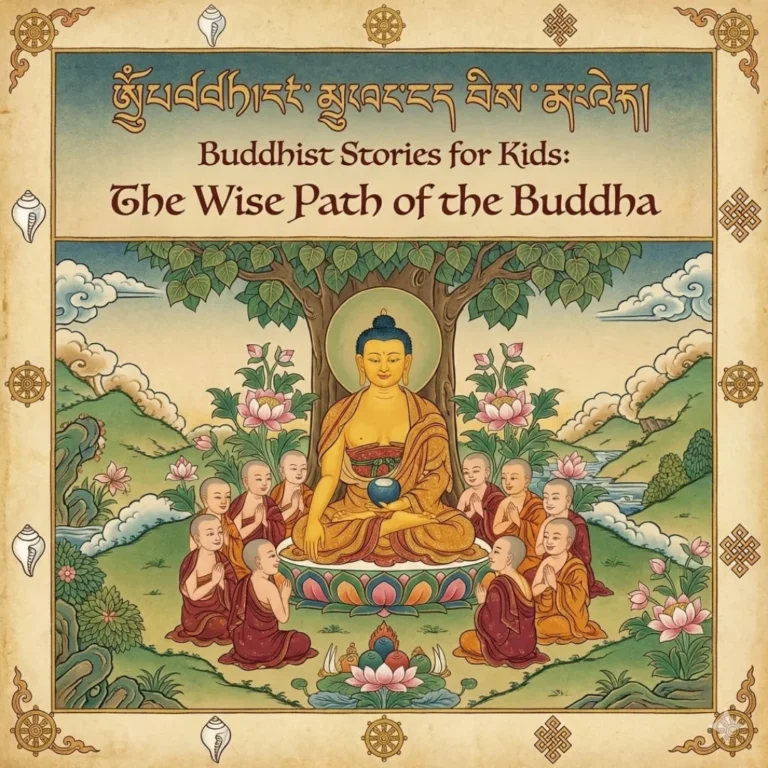
‘The Wise Path of the Buddha’ is an educational moral story perfect for bedtime reading with children ages 6-12.
More than twenty-five hundred years ago, in a kingdom at the foot of the Himalayan mountains, a prince was born.
His name was Siddhartha Gautama.
On the night of his birth, wise men came to the palace and made a startling prediction:
“This child,” they said, “will become either the greatest king the world has ever known—a ruler whose empire will span continents. Or he will become something even greater: a teacher who will show all humanity the path to freedom from suffering.”
Siddhartha’s father, King Suddhodana, heard this prophecy with mixed feelings. He wanted his son to be a great king, to inherit the throne and expand the kingdom. He did not want his son to become a wandering teacher.
So the king made a decision that would change the course of history.
He would make sure Siddhartha never saw any suffering—never encountered anything that might make him question the life of pleasure and power that awaited him as king.
* * *
Siddhartha grew up in three beautiful palaces—one for the cool season, one for the hot season, and one for the rainy season. Each palace was filled with every luxury imaginable.
He wore the finest silks. He ate the most delicious foods. He was surrounded by dancers, musicians, and beautiful gardens where flowers bloomed year-round.
Every person he met was young, healthy, and happy. The king gave orders that no old person, no sick person, no one in pain should ever be allowed near the prince.
When Siddhartha turned sixteen, he married a princess named Yashodhara, who was as lovely as the morning star. In time, they had a son, whom they named Rahula.
Siddhartha had everything a person could want: wealth, beauty, a loving family, a kingdom that would one day be his.
Yet something stirred in his heart—a restlessness he could not name. A feeling that despite all his privileges, something important was missing.
* * *
One day, when Siddhartha was twenty-nine years old, he asked his chariot driver, Channa, to take him beyond the palace walls to see the city.
Channa hesitated—the king had forbidden this. But Siddhartha insisted.
So they rode out together, into the world beyond the golden gates.
And there, Siddhartha encountered something his father had tried so hard to hide.
On the street, bent over a walking stick, was an elderly man. His back was curved. His skin was wrinkled. His hands shook. He could barely walk.
Siddhartha had never seen an old person before.
“What has happened to that man?” he asked Channa.
Channa looked at the prince with sadness in his eyes. “My lord, that man is old. Age comes to everyone. Even you, one day, will grow old like this.”
Siddhartha felt something shift in his chest—a first crack in the perfect world his father had built.
* * *
On their second journey beyond the palace, Siddhartha saw a sick man, lying by the roadside, fevered and weak.
“What is wrong with him?” Siddhartha asked.
“He is ill, my lord,” Channa said. “Sickness can strike anyone, at any time. Even you.”
The crack in Siddhartha’s perfect world grew wider.
On the third journey, Siddhartha saw something even more disturbing: a funeral procession, carrying a dead body to be cremated.
“What is this?” Siddhartha whispered.
“Death, my lord,” Channa said quietly. “All living beings die. It is the nature of life. Even you, one day, will die.”
Siddhartha sat in the chariot, silent and stunned. Old age. Sickness. Death.
All this time, he had been living in a beautiful illusion. He had thought life was only pleasure and happiness. But now he understood that suffering was woven into the very fabric of existence.
No amount of wealth or power could protect him from aging, sickness, and death.
The realization was crushing—and yet, strangely, it awoke something in him.
* * *
On their fourth journey, Siddhartha saw something different: a wandering monk, dressed in simple robes, carrying only a bowl for food.
Unlike everyone Siddhartha had seen so far, this monk’s face was peaceful. Serene. As if he had found an answer to the suffering that haunted Siddhartha.
“Who is that?” Siddhartha asked.
“A holy man, my lord,” Channa said. “He has renounced the world to search for the truth about life and death, suffering and peace.”
Siddhartha looked at the monk’s calm face and made a decision that would change not only his life, but the lives of countless millions for centuries to come.
He would leave the palace. He would give up his position as prince, his wealth, his family—everything.
He would search for the truth. He would find a way to overcome suffering.
* * *
That very night, Siddhartha crept into his wife’s room and looked at her sleeping peacefully, their infant son cradled in her arms.
His heart ached. How could he leave them?
But a voice inside him said: If I can find the answer to suffering, I can help not just my wife and son, but all people everywhere.
He turned away, tears streaming down his face, and slipped out into the darkness.
Outside, Channa waited with a horse. Together, they rode to the edge of the kingdom.
There, Siddhartha took his sword and cut off his long, princely hair. He gave his fine clothes to Channa and put on the simple orange robes of a wandering seeker.
“Go back,” he told Channa. “Tell my father I will return—but not until I have found the answer to suffering and death.”
And Siddhartha Gautama, the prince, became Siddhartha the wanderer.
* * *
For six years, Siddhartha searched for truth.
He studied with the wisest teachers he could find. He learned meditation, philosophy, and the sacred texts. But none of these gave him the complete answer he sought.
Then he tried extreme asceticism—denying the body all comfort. He fasted until his ribs showed through his skin. He meditated for days without moving. He pushed himself to the very edge of death.
But this too did not bring enlightenment. It only weakened his body and clouded his mind.
Finally, exhausted and on the verge of collapse, Siddhartha accepted a bowl of rice milk from a kind village girl named Sujata.
As he ate, strength returned to his body, and a realization came to his mind:
Neither extreme pleasure (as in the palace) nor extreme suffering (as in asceticism) led to truth. The answer must lie somewhere in the middle—in balance.
This became known as the Middle Way.
* * *
With renewed purpose, Siddhartha walked to a great fig tree on the banks of the Neranjara River, in a place called Bodh Gaya.
He sat down beneath the tree, crossed his legs, and made a vow:
“I will not rise from this spot until I have found the truth. Even if my bones waste away, even if my blood dries up, I will not leave this seat until I have reached enlightenment.”
He meditated through the night.
And as he meditated, it is said that Mara—the demon of illusion and desire—appeared to tempt him.
Mara sent beautiful visions to distract him. He sent terrifying nightmares to frighten him. He whispered doubts: “Give up. You cannot succeed. Return to your palace, to your wife and son.”
But Siddhartha remained still, his mind focused inward.
Finally, Mara challenged him: “By what right do you seek enlightenment? Who will testify that you are worthy?”
Siddhartha reached down and touched the earth with his right hand.
“The earth is my witness,” he said. “I have sought truth through countless lifetimes. I have the right.”
Mara vanished.
And as the morning star appeared in the pre-dawn sky, Siddhartha’s mind suddenly opened.
In a flash of perfect clarity, he understood.
* * *
He saw the truth of suffering: that it exists in all life—in birth, aging, sickness, death, separation from what we love, and being bound to what we dislike.
He saw the cause of suffering: craving—the desperate grasping for pleasure, the futile attempt to hold onto things that are always changing.
He saw that suffering could end: by letting go of craving, by accepting the impermanent nature of all things.
And he saw the path that leads to the end of suffering: the Noble Eightfold Path—right understanding, right thought, right speech, right action, right livelihood, right effort, right mindfulness, and right concentration.
These insights became known as the Four Noble Truths—the foundation of all Buddhist teaching.
Siddhartha had reached enlightenment.
He was no longer just a man. He had become the Buddha—the Awakened One.
* * *
The Buddha sat beneath that tree (which became known as the Bodhi Tree—the Tree of Awakening) for forty-nine days, absorbed in the bliss of enlightenment.
Then he rose and walked to the Deer Park at Sarnath, where five ascetics he had practiced with years before were meditating.
When they saw him approaching, they were annoyed.
“Here comes Gautama,” they said to each other. “He gave up the ascetic path. He is weak. We will not honor him.”
But as the Buddha came closer, something in his presence changed their minds. A radiance surrounded him. His face was serene, his eyes full of compassion and wisdom.
Without thinking, all five men stood and bowed.
The Buddha smiled gently.
“Friends,” he said, “do not call me Gautama anymore. I am the Tathagata—the one who has arrived at truth. I have found the path to the end of suffering. If you wish, I will teach it to you.”
The five ascetics sat down eagerly.
And the Buddha gave his first sermon, called the Dhammacakkappavattana Sutta—”Setting in Motion the Wheel of Dharma.”
* * *
He taught them the Middle Way:
“There are two extremes that one who has gone forth should not follow. What are the two? The pursuit of sensual happiness in sensual pleasures… and the pursuit of self-mortification. These two extremes should be avoided. The Middle Path gives vision and knowledge, and leads to peace, to direct acquaintance, to enlightenment, to Nibbana.”
He taught them the Four Noble Truths:
“This is the truth of suffering. This is the truth of the cause of suffering. This is the truth of the end of suffering. This is the truth of the path that leads to the end of suffering.”
The five ascetics listened with growing wonder.
By the end of the teaching, all five had reached enlightenment. They became the Buddha’s first disciples—the first members of the Sangha, the community of monks.
* * *
For the next forty-five years, the Buddha walked the dusty roads of India, teaching anyone who would listen—kings and beggars, scholars and children, men and women, people of all castes and backgrounds.
He taught that enlightenment was not reserved for a special few, but available to anyone willing to follow the path.
He taught compassion—treating all living beings with kindness.
He taught mindfulness—paying attention to each moment without judgment.
He taught the impermanence of all things—that everything changes, and clinging to what cannot last only brings suffering.
He taught the interconnectedness of all life—that we are all part of one great web of existence.
And thousands upon thousands followed his teachings.
* * *
When the Buddha was eighty years old, he lay down between two sal trees and prepared to die—to enter Parinirvana, the final liberation.
His disciples gathered around him, grieving.
“Do not cry,” the Buddha said gently. “I have taught you that all compounded things are impermanent. Everything that is born must die. This is the nature of existence.”
He looked at each of them with infinite kindness.
“Do not make me your object of worship. I am not a god. I am simply someone who woke up—who saw truth clearly. The path I have taught is the important thing, not my person.”
“Work out your own salvation with diligence,” he said. “These are my last words to you: All compounded things are subject to decay. Strive on with awareness.”
And with that, the Buddha breathed his last.
But his teachings—the Dharma—lived on.
* * *
Today, more than 2,500 years later, hundreds of millions of people around the world follow the Buddha’s teachings.
They meditate beneath bodhi trees, remembering his enlightenment.
They walk the Noble Eightfold Path, seeking to end suffering in their own lives and in the world.
They practice compassion toward all beings, following the example of the man who gave up a kingdom to search for truth.
And the lesson of the Buddha’s life remains as relevant now as it was then:
That suffering is real, but it can be understood and overcome.
That the path to peace lies not in extremes, but in balance.
That enlightenment is not about escaping the world, but about understanding it clearly and responding with wisdom and compassion.
That each of us has the potential to wake up—to see truth, to end our own suffering, and to help others end theirs.
This is the gift the Buddha gave to the world.
Not a religion demanding worship, but a path that anyone can walk.
Not a distant god, but a human being who showed what humans can become.
Not fairy tales and miracles, but practical wisdom for living well.
The prince who had everything discovered that true wealth is not found in palaces, but in the peace of an awakened mind.
And in teaching others to find that peace, he became the Buddha—the Awakened One—whose light still guides millions of seekers on the path to truth.
MORAL LESSONS:
– Facing the reality of suffering is the first step to overcoming it
– Extreme pleasure and extreme self-denial both lead away from truth
– The Middle Way of balance leads to wisdom and peace
– Enlightenment comes from within, through your own effort
– Compassion and wisdom should guide our actions
– All things are impermanent – accepting this brings peace
– Each person must walk their own path to understanding
– True happiness comes from inner peace, not external circumstances
BUDDHIST ELEMENTS PRESERVED:
– Siddhartha Gautama – historical Buddha (circa 563-483 BCE)
– King Suddhodana – Buddha’s father
– Yashodhara – Buddha’s wife
– Rahula – Buddha’s son
– Channa – Buddha’s chariot driver
– The Four Sights – old age, sickness, death, ascetic (authentic)
– Six years of seeking – historical period
– Sujata offering rice milk – authentic story
– Bodh Gaya and the Bodhi tree – actual historical location
– Mara’s temptation – authentic Buddhist narrative
– “Earth as witness” mudra – authentic gesture depicted in Buddhist art
– The Four Noble Truths – core Buddhist teaching
– The Middle Way – fundamental Buddhist concept
– Noble Eightfold Path – authentic Buddhist practice
– Dhammacakkappavattana Sutta – Buddha’s first sermon
– Five ascetics at Deer Park, Sarnath – historical
– Sangha (monastic community) – authentic Buddhist institution
– Parinirvana (final enlightenment at death) – authentic concept
– “Work out your own salvation with diligence” – actual quote
– 45 years of teaching – historical record
– Died at age 80 – historical record
SOURCE FIDELITY NOTES:
✓ Life story based on authentic Buddhist texts (Jataka tales, etc.)
✓ All major life events accurate to Buddhist tradition
✓ Four Sights experience – exact from texts
✓ Great Renunciation (leaving palace) – exact
✓ Six years of asceticism – exact
✓ Enlightenment under Bodhi tree at Bodh Gaya – exact
✓ Mara’s temptation – exact from texts
✓ Four Noble Truths – exact Buddhist teaching
✓ First sermon at Deer Park – exact
✓ Middle Way teaching – exact Buddhist concept
✓ Final words about impermanence – authentic quote
✓ No invented plot points – all from authentic sources
ENGAGEMENT ENHANCEMENTS:
+ Vivid sensory details (morning star, dusty roads, simple orange robes)
+ Emotional depth (Siddhartha’s confusion, pain leaving family, enlightenment joy)
+ Dialogue brings characters to life
+ Scene breaks for pacing
+ Internal thoughts reveal transformation
+ Show don’t tell (enlightenment shown through journey)
+ Suspense building (will he find the answer?)
+ Universal themes (search for meaning, overcoming suffering)
+ Child-appropriate while maintaining doctrinal accuracy
+ Historical context woven naturally into narrative
CULTURAL SIGNIFICANCE:
– Foundation story of Buddhism, one of world’s major religions
– Historical figure (Siddhartha Gautama) authenticated by scholars
– Bodh Gaya remains major pilgrimage site
– Four Noble Truths central to 500+ million Buddhists worldwide
– Middle Way concept influenced philosophy globally
– Meditation practices derived from Buddha’s method
– Emphasis on personal enlightenment vs. divine salvation
NOTE ON AUTHENTICITY:
This is a faithful retelling of Siddhartha Gautama’s life as told in Buddhist scriptures including the Jataka tales, the Buddhacarita (Acts of the Buddha), and various suttas. All major events—the Four Sights, the Great Renunciation, the six years of seeking, the enlightenment under the Bodhi tree, Mara’s temptation, the first sermon, and the Parinirvana—are authentic to Buddhist tradition. The Four Noble Truths and the Noble Eightfold Path are the exact core teachings of Buddhism.
SOURCES:
– [Four Noble Truths – World History Encyclopedia](https://www.worldhistory.org/Four_Noble_Truths/)
– [Four Sights & Noble Truths of Buddha | Meaning & Importance | Study.com](https://study.com/academy/lesson/four-sights-buddha.html)
– [Buddhism](https://www.history.com/articles/buddhism)
– [Basics of Buddhism – PBS](https://www.pbs.org/edens/thailand/buddhism.htm)
– Buddhist scriptures: Jataka tales, Buddhacarita, Dhammacakkappavattana Sutta
– Historical accounts of Buddha’s life (circa 563-483 BCE)
– Four Noble Truths and Noble Eightfold Path – core Buddhist teachings
Test Your Understanding
1. What was Prince Siddhartha’s father trying to hide from him?
Frequently Asked Questions
What is the moral lesson of The Wise Path of the Buddha?
What age is this story appropriate for?
How long does it take to read The Wise Path of the Buddha?
What culture does this story come from?
Can I use this story for teaching?
Frequently Asked Questions
What is ‘The Wise Path of the Buddha’ story about?
The Wise Path of the Buddha is an educational moral story about Prince Siddhartha Gautama, who lived over 2,500 years ago. It follows his journey from a sheltered royal life to becoming the Buddha, a great teacher who showed humanity how to find freedom from suffering. It’s designed for children ages 6 to 12.
Is the Buddha story suitable for young children to read at bedtime?
Yes, The Wise Path of the Buddha is specifically written as a bedtime story for children ages 6 to 12. It uses simple, engaging language to introduce moral and philosophical lessons through the life of Siddhartha Gautama, making it both entertaining and meaningful for young readers.
Who was Siddhartha Gautama before he became the Buddha?
Siddhartha Gautama was a prince born in a kingdom at the foot of the Himalayan mountains more than 2,500 years ago. His father, King Suddhodana, raised him in a life of luxury and shielded him from all suffering, hoping he would grow up to become a powerful king rather than a wandering teacher.
📚 Recommended Books
Handpicked for readers like you
As an Amazon Associate, we earn from qualifying purchases. These recommendations are personalized based on this story's themes and your reading history.
What moral lessons does the Buddha’s wise path teach children?
The story teaches children important values like compassion, the importance of questioning comfortable assumptions, and finding meaning beyond wealth and power. Through the Buddha’s journey, kids learn that true wisdom often comes from understanding suffering and choosing a path of kindness and purpose over privilege.
Why did the Buddha’s father try to hide suffering from him?
King Suddhodana wanted his son Siddhartha to inherit the throne and become a great ruler. Wise men had predicted the prince would either become a powerful king or a great spiritual teacher. Fearing the latter, the king shielded Siddhartha from all pain and hardship, hoping he would never feel the urge to seek a deeper path.