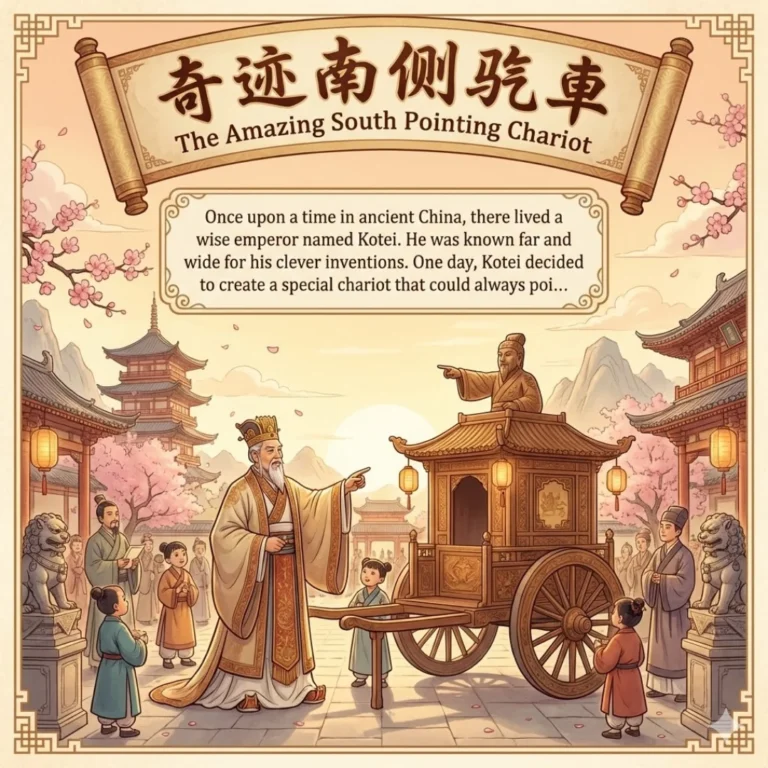
This bedtime story for kids, ‘The Amazing South Pointing Chariot’, teaches children ages 6-12 about important moral values.
Chapter One: A Star Is Born
Long ago, in the age when dragons still soared through clouds and phoenixes nested in ancient trees, a woman named Fubao walked alone in the evening meadows. She was the wife of a tribal chief, and though her life was comfortable, she often felt that something greater lay waiting just beyond the horizon.
On this particular evening, the sky was especially clear. Stars sparkled like diamonds scattered across black silk, and the North Star burned brighter than Fubao had ever seen it. As she watched, something extraordinary happened.
A beam of pure light shot down from the North Star, surrounding her in golden radiance. The light was warm, not burning, and it filled Fubao with a sense of wonder and purpose. When it faded, she knew that something miraculous had occurred.
Nine months later, a baby boy was born. From the moment he opened his eyes, it was clear he was no ordinary child. His gaze was thoughtful and deep, as if he already understood secrets that took others a lifetime to learn.
They named him Huangdi, and he would grow to become the Yellow Emperor, one of the greatest leaders in all of history.
Chapter Two: The Young Emperor
Huangdi grew into a remarkable young man. While other princes learned only to fight and hunt, Huangdi studied everything: the movements of stars, the properties of plants, the secrets of metalworking, the patterns of weather.
“Why do you spend so much time thinking?” his father’s advisors would ask. “A leader should be decisive, not contemplative.”
“A leader who does not think,” young Huangdi replied, “is like a river without a source. He may rush forward quickly, but he will soon run dry.”
When Huangdi’s father passed away, the young man became emperor. He immediately set about improving the lives of his people. He taught farmers new ways to grow rice that doubled their harvests. He showed healers how to use herbs and needles to cure illnesses. He organized the scattered tribes into a unified nation.
Under his wise rule, the land prospered. People called this golden age the time of Great Harmony.
But harmony, as Huangdi knew well, is a delicate thing. And there was one who wished to shatter it completely.
Chapter Three: The Rebel Chiyou
In the southern mountains, there lived a warlord named Chiyou. He was not like other men. His head was made of bronze, his eyes could shoot fire, and his voice was like thunder that shook the earth. Some said he was part demon, others that he had made dark bargains with the spirits of chaos.
Chiyou gathered an army of fierce warriors and strange creatures. He wanted to rule the world, not through wisdom and kindness as Huangdi did, but through fear and force.
“The Yellow Emperor is weak,” Chiyou bellowed to his followers. “He wastes time teaching farmers and caring for the sick when he should be conquering. I will show the world what true power looks like!”
His army swept across the land like a plague of locusts, destroying villages and enslaving the people. Smoke rose from burning fields, and the cries of the suffering reached all the way to Huangdi’s palace.
The Yellow Emperor knew he must act. He gathered his own army, the finest warriors from every tribe, men who fought not for glory or gold but to protect their families and their peaceful way of life.
The two forces met on a vast plain called Zhuolu, and there began the most important battle in the history of the world.
Chapter Four: The Battle in the Fog
At first, Huangdi’s army fought bravely. Though Chiyou’s soldiers were fierce, they were met with equal courage. The battle raged for days, neither side gaining clear advantage.
Then Chiyou unveiled his most terrible weapon.
He raised his bronze arms to the sky and began to chant in a language older than mankind. Dark clouds gathered overhead. The air grew cold and thick. And then, from all directions at once, a fog rolled across the battlefield.
But this was no ordinary fog. It was magical, created by dark spirits loyal to Chiyou. It was so thick that soldiers could not see their hands before their faces. It was so confusing that men lost all sense of direction, wandering in circles until they collapsed from exhaustion.
“Which way is north?” the soldiers cried. “Where is the enemy? Where are our friends?”
The battle dissolved into chaos. Warriors stumbled into ravines. Horses ran in all directions. The mighty army of Huangdi scattered like leaves before a storm.
The Yellow Emperor himself became separated from his generals. He stood alone in the swirling gray mist, unable to see the sun or stars, unable to tell friend from foe.
For the first time in his life, Huangdi felt lost.
Chapter Five: The Voice in the Silence
That night, as the fog still swirled around him, Huangdi sat beneath a tree and did what he always did in times of trouble: he thought.
“The fog takes away our sight,” he murmured. “It hides the sun and stars that would guide us. But there must be another way to find direction. There must be a constant that even Chiyou’s magic cannot corrupt.”
He remembered something his old teacher had once said: “The earth itself knows which way is which. Certain stones are drawn always toward the north, as if the earth whispers its secrets to them.”
Lodestones! The mysterious rocks that seemed to possess magical properties. Could they be the key?
Huangdi’s mind raced with possibilities. If he could harness the lodestone’s power, he could build a device that always pointed in one direction, regardless of fog or darkness or any confusion Chiyou might create.
Working through the night, using materials he gathered from the battlefield, Huangdi began to build.
Chapter Six: The South Pointing Chariot
What Huangdi created was a marvel of engineering. It was a chariot with two wheels, and atop it stood a wooden figure with one arm extended, pointing forward. But the genius lay in the mechanism hidden beneath the platform.
Using gears and axles connected to the chariot’s wheels, Huangdi designed a system so that no matter which way the chariot turned, the figure’s arm would always point in the same direction: south.
“The lodestone told me the secret,” Huangdi explained to his amazed generals when they finally reunited. “But I realized we did not need the stone itself. We needed only to remember the direction it revealed. This chariot, once set pointing south, will maintain that direction through any turn, any confusion, any fog. It is not magic that guides us, but understanding.”
The generals looked at the simple-seeming device with wonder. Such a small thing, yet it could change the course of the war.
“Tomorrow,” Huangdi declared, “we will face Chiyou again. But this time, his fog will not save him.”
Chapter Seven: Victory Through Wisdom
The next morning, Huangdi’s army assembled once more. The south-pointing chariot took its place at the head of the formation, its wooden figure stretching its arm toward the southern horizon.
When Chiyou saw the enemy reforming, he laughed his thunderous laugh. “Fools! Did you not learn your lesson? Let us see if you enjoy the fog a second time!”
Again he raised his arms. Again the dark clouds gathered. Again the magical fog rolled across the battlefield, thick and blinding and impossible to see through.
But this time was different.
“Forward!” Huangdi commanded. “Follow the chariot! As long as we keep the figure on our left, we travel east. Keep it on our right, and we travel west. Behind us, we travel north. Before us, south. The fog cannot confuse us now!”
And it was true. No matter how the fog swirled, no matter how disorienting the magical mist became, the soldiers could always see the chariot’s pointing arm. They knew which way they faced. They could maintain their formations and fight as one unified force.
Chiyou’s warriors, who had expected easy victory, found themselves facing a disciplined enemy that could not be scattered. The battle turned.
Hour by hour, the fog began to lift. The dark magic weakened as Chiyou’s concentration broke. And when at last the sun broke through, shining bright and clear, Huangdi’s army stood triumphant.
Chapter Eight: The Legacy
Chiyou was defeated and banished to the far corners of the world, where his dark influence could harm no one. The land returned to peace, and the people celebrated their wise emperor who had turned defeat into victory not through greater violence, but through greater understanding.
Huangdi ruled for many more years, teaching his people the arts of civilization. He is remembered as the Father of Chinese Culture, credited with countless inventions that improved human life.
But perhaps his greatest lesson was the one he demonstrated at Zhuolu: that the mightiest power is not the ability to create confusion, but the wisdom to find clarity within it.
The south-pointing chariot became a symbol of this truth. For centuries afterward, Chinese inventors built ever more sophisticated versions, demonstrating that human ingenuity could solve problems that seemed impossible.
“When you feel lost,” the old stories say, “remember Huangdi. Remember that there is always a way to find your direction. Remember that knowledge and clear thinking can guide you through any fog, any darkness, any confusion. The world may seem chaotic, but patterns exist for those who look carefully enough.”
And so, to this day, the tale of the south-pointing chariot reminds us that the greatest battles are won not by the strongest sword, but by the clearest mind, and that even when we cannot see our way forward, wisdom can light the path.
Moral Lessons
- When confusion surrounds us, knowledge and clear thinking can guide us through. Problems that seem impossible to solve often have solutions waiting to be discovered by those who think carefully and refuse to give up.
Test Your Understanding
1. Who was Huangdi and what was he known for?
2. Who was Chiyou and what was his terrible weapon?
3. What was the South Pointing Chariot and how did it work?
4. What inspired Huangdi to build the South Pointing Chariot?
5. How did Huangdi’s army defeat Chiyou in the second battle?
6. What is the main moral lesson of this story?
Frequently Asked Questions
What is the moral lesson of The Amazing South Pointing Chariot?
What age is this story appropriate for?
How long does it take to read The Amazing South Pointing Chariot?
What culture does this story come from?
Can I use this story for teaching?
Frequently Asked Questions
What is the South Pointing Chariot in this Chinese story?
The South Pointing Chariot was a legendary invention created by the Yellow Emperor (Huangdi) in ancient China. This miraculous device always pointed south, helping travelers navigate even when they couldn’t see the sun or stars, demonstrating the power of wisdom and innovation.
Who was the Yellow Emperor and why is he important?
The Yellow Emperor, called Huangdi, was a legendary Chinese ruler born from divine light from the North Star. He became one of China’s greatest leaders, known for his wisdom, inventions, and founding Chinese civilization. He’s considered the ancestor of all Chinese people.
Is this South Pointing Chariot story appropriate for young children?
Yes, this bedtime story is specifically designed for children ages 6-12. It teaches important moral values like perseverance, wisdom, and innovation through engaging Chinese mythology, making it perfect for bedtime reading while being educational and age-appropriate.
📚 Recommended Books
Handpicked for readers like you
As an Amazon Associate, we earn from qualifying purchases. These recommendations are personalized based on this story's themes and your reading history.
What moral lessons does this Chinese story teach kids?
This story teaches children about the importance of innovation, problem-solving, and using wisdom to help others. The Yellow Emperor’s invention of the South Pointing Chariot shows how creativity and determination can solve difficult challenges and benefit entire communities.
Is the Yellow Emperor’s story based on real Chinese history?
The Yellow Emperor is a central figure in Chinese mythology and culture, considered both legendary and historical. While the magical elements are mythical, Huangdi represents the founding of Chinese civilization and is revered as an important cultural ancestor in Chinese tradition.