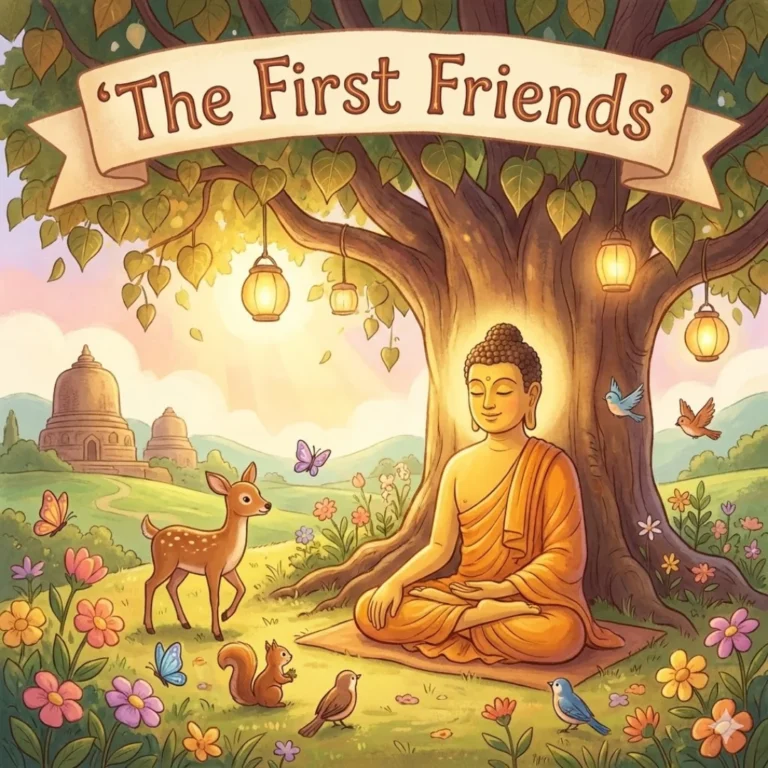

This bedtime story for kids, ‘The First Friends’, teaches children ages 6-12 about important moral values.
In the ancient land of India, in a time when the morning mist still clung to the sacred river Nerañjarā and peacocks called from the forest, something extraordinary had happened.
Under a great tree—the Bodhi tree—a man named Siddhartha Gautama had achieved something that seekers had been searching for since the beginning of time.
He had become enlightened.
He was now the Buddha—the Awakened One.
* * *
## SEVEN WEEKS OF BLISS
For seven weeks after his enlightenment, the Buddha sat in meditation, experiencing the profound peace and freedom he had discovered.
He did not eat. He did not sleep. He simply rested in the state of perfect understanding, free from all suffering, all craving, all confusion.
The first week, he sat beneath the Bodhi tree without moving, his mind completely still.
The second week, he stood and gazed at the Bodhi tree with gratitude, his eyes unblinking, understanding the profound gift the tree had given him by providing shelter during his final night of seeking.
The third week, he walked back and forth between two points, contemplating the depths of the truth he had discovered.
The fourth week, he sat in a jeweled house that appeared through his spiritual power, radiating six-colored light.
The fifth week, he sat beneath the shade of a shepherd’s tree, and the demon Mara tried to tempt him away from his path—but the Buddha remained unmoved.
The sixth week, he sat beneath a mucalinda tree when a terrible storm arose. A great serpent-king named Mucalinda coiled around the Buddha’s body seven times and spread his hood above the Buddha’s head to protect him from the rain. When the storm passed, the serpent transformed into a young man and bowed to the Buddha.
By the seventh week, the Buddha sat beneath the Rajāyatana tree, still immersed in the bliss of liberation.
But now, his body needed sustenance. Seven weeks without food had left him thin and weak.
The Buddha’s enlightenment had freed his mind, but his body was still human. It still needed care.
And at that precise moment, as if guided by the universe itself, two travelers appeared on the road.
* * *
## THE MERCHANT BROTHERS
Tapussa and Bhallika were brothers—merchants from a faraway land.
They traveled with their caravan of bullock carts loaded with goods: spices from the coast, fine cloth from the north, brass vessels that gleamed in the sunlight. They were journeying to the great city of Rājagaha to trade at the market there.
It was hard, dusty work, traveling the ancient roads. The wheels of the carts creaked. The oxen plodded slowly. The sun beat down relentlessly.
But the brothers were good men—honest in their dealings, generous with their workers, always ready with a kind word or a helping hand.
As they traveled along the road that passed near the Bodhi tree, something strange happened.
The oxen stopped.
“Hyah! Move!” called the drivers, but the oxen would not budge.
They stood completely still, as if an invisible force held them in place.
Tapussa and Bhallika climbed down from their carts to see what was wrong.
“There’s nothing blocking the road,” Bhallika said, puzzled.
“The animals aren’t sick or tired,” Tapussa added. “Why won’t they move?”
Then, both brothers felt it—a presence, powerful and peaceful, drawing their attention like a gentle hand on their shoulders.
They looked toward the forest.
There, beneath a tree not far from the road, sat a man.
* * *
## THE RADIANT STRANGER
Even from a distance, they could see that this was no ordinary person.
The man sat in perfect stillness, his legs crossed, his hands rested peacefully in his lap. His face was serene—not merely calm, but radiating a peace so deep it seemed to flow out from him like ripples in a pond.
He wore simple robes. His head was shaved. He possessed nothing—no bag, no bowl, no belongings of any kind.
Yet he seemed to possess everything.
The brothers looked at each other.
“Do you feel that?” Tapussa whispered.
“Like… peace,” Bhallika said softly. “Like everything is exactly as it should be.”
At that moment, a figure appeared beside them—transparent, glowing softly, barely visible in the bright daylight.
A deva—a celestial being, a god of the heavens.
The brothers gasped and fell to their knees.
“Do not be afraid,” the deva said gently. “I appear to you because you have earned merit in many lifetimes. That man sitting beneath the tree is no ordinary sage. He has achieved what countless seekers have failed to achieve. He has become perfectly enlightened—a Buddha, an Awakened One.”
The deva’s voice grew softer, more intimate.
“In your previous life, I was your mother. I loved you then, and I love you still. I appear now to give you a great gift: you have the opportunity to be the very first people to make an offering to the Buddha. This merit will follow you through countless lifetimes. Go to him. Offer him food. Listen to his teachings.”
And with that, the deva vanished like mist in the morning sun.
* * *
## THE OFFERING
Tapussa and Bhallika stood slowly, their hearts pounding with a mixture of awe and joy.
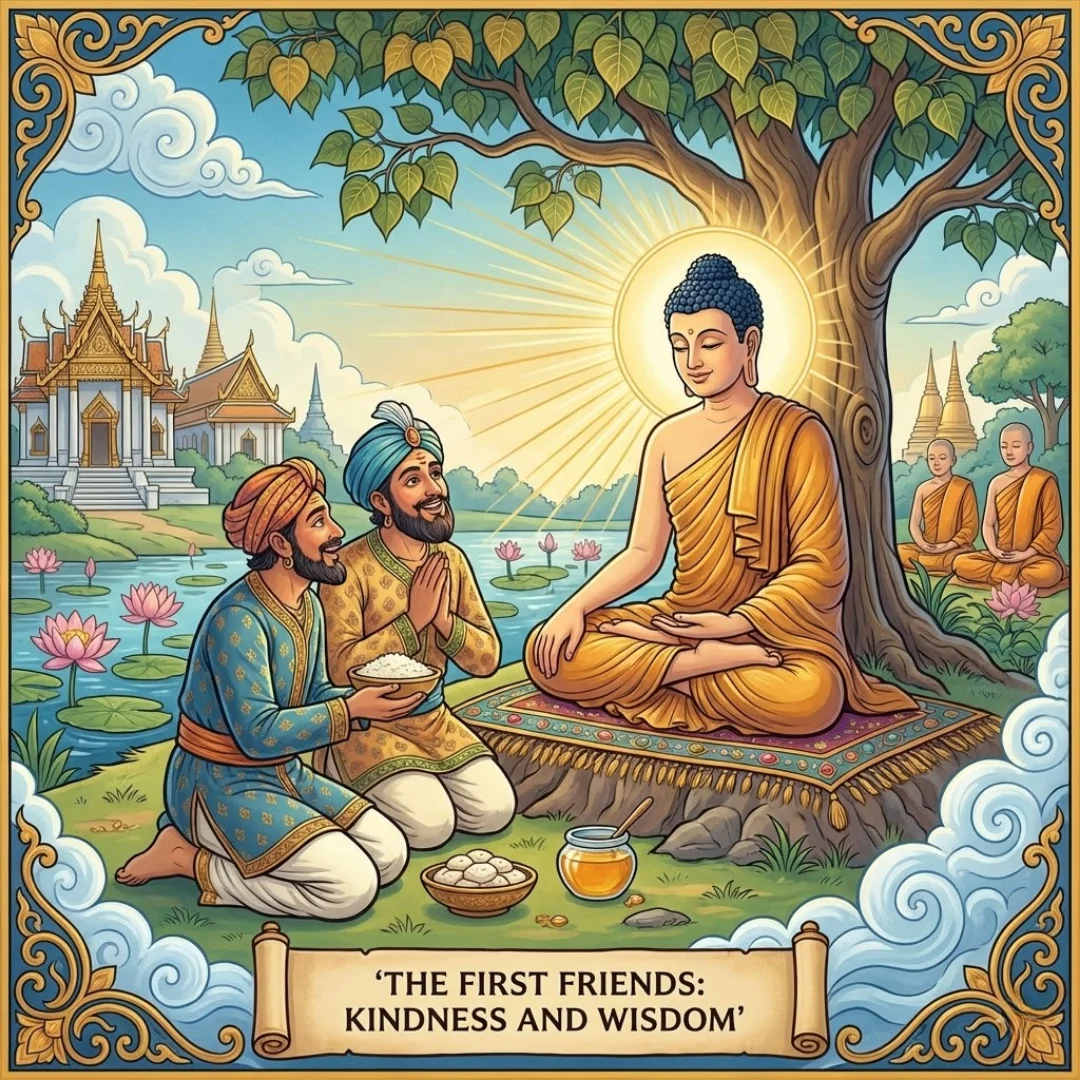
They hurried back to their caravan and gathered the finest food they had: rice cakes, sweet and golden, flavored with honey that had been collected from the forest flowers of their homeland.
But as they approached the Buddha, they realized something.
He had no bowl.
How could they offer food to someone who had nothing to receive it in?
The Buddha smiled gently, understanding their dilemma.
At that moment, the Four Great Kings—divine guardians of the four directions—appeared, each holding a bowl made of stone, gleaming and perfect.
“Accept these bowls, Blessed One,” the Four Kings said, bowing deeply.
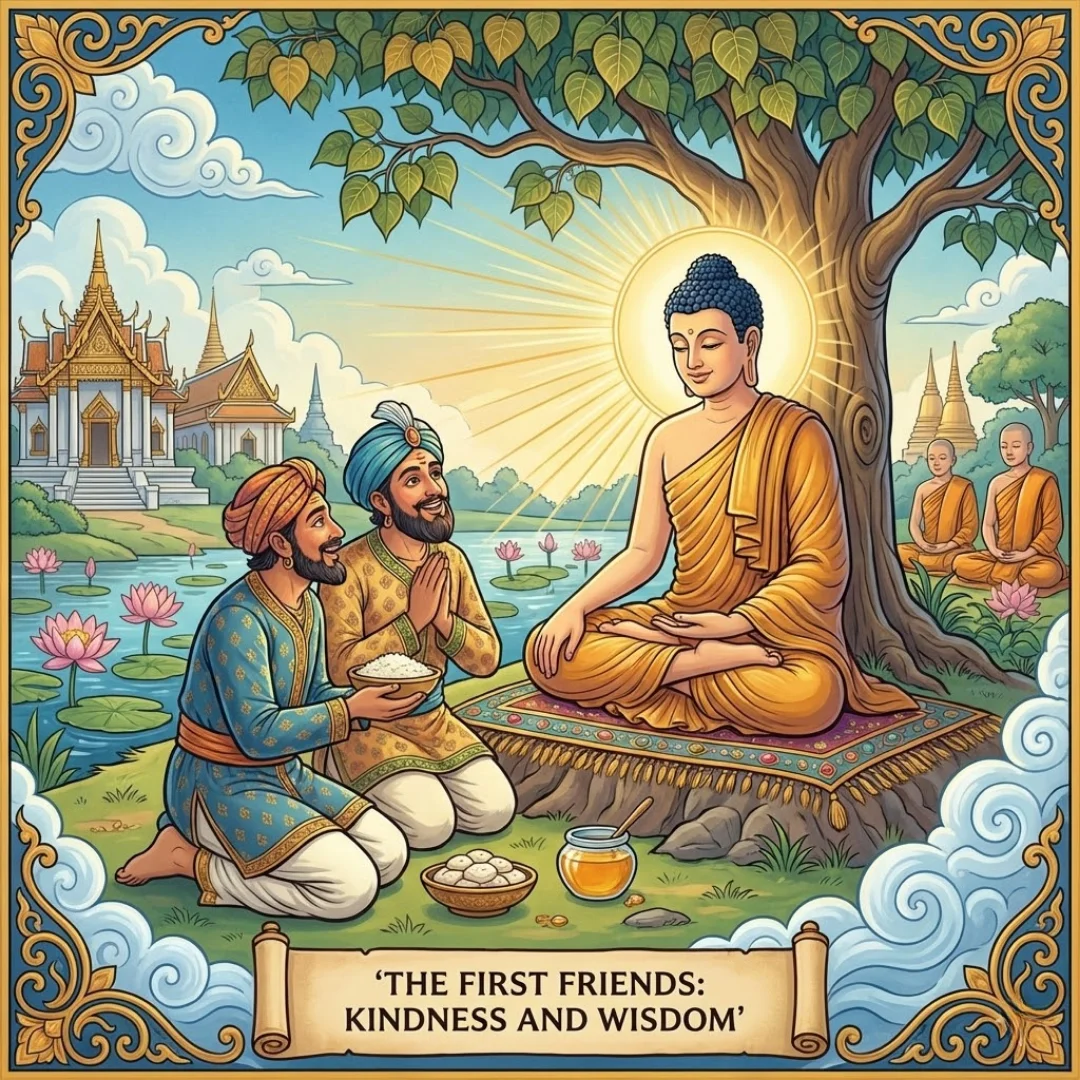
The Buddha, with his compassion and skill, miraculously transformed the four bowls into one—a single vessel that would receive the merchants’ offering.
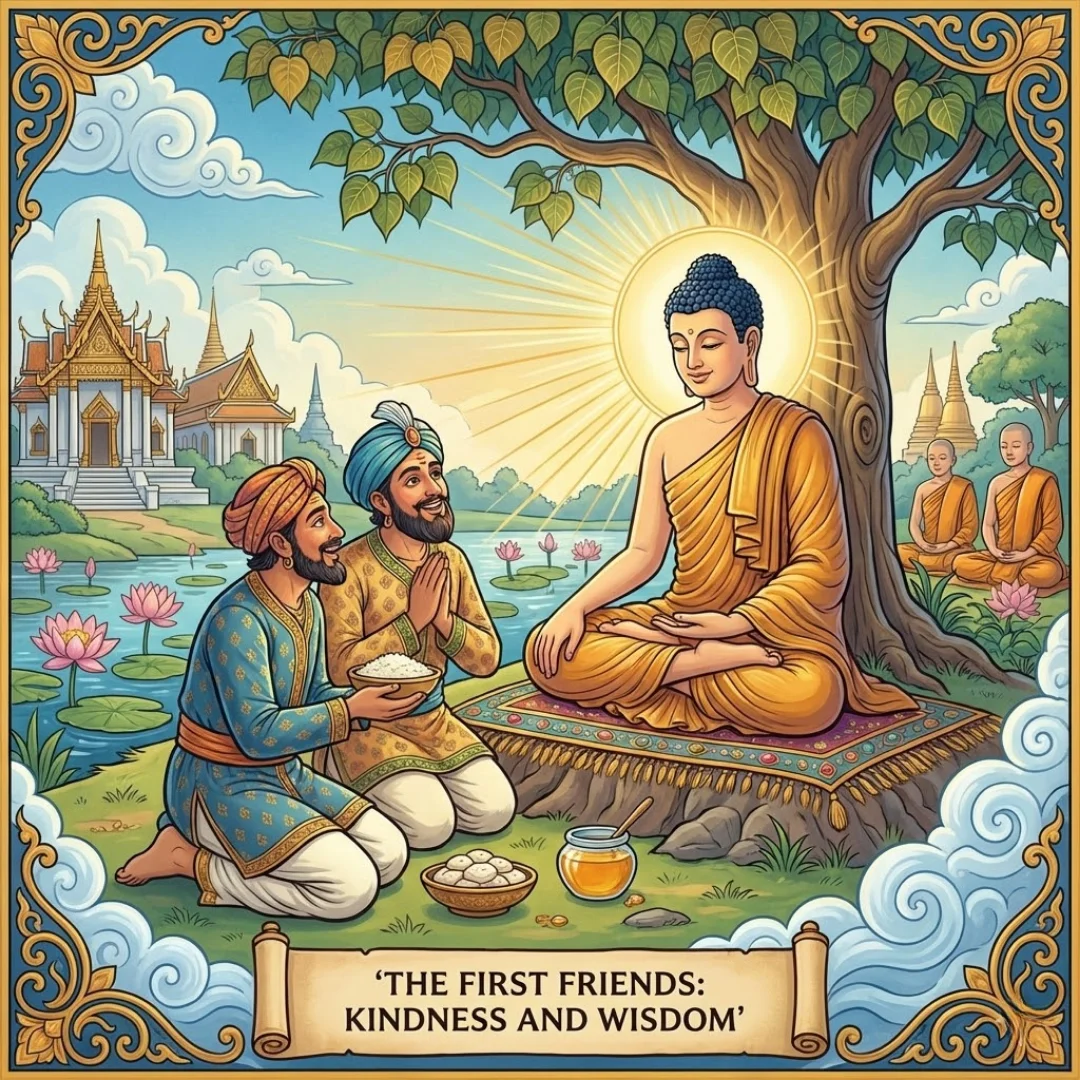
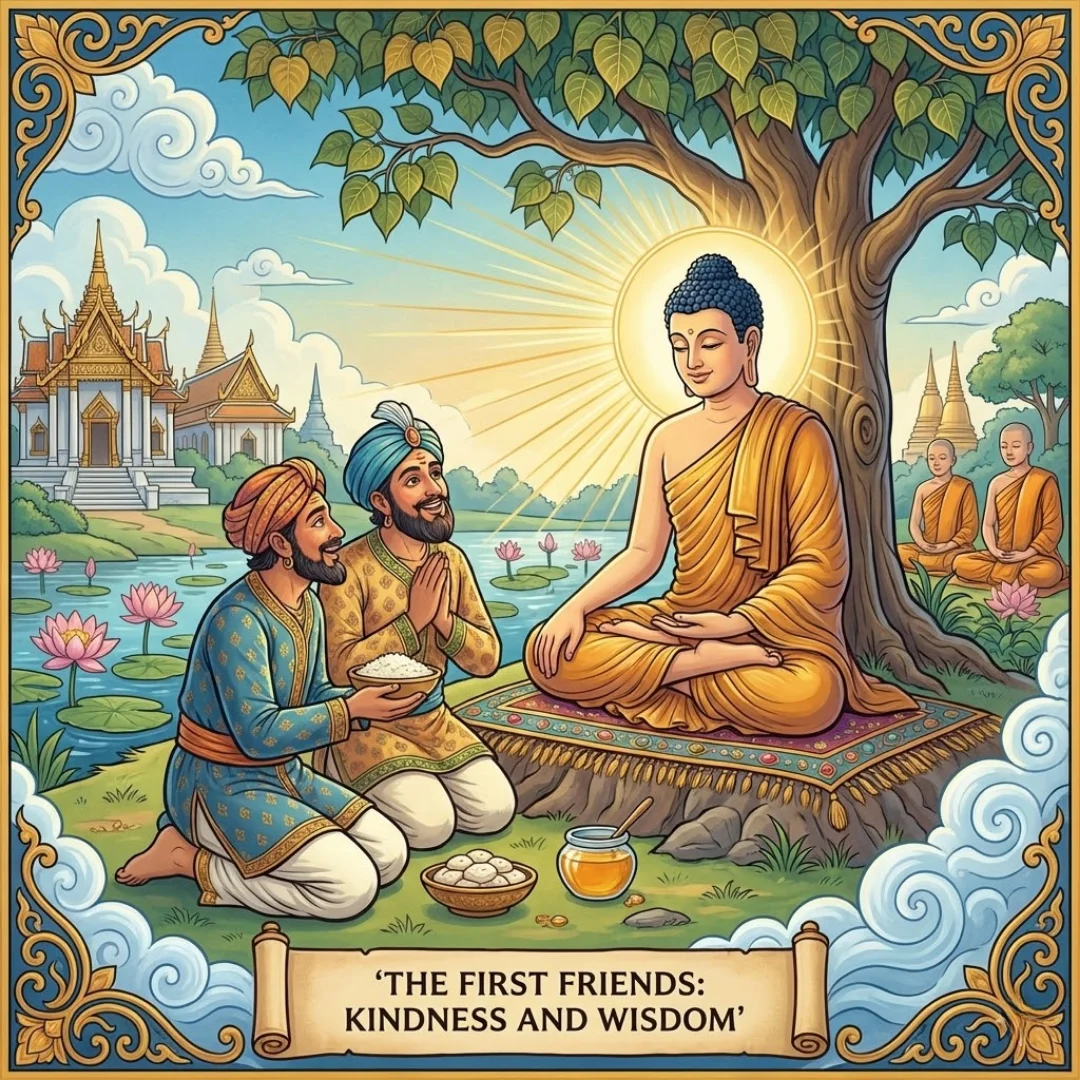
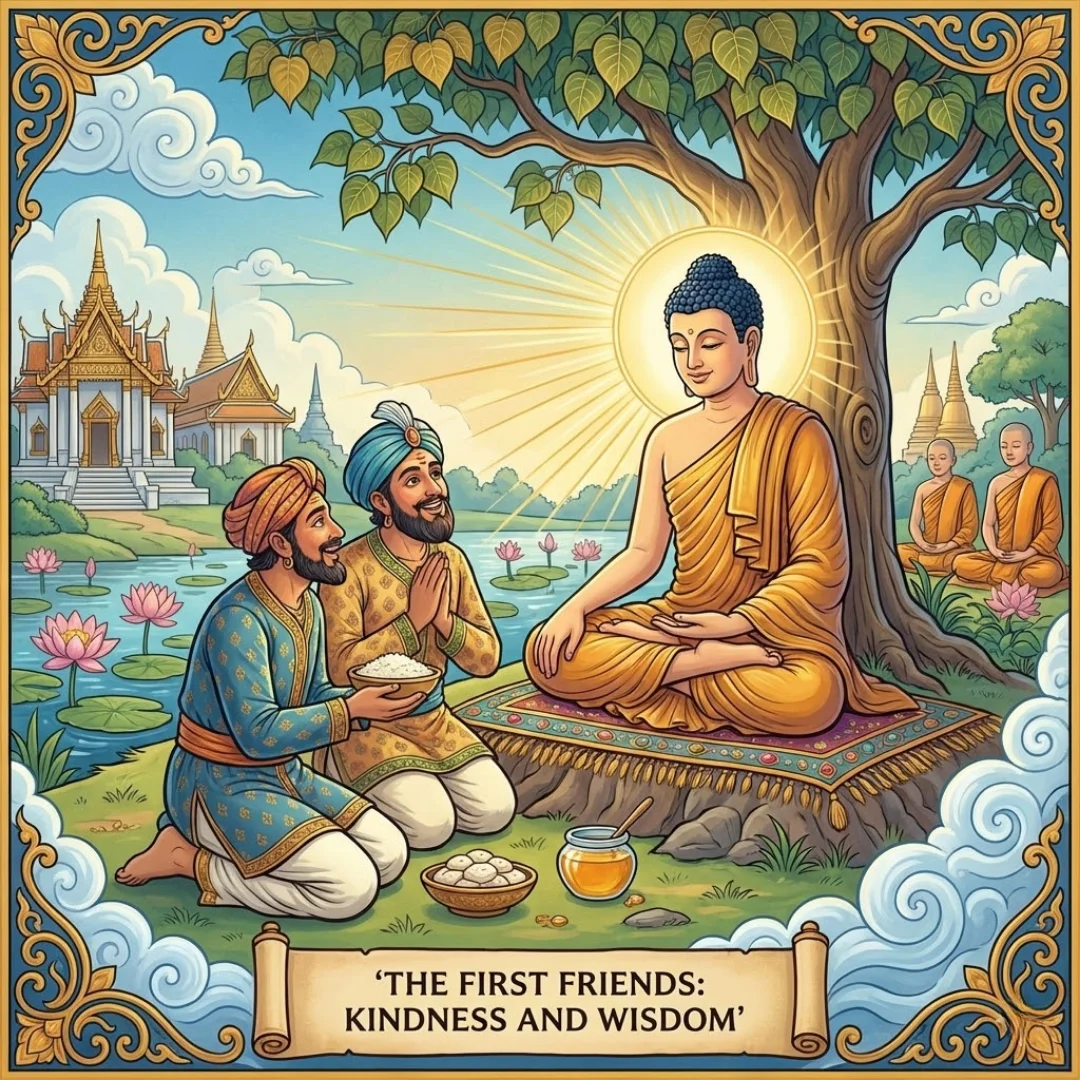
Tapussa and Bhallika placed their rice cakes and honey into the bowl with trembling hands.
It was the Buddha’s first meal after enlightenment.
He ate slowly, mindfully, each bite received with full awareness and gratitude.
When he finished, he looked up at the two brothers with eyes full of kindness.
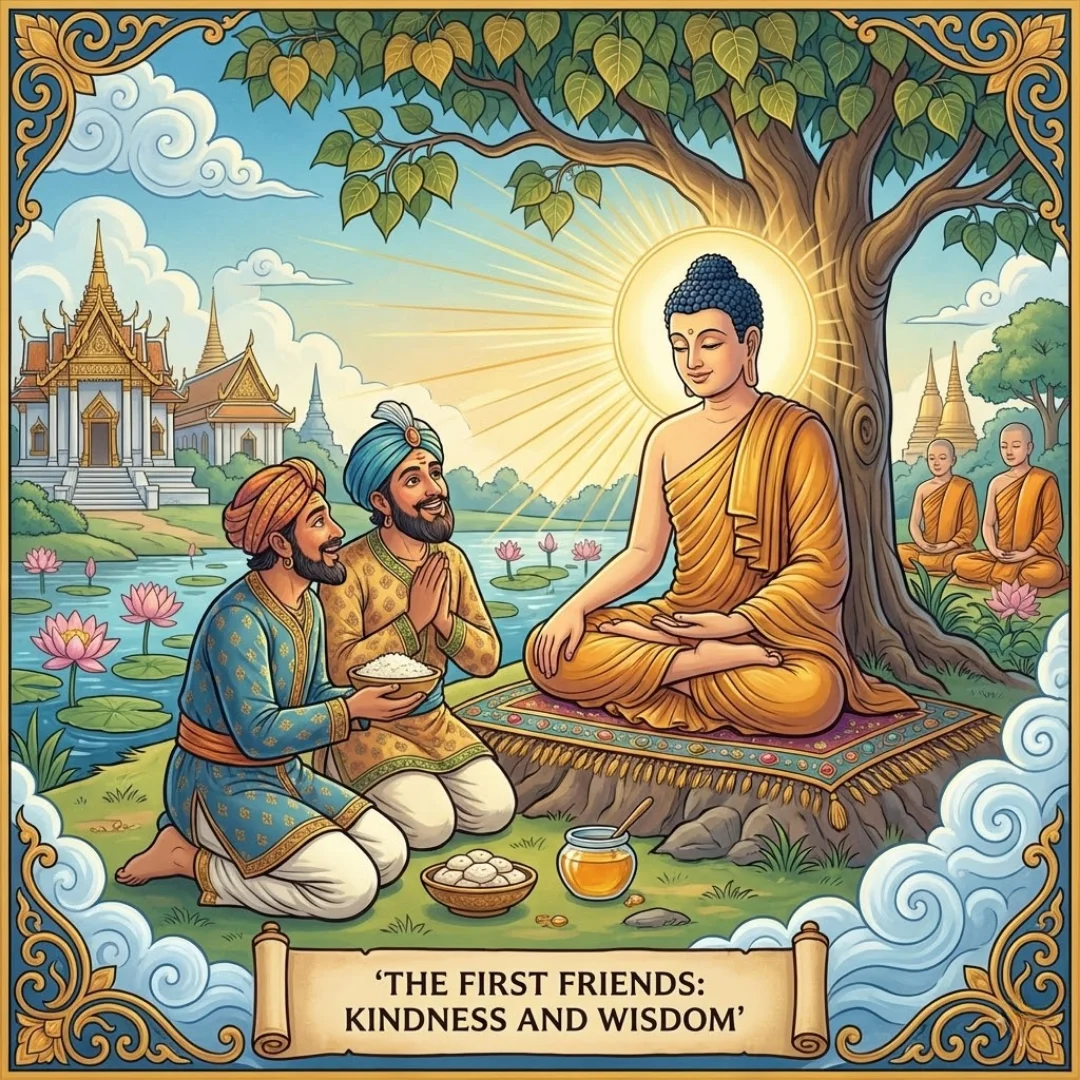
“You have offered me food when my body needed it most,” the Buddha said. “Now let me offer you something in return—food for your hearts and minds.”
* * *
## THE FIRST TEACHING
The brothers sat down on the ground before him, their legs folded, their hands pressed together in respect.
And the Buddha began to teach.
He spoke about dukkha—the suffering that touches all life. Birth is suffering. Aging is suffering. Illness is suffering. Death is suffering. Being separated from what we love is suffering. Being stuck with what we hate is suffering.
But, he explained, this suffering has a cause: craving and attachment. We suffer because we cling to things—possessions, relationships, ideas, even our own sense of self. We want things to stay the same, but everything changes. We want to control life, but life is beyond our control.
And then he shared the most important truth of all:
Suffering can end.
There is a path out of suffering—a way to live with wisdom, compassion, and peace. By understanding the nature of reality, by letting go of attachment and craving, by training the mind through meditation and ethical living, anyone can find freedom.
The brothers listened, and with each word, something in them shifted.
The teachings made sense—not just intellectually, but in their hearts. They felt old burdens lifting. Old worries dissolving.
For the first time in their lives, they understood.
* * *
## THE FIRST DISCIPLES
When the Buddha finished speaking, Tapussa and Bhallika bowed down until their foreheads touched the ground.
“Blessed One,” Tapussa said, his voice shaking with emotion, “we wish to become your followers. We take refuge in you and in your teachings.”
This moment was historic.
There was no Sangha yet—no community of monks. The Buddha’s enlightenment was so recent that no one else had yet committed to following his path.
So Tapussa and Bhallika took the first refuges ever spoken:
*”Buddham saranam gacchami”* — I go to the Buddha for refuge.
*”Dhammam saranam gacchami”* — I go to the Dharma (the teachings) for refuge.
They did not say the third refuge—”I go to the Sangha for refuge”—because the Sangha did not yet exist. They were the very first.
The Buddha smiled with deep joy.
“You are welcome, friends. Go forth with these teachings. Live with kindness. Speak truthfully. Act with compassion. And wherever you go, may you bring peace to those you meet.”
The brothers bowed again.
“Blessed One,” Bhallika said hesitantly, “we must continue our journey soon. But we wish to have something to remember you by—something to worship when you are far away and we need to remember your teachings.”
The Buddha raised his hand to his head and stroked it eight times.
Each time, a handful of his hair came away.
He divided the hair into two portions and gave them to the brothers.
“These are not just hair,” the Buddha said. “They represent my presence. Build shrines for them. Let them remind you—and anyone who sees them—that enlightenment is possible. That suffering can end. That peace is real.”
Tapussa and Bhallika received the sacred hair with reverence, wrapping it carefully in cloth.
* * *
## THE JOURNEY CONTINUES
The brothers returned to their caravan.
The moment they climbed back onto their carts, the oxen began to move again, as if the invisible force that had held them had released its grip.
But Tapussa and Bhallika were no longer the same men who had stopped on this road.
They had been the first to offer food to the Buddha after his enlightenment.
They had been the first to hear his teachings as lay disciples.
They had been the first to take refuge in him.
As they traveled toward Rājagaha, they carried more than goods to trade. They carried the Buddha’s hair—sacred relics that would later be enshrined in stupas, monuments that people would visit for thousands of years.
And they carried something even more precious: the Dharma—the teachings—burning bright in their hearts.
* * *
## THE LEGACY
Years later, when the Buddha’s teaching had spread and thousands had become his followers, Tapussa and Bhallika returned to visit him in Rājagaha.
The Buddha greeted them with recognition and love.
“My first friends,” he said warmly. “You supported me when my teaching was brand new and unknown. You had faith before there was a community to have faith in. You are honored among all my disciples.”
During that visit, Tapussa attained Stream-Entry—the first stage of enlightenment, which meant he would be reborn no more than seven more times before reaching full liberation.
His younger brother, Bhallika, went even further. He became a monk and, through dedicated practice, achieved arahatship—complete enlightenment—becoming one of the Buddha’s fully awakened disciples.
The two brothers who had stopped on a dusty road to offer rice cakes to a stranger became two of the most honored figures in Buddhist history.
* * *
## WHAT THE STORY TEACHES US
This story is not just about two merchants meeting a holy man.
It is about **recognizing what is valuable.**
Tapussa and Bhallika were wealthy men. They carried spices, cloth, brass vessels—goods worth fortunes. But when they saw the Buddha, they recognized something more valuable than any treasure: wisdom, peace, and truth.
It is about **generosity.**
They didn’t hesitate to offer their finest food to someone who had nothing. They gave freely, without expecting anything in return.
It is about **being first.**
Not in a competitive way, but in a courageous way. Tapussa and Bhallika had no tradition to follow, no community to join, no proof that the Buddha’s teachings worked. They simply listened, understood, and committed. That takes tremendous faith.
It is about **friendship.**
The Buddha called them “friends.” Not followers, not servants, but friends. True spiritual teaching is not about power or control—it is about mutual respect, care, and the sharing of truth.
And it is about **how small moments can change everything.**
A caravan stopped on a road. Two brothers offered a meal. A teaching was shared. And from that small moment, a friendship formed that would ripple across centuries, touching millions of lives.
* * *
## THE STUPAS
Today, thousands of years later, the hair relics given by the Buddha to Tapussa and Bhallika are said to be enshrined in stupas—sacred monuments—in multiple countries.
In Myanmar, the Shwedagon Pagoda in Yangon is believed to enshrine some of these hairs, along with relics of previous Buddhas. It is one of the most sacred sites in Buddhism, covered in gold, towering over the city, visited by millions.
In other countries—Sri Lanka, Thailand, India—similar claims are made, each stupa a reminder of that moment on the road when two brothers stopped to help a stranger.
Every time someone visits these stupas, offers flowers, lights incense, or meditates there, they are continuing the legacy of Tapussa and Bhallika.
The first friends.
The first to give.
The first to listen.
The first to understand.
* * *
And so, this story reminds us:
No act of kindness is too small.
No moment of generosity is wasted.
When we offer what we have—whether it is food, time, attention, or compassion—to someone in need, we are doing what Tapussa and Bhallika did.
We are creating friendship.
We are honoring truth.
We are building something that will last far beyond our own lives.
And perhaps, just perhaps, we might be the first—the first to help someone who will go on to help many others, the first to recognize something precious that others have overlooked, the first to act with courage and kindness when no one else will.
That is the gift of being a true friend.
And that is the lesson of Tapussa and Bhallika—
The very first friends of the Buddha.
MORAL LESSONS:
– Recognize what is truly valuable in life (wisdom over wealth)
– Practice generosity without expecting anything in return
– Have faith in goodness even when it’s new and unproven
– Small acts of kindness can have enormous consequences
– Being “first” takes courage—don’t wait for others to act before doing good
– True teaching is about friendship and respect, not power
– Listen deeply when wisdom is offered
– What we do today can create ripples that last for generations
– Honor and preserve what is sacred
– Support those who are doing good work, especially when they are just beginning
BUDDHIST ELEMENTS PRESERVED:
– Buddha’s seven weeks after enlightenment – exact from Pali Canon
– Seven locations/activities during the seven weeks – exact tradition
– Buddha at Rajāyatana tree in seventh week – exact
– Tapussa and Bhallika as merchant brothers – exact
– Traveling with bullock cart caravan – exact historical detail
– Deva (their former mother) guiding them – exact from sources
– Offering rice cakes and honey – exact
– Buddha’s first meal after enlightenment – exact
– Four Great Kings offering stone bowls – exact miracle story
– Buddha combining four bowls into one – exact
– First lay disciples taking refuge – exact historical significance
– Two refuges only (no Sangha yet) – exact theological detail
– Buddha giving eight handfuls of hair – exact from tradition
– Hair relics enshrined in stupas – exact (Shwedagon Pagoda, etc.)
– Tapussa attaining Stream-Entry – exact
– Bhallika becoming monk and attaining arahatship – exact
– Teaching about dukkha, craving, and path to freedom – authentic dharma
– Pali phrases for refuges – authentic language
SOURCE FIDELITY NOTES:
✓ Based on Pali Canon and early Buddhist texts
✓ All major events from authentic Buddhist tradition
✓ Seven weeks after enlightenment accurate from scriptures
✓ Names Tapussa and Bhallika exact (also Trapusa/Bahalika)
✓ Merchant occupation and caravan details accurate
✓ Deva as former mother – exact from sources
✓ Rice cakes and honey – exact offering
✓ Four Regent Gods/Kings and bowl miracle – exact
✓ First lay disciples status – historically accurate
✓ Two refuges (not three) – theologically significant detail
✓ Hair relics and stupa enshrinement – exact tradition
✓ Shwedagon Pagoda connection – actual historical claim
✓ Later attainments (Stream-Entry, arahatship) – exact from texts
✓ Buddha’s teaching content authentic to dharma
ENGAGEMENT ENHANCEMENTS:
+ Complete narrative context (seven weeks after enlightenment)
+ Rich sensory details (morning mist, peacock calls, dusty roads)
+ Character development (brothers as generous merchants)
+ Dialogue brings moment to life
+ Miracle elements presented naturally (deva, Four Kings, hair offering)
+ Emotional depth (brothers’ awe, Buddha’s compassion)
+ Scene breaks for pacing
+ Connection to present day (stupas, continued legacy)
+ Universal themes about kindness and recognizing value
+ Shows historical significance of being “first”
+ Child-appropriate while maintaining spiritual depth
CULTURAL SIGNIFICANCE:
– Tapussa and Bhallika honored as first lay disciples in all Buddhist traditions
– Demonstrates that enlightenment teaching is for laypeople, not just monks
– Shows Buddha’s accessibility and compassion
– Establishes pattern of dana (generosity) as foundation of Buddhist practice
– Hair relics important in Buddhist relic veneration tradition
– Shwedagon Pagoda one of most sacred sites in Buddhism
– Two refuges (vs. three) shows evolution of early Buddhist community
– Models proper relationship between teacher and student (friendship)
– Emphasizes merit-making through offerings
– Shows how small acts create lasting spiritual legacy
NOTE ON AUTHENTICITY:
This retelling faithfully follows the traditional Buddhist account of Tapussa and Bhallika as preserved in the Pali Canon and commentarial literature. The seven weeks after enlightenment, the location at the Rajāyatana tree, the deva as former mother, the offering of rice cakes and honey, the miracle of the four bowls becoming one, the giving of hair relics, and the brothers’ later spiritual attainments are all exact from Buddhist scriptures and tradition. The significance of being the first lay disciples to take refuge (using only two refuges because the Sangha didn’t yet exist) is an important historical and theological detail. The connection to the Shwedagon Pagoda and other stupas is part of actual Buddhist tradition that continues today.
SOURCES:
– [Tapussa and Bhallika | Vipassana Research Institute](https://www.vridhamma.org/Tapussa-and-Bhallika)
– [The Great Chapter – The First Teachings](https://ancient-buddhist-texts.net/English-Texts/Great-Chapter/04-Tapussa-Bhallika.htm)
– [Trapusa and Bahalika – Wikipedia](https://en.wikipedia.org/wiki/Trapusa_and_Bahalika)
– [Life of Buddha: 7 Weeks after Enlightenment](https://www.buddhanet.net/e-learning/buddhism/lifebuddha/17lbud/)
– [Stories Of Select Disciples Of The Buddha: Tapussa And Bhallika](https://satima.net/stories-of-select-disciples-of-the-buddha-tapussa-and-bhallika/)
– [Biography (1): Tapussa and Bhallika | Wisdom Library](https://www.wisdomlib.org/buddhism/book/the-great-chronicle-of-buddhas/d/doc365052.html)
– Pali Canon and Buddhist scriptural traditions
– Historical accounts of the Shwedagon Pagoda and Buddhist relic veneration
Test Your Understanding
1. What did Draupadi wish for that led to her having five husbands?
Frequently Asked Questions
What is the moral lesson of The First Friends?
What age is this story appropriate for?
How long does it take to read The First Friends?
What culture does this story come from?
Can I use this story for teaching?
Frequently Asked Questions
What is ‘The First Friends’ bedtime story for kids about?
This moral story for children ages 6-12 tells about Buddha’s enlightenment under the Bodhi tree and his first disciples who became his closest friends. Set in ancient India, it teaches kids about friendship, wisdom, and important Buddhist values in an age-appropriate way.
Who was Buddha and how did he become enlightened?
Buddha was originally named Siddhartha Gautama, a man who achieved perfect understanding and freedom from suffering under the Bodhi tree by the sacred river Nerañjarā. After his enlightenment, he became known as ‘the Awakened One’ and spent seven weeks in deep meditation.
What happened during Buddha’s seven weeks of meditation after enlightenment?
After becoming enlightened, Buddha sat in meditation for seven weeks experiencing profound peace and perfect understanding. During this time, he didn’t eat or sleep, simply resting in a state of complete freedom from suffering, craving, and confusion.
📚 Recommended Books
Handpicked for readers like you
As an Amazon Associate, we earn from qualifying purchases. These recommendations are personalized based on this story's themes and your reading history.
Is this Buddhist story appropriate for young children at bedtime?
Yes, this story is specifically designed as a bedtime story for kids ages 6-12. It presents Buddhist teachings about friendship and wisdom in a gentle, age-appropriate way that’s perfect for bedtime reading while teaching important moral values.
What moral lessons does this story teach children?
This educational story teaches kids about the importance of true friendship, inner peace, and wisdom. Through Buddha’s journey and his first disciples, children learn valuable lessons about loyalty, understanding, and how meaningful relationships are built on shared values and mutual respect.