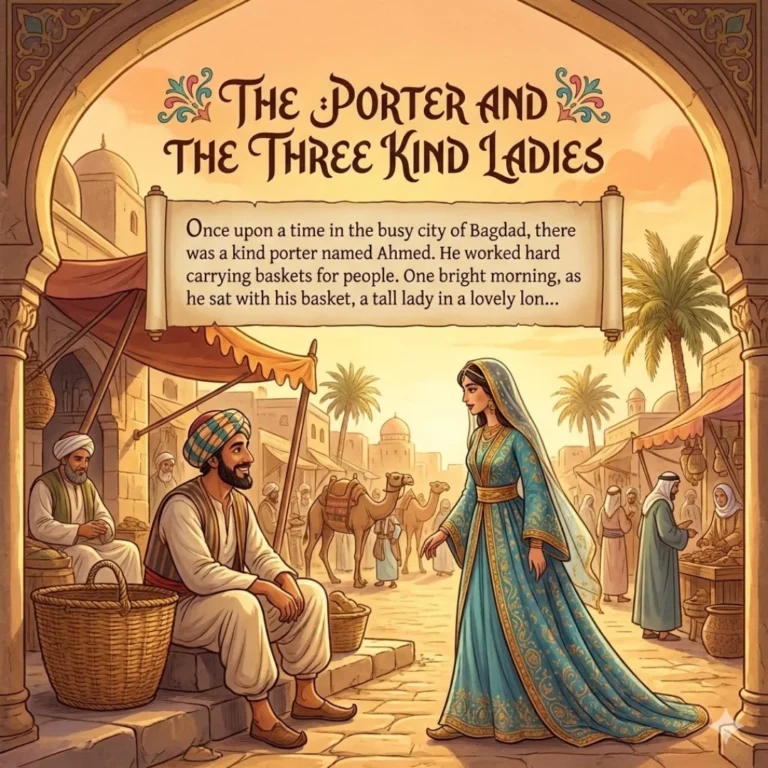
This bedtime story for kids, ‘The Porter and the Three Kind Ladies’, teaches children ages 6-12 about important moral values.
Chapter One: The Porter’s Morning
In the golden age of Baghdad, when the city sparkled like a jewel on the banks of the Tigris River, there lived a humble porter named Ahmed. Every morning, he would rise before the sun, wash his face in cool water, say his prayers, and take up his basket – a large, sturdy basket woven from reeds that he wore on his back using leather straps.
Being a porter was hard work. Ahmed would stand in the marketplace, waiting for merchants or shoppers who needed help carrying their purchases. For a few copper coins, he would hoist heavy bundles onto his back and follow his customers through the winding streets of the city.
But Ahmed never complained. “Every honest job has dignity,” he would say to his friends. “The baker, the scholar, the porter – we each play our part in making the city run smoothly.”
One particular morning, the spring air was sweet with the smell of jasmine flowers, and Ahmed felt especially cheerful. He stood near the fountain in the central bazaar, his empty basket ready for work, humming a happy tune.
“Perhaps today will bring an interesting adventure,” he thought to himself. Little did he know how right he would be!
Chapter Two: The Mysterious Lady
As Ahmed sat on the edge of the fountain, enjoying the spray of cool water in the warm air, he noticed an elegant lady approaching. She was tall and graceful, dressed in a flowing robe of deep blue silk, and she wore a veil that covered her face, leaving only her bright, intelligent eyes visible.
“Good morning, honest porter,” she said in a voice like music. “I require someone to carry my purchases. Are you for hire?”
“Indeed, my lady,” Ahmed replied, springing to his feet and bowing politely. “I am at your service.”
“Excellent. But I warn you – we shall be visiting many shops today, and you must carry everything without complaint. Can you do this?”
Ahmed smiled. “My basket has carried heavier loads than you might imagine, my lady. Lead the way, and I shall follow.”
The lady nodded, and they set off into the bustling bazaar.
Their first stop was a fruit seller’s stall, piled high with pomegranates red as rubies, oranges bright as sunset, dates glossy as polished wood, and grapes that hung in purple clusters. The lady selected the finest of everything, and Ahmed carefully arranged the fruit in his basket.
“That looks heavy already,” the fruit seller remarked.
“A porter’s back is strong,” Ahmed replied cheerfully, “and these fruits smell like paradise!”
Chapter Three: Through the Bazaar
Next, they visited a flower seller. The lady chose armfuls of jasmine, roses, and rare lilies that perfumed the air around them.
“Oh my!” Ahmed exclaimed, breathing deeply. “Wherever we are going, it must be a place of great celebration!”
The lady’s eyes crinkled, suggesting a smile beneath her veil. “We are just getting started, honest porter.”
At the butcher’s shop, she purchased the finest cuts of lamb and chicken. At the grocer’s, she selected almonds, pistachios, honey, olive oil, and spices – cinnamon, cardamom, and saffron worth their weight in gold. At every shop, the merchants greeted her with respect and gave her their very best goods.
Ahmed’s basket grew heavier and heavier. The leather straps bit into his shoulders, and sweat began to trickle down his forehead. But he noticed something remarkable – at each shop, the lady treated everyone with the same gracious courtesy, whether they were wealthy merchants or their youngest apprentices.
“You are very kind to everyone we meet,” Ahmed observed.
The lady turned to look at him thoughtfully. “Every person has a story, honest porter. The boy sweeping the shop floor may become a great merchant one day. The old woman selling herbs by the road may know secrets that scholars have forgotten. How can we know whom we might need, or who might need us?”
Chapter Four: The Golden Door
At last, after what seemed like hours of walking, they stopped before a great wooden door set in a high white wall. The door was carved with intricate patterns – flowers and geometric shapes that seemed to dance before Ahmed’s eyes.
The lady knocked three times.
The door swung open to reveal an old man with a long white beard and kind eyes. He wore simple clothes but carried himself with quiet dignity. Without a word, the lady handed him some coins, and he disappeared into the house.
“He is the gardener,” the lady explained. “He tends the courtyard and watches the gate.”
Moments later, the old man returned with a large clay jar filled with the finest juice – a blend of pomegranate and orange, cool and refreshing.
“Please add this to your basket, porter,” the lady said. “We are nearly home.”
Ahmed did so, though his arms were now trembling with the weight. “My lady,” he laughed, “if I had known how much you intended to buy, I would have brought a camel instead of a basket!”
To his surprise and delight, the lady laughed too – a warm, genuine laugh that made Ahmed feel as though he had known her for years.
“Your humor has lightened our journey,” she said. “Come, let us enter.”
Chapter Five: The Palace of Wonders
Ahmed stepped through the doorway and gasped. Beyond the simple outer gate lay a courtyard of breathtaking beauty. Marble tiles in patterns of white and blue covered the ground. In the center, a fountain bubbled up from the mouth of a golden lion, sending glittering arcs of water into the air. Fruit trees – orange, lemon, and fig – grew in clay pots, and songbirds chirped from silver cages.
“This way,” the lady said, leading him through an archway hung with silk curtains.
They entered a great hall. Cushions of velvet and silk were arranged around a central space. Lanterns of colored glass hung from the ceiling, casting rainbow patterns on the walls. And there, seated on a cushioned throne made of amber and decorated with pearls and precious stones, sat the most beautiful woman Ahmed had ever seen.
“Welcome to our home,” the woman said warmly. “I am Zobeida, the eldest sister. I see you have met Safie, who brought you here.”
The blue-robed lady – Safie – bowed to her sister. “This porter has worked hard and never complained,” she said. “His basket carried half the bazaar, and still he made me laugh.”
A third woman appeared from behind a curtain, younger than the others but with the same graceful bearing. “I am Amina, the youngest,” she said, smiling at Ahmed. “Please, let us help you with that heavy basket.”
Chapter Six: The Feast of Gratitude
Together, the three sisters lifted the basket from Ahmed’s aching back. He wanted to protest – after all, they were fine ladies, and he was just a porter – but they insisted.
“You have served us well,” Zobeida said. “Now let us serve you.”
They laid out the food on silver trays – the fruit arranged in patterns, the meats cooked with fragrant spices, the bread warm from the oven. The flowers were arranged in crystal vases around the room, filling the air with sweetness.
“Please, sit and eat with us,” Amina said, gesturing to a cushion beside the fountain.
“But my lady,” Ahmed stammered, looking down at his dusty clothes and calloused hands, “I am only a porter. Surely it would not be proper for me to sit at your table.”
Zobeida shook her head gently. “In this house, we judge people not by their clothes or their occupation, but by their character. You have been honest, hardworking, and cheerful. You treated every merchant and shopkeeper with respect. You made my sister laugh during a long and tiring journey. These things are worth more than gold.”
She held out a golden cup filled with the cool pomegranate juice. “Drink, honest porter, and know that you are welcome here.”
Chapter Seven: The Gift of Dignity
Ahmed stayed for the feast, and it was the most wonderful meal of his life. The sisters told stories and laughed at his jokes. They asked about his life, his family, his hopes and dreams. No one had ever shown such interest in a simple porter before.
When it was time to leave, Zobeida pressed a small leather pouch into his hands. It was heavy with gold coins – more money than Ahmed would normally earn in a year.
“This is too much,” Ahmed protested. “I only carried a basket.”
“You carried more than a basket,” Safie said softly. “You reminded us of something we sometimes forget in our fine house. Every person deserves to be treated with kindness. Every job has value. Every soul has worth.”
Amina nodded. “Go home, honest porter. Tell your family about the three sisters who learned as much from you as you did from them.”
Ahmed bowed deeply, tears of gratitude in his eyes. As he walked home through the evening streets of Baghdad, his basket empty but his heart full, he thought about all he had experienced.
He had entered that house as a porter, a carrier of burdens. He left as something more – a reminder that kindness knows no social boundaries, and that true wealth lies not in gold and silver, but in how we treat one another.
And from that day forward, whenever Ahmed stood in the marketplace with his basket, he would smile and remember: every person who passed by had a story, a dream, a heart that deserved respect. He had been treated like a prince by three kind ladies, and he would spend the rest of his life passing that kindness on to others.
Moral Lessons
- Treat everyone with kindness and respect, no matter their job or appearance. Everyone has value and can make the world a better place. True wealth is not measured in gold, but in the dignity and compassion we show to others.
Test Your Understanding
1. What was Ahmed’s job in the city of Baghdad?
2. What did the elegant lady in the blue robe say about treating people?
3. Who were the three kind ladies Ahmed met?
4. Why did the sisters insist that Ahmed stay and eat with them?
5. What did Safie say Ahmed reminded them of?
6. What is the main moral lesson of this story?
Frequently Asked Questions
What is the moral lesson of The Porter and the Three Kind Ladies?
What age is this story appropriate for?
How long does it take to read The Porter and the Three Kind Ladies?
What culture does this story come from?
Can I use this story for teaching?
Frequently Asked Questions
What is ‘The Porter and the Three Kind Ladies’ about?
The Porter and the Three Kind Ladies is a bedtime story for kids set in the golden age of Baghdad. It follows Ahmed, a humble porter, and his encounter with three kind ladies. The story teaches children ages 6-12 important moral values about dignity, honesty, and kindness through an engaging adventure-style tale.
What age group is The Porter and the Three Kind Ladies suitable for?
This story is written for children between the ages of 6 and 12. The language is simple and engaging enough for younger readers, while the moral lessons and storytelling are rich enough to keep older kids interested. It also works great as a bedtime story read aloud by parents.
What moral lessons do kids learn from this story?
The story teaches children that every honest job has dignity and that hard work deserves respect. It also explores themes of kindness, humility, and integrity. Ahmed the porter demonstrates that a positive attitude and good values matter more than wealth or status.
📚 Recommended Books
Handpicked for readers like you
As an Amazon Associate, we earn from qualifying purchases. These recommendations are personalized based on this story's themes and your reading history.
Where is The Porter and the Three Kind Ladies set?
The story is set in Baghdad during its golden age, when the city was a vibrant cultural and trading hub on the banks of the Tigris River. This historical backdrop brings the tale to life, making it both an entertaining and subtly educational read for young children.
Is The Porter and the Three Kind Ladies a good bedtime story for kids?
Yes, it makes an excellent bedtime story for kids. The calming, descriptive language and positive moral themes help children wind down while absorbing valuable life lessons. The story’s manageable chapters and relatable main character also make it easy for parents to read aloud at bedtime.