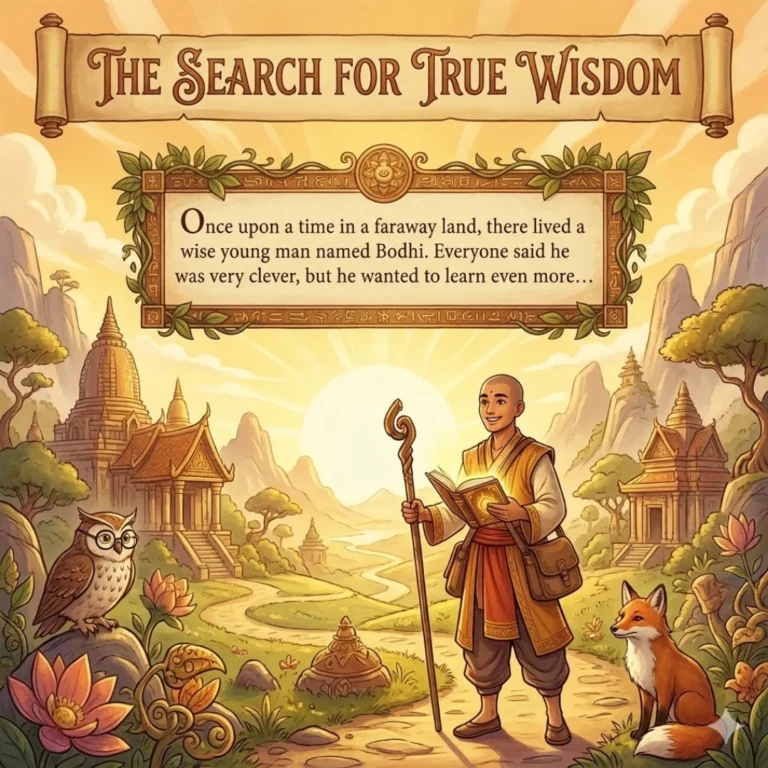
This bedtime story for kids, ‘The Search for True wisdom/” title=”More stories about wisdom”>Wisdom’, teaches children ages 6-12 about important moral values.
Chapter One: The Young Seeker
Long ago, in the foothills of the Himalayan mountains, in a land that is now Nepal and India, there lived a young man named Siddhartha. He had been born a prince, surrounded by every luxury imaginable – silken robes, golden palaces, and gardens filled with the sweetest fruits and most fragrant flowers.
But Siddhartha was troubled. Despite all his wealth, he had discovered something that shook him to his core: outside the palace walls, people suffered. They grew old, they fell ill, and eventually, they all died. No amount of gold could protect anyone from these sorrows.
“There must be a way to find peace,” Siddhartha thought. “There must be a wisdom that can help all beings overcome suffering.”
So one night, while the palace slept, Siddhartha removed his princely robes, traded them for the simple orange garment of a wandering seeker, and set out into the world to find true wisdom.
Chapter Two: The First teacher
Siddhartha traveled for many days through forests and across rivers until he reached a grove of mango trees where a famous teacher named Alara Kalama sat surrounded by his students. Alara was known throughout the land for his deep understanding of the mind and spirit.
“Great teacher,” Siddhartha said, bowing respectfully, “I have come seeking wisdom. Will you teach me?”
Alara looked at the young man with kind eyes. “Sit, young seeker. I will share what I know.”
Day after day, Siddhartha listened and learned. Alara taught him about meditation – how to quiet the busy chatter of the mind like stilling ripples on a pond. He taught him about the self.
“What is this self that speaks and feels?” Alara asked one morning as sunlight filtered through the mango leaves. “It sees through your eyes, hears through your ears, smells the morning flowers, and thinks the thoughts in your head. Is this self your body?”
“No, teacher,” another student answered. “For my body changes – I was once a child, now I am grown – yet I am still me.”
“Then is your self your mind?” Alara continued.
The students pondered this deeply.
“The self is that which makes you feel and move,” Alara explained. “It is separate from the physical world. When we free ourselves from all desires, from wanting things and fearing things, we reach a state of perfect peace. Imagine a bird escaping from its cage to fly freely in the sky – that is what true happiness feels like!”
Chapter Three: Something Missing
Siddhartha was an exceptional student. Within months, he had mastered everything Alara could teach him. The old teacher was amazed.
“Young Siddhartha,” Alara said one evening, “you have learned all that I know. Stay and teach beside me. Together we can guide many seekers on the path.”
But Siddhartha sat quietly, his brow furrowed in thought. “I am grateful, teacher, for all you have shared. Your teachings are profound. And yet… something is still missing.”
“Missing?” Alara looked surprised. “What more could there be?”
“Your teaching says that each person has a separate self, like a candle flame enclosed in a lantern,” Siddhartha said slowly, working out his thoughts. “But I wonder… are we really so separate? When I look at the mango tree, where do I end and the tree begin? I breathe the air it releases; it feeds on the soil where my footsteps have fallen. We seem more connected than separated.”
Alara stroked his beard thoughtfully. He had not considered this perspective before.
Chapter Four: The Second Teacher
Siddhartha bid farewell to Alara and traveled onward until he found another renowned teacher named Uddaka Ramaputta. This teacher sat in meditation so deep that he seemed more like a statue than a living man.
“I seek true wisdom,” Siddhartha told him. “May I learn from you?”
Uddaka opened his eyes slowly. “Sit, young one.”
With Uddaka, Siddhartha learned even more advanced meditation techniques. He learned to enter states of consciousness so subtle and refined that they seemed beyond the world itself.
Uddaka taught him about karma – the idea that every action has consequences.
“Think of it like throwing a stone into a pond,” Uddaka explained. “The ripples spread outward in all directions. Your good actions create good ripples that come back to you. Your harmful actions create harmful ripples. Those who act with kindness plant seeds of future happiness. Those who act with cruelty plant seeds of future sorrow.”
“This makes sense,” Siddhartha nodded. “But teacher, what is the end of this? Can we ever escape from these ripples entirely?”
“Through perfect meditation and withdrawal from the world,” Uddaka replied, “we can rise above the cycle entirely.”
Chapter Five: The Heart of Connection
Once again, Siddhartha mastered everything his teacher could offer. Once again, he was invited to stay and teach. And once again, something troubled him.
One night, as the other students slept, Siddhartha sat beneath a sal tree, watching fireflies dance in the darkness. A thought was forming in his mind, piece by piece, like a flower slowly opening its petals.
“Teacher,” he said to Uddaka the next morning, “I must speak what is in my heart.”
“Speak freely, young seeker.”
“Your teaching is beautiful and powerful. But when you speak of the self reaching peace alone, separate from all things… I wonder if this is truly possible. You see, I have been thinking. What is fire without heat?”
Uddaka blinked. “Fire without heat is not fire at all.”
“Exactly!” Siddhartha’s eyes brightened. “Fire needs heat to be fire. And perhaps… perhaps we need each other to be ourselves. When I help another person, I am not separate from them – I am connected to them. Their joy becomes my joy. Their peace becomes my peace.”
He stood and began pacing as the ideas flowed.
“We are like waves in the ocean, teacher. Each wave looks separate, rising and falling on its own. But beneath the surface, all waves are the same ocean. What if true peace comes not from separating ourselves from others, but from understanding that we were never really separate at all?”
Chapter Six: The Path of Connection
The students who had been listening gathered closer, intrigued by Siddhartha’s words.
“Think of a single thread,” Siddhartha continued, picking up a loose string from his robe. “Alone, it is fragile. It can do little. But woven together with thousands of other threads, it becomes a strong cloth that can shelter us from cold, carry our belongings, and bring comfort to many.”
He looked around at the circle of seekers, his face filled with warmth.
“We are like those threads. Our true nature is not to be alone, seeking peace in isolation. Our true nature is to be woven together, each of us strengthening the whole. When we help each other, when we share and care for one another, we find something that sitting alone on a mountaintop can never give us.”
“But what about meditation?” one student asked. “What about quieting the mind?”
“These are valuable tools,” Siddhartha agreed. “Like a farmer’s plow or a carpenter’s saw. But tools are meant to be used for building something. We quiet our minds so that we can see clearly. And when we see clearly, we see that kindness and connection are at the heart of everything.”
Chapter Seven: The Wisdom That Spreads
Siddhartha left Uddaka’s grove with gratitude in his heart. He continued his search, and eventually, through his own practice and insight, he became the Buddha – the “Awakened One.” But he never forgot what he had learned from his teachers, or what he had discovered by looking beyond their teachings.
The wisdom he found was this: we are all connected. Like the mango tree and the soil, like the fire and the heat, like the threads in a cloth. True happiness does not come from withdrawing from the world, but from understanding our place in it and treating all beings with kindness.
The Buddha spent the rest of his long life wandering from village to village, teaching this wisdom to anyone who wished to hear it. Kings and beggars, old and young, rich and poor – all were welcome.
“There is suffering in the world,” he would say. “But there is also a way out of suffering. It lies in understanding, in compassion, and in the connections we make with one another. We do not become wise by being alone. We become wise by being together in kindness.”
And so, dear children, remember the story of Siddhartha’s search for true wisdom. The greatest teachers could not give him what he was looking for, because what he sought was not something you receive – it is something you discover when you open your heart to others.
True happiness comes not from being alone in wisdom, but from being together in kindness.
Moral Lessons
- True happiness comes not from being alone in wisdom, but from being together in kindness. We are all connected, and when we help and care for one another, we find the deepest peace and the truest wisdom.
Test Your Understanding
1. Why did Prince Siddhartha leave his palace and begin his search for truth?
2. What did Siddhartha’s first teacher Alara Kalama teach about the self?
3. What question troubled Siddhartha about his teachers’ lessons?
4. What metaphor did Siddhartha use to explain how we are all connected?
5. What did Siddhartha say about meditation and quieting the mind?
6. What is the main moral lesson of this story?
Frequently Asked Questions
What is the moral lesson of The Search for True Wisdom?
What age is this story appropriate for?
How long does it take to read The Search for True Wisdom?
What culture does this story come from?
Can I use this story for teaching?
Frequently Asked Questions
What is ‘The Search for True Wisdom’ story about?
This bedtime story follows young Prince Siddhartha, who leaves his luxurious palace life to find true wisdom that can help people overcome suffering. Set in ancient Nepal and India, it teaches children about the importance of seeking inner peace and understanding rather than focusing only on material wealth and comfort.
Is this story appropriate for my child?
Yes, this moral story is specifically written for children ages 6-12. It presents deep philosophical concepts about wisdom and life in an age-appropriate way, using gentle storytelling without frightening content. It’s perfect as a bedtime story that teaches valuable life lessons while entertaining young readers.
Who is Siddhartha and why did he leave the palace?
Siddhartha was a prince who had everything money could buy – gold, silk robes, and beautiful gardens. However, he discovered that people outside his palace suffered from old age, illness, and death. This troubled him deeply, so he left his comfortable life to find wisdom that could help all beings find peace.
📚 Recommended Books
Handpicked for readers like you
As an Amazon Associate, we earn from qualifying purchases. These recommendations are personalized based on this story's themes and your reading history.
What kind of wisdom does this story teach children?
The story teaches that true wisdom comes from understanding and compassion rather than material possessions. Children learn that seeking knowledge and inner peace is more valuable than wealth, and that we should care about others’ suffering. It introduces concepts of empathy and spiritual growth in simple terms.
Where and when does this story take place?
The story is set long ago in the foothills of the Himalayan mountains, in the lands that are now Nepal and India. This ancient setting provides a rich cultural backdrop that helps children learn about different parts of the world while following Siddhartha’s transformative journey to enlightenment.