

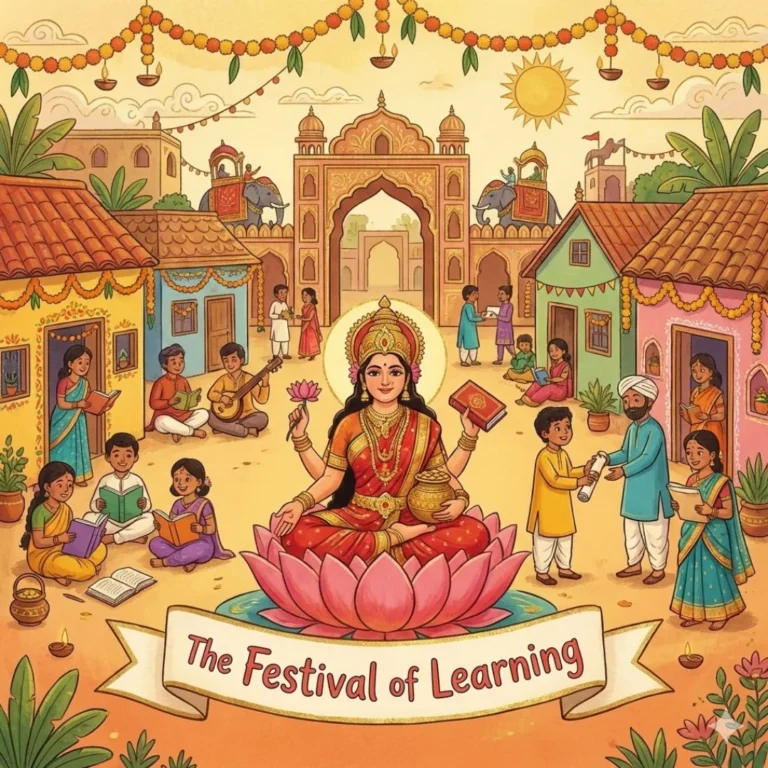
This bedtime story for kids, ‘The Festival of learning’, teaches children ages 6-12 about important moral values.
Chapter One: The Golden Morning
The first rays of dawn painted the sky in shades of orange and pink as young Priya opened her eyes. Today was no ordinary day. Today was Vasant Panchami, the most wonderful festival of the year for students like her.
“Priya! Wake up, little scholar!” called her grandmother, Nani-ji, from the courtyard. “The goddess Saraswati awaits our offerings!”
Priya jumped out of bed with excitement bubbling in her chest. She could already smell the sweet fragrance of marigolds and jasmine flowers drifting through the window. Outside, the entire village of Vrindavan was coming alive with activity.
As Priya stepped into the courtyard, she gasped at the beautiful sight before her. Her mother had created an elaborate altar decorated with yellow flowers, white silk cloths, and glittering brass lamps. In the center stood a magnificent image of Goddess Saraswati, seated gracefully on a white lotus flower, her four arms holding a veena (a musical instrument), sacred scriptures, a mala of crystal beads, and a pot of sacred water.
“She is beautiful, Nani-ji,” Priya whispered in awe.
Her grandmother smiled warmly. “Indeed she is, my child. Do you know why we celebrate this special day?”
Priya shook her head, her dark braids swinging.
Chapter Two: The Story of the Divine Goddess
Nani-ji sat down on a woven mat and patted the space beside her. “Come, let me tell you the ancient story of how Saraswati came to bless us with knowledge.”
Priya settled beside her grandmother as the morning birds began their chorus.
“Long, long ago,” Nani-ji began, her voice soft and melodious, “when the universe was young and empty, there was only Lord Brahma, the Creator. He looked around at the silent void and felt a deep sadness. The world needed order, beauty, and meaning.”
“What did he do?” Priya asked, her eyes wide.
“Brahma sat in deep meditation, and from his divine energy emerged a radiant goddess dressed in pure white. She was Saraswati, more beautiful than the morning star, with skin the color of jasmine and eyes that sparkled with infinite wisdom.”
“Wow!” Priya exclaimed.
“Indeed. Saraswati brought with her the gift of knowledge. She taught humans how to speak, how to write, how to create music and art. She showed them how to understand the mysteries of the world through learning. Without her blessings, we would still be wandering in darkness, unable to share our thoughts or preserve our memories.”
Chapter Three: The Ritual of Reverence
“That is why,” Nani-ji continued, “on this special day, we honor everything that helps us learn.”
She gestured to the courtyard where Priya’s parents were arranging items on yellow cloths spread across the ground. Priya saw her schoolbooks, her notebooks, her pencils and pens, and even her father’s accounting ledgers.
“We give our tools of learning a day of rest,” Nani-ji explained. “We clean them, decorate them with flowers, and place them before the goddess. On Vasant Panchami, we do not write or study. Instead, we express gratitude for the knowledge we have received.”
Priya’s mother approached carrying a brass plate filled with offerings: sweet rice pudding colored with saffron, fresh fruits, and small clay lamps filled with ghee.
“Come, Priya,” her mother said gently. “It is time for the puja.”
The whole family gathered around the altar. Priya’s father rang a small brass bell, its clear tone echoing across the courtyard. Her mother lit the lamps, and golden light danced across Saraswati’s serene face.
“O Saraswati, mother of all knowledge,” her father chanted, “bless our daughter with wisdom and understanding. May she use her learning to help others and make the world a better place.”
Chapter Four: The Village Celebration
After the family puja, Priya and her family walked through the winding lanes of Vrindavan to join the village celebration. Everywhere she looked, people wore yellow clothes, the color of spring and knowledge. Yellow marigolds hung from doorways, and the air was thick with the scent of sandalwood incense.
In the village square, a magnificent pandal had been erected, a temporary temple decorated with banana leaves, mango garlands, and hundreds of tiny bells that chimed in the breeze. At its center stood a grand statue of Saraswati, surrounded by offerings from every family in the village.
“Look, Priya!” called her best friend Arun, waving excitedly. “My father let me bring my harmonium to be blessed!”
Arun was learning to play the traditional keyboard instrument, and he treasured it above all his possessions.
“And I brought my dance bells,” added Meera, another friend, showing off the silver bells her grandmother had given her.
The village teacher, Master Sharma, gathered all the children together near the altar.
“Children,” he said, his kind eyes twinkling, “today we celebrate the goddess who makes learning possible. But do you know what the true gift of Saraswati is?”
The children looked at each other, uncertain.
“It is not just the ability to read books or solve problems,” Master Sharma continued. “It is the gift of curiosity, the desire to ask questions and seek answers. Every time you wonder ‘why’ or ‘how,’ you are honoring Saraswati.”
Chapter Five: The Lesson of the Yellow Flowers
As the day progressed, the villagers shared a grand feast. There was puri and halwa, kheer and ladoo, all colored golden yellow in honor of the festival. Musicians played traditional songs, and young girls performed classical dances before the goddess.
But as evening approached, Priya noticed something that troubled her. Her younger cousin, little Ravi, sat alone under a neem tree, looking sad.
“What is wrong, Ravi?” Priya asked, sitting beside him.
“I cannot read yet,” Ravi said, his lower lip trembling. “I am too small. The goddess will not bless me because I do not have any books to offer.”
Priya felt her heart swell with compassion. She remembered Nani-ji’s story and Master Sharma’s words.
“Oh, Ravi,” she said gently, taking his small hand. “Saraswati does not only bless those who can already read. She blesses those who want to learn. Do you want to learn?”
Ravi nodded eagerly.
“Then come with me.”
Priya led her cousin to the altar and helped him pick up a small yellow flower.
“Close your eyes,” she whispered, “and ask the goddess to help you learn. That is all you need to do.”
Ravi squeezed his eyes shut tight, his face a picture of earnest concentration. When he opened them again, he was smiling.
“I felt something warm in my heart!” he exclaimed.
“That is the blessing of knowledge beginning to grow,” Priya said. “And I promise, I will help you learn to read.”
Chapter Six: The Night of Stars
As darkness fell over Vrindavan, the family returned home. The oil lamps around Saraswati’s image cast dancing shadows on the walls, and the night was filled with the distant sounds of devotional songs.
Priya sat on the roof with Nani-ji, looking up at the stars that sparkled like diamonds scattered across black velvet.
“Nani-ji,” Priya said thoughtfully, “I learned something important today.”
“Tell me, my wise granddaughter.”
“Knowledge is not just for ourselves. When we learn something, we should share it with others. Like how I will teach Ravi to read. That way, the goddess’s blessing spreads to everyone.”
Nani-ji’s eyes glistened with happy tears. She pulled Priya close and kissed the top of her head.
“You have understood the deepest truth of Vasant Panchami,” she said. “Saraswati gives us knowledge so we can light lamps in the minds of others. Every teacher, every parent, every friend who shares what they know, becomes a servant of the goddess.”
The stars seemed to twinkle more brightly as Priya made a silent promise. She would always love learning, but more importantly, she would always share what she learned with others.
And somewhere in the heavens, the goddess Saraswati smiled, for another young heart had discovered the true meaning of wisdom.
Moral Lessons
- Knowledge is a sacred gift meant to be shared. When we learn, we should help others learn too, for wisdom grows greater when it is passed from one heart to another.
Test Your Understanding
1. Who is Saraswati and what is she the goddess of?
2. What do people traditionally do on Vasant Panchami?
3. What color is traditionally worn during Vasant Panchami?
4. Why was little Ravi sad during the festival?
5. What important truth did Priya learn about knowledge?
6. What is the main moral lesson of this story?
Frequently Asked Questions
What is the moral lesson of The Festival of Learning?
What age is this story appropriate for?
How long does it take to read The Festival of Learning?
What culture does this story come from?
Can I use this story for teaching?
Frequently Asked Questions
What is the Festival of Learning?
The Festival of Learning refers to Vasant Panchami, a Hindu festival celebrating Goddess Saraswati, the deity of knowledge, wisdom, and arts. This spring festival is especially important for students and scholars who seek blessings for their educational journey and creative pursuits.
What is Vasant Panchami and when is it celebrated?
Vasant Panchami is a Hindu spring festival typically celebrated in January or February. It marks the arrival of spring and honors Goddess Saraswati. Devotees wear yellow clothes, offer prayers, and students place their books and instruments near the goddess for blessings.
Who is Goddess Saraswati and why is she important?
Goddess Saraswati is the Hindu deity of knowledge, wisdom, learning, music, and arts. She’s typically depicted with four arms holding a veena (musical instrument), sacred texts, prayer beads, and holy water, representing different aspects of learning and creativity.
📚 Recommended Books
Handpicked for readers like you
As an Amazon Associate, we earn from qualifying purchases. These recommendations are personalized based on this story's themes and your reading history.
What age group is this learning story suitable for?
This Festival of Learning story is designed for children ages 6-12. It’s written as an engaging bedtime story that teaches moral values while introducing young readers to Hindu cultural traditions and the importance of education and wisdom.
What moral lessons can children learn from this festival story?
This story teaches children about the value of education, respect for knowledge, and cultural traditions. Through the character Priya’s experience celebrating Vasant Panchami, kids learn about dedication to learning, reverence for wisdom, and the joy of festivals that celebrate intellectual growth.
