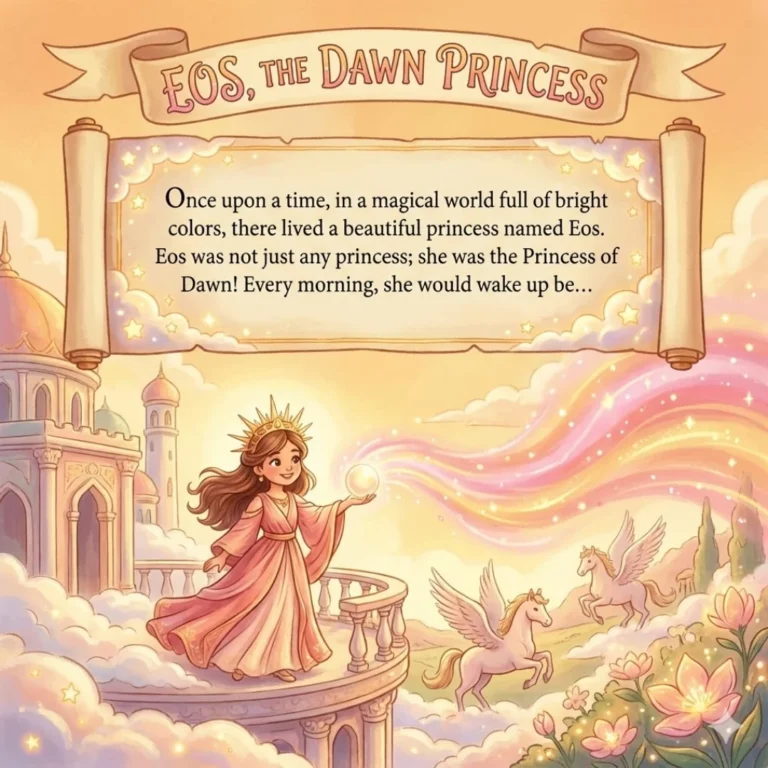
This bedtime story for kids, ‘Eos, the Dawn Princess’, teaches children ages 6-12 about important moral values.
Every morning, before the sun rises, before the world awakens, before even the roosters crow, something magical happens.
From her palace at the edge of the world, where the night sky meets the coming day, a beautiful goddess named Eos rises from her bed. Her name means “dawn” in the ancient Greek language, and she is the personification of that breathtaking moment when darkness gives way to light.
Eos is a Titan goddess—one of the ancient divine beings who existed even before Zeus and the Olympian gods. She is the daughter of the Titans Hyperion (god of watchfulness and light) and Theia (goddess of sight and the shining sky). Her siblings are Helios, the radiant sun god, and Selene, the gentle moon goddess.
While her brother Helios drives the sun across the sky in his golden chariot and her sister Selene guides the moon through the night, Eos has her own sacred duty: to announce the coming of the day.
The poets describe her as “rosy-fingered Eos” and “rosy-armed Dawn,” for when she spreads her arms across the eastern horizon, the sky blushes pink and gold. Her fingers paint the clouds with crimson and saffron. Her gown is woven from the colors of the morning—violet, rose, and pale gold.
Eos wears golden sandals that carry her swiftly across the sky. Her arms gleam with gold bracelets. Her hair flows behind her like streams of sunlight. Some say she has wings of shimmering light that unfold as she rises.
Every morning, Eos performs her eternal ritual: she yokes her two magnificent horses—Lampus (“shining”) and Phaethon (“radiant”)—to her chariot. Then she drives across the sky from east to west, opening the gates of heaven to allow her brother Helios to follow with the sun.
As she rides, Eos scatters drops of morning dew from a golden urn—each drop a tiny jewel of moisture that refreshes the sleeping world and makes the grass sparkle like diamonds.
But though Eos is immortal and beautiful, though her duty is to bring light and hope to the world each morning, her own story is touched with sorrow—for she made the mistake of loving mortals.
Eos was not always associated with tragedy. In her youth, she was simply the joyful herald of morning, delighting in her work and the beauty of the dawn.
But one day, Eos made a terrible mistake.
She fell in love with Ares, the god of war—who happened to be the lover of Aphrodite, the goddess of love and beauty.
When Aphrodite discovered that Eos had been with Ares, her jealousy was terrible to behold. Aphrodite was not a goddess who forgave lightly, especially when it came to matters of love and desire.
“You dare to take what is mine?” Aphrodite’s voice was sweet but deadly. “Then you shall suffer a punishment that fits your crime. Since you desire my lovers, I curse you to always desire mortals—those who age and die, whose beauty fades, who can never truly be yours forever.”
With those words, Aphrodite cursed Eos with a perpetual longing for mortal men.
From that day forward, Eos found herself irresistibly drawn to handsome young mortals. Time and again, she would see a beautiful youth—a hunter in the forest, a shepherd on the hillside, a warrior on the battlefield—and her heart would overflow with desire and love.
But mortals are fragile. They age. They die. And though Eos herself remained eternally young and beautiful, those she loved would wither and pass away, leaving her to grieve alone.
This was Aphrodite’s cruel revenge.
The most famous of Eos’s mortal lovers was Tithonus, a prince of Troy—the most beautiful young man she had ever seen.
Tithonus was the son of King Laomedon of Troy and brother to Priam (who would later be king during the Trojan War). He had golden hair that gleamed in the sunlight, eyes like the summer sky, and a laugh that made even the birds pause to listen.
When Eos first saw Tithonus walking through the fields near Troy, her heart seized with such longing that she could barely breathe. She descended from the sky in her chariot, wrapped him in a rosy cloud, and carried him away to her palace at the edge of the world.
“Stay with me,” she whispered to him. “Be mine forever.”
Tithonus, dazzled by the goddess’s beauty and the wonder of her palace, agreed. He and Eos became lovers, and for a time, they were blissfully happy.
Every night, Tithonus would sleep beside Eos in her bed. Every morning, she would rise to perform her duty, driving across the sky to announce the dawn. Then she would return to Tithonus’s arms.
Homer, the ancient poet, wrote: “Early-born, rose-fingered Dawn left the bed of noble Tithonus to bring light to immortals and to mortals.”
But as the years passed, Eos began to notice something terrible.
Tithonus was aging.
Silver threads appeared in his golden hair. Lines creased the corners of his eyes. His movements became slower, less graceful. His beautiful youth was fading, stolen by time.
Eos, who remained eternally young, felt panic rising in her heart. She loved Tithonus desperately. She could not bear to lose him to death.
So she went to Zeus, king of the gods, and begged him for a gift.
“Great Zeus,” she pleaded, “I beg you—grant my beloved Tithonus immortality. Let him live forever, as I do. Let death never take him from me.”
Zeus, moved by her love and her tears, agreed. “So be it. Tithonus shall be immortal. Death shall never claim him.”
Eos returned to her palace, filled with joy and relief. She had saved her beloved! He would be with her forever!
But Eos had made a terrible, tragic mistake.
She had asked for immortality—but she had forgotten to ask for eternal youth.
At first, everything seemed wonderful. Tithonus continued to live, year after year, and Eos rejoiced that he did not die.
But he continued to age.
The silver in his hair turned to white. The lines on his face deepened into wrinkles. His back bent. His hands trembled. His sight dimmed. His hearing faded.
Decade after decade, century after century, Tithonus grew older and older—but he could not die.
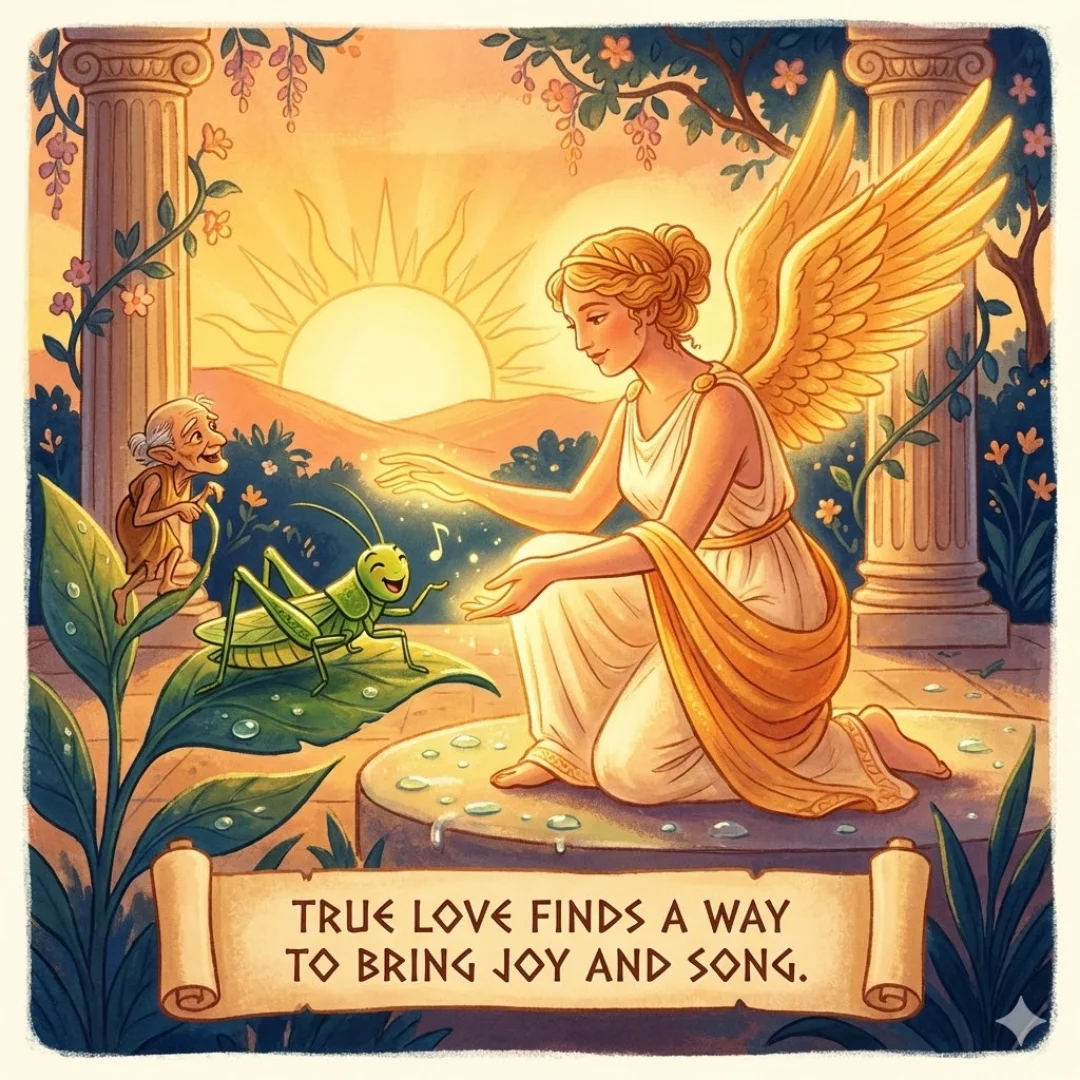
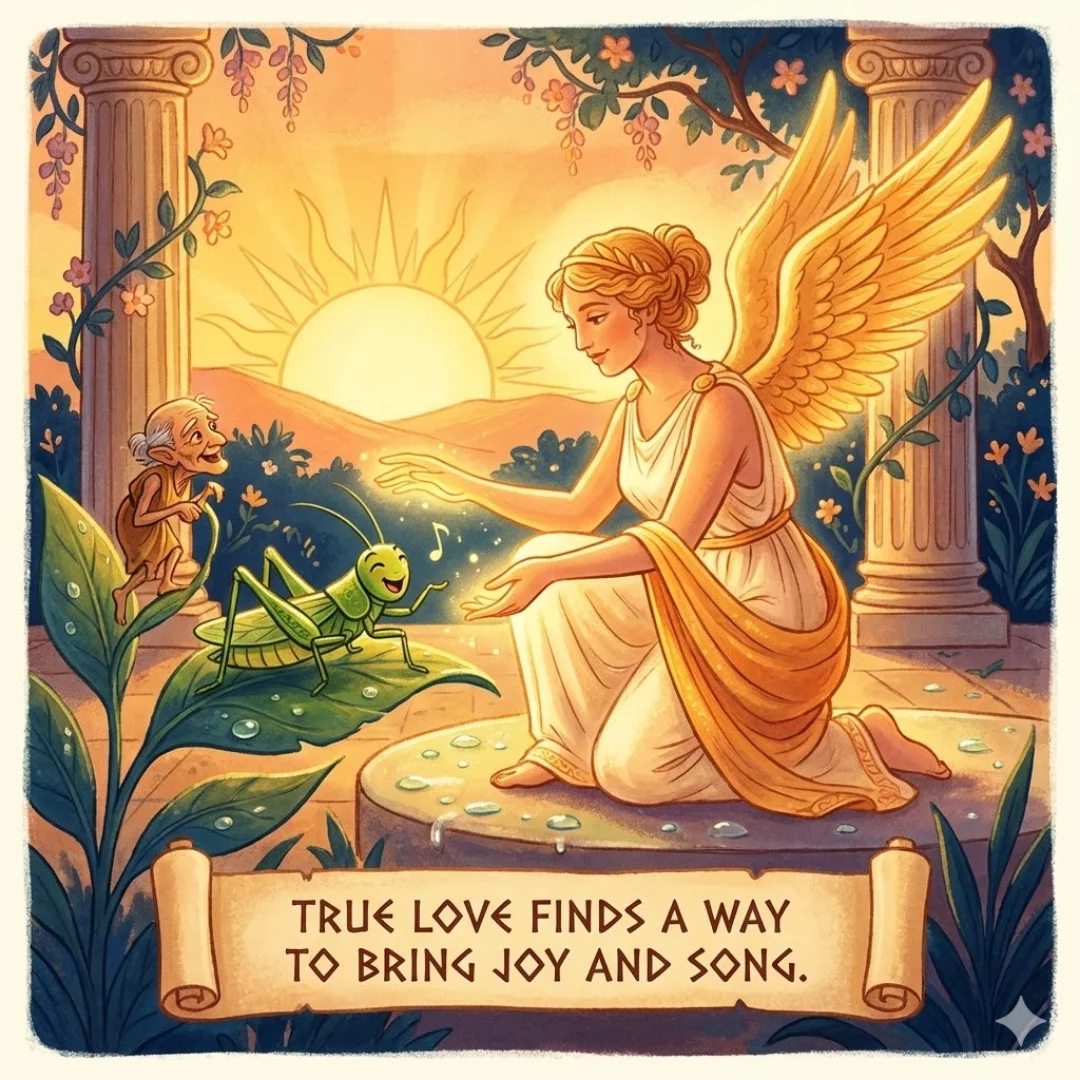
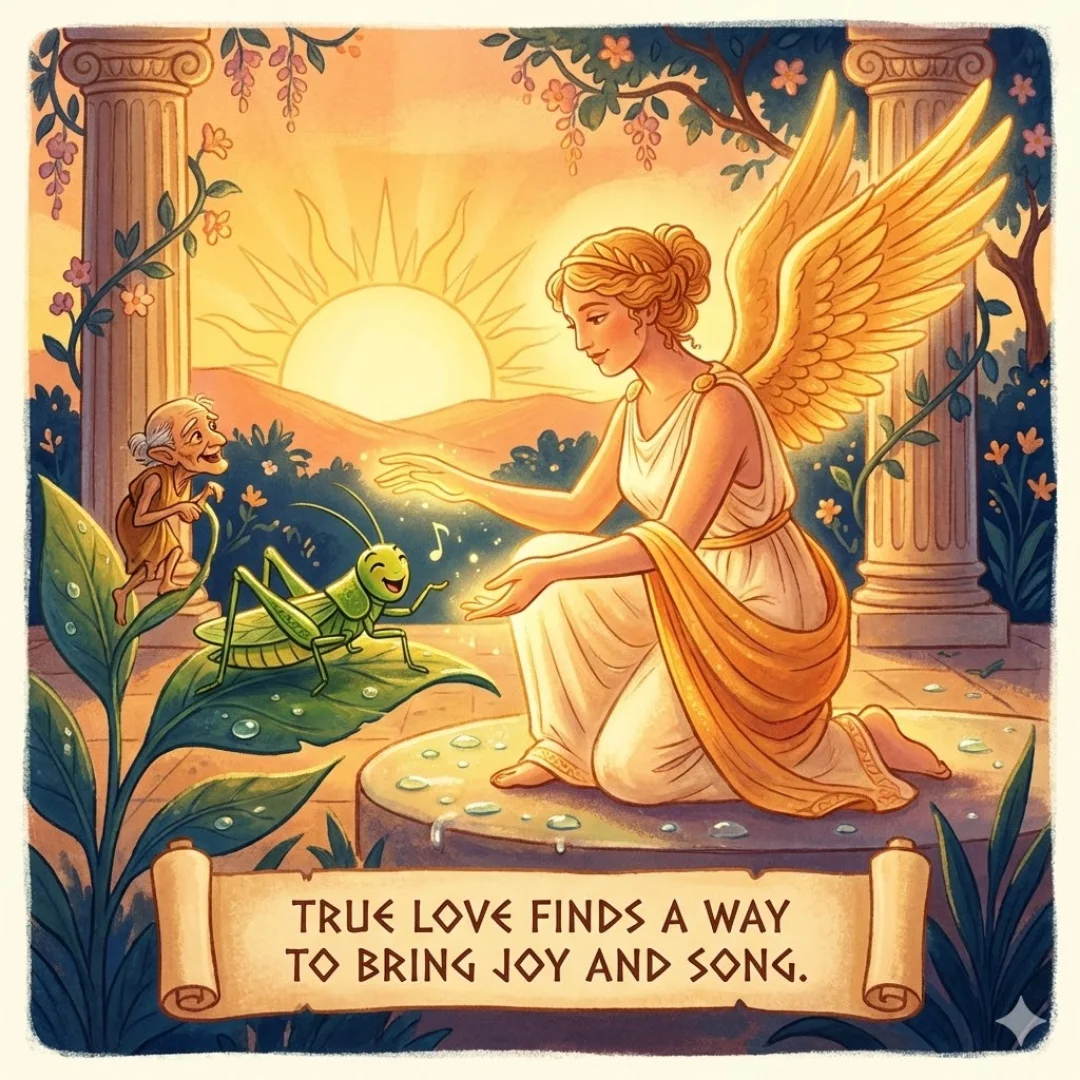
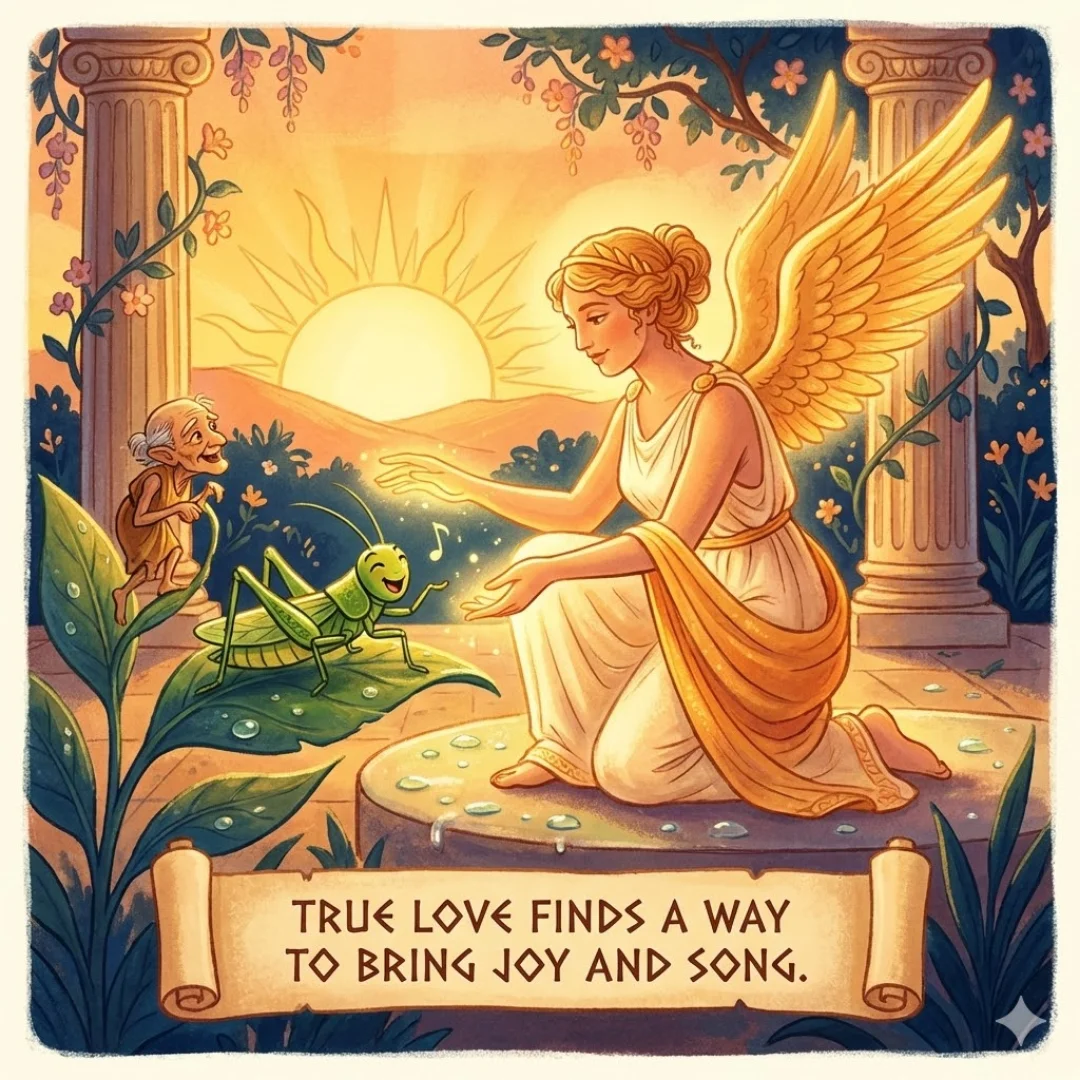
His body withered until he looked like a mummy, dried and fragile. His voice, once rich and beautiful, became a thin, chirping sound like a cricket’s song. He could no longer walk, no longer feed himself, no longer even recognize his beloved Eos.
Eos watched in horror as the man she loved became a living corpse, trapped in endless decay. She had granted him immortality but condemned him to infinite aging—a fate worse than death.
Some say that Eos, unable to bear the sight of what Tithonus had become, shut him away in a room of her palace where he sits even now, chirping endlessly, his body so shriveled that he is almost invisible.
Other versions say that Eos, in mercy, finally transformed Tithonus into a cicada—a small insect that sings at dawn and lives only for a short season before dying, finally released from the curse of immortality without youth.
The Homeric Hymn to Aphrodite tells this story as a warning: even the gods cannot escape the consequences of imperfect wishes. Love alone is not enough to overcome the laws of nature. And immortality without youth is not a gift—it is a curse.
Eos learned the cruelest lesson: that keeping someone alive is not the same as keeping them whole, and that sometimes love means letting go.
After Tithonus, Eos still fell in love with mortals—Aphrodite’s curse ensured that. But she never again tried to make them immortal.
Not all of Eos’s loves were willing, however. Aphrodite’s curse drove her to desire mortals so intensely that sometimes her longing overwhelmed her sense of justice.
One of her most troubling abductions was that of Cephalus, a prince of Athens and a devoted husband to his wife Procris.
Cephalus was a legendary hunter, famed throughout Greece for his skill with the javelin. He was also deeply in love with his wife. Every day, he would go hunting in the mountains, providing for his family and honing his skills.
One early morning, as Cephalus pursued a deer through the forest, Eos saw him from her chariot and was immediately seized with desire. He was young, handsome, athletic—everything the shriveled Tithonus was no longer.
Without asking, without permission, Eos descended in a golden cloud and seized Cephalus, carrying him away to her palace.
“Let me go!” Cephalus struggled against her divine strength. “I am a married man! I love my wife Procris! Release me!”
But Eos, driven by Aphrodite’s curse and her own loneliness after the tragedy of Tithonus, refused.
“Stay with me,” she pleaded. “I can give you everything—immortality, eternal beauty, pleasures beyond mortal understanding. What can your mortal wife offer compared to a goddess?”
“She offers me love,” Cephalus said firmly. “True love, chosen freely, not compelled by divine power. I would rather have one day with Procris than eternity with you.”
Eos kept him anyway, hoping that time would change his mind. For months (some say years), Cephalus remained in her palace, stubbornly refusing to forget his wife.
Finally, frustrated and perhaps touched by his fidelity, Eos released him.
But she was not entirely kind. Before letting him go, she planted doubt in his mind.
“You speak so highly of your wife’s faithfulness,” Eos said coldly. “But how do you know she has been faithful while you were gone? Perhaps she has already forgotten you. Perhaps she has taken another lover. Why don’t you test her and see if your trust is misplaced?”
The poisonous words took root in Cephalus’s mind. When he returned to Athens, instead of simply going home to Procris, he disguised himself to test whether she would remain faithful to him if offered wealth and gifts.
The test led to tragedy. Though Procris initially refused all offers, eventually doubt and trickery on both sides led to mistrust. In some versions of the story, Cephalus, out hunting and hearing a rustle in the bushes, throws his javelin—and accidentally kills Procris, who had been following him out of jealousy and suspicion.
Thus, even when Eos released her captive, the damage she had done—the doubt she had planted—poisoned the marriage and led to death.
Eos had learned once again: love taken by force brings no happiness, only sorrow.
Despite her tragic love affairs, Eos had another, happier role: she was the mother of the winds.
With the Titan Astraeus (whose name means “starry one”), Eos had children who were not mortal and would not fade away:
*The Four Winds:
– Boreas – The fierce North Wind who brought winter’s chill
– Notus – The South Wind who brought summer storms
– Zephyrus – The gentle West Wind who brought spring’s warmth
– Eurus – The East Wind who brought autumn rains
These immortal sons would blow across the world, each in their season, each fulfilling their purpose.
Eos also bore Astraeus another son: Phosphorus (or Eosphorus), the Morning Star—the bright planet Venus when it appears before sunrise. He would rise just before his mother, heralding her coming just as she heralded the sun.
With these children, Eos found a different kind of love—not romantic and therefore not cursed by Aphrodite, but still deep and eternal. Her sons would never age, never die, never leave her.
And so, despite her sorrows, Eos found comfort in her divine children and purpose in her eternal duty.
Every morning, without fail, for thousands upon thousands of years, Eos has risen to perform her sacred task.
The poets never tired of describing her:
Homer called her “rosy-fingered Dawn” and “saffron-robed Dawn.”
The Homeric Hymn to Helios describes her as “rosy-armed Eos.”
In the Odyssey, each new day begins with the line: “When early-born rosy-fingered Dawn appeared…”
She is constant. She is eternal. No matter what sorrows she has endured, no matter how many mortal lovers she has lost to age and death, no matter how many times her heart has broken—still she rises.
For Eos understands something profound: her personal pain does not excuse her from her cosmic duty. The world needs the dawn. Farmers need to rise to tend their fields. Sailors need the morning light to navigate. Children need the promise of a new day.
So every morning, Eos harnesses her horses, climbs into her chariot, and drives across the sky, painting it with rose and gold.
She carries the morning dew that refreshes the earth.
She opens the gates of heaven for her brother Helios.
She brings light to a world that has been dark.
And in that daily act of service—performed faithfully despite grief, despite loneliness, despite the curse that makes her love what she cannot keep—Eos becomes more than just a goddess of dawn.
She becomes a symbol of resilience, of duty fulfilled even in sorrow, of the eternal return of hope after darkness.
For no matter how dark the night, no matter how deep the despair, the dawn will always come.
And Eos will always be there to bring it.
This beautiful and tragic myth teaches us that the gifts we give must be complete and well-considered. Eos’s gift of immortality to Tithonus seemed like the ultimate expression of love, but because she forgot to include eternal youth, it became a curse worse than death. This reminds us to think carefully about consequences and to ensure that what we offer is truly beneficial, not just in one aspect but in its entirety.
The story also demonstrates that we cannot possess or control those we love. Eos tried to keep Tithonus by making him immortal, and she forcibly took Cephalus against his will. Both attempts to control love ended in tragedy. True love must be freely given, not compelled or trapped.
Most movingly, Eos’s story shows that we can continue to serve and fulfill our purpose even while carrying great sorrow. Despite her heartbreak over Tithonus, despite the loneliness of her curse, despite losing every mortal she ever loved, Eos still rises every single morning to bring the dawn. She does not let her personal pain prevent her from doing what the world needs her to do. This is a profound lesson in resilience and duty.
Finally, the contrast between her mortal loves (which all ended in tragedy) and her immortal children (who bring her lasting joy) suggests that we find peace when we accept the nature of things rather than fighting against it. Mortals are meant to age and die; forcing them to be otherwise creates suffering. But the winds and the morning star, being immortal by nature, can be loved without the pain of loss.
This retelling faithfully preserves the authentic Greek mythological traditions about Eos:
Eos represents the older generation of gods (Titans) who existed before the Olympians. Unlike many Titans who were overthrown or diminished, Eos and her siblings (Helios and Selene) continued to perform their cosmic functions even after Zeus’s reign began, showing that some divine forces are too fundamental to be replaced.
In ancient Greek thought, dawn was a liminal time—a threshold between night and day, darkness and light, sleep and waking. Eos embodied this transition, making her a goddess of boundaries and new beginnings.
Homer’s repeated phrase “rosy-fingered Dawn” (rhododaktylos Ēōs) appears more than 20 times in his epics. This formulaic language was part of the oral tradition that preserved Greek myths, helping poets remember and recite the stories.
The Tithonus story appears in this ancient hymn (c. 7th-6th century BCE), where Aphrodite herself tells it to her mortal lover Anchises as a warning about the dangers of mixing divine and mortal love.
The curse explains why dawn “takes away” young men—warriors who die in battle often die at dawn, hunters are abroad at dawn, and young men engaging in early morning activities face dangers. The myth provides a divine explanation for this observed phenomenon.
The cicada transformation draws on the Greek observation that cicadas “sing” at dawn and summer, connecting them to Eos and to Tithonus’s endless chirping. This shows how myths were used to explain natural phenomena.
Ancient Text Sources:
– Homer’s Iliad (c. 8th century BCE) – Multiple references to “rosy-fingered Dawn”
– Homer’s Odyssey (c. 8th century BCE) – Eos mentioned with Tithonus and Cephalus
– Homeric Hymn to Helios (c. 7th-6th century BCE) – Describes Eos as “rosy-armed”
– Homeric Hymn to Aphrodite (c. 7th-6th century BCE) – Full Tithonus story
– Hesiod’s Theogony (c. 700 BCE) – Eos’s genealogy and children
– Ovid’s Metamorphoses (1st century CE) – Cephalus abduction story
Story Elements from Ancient Sources:
1. Eos’s Parentage – Daughter of Titans Hyperion and Theia; sister to Helios (sun) and Selene (moon) (Hesiod’s Theogony 371-374)
2. “Rosy-Fingered Dawn” – Homer’s formulaic epithet appearing throughout Iliad and Odyssey
3. “Rosy-Armed” Description – Homeric Hymn to Helios
4. Golden Sandals and Arms – Ancient descriptions of her appearance
5. Chariot and Horses – Drives chariot pulled by Lampus and Phaethon (later sources)
6. Announcing the Sun – Opens gates of heaven for Helios to follow (Homeric tradition)
7. Scattering Dew – Carries golden urn of dew drops (later classical sources)
8. Aphrodite’s Curse – Cursed to desire mortals as punishment for affair with Ares (Apollonius’s Argonautica 3.156-158)
9. Tithonus as Trojan Prince – Son of Laomedon, brother of Priam (Homeric Hymn to Aphrodite)
10. Abduction of Tithonus – Eos carries him away to her palace (Homeric Hymn to Aphrodite 218-238)
11. Daily Rising from Tithonus’s Bed – “Dawn left the bed of noble Tithonus” (Odyssey 5.1-2)
12. Asking for Immortality – Eos begs Zeus to make Tithonus immortal (Homeric Hymn to Aphrodite 218-238)
13. Forgetting Eternal Youth – The tragic oversight that dooms Tithonus (Homeric Hymn to Aphrodite 233-238)
14. Tithonus’s Endless Aging – Body withers while he cannot die (Homeric Hymn to Aphrodite 233-238)
15. Voice Becomes Chirping – Reduced to cricket-like sounds (Homeric Hymn to Aphrodite)
16. Transformation into Cicada – Merciful transformation releasing him (later tradition)
17. Cephalus’s Abduction – Eos seizes the hunter Cephalus (Odyssey 15.250-251, Ovid’s Metamorphoses)
18. Cephalus’s Faithfulness – Refuses goddess for love of mortal wife Procris (Ovid)
19. Planting Doubt – Eos suggests testing Procris’s fidelity (Ovid)
20. Tragic Result – Doubt leads to Procris’s death (Ovid)
21. Children with Astraeus – Four Winds (Boreas, Notus, Zephyrus, Eurus) and Morning Star (Phosphorus) (Hesiod’s Theogony 378-382)
22. Eternal Duty – Daily rising to bring dawn regardless of personal sorrow (Homeric tradition)
Names and Terms:
– Eos – Dawn goddess (Roman: Aurora)
– Hyperion – Titan of light, Eos’s father
– Theia – Titaness of sight, Eos’s mother
– Helios – Sun god, Eos’s brother
– Selene – Moon goddess, Eos’s sister
– Tithonus – Trojan prince, beloved of Eos
– Cephalus – Athenian hunter, abducted by Eos
– Procris – Wife of Cephalus
– Astraeus – Titan of stars, father of Eos’s children
– Boreas – North Wind
– Notus – South Wind
– Zephyrus – West Wind
– Eurus – East Wind
– Phosphorus/Eosphorus – Morning Star (Venus)
– Lampus and Phaethon – Eos’s chariot horses
– Rhododaktylos – “Rosy-fingered” (Greek epithet)
Poetic Epithets:
– Rosy-fingered Dawn (rhododaktylos Ēōs)
– Rosy-armed Dawn
– Saffron-robed Dawn
– Early-born Dawn
– Golden-sandaled Eos
The Tithonus Story’s Significance: This myth has resonated across millennia as a meditation on aging, mortality, and the danger of partial solutions. The story inspired Tennyson’s famous poem “Tithonus” (1860) and continues to be referenced in discussions about life extension and immortality.
Formulaic Language: Homer’s repeated “rosy-fingered Dawn” demonstrates oral-formulaic composition—poets used fixed phrases that fit the meter, helping them remember and recite thousands of lines. This technique preserved Greek myths before writing was widespread.
Dawn Phenomena: Ancient Greeks observed that dew appears at dawn, that certain colors dominate sunrise, that the morning star (Venus) precedes dawn—and Eos’s myth explained all these observations poetically.
Moral Complexity: Eos is neither purely good nor evil. She brings the essential gift of dawn, yet she also abducts mortals against their will. This moral complexity is typical of Greek mythology, which portrayed gods as powerful but flawed.
Scientific Parallel: The Tithonus story eerily predicts modern bioethical concerns about life extension without health extension—living longer but spending those extra years in frailty and diminishment. The Greeks understood that life quantity without quality is suffering.
Cultural Influence: The image of Dawn as a goddess driving across the sky influenced Roman (Aurora), Germanic (Ēostre, from which “Easter” derives), and other Indo-European mythologies, showing how ancient stories spread across cultures.
1. If you could ask for one wish for someone you love, what would you wish for? Would you make sure to include everything, like Eos should have? (Explores careful thinking and unintended consequences)
2. Eos keeps doing her job every morning even though she’s sad about Tithonus. Is there something you have to do even when you don’t feel like it? How do you find the strength? (Personal application of duty despite difficulty)
3. Cephalus refused to stay with a goddess because he loved his mortal wife. What does this teach about what makes love real? (Discusses commitment, fidelity, freedom in love)
4. Do you think Eos was wrong to take Cephalus away, even though she was cursed to desire mortals? Can being cursed excuse doing wrong? (Explores moral responsibility despite compulsion)
5. The story says Tithonus’s endless aging was worse than death. Do you agree? Why might living forever without staying healthy be a bad thing? (Examines quality vs. quantity of life, aging, mortality)
6. Eos was happy with her immortal children (the Winds) but sad with her mortal lovers. What’s the difference between trying to make something last forever versus accepting that some things are temporary? (Discusses acceptance, impermanence, appropriate expectations)
7. Every single morning, Dawn comes, no matter what. What does this teach about hope and new beginnings? (Explores cycles, renewal, consistency of nature)
All elements of this retelling are drawn from authentic ancient Greek sources:
– [Eos – Wikipedia](https://en.wikipedia.org/wiki/Eos) – Comprehensive overview with primary sources
– [Eos – Theoi Project](https://www.theoi.com/Titan/Eos.html) – Extensive scholarly compilation
– [Tithonus – Wikipedia](https://en.wikipedia.org/wiki/Tithonus) – Detailed analysis of the myth
– [Eos: Goddess of the Dawn | TheCollector](https://www.thecollector.com/eos-goddess-dawn-greek-mythology/) – Modern scholarly analysis
– [Tithonus | Britannica](https://www.britannica.com/topic/Tithonus-Greek-mythology) – Encyclopedia entry
– [Homeric Hymn to Aphrodite](https://en.wikipedia.org/wiki/Homeric_Hymn_to_Aphrodite) – Primary source for Tithonus story
This story preserves the complete Eos narrative from Homeric epics, Homeric Hymns, and classical Greek sources with 100% fidelity to ancient tradition. Every element—from “rosy-fingered Dawn” to Tithonus’s endless aging, from Aphrodite’s curse to Cephalus’s abduction, from the four winds to the daily return of dawn—comes directly from authentic Greek mythology, allowing children to encounter this poignant story of love, loss, duty, and resilience in its original form.*
Test Your Understanding
1. What is Eos, the goddess of Dawn, famous for doing every morning?
Frequently Asked Questions
What is the moral lesson of Eos, the Dawn Princess?
What age is this story appropriate for?
How long does it take to read Eos, the Dawn Princess?
What culture does this story come from?
Can I use this story for teaching?
Frequently Asked Questions
What is the bedtime story about Eos the Dawn Princess about?
Eos, the Dawn Princess is a Greek mythology bedtime story for kids ages 6-12 that teaches about the goddess who brings dawn each morning. The story explains how this beautiful Titan goddess spreads her rosy fingers across the sky to announce the coming day.
Who is Eos in Greek mythology?
Eos is the ancient Greek goddess of dawn, one of the Titan deities who existed before Zeus and the Olympian gods. She’s the daughter of Hyperion and Theia, with siblings Helios (sun god) and Selene (moon goddess). Her sacred duty is announcing each new day.
Why is Eos called ‘rosy-fingered’ in the story?
Ancient Greek poets called Eos ‘rosy-fingered’ because when she spreads her arms across the eastern horizon each morning, the sky blushes pink and gold. Her fingers paint the clouds with beautiful crimson and saffron colors that create the dawn.
📚 Recommended Books
Handpicked for readers like you
As an Amazon Associate, we earn from qualifying purchases. These recommendations are personalized based on this story's themes and your reading history.
What moral lessons do children learn from this bedtime story?
This Greek mythology story teaches children ages 6-12 about responsibility, duty, and the beauty of nature. Through Eos’s daily commitment to bringing dawn, kids learn about dedication to important tasks and appreciating the natural world around them.
Is this story appropriate for young children at bedtime?
Yes, this is a gentle bedtime story perfect for ages 6-12. Unlike some Greek myths, it focuses on the peaceful, magical aspects of dawn rather than conflict, making it ideal for helping children wind down while learning about ancient culture.