This moral story for children ages 6-12 combines entertainment with important values.
CHAPTER ONE: THE KINGDOM OF KIND HEARTS
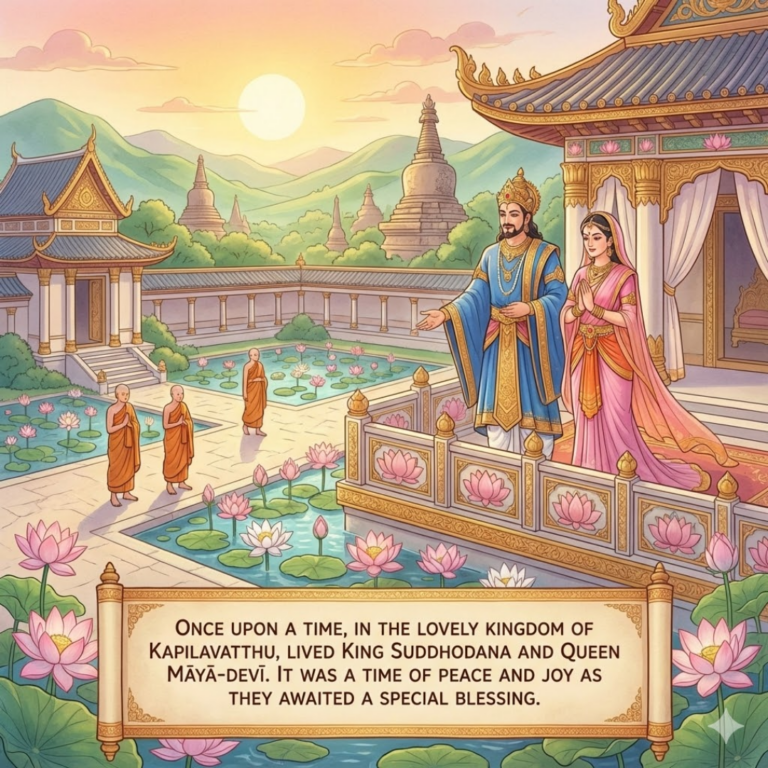
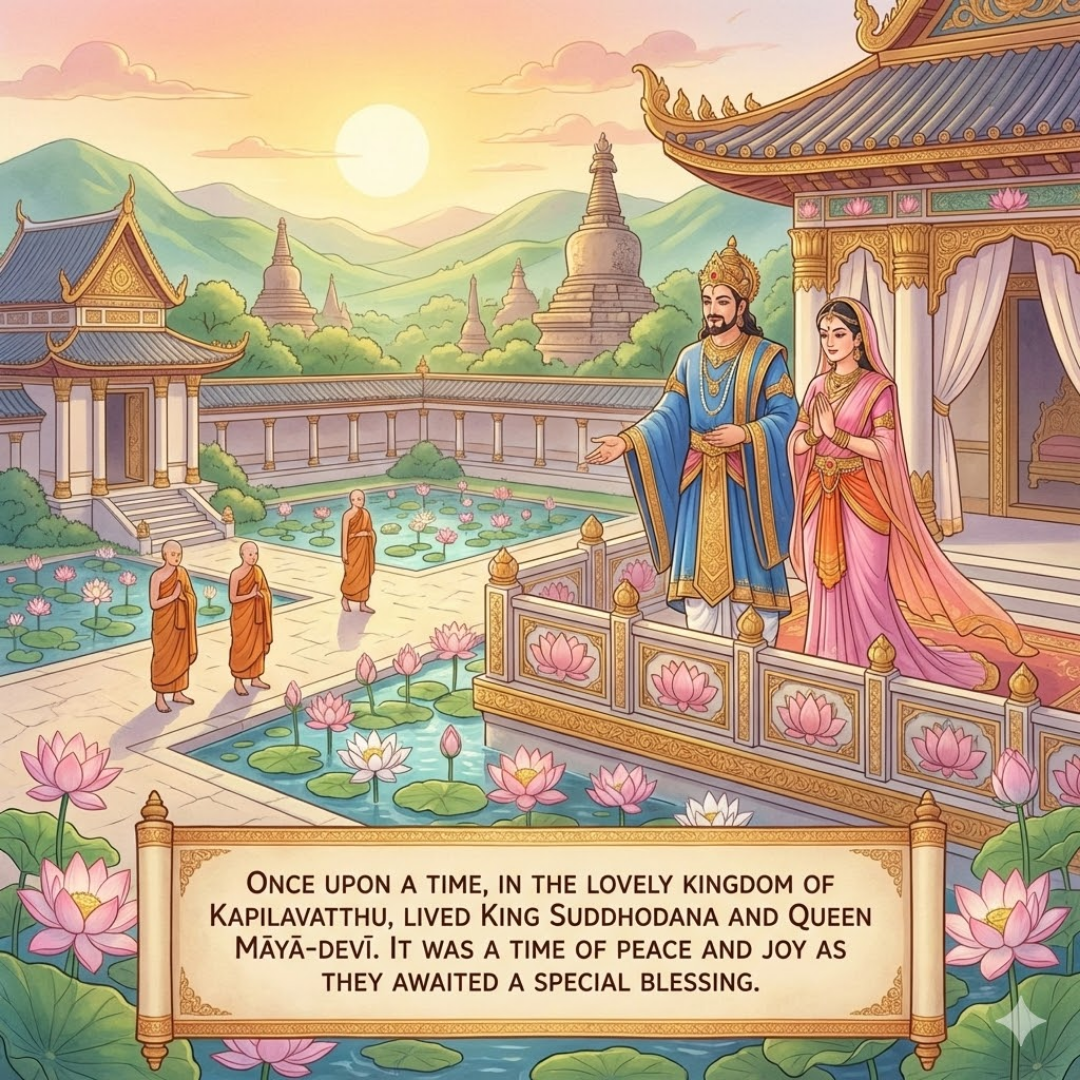
Long, long ago, at the foot of the mighty Himalaya mountains, there lay a beautiful kingdom called Kapilavatthu. The hills were covered with forests where elephants walked majestically and peacocks displayed their brilliant feathers. Rivers flowed like silver ribbons through valleys filled with mango trees and rice paddies.
In this peaceful kingdom lived King Suddhodana and Queen Maya. The king was tall and strong, with wise eyes that seemed to see the truth in every matter brought before him. He ruled his people with fairness and kindness, and in return, they loved him dearly.
But it was Queen Maya who truly captured everyone’s hearts. She moved through the palace like a graceful swan gliding across a still lake. Her smile could make flowers seem to bloom, and her voice was as sweet as honey mixed with morning dew.
“She is like a water-lily growing in clear waters,” the people often said. “Pure in heart, beautiful in spirit, kind to all creatures.”
The king and queen had one secret sorrow. Though they longed for a child to fill their palace with laughter and love, the years passed without the blessing of a baby.
“Perhaps it is not meant to be,” Queen Maya sometimes whispered to her husband in the quiet of evening.
“We must have faith,” King Suddhodana would reply, holding her hand. “Sometimes the greatest blessings come when we least expect them.”
And the king was right—though neither he nor the queen could have imagined just how extraordinary that blessing would be.
* * *
CHAPTER TWO: THE dream OF THE WHITE ELEPHANT
One night, as the full moon rose over Kapilavatthu, painting the palace walls with silver light, Queen Maya had a most remarkable dream.
She dreamed she was lifted gently by four celestial beings—angels with wings like spun gold—and carried far from the palace, over mountains and clouds, to a beautiful silver mansion on a hillside made of silver.
The angels bathed her in fragrant waters from a sacred lake and dressed her in heavenly garments softer than any silk she had ever touched. They led her to a golden couch covered with flower petals, where she lay down facing the east.
Then, from the golden sky, something wonderful appeared.
A magnificent white elephant, whiter than the snow on the highest mountain peaks, came walking through the clouds. His trunk carried a perfect white lotus flower, and his six tusks gleamed like polished ivory. He circled around the queen three times, his massive feet making no sound, moving with a grace that seemed impossible for such a great creature.
Then, gently, so gently, the white elephant touched her side with his trunk.
Queen Maya woke with a start, her heart filled with a joy she had never known before. The room seemed brighter than usual, and she could swear she smelled lotus flowers, though none grew in the palace gardens at this time of year.
She shook King Suddhodana awake. “My lord! I have had the most extraordinary dream!”
* * *
CHAPTER THREE: THE WISE MEN’S PROPHECY
The next morning, King Suddhodana summoned the wisest brahmins in the kingdom—men who could read the meaning of dreams and the movement of stars.
When Queen Maya finished describing her vision, the wise men looked at one another with amazement. Then the eldest among them, a man with a beard as white as the elephant in the dream, rose to speak.
“O King, O Queen, rejoice!” he proclaimed, his voice trembling with emotion. “This dream is the most auspicious sign imaginable. A great soul—perhaps the greatest ever to walk the earth—has chosen to be born as your child!”
The queen’s eyes filled with tears of joy. “A child? At last?”
“Not just any child,” another brahmin added. “The white elephant is the symbol of perfect wisdom and strength. Its six tusks represent the six perfections that all great souls must master: generosity, morality, patience, energy, meditation, and wisdom.”
“Your son will either become the greatest king the world has ever known,” the first brahmin continued, “or he will become something even more extraordinary—a Buddha, an Awakened One, who will bring light to all beings and end the darkness of suffering forever.”
King Suddhodana felt his heart swell with pride and wonder. A son! And such a son!
Queen Maya simply smiled, her hand resting gently on her heart, already feeling the tiny spark of new life within her.
* * *
CHAPTER FOUR: THE JOURNEY TO LUMBINI
Ten months passed, and the time came for Queen Maya to give birth. According to the custom of her people, she wished to travel to her parents’ home in a neighboring kingdom, where she could be surrounded by family during this important time.
King Suddhodana prepared everything with loving care. He ordered that the road be smoothed and scattered with fresh flowers. He arranged for comfortable palanquins—covered chairs carried by servants—so that the queen could rest during the journey. He sent messengers ahead to ensure that every village along the way would welcome her with music and celebration.
The procession set out on a beautiful morning, with Queen Maya smiling and waving to the crowds who gathered to wish her well. Dancers performed, musicians played, and children threw flower petals in her path.
About halfway to her destination, the procession passed through a magnificent grove of sala trees called Lumbini. The trees were in full bloom, their branches heavy with sweet-smelling blossoms that made the air smell like heaven itself.
“Please,” Queen Maya said to her attendants, “let us stop here for a while. I wish to walk among these beautiful trees.”
The attendants were happy to oblige. They helped the queen down from her palanquin and supported her as she walked slowly through the grove, her silk robes brushing against the flower-covered ground.
It was here, beneath the blooming sala trees, that something miraculous was about to happen.
* * *
CHAPTER FIVE: THE MIRACLE OF LUMBINI
Queen Maya came to the most beautiful tree in the grove—a sala tree so perfectly shaped, with branches so laden with blossoms, that it seemed to bow down before her in respect.
The queen reached up and took hold of one low-hanging branch. As she did, the world seemed to hold its breath.
And then—the child was born.
But this was no ordinary birth. Four celestial beings appeared, just as in Maya’s dream, and they caught the baby in a golden net woven from threads of light. They bathed the newborn in streams of pure water that fell from the sky—one stream warm, one stream cool—washing away all dust of the earthly world.
The baby did not cry, as other newborns do. Instead, with perfect awareness in his dark, shining eyes, he stood upright on the soft earth. He looked to the north, to the south, to the east, and to the west.
Then he took seven steps in each direction, and where his tiny feet touched the ground, lotus flowers bloomed.
With a voice clear as a temple bell, the newborn spoke:
“In all the world, I am the most honored one. This is my final birth. I have come to end the suffering of all beings.”
At that very moment, wonders occurred throughout the universe. Rivers that had been dry began to flow. Trees that had been barren burst into flower. The blind could suddenly see, and the deaf could suddenly hear. Musical instruments that had sat silent for years began to play by themselves.
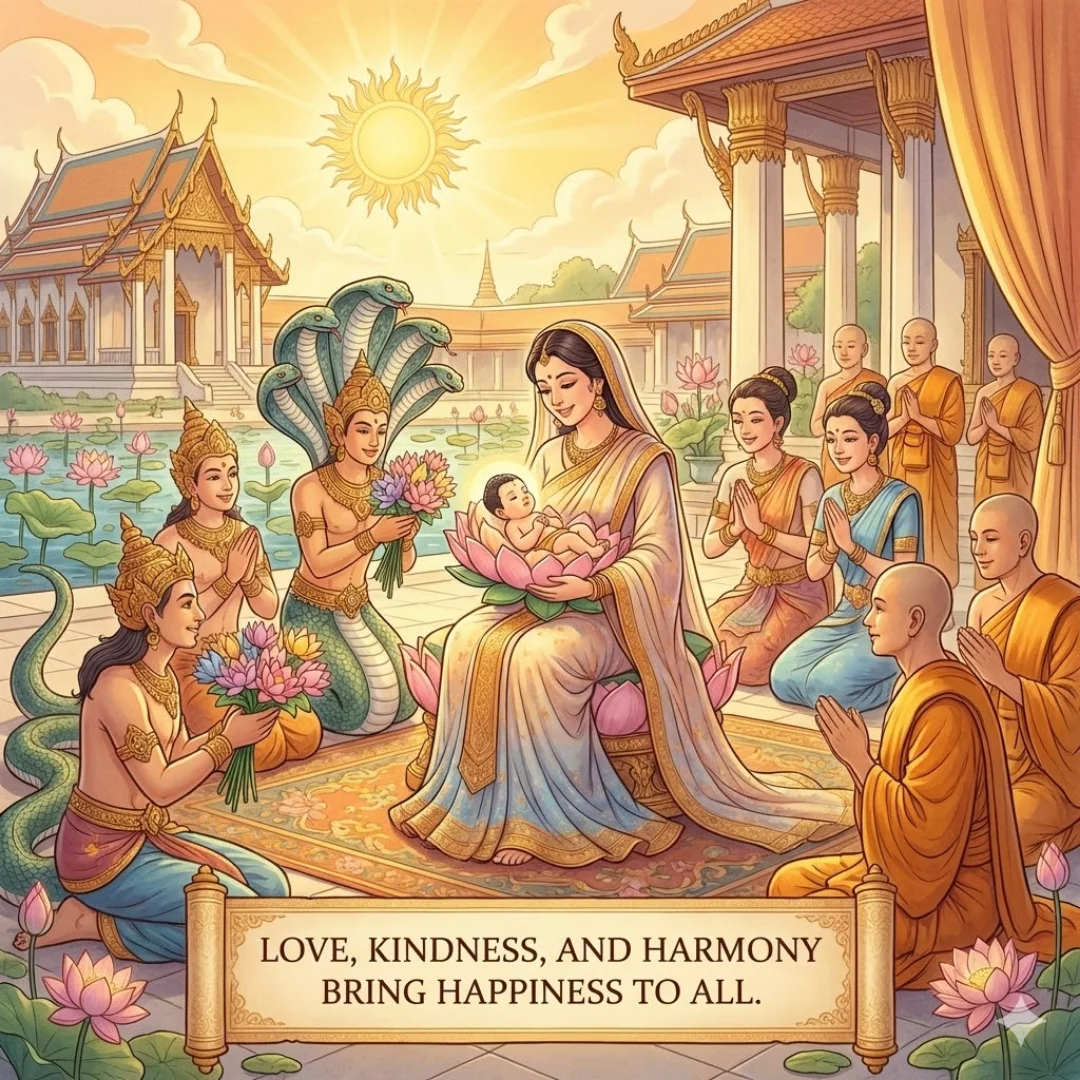
In the heavens, celestial beings gathered to celebrate. They showered the earth with flowers and filled the sky with music. Even the kings of the nagas—the great serpent beings who lived beneath the earth—emerged from their underground palaces to pay homage to the newborn child.
* * *
CHAPTER SIX: THE LIGHT OF THE WORLD
News of the miraculous birth spread faster than any messenger could carry it. People came from far and near to see the extraordinary child, who had been named Siddhartha, meaning “one who has achieved his aim.”
King Suddhodana arrived in Lumbini with tears of joy streaming down his face. When he saw his son—so peaceful, so beautiful, already seeming wise beyond his minutes of life—the king felt as though he were looking at the sun itself.
“My son,” he whispered, lifting the baby gently in his arms. “Whatever path you choose in life, I will love you and support you always.”
But even in this moment of joy, there was a shadow of sadness. The sages had said that Siddhartha would become either a great king or a great Buddha. King Suddhodana desperately hoped his son would choose the path of kingship—would stay by his side, inherit the throne, continue the royal line.
He did not yet understand that his son’s destiny was far greater than any earthly kingdom.
Queen Maya looked at her baby with eyes full of love and something else—a gentle knowing, as if she could see the wonderful things he would one day accomplish. Though she would not live long after his birth, her love would stay with Siddhartha forever, like starlight that continues to shine long after the star has set.
* * *
CHAPTER SEVEN: THE BEGINNING OF EVERYTHING
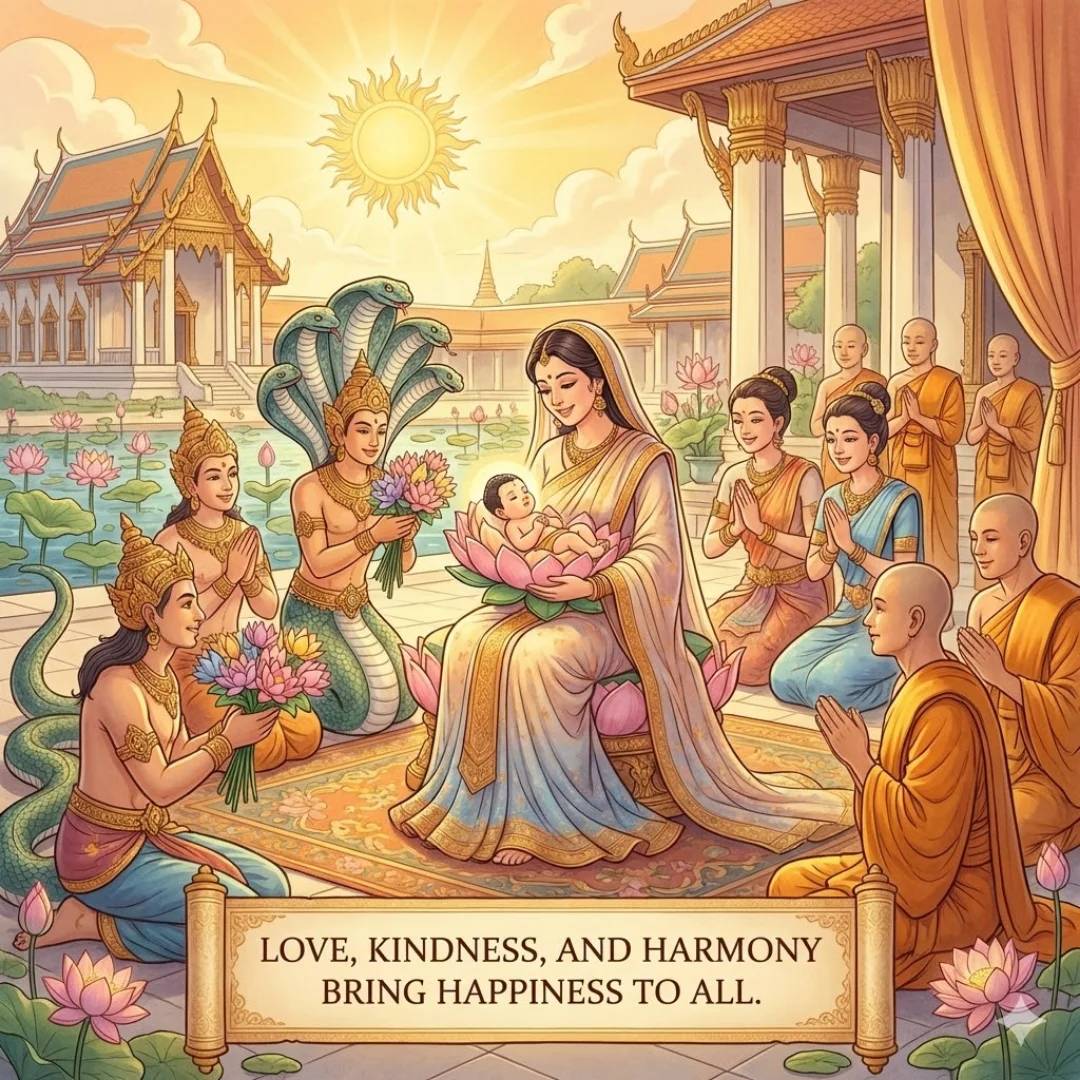
The child Siddhartha grew under the loving care of his father and his aunt Mahapajapati, who raised him after Queen Maya’s passing. True to the prophecies, he showed extraordinary gifts from the very beginning—learning faster than any child before him, showing compassion for every living creature, asking questions that even the wisest teachers struggled to answer.
But that is a story for another time.
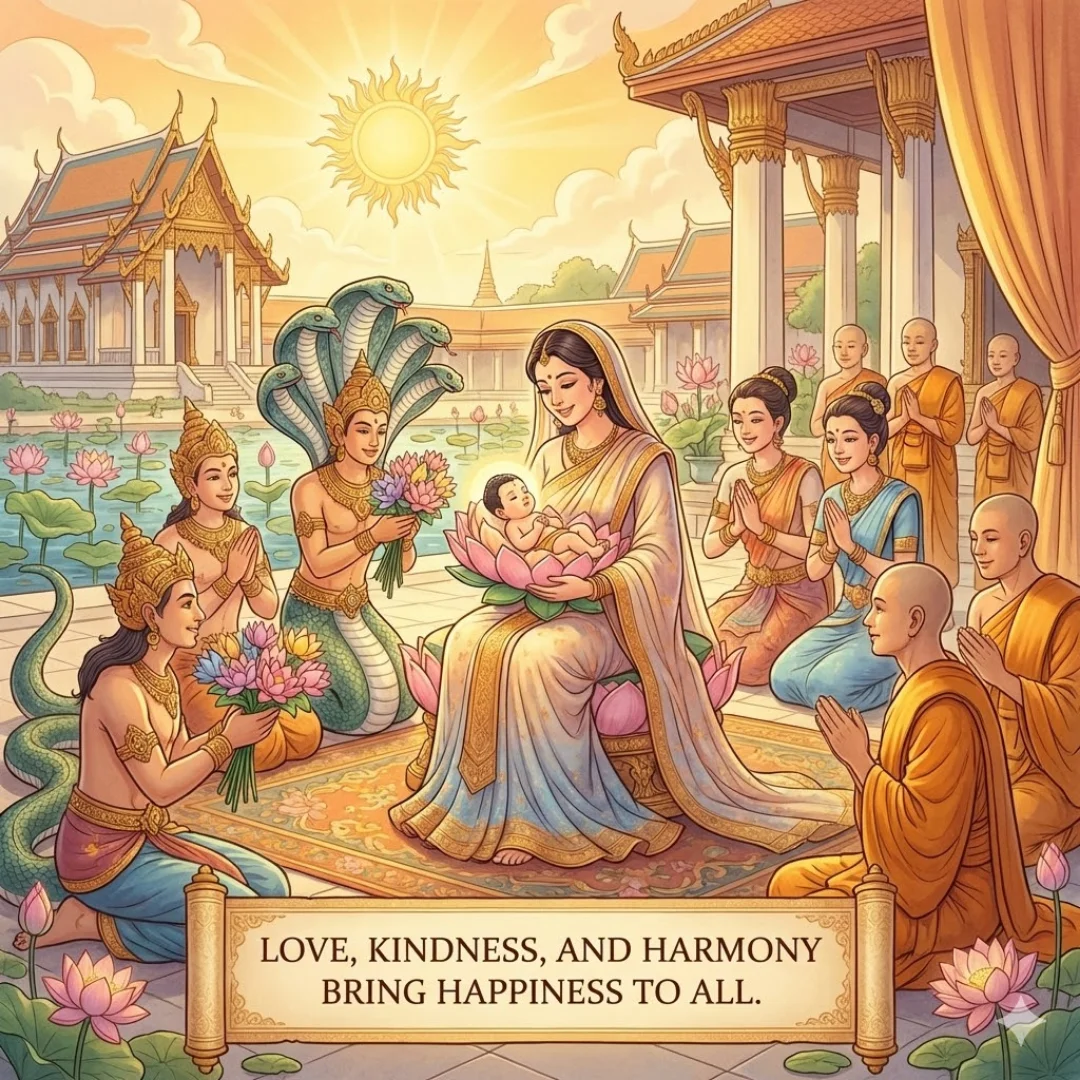
What matters in this story is the message carried by those seven steps the newborn Buddha took at Lumbini—the message that echoes through the ages down to our own day:
Every child comes into the world with a light inside them.
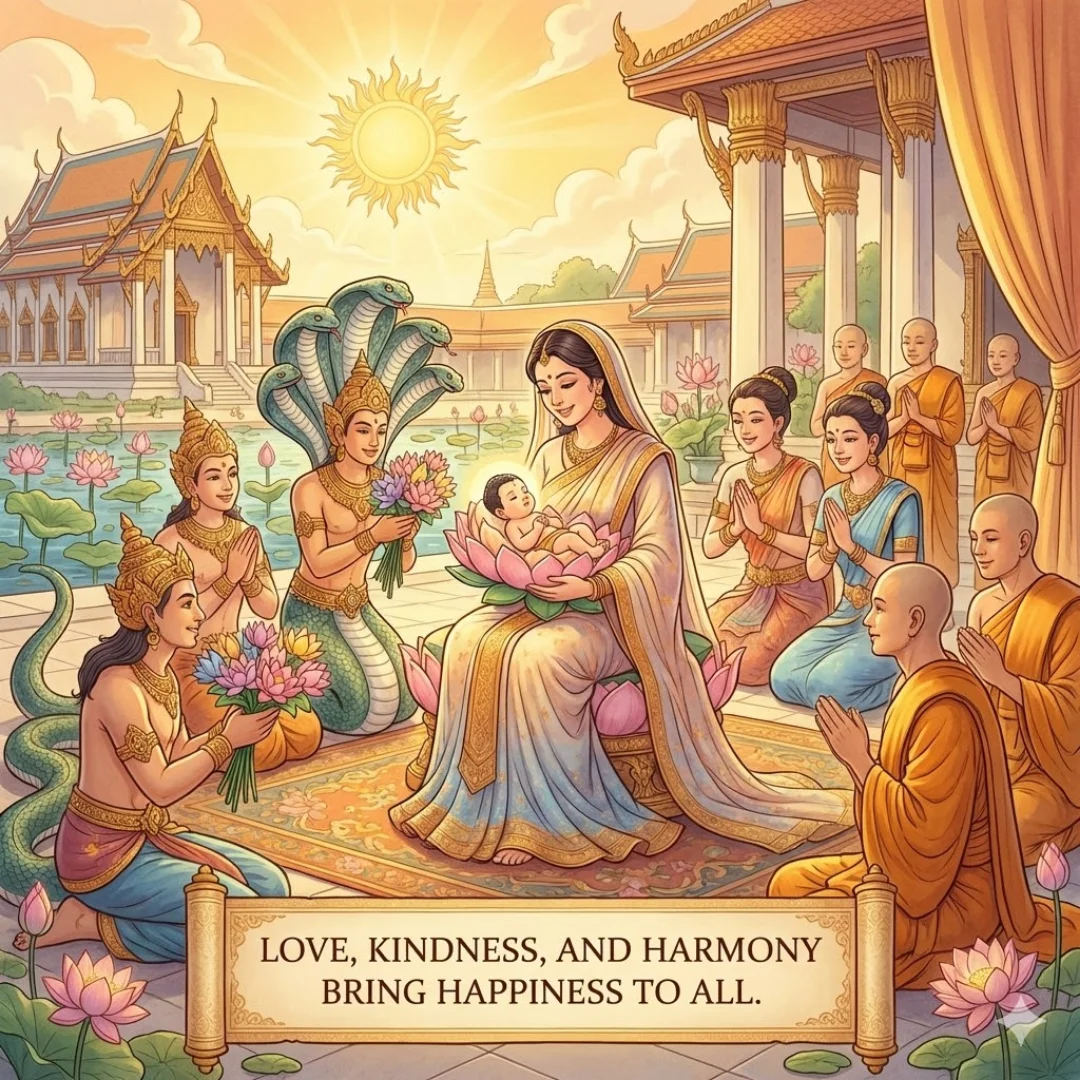
Every birth is a miracle.
Every life has the potential for greatness.
The Buddha’s light shone so brightly that it illuminated the path for millions of people over thousands of years. But we all carry our own light, given to us at the moment of our birth. Our task is to nurture that light, to let it grow strong, and to share it with others.
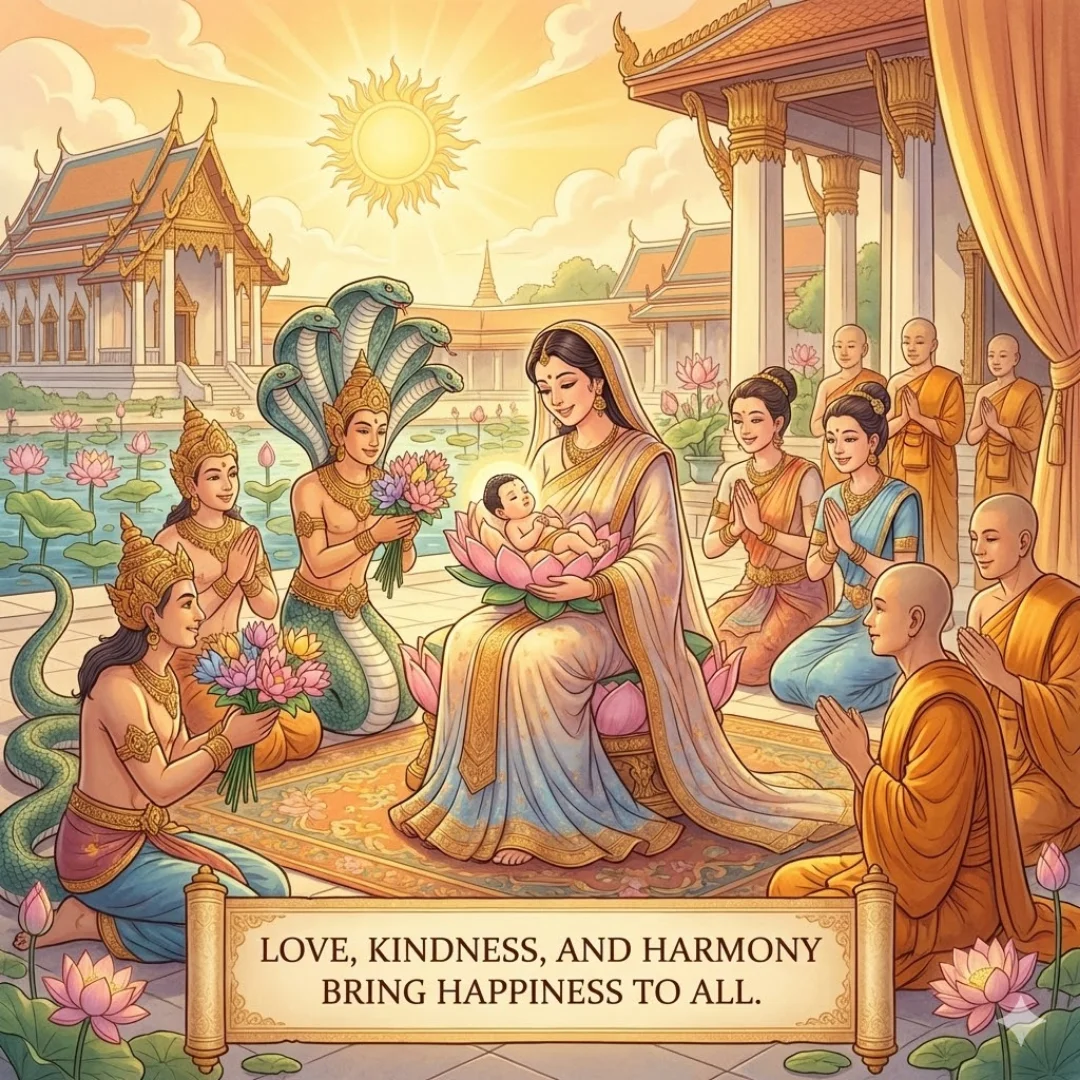
The lotus flowers that bloomed where the baby Buddha walked remind us that beauty can emerge from anywhere—from muddy waters, from difficult circumstances, from the humblest beginnings.
And the celestial music that filled the sky at his birth reminds us that the universe celebrates each new life, each new soul, each new chance to bring more love and kindness into the world.
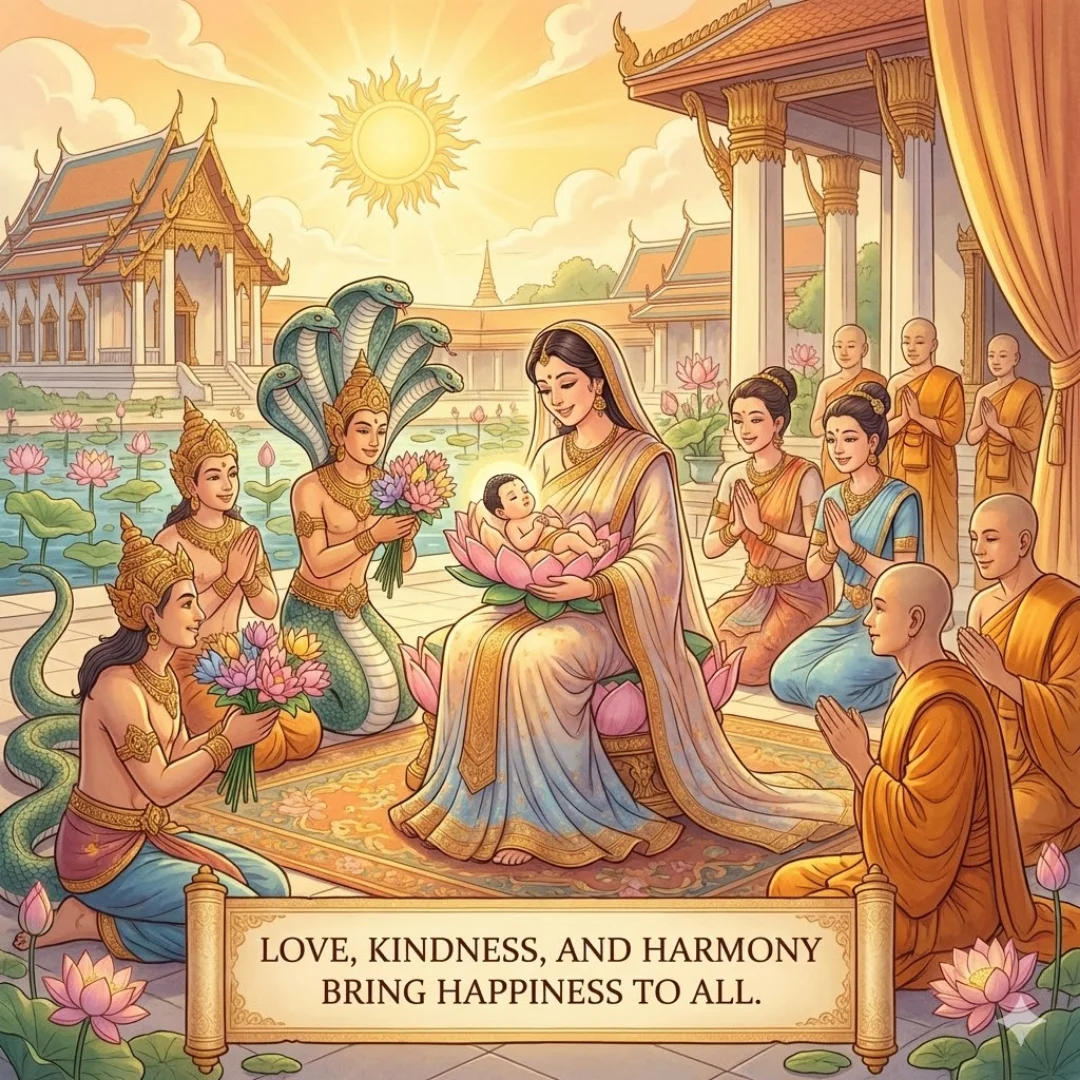
For every child, like the Buddha before them, has the power to change everything.
Moral Lessons
- Love and kindness can create happiness and peace in the world, and every child has the potential to bring light to others.
Test Your Understanding
1. What did Queen Maya dream about before the baby was born?
2. According to the wise brahmins, what did the six tusks of the white elephant represent?
3. Where was baby Siddhartha born?
4. What miraculous thing happened when the newborn baby took his first steps?
5. What did the brahmins prophesy about the child’s future?
6. What is the main moral lesson of this story?
Frequently Asked Questions
What is the moral lesson of The Birth of a Special Child?
What age is this story appropriate for?
How long does it take to read The Birth of a Special Child?
What culture does this story come from?
Can I use this story for teaching?
Frequently Asked Questions
What is ‘The Birth of a Special Child’ story about?
This moral story for children tells the tale of a special child born to King Suddhodana and Queen Maya in the ancient kingdom of Kapilavatthu. Set at the foot of the Himalaya mountains, it’s an educational story that teaches important values through engaging storytelling and beautiful imagery.
Is this bedtime story appropriate for young children?
Yes, this story is specifically designed for children ages 6-12. It combines entertainment with moral lessons in an age-appropriate way, featuring peaceful kingdoms, wise rulers, and gentle themes that make it perfect for bedtime reading or educational storytelling.
Who are the main characters in this story?
The main characters are King Suddhodana, a tall and wise ruler known for his fairness, and Queen Maya, described as graceful and pure-hearted like a water-lily. They rule the peaceful kingdom of Kapilavatthu with kindness and are beloved by their people.
📚 Recommended Books
Handpicked for readers like you
As an Amazon Associate, we earn from qualifying purchases. These recommendations are personalized based on this story's themes and your reading history.
Where does this children’s story take place?
The story is set in the beautiful kingdom of Kapilavatthu, located at the foot of the mighty Himalaya mountains. The kingdom features forests with elephants and peacocks, silver rivers, mango trees, and rice paddies, creating a magical backdrop for the tale.
What moral lessons will children learn from this story?
This educational story teaches children about kindness, fairness, wisdom, and purity of heart through the examples of King Suddhodana and Queen Maya. It shows how good leadership and gentle hearts create peaceful, loving communities that flourish together.