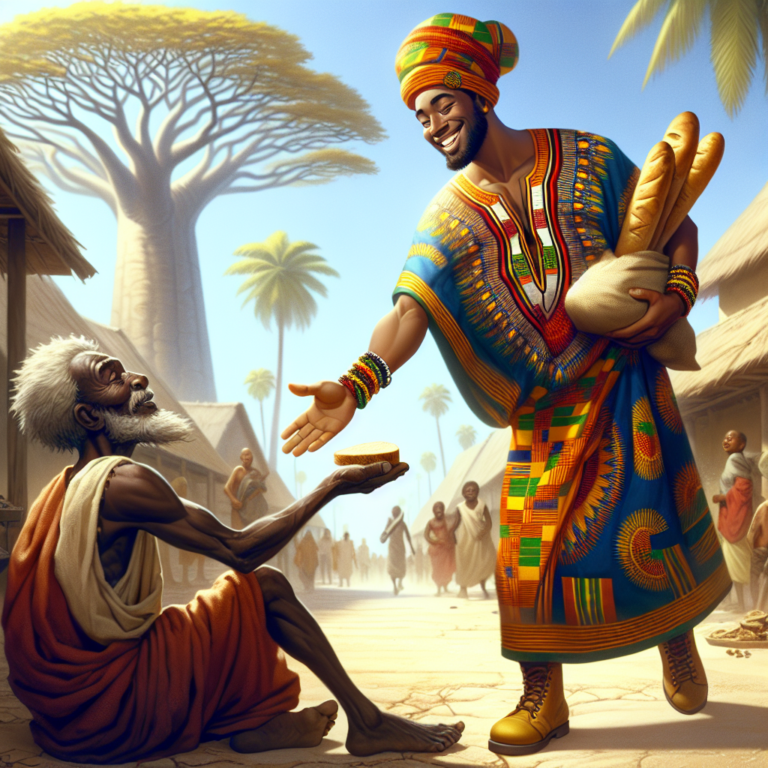
‘The Joyous Wanderer’s Gift of Boundless Love’ is an educational moral story perfect for bedtime reading with children ages 6-12.
Chapter One: The Man with the Singing Heart
In a village nestled between rolling green hills and a river that sparkled like liquid gold, there lived a man known to everyone as the Joyous Wanderer. His real name was Themba, which means “hope” in the language of his people, and he had been given this name because even as a baby, he had smiled at everyone who looked upon him.
Themba was different from other men. While his neighbors spent their days gathering cattle, building larger huts, and counting their cowrie shells, Themba spent his time walking the paths between villages, singing songs that made even the birds stop to listen.
“Lira, la, la,” he would sing as he walked, “the sun is warm, the road is long, and my heart is full of song!”
His traveling pack contained only the simplest things: a loaf of bread baked that morning by his beloved wife, Nomsa, three gold coins that had been his father’s, and a wooden flute that he had carved himself. But Themba insisted he carried something far more valuable than any treasure.
“What is this precious cargo?” the village children would ask, searching his pack for hidden jewels.
Themba would tap his chest and smile. “Here,” he would say. “I carry the love of my Nomsa, the blessing of my ancestors, and the spirit of Ubuntu. These things weigh nothing but are worth more than all the gold in all the kingdoms of the world.”
Chapter Two: The Hungry Stranger
One morning, Themba set out on the road that led to the distant market town. The sun painted the sky in shades of orange and pink, and a gentle breeze carried the sweet smell of wild jasmine.
He had not traveled far when he came upon a man sitting beneath a baobab tree. The stranger’s clothes were ragged, his face hollow with hunger, and his eyes had the dull look of someone who had lost all hope.
“Good morning, friend,” Themba called out cheerfully. “Lira, la, la! What a beautiful day for traveling!”
The stranger looked up with weary eyes. “Beautiful for those with food in their bellies,” he replied bitterly. “I have not eaten in three days. I had a family once, and a farm, but drought took everything. Now I wander the roads, hoping someone will show me kindness.”
Without a moment’s hesitation, Themba reached into his pack and withdrew his entire loaf of bread, the bread that Nomsa had baked for him with her own hands.
“No, no,” the stranger protested weakly. “That is your food for the journey. You need it.”
“Friend,” Themba said, pressing the bread into the man’s hands, “I have eaten this morning and will eat again this evening. You have eaten nothing for three days. Besides, my heart would be too heavy to carry if I walked past you with a full pack while you sat here hungry. Take it all, with my blessing.”
The stranger’s eyes filled with tears as he accepted the bread. “Why would you do this for someone you don’t even know?”
“In my village, we have a saying,” Themba replied. “Umuntu ngumuntu ngabantu. A person is a person through other persons. Your hunger is my concern because your well-being is connected to mine. When I feed you, I feed myself. When I help you, I help the whole world.”
He played a cheerful tune on his wooden flute while the stranger ate, and when the man had finished, color had returned to his cheeks.
“I have nothing to give you in return,” the stranger said.
“You have given me the gift of allowing me to help,” Themba replied. “That is enough. Lira, la, la!”
Chapter Three: The Crossroads Thief
Themba continued his journey, his step light despite his empty pack. The sun climbed higher, and the road wound through a forest where monkeys chattered in the treetops and colorful birds flashed between the branches.
At a lonely crossroads, where the path split in three directions, a figure stepped out from behind a rock. This man was young and strong, with sharp eyes and a knife tucked into his belt.
“Stop, traveler,” the young man commanded. “I am called Sipho the Shadow, and I take what I want from those who pass this way. Give me your money, or I will take it by force.”
Themba studied the young man for a long moment. He saw the hardness in his eyes, yes, but beneath it, he also saw something else: pain, loneliness, and a desperate fear that had curdled into cruelty.
“Very well,” Themba said calmly, reaching into his pack. He withdrew his three gold coins, the inheritance from his father, and offered them to Sipho. “Here are my coins. But wait, take the pouch as well. It is of good leather and will serve you better than it serves me now.”
Sipho stared at him, his hand frozen in the act of snatching the coins. “You are not afraid of me?”
“I am not afraid,” Themba agreed. “But not because I am brave. I simply understand that you have taken my gold, but you cannot take what truly belongs to me. My memories of my father remain. My love for my wife remains. My joy in this beautiful day remains. These things cannot be stolen.”
Sipho’s hardness flickered for just a moment. “You are a strange man.”
“Perhaps,” Themba said. “Or perhaps the world has taught you strange things about what is truly valuable. My father used to say that a man who lives for gold will die clutching it, alone and cold. But a man who lives for others will die surrounded by those he has loved, warm and content.”
Sipho tucked the coins into his belt and walked away without another word. But Themba noticed that he walked more slowly than before, as if carrying a heavier weight than three gold coins.
Chapter Four: The Village of Sorrows
As evening approached, Themba came upon a village he had never visited before. Usually, villages welcomed travelers with curiosity and hospitality. But this village was silent. No children played in the dusty streets. No cooking fires sent smoke into the sky. The huts looked shabby and uncared for.
In the center of the village, Themba found the people gathered around a dying fire, their faces masks of grief.
“What has happened here?” Themba asked gently.
An old woman looked up at him with hollow eyes. “Sickness came through our village a season ago. It took our children, our strongest workers, our hope. We have lost so many that the survivors barely have the heart to continue living.”
Themba sat down among them, though he had no bread to share, no coins to give. All he had was himself.
“Let me tell you a story,” he said, pulling out his wooden flute. “Once, there was a village where the baobab tree at its center began to wither and die. The people mourned, for this tree had stood for a hundred generations. But a wise woman told them that the tree was not dying, it was transforming. Its roots were spreading deeper into the earth, reaching for water that would sustain not just itself, but the entire land around it.”
He played a soft, melancholy tune that somehow held hope within its sadness. The villagers listened, and for the first time in months, tears flowed freely, not tears of despair but tears of release.
“Your loved ones are not gone,” Themba continued. “They have transformed. They are in the wind that cools your face, in the rain that feeds your crops, in the soil that will grow new life. And you who remain are like those roots, spreading deeper, growing stronger, preparing to sustain new generations.”
He stayed with the village through the night, telling stories, playing songs, and simply sitting with those who needed silent company. When dawn broke, something had changed. A woman began sweeping the path outside her hut. A man started repairing a fence. Two children, the youngest survivors, began playing a game in the dust.
Chapter Five: The Final Journey
Themba continued his wandering for many more years, giving away everything he had again and again. His bread to the hungry, his coins to the desperate, his songs to the sorrowful, and his wisdom to the lost. Each time, he would return to Nomsa with empty hands, and she would smile and refill his pack.
“You give away everything I bake for you,” she would tease. “How are you not skin and bones?”
“Because love is the only food that multiplies when you share it,” he would reply, kissing her cheek. “Every time I give away your bread, I am fed by the gratitude in the receiver’s eyes. Every time I give away a coin, I am enriched by the relief I see. I have been the wealthiest man in Africa for years now, and few have noticed.”
Finally, the day came when even the Joyous Wanderer could walk no more. He was very old now, his hair white as clouds, his body bent like a tree that had weathered many storms. He sat beneath his favorite baobab tree and watched the sunset paint the sky.
A figure approached, cloaked in shadow despite the remaining light. Themba knew without seeing its face that Death had finally come for him.
“You have found me at last,” Themba said, not with fear but with something like greeting an old friend expected for dinner.
“You do not seem afraid,” Death observed.
“Why should I be?” Themba replied. “I have nothing left to lose. I gave away my food, my money, my possessions. And yet I die richer than any king.”
“How can that be?”
Themba smiled his eternal smile. “Because I carry the gratitude of the hungry man I fed so many years ago, who went on to help others because of my example. I carry the change I saw in Sipho, who stopped robbing travelers and became a guide instead, helping people safely through the forest. I carry the healing of that grieving village, which now flourishes again. And most of all, I carry the love of my Nomsa, which I have given away a thousand times only to find it always returned, multiplied, overflowing.”
He looked up at Death and began to sing one last time: “Lira, la, la, the road was long, but my heart was always full of song!”
And so the Joyous Wanderer passed from this world, but his spirit, they say, still walks the paths between villages. Whenever you feel an unexplained warmth in your heart, a sudden urge to help a stranger, or joy bubbling up for no reason at all, the old people say it is Themba, the Joyous Wanderer, sharing the love that never runs out.
Moral Lessons
- True wealth is not found in material possessions but in the love we give, the kindness we share, and the connections we build with others. When we give generously, we become richer, not poorer.
Test Your Understanding
1Who was the Joyous Wanderer?
Frequently Asked Questions
What is the moral lesson of The Joyous Wanderer’s Gift of Boundless Love?
What age is this story appropriate for?
How long does it take to read The Joyous Wanderer’s Gift of Boundless Love?
What culture does this story come from?
Can I use this story for teaching?
Frequently Asked Questions
What age group is The Joyous Wanderer’s Gift of Boundless Love suitable for?
The Joyous Wanderer’s Gift of Boundless Love is an educational moral story designed for children ages 6 to 12. It works especially well as a bedtime story that parents and kids can enjoy together, combining engaging characters with meaningful life lessons about generosity and kindness.
What is the main lesson in The Joyous Wanderer’s Gift of Boundless Love?
The story teaches children that boundless love and a generous spirit are more valuable than material possessions. Through Themba the Joyous Wanderer, readers learn that joy, kindness, and sharing warmth with others are the greatest treasures anyone can carry through life.
Who is the main character in this story?
The main character is Themba, a man known as the Joyous Wanderer. His name means ‘hope,’ and he travels between villages singing and spreading happiness. Unlike his neighbors who focus on wealth, Themba values love and human connection above all else.
📚 Recommended Books
Handpicked for readers like you
As an Amazon Associate, we earn from qualifying purchases. These recommendations are personalized based on this story's themes and your reading history.
Is this a good bedtime story for young children?
Yes, this story is perfect for bedtime reading. Its gentle, rhythmic storytelling, warm characters, and positive moral message make it soothing and engaging for children ages 6 to 12. The simple language and relatable themes help kids wind down while absorbing an uplifting life lesson.
What cultural background does The Joyous Wanderer story draw from?
The story draws from African culture, featuring names like Themba, which means ‘hope,’ and Nomsa, along with references to village life, cattle, cowrie shells, and traditional huts. This cultural setting gives the story a rich, authentic backdrop that introduces children to diverse traditions in a warm and accessible way.