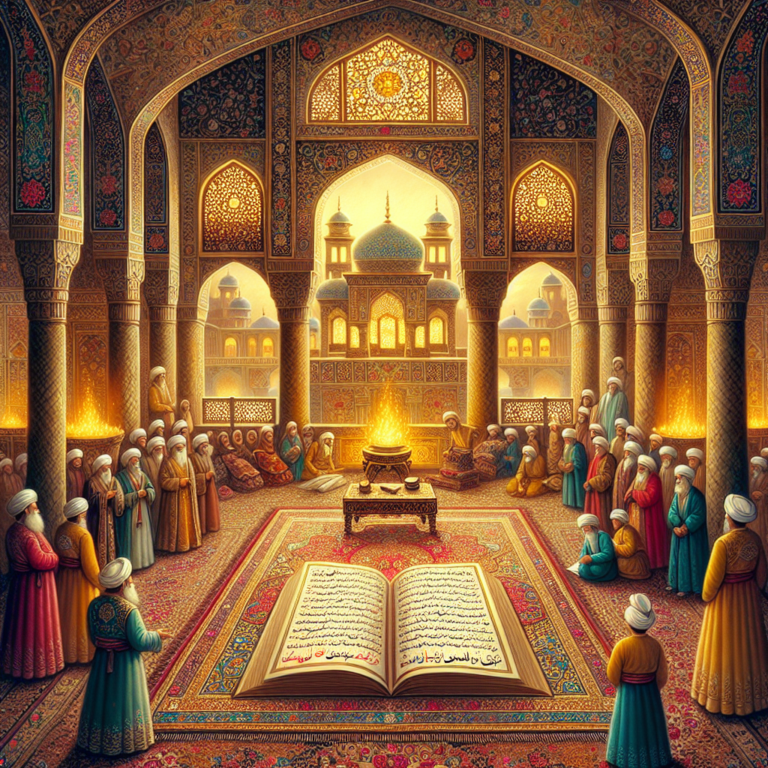
‘Vendîdâd’s Light: The Epic Quest for truth and purity’ is an educational moral story perfect for bedtime reading with children ages 6-12.
Before the mountains rose from the earth. Before the rivers carved their paths to the sea. Before the first bird sang or the first flower bloomed—there was a great void, and in that void dwelt two spirits.
One was Ahura Mazda, the Wise Lord. He was made of pure light, of truth, of all that is good and beautiful and right. From him flowed creation itself—the spark that would become fire, the thought that would become wisdom, the love that would become life.
The other was Angra Mainyu, the Destructive Spirit. He was made of darkness, of lies, of all that corrupts and destroys and deceives. Where Ahura Mazda built, Angra Mainyu sought to tear down. Where the Wise Lord brought light, the Destructive Spirit brought shadow.
These two spirits existed in eternal opposition, for such is the nature of good and evil. They cannot be reconciled. They cannot find peace. One must ultimately triumph over the other.
But Ahura Mazda, in his infinite wisdom, knew that the battle would not be simple. Darkness cannot be defeated by light alone—it must be overcome through the choices of conscious beings, through the accumulation of righteous deeds, through the patient triumph of truth over falsehood.
And so the Wise Lord conceived of a plan.
“I shall create a world,” Ahura Mazda declared, his voice like a thousand suns singing in harmony. “A world of matter and spirit, of form and meaning. And in that world shall dwell creatures who can choose—who can look upon light and darkness and decide which path to follow. Through their choices, through their struggles, through their victories over temptation and despair, the darkness shall be pushed back until it is no more.”
And so creation began.
Ahura Mazda set about creating the world with joy and purpose. Each creation was perfect in its conception, beautiful in its design, meaningful in its function.
First, he created the sky—a vast dome of crystal that would hold back the primal chaos and shelter all that lived beneath it.
Then, he created the waters—sweet and pure, carrying life wherever they flowed, singing their liquid songs as they cascaded down mountains and meandered through valleys.
Next, he created the earth—rich and fertile, ready to bring forth plants and animals and all manner of growing things.
After that, he created plants—trees that reached toward the heavens, flowers that painted the meadows with color, herbs that could heal the sick and nourish the hungry.
Then, he created animals—creatures of every form and kind, from the mighty cattle that represented goodness to the swift horses that carried the righteous, from the faithful dogs that guarded homes to the countless beings that filled the forests and seas.
Finally, and most importantly, Ahura Mazda created humanity—beings made in his image, endowed with reason and free will, capable of choosing between truth and lies, between light and darkness.
“You are my greatest creation,” the Wise Lord told the first humans. “For you alone have the power to choose your path. You can follow the way of Asha—of truth, righteousness, and cosmic order—and thereby strengthen the light. Or you can follow the way of Druj—of lies, wickedness, and chaos—and thereby serve the darkness. The choice is yours, and the consequences of that choice shall shape the world itself.”
But Ahura Mazda was not alone in his work. For as he created, Angra Mainyu worked to corrupt.
Angra Mainyu watched from the shadows as Ahura Mazda brought forth the world, and his jealousy and hatred grew with each act of creation.
“I cannot create,” the Destructive Spirit snarled, “but I can corrupt. I cannot bring light, but I can spread darkness. I cannot build, but I can destroy.”
And so, for every good thing that Ahura Mazda created, Angra Mainyu fashioned a corruption:
When Ahura Mazda created the beautiful lands where people could live in peace and prosperity, Angra Mainyu filled them with severe winters, scorching deserts, poisonous creatures, and diseases that ravaged the body.
When Ahura Mazda created pure water, Angra Mainyu created drought and pollution, making the waters bitter and bringing thirst to the world.
When Ahura Mazda created fertility and abundance, Angra Mainyu created famine and scarcity, so that even the richest lands might know hunger.
When Ahura Mazda created contentment and righteous pleasure, Angra Mainyu created doubt and excessive desire, so that people would never be satisfied with what they had.
When Ahura Mazda gave humans the power of choice, Angra Mainyu gave them the temptation to choose wrongly—lies that seemed like truth, pleasures that led to ruin, easy paths that ended in darkness.
The battle was joined.
But Ahura Mazda did not leave his creations defenseless against the darkness. Along with the world, he revealed to humanity the way of Asha—the path of truth and righteousness that would lead to victory over evil.
This teaching was preserved in the sacred texts, including the Vendidad—the laws that protected life and light from corruption and shadow.
“Purity,” the Wise Lord taught, “is your greatest weapon against the darkness. For Angra Mainyu cannot touch what is pure. His lies cannot penetrate truth. His corruption cannot stain righteousness. His darkness cannot extinguish the light of a soul that walks in Asha.”
The laws of purity were many and detailed, for the battle against darkness must be fought on every front:
Keep your body pure—for the body is a temple of the sacred fire that burns within each person. Care for your health, avoid what pollutes and poisons, treat the physical world as a gift to be honored.
Keep your mind pure—for the mind is the seat of choice, where the decision between truth and lies is made. Seek knowledge, reject falsehood, let your thoughts be clear and clean as mountain streams.
Keep your words pure—for words have power to create and destroy. Speak truth, honor your promises, let no lie pass your lips even when lies seem easier than truth.
Keep your deeds pure—for deeds are the measure of the soul. Act righteously, protect the innocent, fight against evil wherever you find it, and never let laziness or fear keep you from doing what is right.
And keep your world pure—for the world itself is sacred. Care for the waters, tend the earth, protect the fire that represents Ahura Mazda’s presence, and do not let corruption spread unchallenged.
Many ages after the creation, when humanity had multiplied and spread across the earth, Ahura Mazda chose a special messenger to remind the world of the ancient truths.
His name was Zarathustra, and he was a priest in the land of Persia.
From his youth, Zarathustra had sought wisdom. He had asked questions that others dared not ask: Why is there suffering in the world? Why do the wicked prosper and the righteous struggle? What is the true nature of the gods?
When Zarathustra was thirty years old, he went to a river to fetch water for a sacred ceremony. As he emerged from the water, a radiant being appeared before him—Vohu Manah, the Good Mind, one of the Amesha Spentas, the immortal spirits who served Ahura Mazda.
Vohu Manah led Zarathustra into the presence of the Wise Lord himself.
“I have chosen you,” Ahura Mazda declared, “to be my prophet among mortals. You shall teach them the truth they have forgotten: that there is one God, one source of all good, and that the darkness which troubles the world is not my creation but the corruption of Angra Mainyu. You shall show them the way of Asha, the path of truth and righteousness that leads to victory over evil.”
“But how shall I convince them?” Zarathustra asked. “The old ways are strong. People worship many gods and follow many paths. Why should they listen to me?”
“Because truth carries its own authority,” Ahura Mazda answered. “You shall not compel them with force or frighten them with threats. You shall simply speak the truth, live the truth, and let the truth speak for itself. Those whose eyes are open will see. Those whose hearts are pure will understand. And through them, the light will spread until it fills the world.”
Zarathustra returned to the world of mortals and began to teach. His message was revolutionary:
“There is one God—Ahura Mazda, the Wise Lord, the source of all light and truth and goodness. The other beings that people worship are either servants of the Wise Lord or servants of the Destructive Spirit. Choose carefully whom you follow.”
“Every human being is a warrior in the cosmic battle between light and darkness. Your thoughts, your words, your deeds—each is a stroke in this eternal conflict. When you choose truth, you strengthen Ahura Mazda. When you choose lies, you serve Angra Mainyu. There is no neutral ground.”
“Good and evil are not equally matched. Though the darkness may seem powerful now, it is doomed to fail. Truth is stronger than lies. Light is more fundamental than shadow. In the end, Ahura Mazda shall triumph, and all who have followed the path of Asha shall share in that triumph.”
“This world is not a prison or a place of exile. It is a battlefield and a garden—a place where good must be defended and cultivated. Do not flee from the world; transform it. Do not surrender to evil; fight it. Every righteous deed makes the world brighter.”
“Fire is sacred, for fire represents the presence of Ahura Mazda in the material world. Tend the sacred fire, keep it burning bright, and let it remind you always of the light that shines within you and the light that awaits you when darkness is finally defeated.”
“The soul continues after death. Those who have followed Asha shall cross the Bridge of the Separator and enter the House of Song, where they shall dwell in happiness with Ahura Mazda forever. Those who have served the Lie shall fall from the bridge into the House of Darkness, where they shall know the consequences of their choices.”
There once lived in Persia a young man named Darius, the son of a merchant.
Darius had grown up hearing the teachings of Zarathustra, learning the prayers and practices of the Good Religion. But as he grew older, doubts crept into his mind.
“The way of Asha is hard,” he thought. “It demands truth when lies are easier, righteousness when wickedness is more profitable, purity when corruption seems to bring pleasure. Why should I struggle so, when others who ignore these teachings seem to prosper?”
One night, as Darius wrestled with these doubts, he had a vision.
He found himself standing on a vast plain, with two paths stretching before him. One path was straight and narrow, paved with rough stones that would cut the feet of any who walked there. But it led toward a distant mountain, and on that mountain blazed a light so beautiful that it brought tears to Darius’s eyes.
The other path was wide and smooth, carpeted with soft grass and shaded by pleasant trees. It curved gently through valleys filled with flowers and streams that sparkled in the sunlight.
“Come,” said a voice from the smooth path. “Walk with me. There is no need for struggle, no need for sacrifice. Take what you want, say what is convenient, do what feels good. Is that not wisdom?”
But another voice spoke from the narrow path: “The easy way leads to shadows. The grass will turn to thorns, the streams to poison, the pleasant valleys to darkness from which there is no return. Only through struggle comes strength. Only through truth comes liberation. Walk the hard path, young one, and find the light that never fades.”
Darius stood between the two paths, feeling the weight of his choice. He remembered his parents, who had lived simply and honestly and died with peace in their hearts. He remembered the teachings of Zarathustra, who had endured mockery and persecution because he would not surrender the truth. He remembered the words of Ahura Mazda: “Your choices shape the world.”
And Darius chose.
He stepped onto the narrow path with its rough stones, and though the walking was hard, his heart grew lighter with every step. The light on the mountain grew brighter, closer, more glorious. And he understood at last what the ancient teachings meant:
The struggle itself was the victory. Every step on the path of Asha was a triumph over darkness. Every choice for truth was a blow against the Lie. The destination was important, yes—but the journey was where the soul was forged.
When Darius awoke from his vision, he knew what he had to do. He would live according to Asha, no matter the cost. He would speak truth, do right, keep pure, and serve the light. And though the path might be hard, he would walk it with joy, knowing that every step brought him closer to the ultimate victory of Ahura Mazda over Angra Mainyu.
The Vendidad teaches that the current age of mixture—when good and evil exist together, when light and darkness contend for dominion—will not last forever.
At the end of time, there shall come a great renewal called Frashokereti, when the world will be made perfect and all corruption will be purged away.
The dead shall rise, and all souls shall be judged by their deeds. The wicked shall be purified through a river of molten metal—a purification that will seem like warm milk to the righteous but burning fire to the sinful. And when the purification is complete, all shall enter the renewed world, where Angra Mainyu and all his works shall be no more.
“Until that day,” the teachings say, “fight on. Let your good thoughts, good words, and good deeds be your weapons against the darkness. Keep the sacred fire burning. Maintain purity of body, mind, and spirit. And know that every righteous act hastens the coming of the final victory.”
This is the hope that the Vendidad offers: that darkness is not eternal, that evil is not invincible, that the struggle between light and shadow will one day end in light’s complete triumph.
And this is the call that echoes down through the ages: Choose wisely. Choose truth. Choose light. For in your choices lies the fate of worlds.
This ancient Zoroastrian teaching offers several profound moral lessons:
*Truth and righteousness matter. The constant struggle between Ahura Mazda and Angra Mainyu represents the eternal choice between honesty and deception, between doing right and doing wrong. Every person faces this choice daily, and every choice has consequences.
Purity protects against corruption. The Vendidad’s emphasis on purity—physical, mental, verbal, and moral—teaches that we can guard ourselves against evil by maintaining cleanliness and righteousness in all aspects of life.
The struggle itself has value. The path of Asha is described as difficult, but that difficulty is not a flaw—it is a feature. Growth, strength, and virtue come through overcoming challenges, not through avoiding them.
Hope is essential. The promise of Frashokereti—the ultimate renewal—teaches that we should never despair, even when darkness seems overwhelming. Good will triumph in the end.
Zoroastrianism is one of the world’s oldest monotheistic religions, founded by the prophet Zarathustra (Zoroaster in Greek) in ancient Persia, possibly as early as the 2nd millennium BCE. It was the state religion of several Persian empires and profoundly influenced later religions including Judaism, Christianity, and Islam.
The Vendidad (or Videvdad, meaning “Law Against the Demons”) is one of the texts of the Avesta, the primary collection of Zoroastrian scriptures. It contains:
– Mythological narratives about creation and the struggle between good and evil
– Laws of purity and purification
– Religious observances and practices
– Stories about Ahura Mazda’s revelations to Zarathustra
– Ahura Mazda: The Wise Lord, supreme deity of light and truth
– Angra Mainyu (also Ahriman): The Destructive Spirit, source of evil and lies
– Asha: Truth, righteousness, cosmic order
– Druj: Lie, wickedness, chaos
– Amesha Spentas: The Bounteous Immortals, seven divine emanations of Ahura Mazda
– Frashokereti: The final renovation of the universe
– Sacred Fire: The symbol of Ahura Mazda’s presence
Zoroastrianism is still practiced today, primarily by:
– Parsis: Descendants of Zoroastrians who fled to India after the Islamic conquest of Persia
– Iranian Zoroastrians: A small but enduring community in modern Iran
– Diaspora communities: Zoroastrians living around the world
Primary Sources:
This retelling draws on authentic Zoroastrian sources:
– The Vendidad (Videvdad) – Laws against demons and creation narratives
– The Gathas – Hymns attributed to Zarathustra himself
– The Yasna – Liturgical texts including the Ahuna Vairya prayer
– Later Pahlavi texts – Middle Persian elaborations of Zoroastrian mythology
Story Elements from Zoroastrian Tradition:
1. The primordial confrontation between Ahura Mazda and Angra Mainyu – From Bundahishn and other texts
2. The six creations (sky, water, earth, plants, animals, humans) – Traditional cosmogony
3. Counter-creations of Angra Mainyu – Vendidad chapters 1-2
4. The emphasis on purity – Central theme of the Vendidad
5. Zarathustra’s vision and calling – Traditional biography
6. The ethical dualism (good thoughts, words, deeds) – Core Zoroastrian ethics
7. Frashokereti (final renovation) – Eschatological beliefs
Terms and Names:
– Ahura Mazda (Avestan: Aura Mazda) – The Wise Lord
– Angra Mainyu (Avestan; Pahlavi: Ahriman) – The Destructive Spirit
– Asha (Avestan) – Truth, righteousness
– Druj (Avestan) – Lie, falsehood
– Vendidad/Videvdad – “Law Against the Demons”
– Amesha Spentas – Bounteous Immortals
– Vohu Manah – Good Mind (one of the Amesha Spentas)
Historical Context: Zoroastrianism emerged in ancient Persia (modern-day Iran) and became one of the most influential religions in history. Its concepts of a cosmic battle between good and evil, angels and demons, heaven and hell, and a final judgment at the end of time influenced the development of Jewish, Christian, and Islamic theology.
The Parsi Community: The Parsis of India, descended from Zoroastrians who fled Persia after the Islamic conquest in the 7th-10th centuries CE, have preserved Zoroastrian traditions to the present day. Famous Parsis include the Tata industrial family and the musician Freddie Mercury.
Discussion Starters:
1. The Zoroastrians believed that every choice we make affects the cosmic battle between good and evil. How does this idea make you think about your daily decisions?
2. What does “purity” mean to you? How might keeping your thoughts, words, and deeds “pure” help you be a better person?
3. The story says the hard path leads to light, while the easy path leads to darkness. Do you think this is true in real life?
4. Zoroastrianism teaches that good will ultimately triumph over evil. Why is hope important when facing difficulties?
1. Ahura Mazda created beautiful things, and Angra Mainyu corrupted them. What does this tell us about the nature of evil? (Evil is parasitic—it cannot create, only corrupt)
2. The Vendidad emphasizes purity of body, mind, words, and deeds. Why do you think all four are important? (They work together; impurity in one area affects the others)
3. Darius in the story was tempted by the easy path. What made him choose the hard path instead? (He remembered the teachings, thought of those who had lived righteously, and recognized the truth)
4. The teachings say that “the struggle itself was the victory.” What does this mean? (The process of choosing good and fighting evil is itself valuable, not just the final outcome)
5. Zoroastrianism influenced many later religions. Why do you think its ideas about good vs. evil were so powerful? (They resonate with human experience of moral choice)
6. The story emphasizes that humans have free will—the power to choose between truth and lies. Why is free will important in this belief system? (Without choice, there can be no moral meaning; the battle between good and evil is fought through human decisions)
– Ahura Mazda: The Wise Lord, supreme god of Zoroastrianism
– Angra Mainyu: The Destructive Spirit, source of all evil
– Asha: Truth, righteousness, and cosmic order
– Druj: Falsehood, wickedness, and chaos
– Vendidad: “Law Against the Demons,” a Zoroastrian scripture
– Zarathustra/Zoroaster: The prophet who founded Zoroastrianism
– Frashokereti: The final renewal of the world when good triumphs
– Parsi: A Zoroastrian of Indian descent
– [Vendidad – Avesta.org](http://www.avesta.org/vendidad/vendidad.htm) – Sacred text
– [Zoroastrianism – Encyclopedia Britannica](https://www.britannica.com/topic/Zoroastrianism) – Overview
– [The Gathas of Zarathustra](https://www.britannica.com/topic/Avesta) – Earliest Zoroastrian texts
– [Parsi Religion and Culture](https://www.bbc.co.uk/religion/religions/zoroastrian/) – Living tradition
This story faithfully preserves the core teachings of Zoroastrianism as found in the Vendidad and related texts, presenting the ancient Persian understanding of the cosmic battle between Ahura Mazda (Light and Truth) and Angra Mainyu (Darkness and Lies). The emphasis on purity, righteousness, and the eternal significance of human choices reflects authentic Zoroastrian doctrine, offering young readers an introduction to one of the world’s oldest and most influential religious traditions.*
Test Your Understanding
1What is the Vendîdâd primarily about?
Frequently Asked Questions
What is the moral lesson of Vendîdâd’s Light: The Epic Quest for Truth and Purity?
What age is this story appropriate for?
How long does it take to read Vendîdâd’s Light: The Epic Quest for Truth and Purity?
What culture does this story come from?
Can I use this story for teaching?
Frequently Asked Questions
What is Vendîdâd’s Light about?
Vendîdâd’s Light is an educational moral story about the epic quest for truth and purity, inspired by ancient Zoroastrian mythology. It follows the cosmic battle between Ahura Mazda, the spirit of light and goodness, and Angra Mainyu, the spirit of darkness and lies. It’s written for children ages 6-12 and is great for bedtime reading.
What age group is Vendîdâd’s Light suitable for?
Vendîdâd’s Light is designed for children between 6 and 12 years old. Its storytelling style makes it ideal for bedtime reading, combining imaginative epic narrative with meaningful moral lessons about truth, purity, and the difference between good and evil.
What moral lessons does the quest for truth and purity teach children?
The story teaches children that truth and goodness are worth fighting for, that light can overcome darkness, and that wisdom guides us through difficult challenges. It encourages kids to value honesty, resist deception, and understand that doing what’s right often requires courage and perseverance.
📚 Recommended Books
Handpicked for readers like you
As an Amazon Associate, we earn from qualifying purchases. These recommendations are personalized based on this story's themes and your reading history.
Is Vendîdâd’s Light based on a real mythology or religion?
Yes, the story draws inspiration from Zoroastrianism, one of the world’s oldest religions. Characters like Ahura Mazda, the Wise Lord of light and truth, and Angra Mainyu, the Destructive Spirit of darkness, are rooted in ancient Zoroastrian beliefs about the eternal struggle between good and evil.
Why should I read Vendîdâd’s Light to my child at bedtime?
Vendîdâd’s Light combines rich imaginative storytelling with valuable life lessons about truth, purity, and wisdom. Its epic, mythological setting sparks curiosity and creativity, while its moral themes give children meaningful ideas to reflect on. It’s both entertaining and thought-provoking — a perfect combination for bedtime reading.