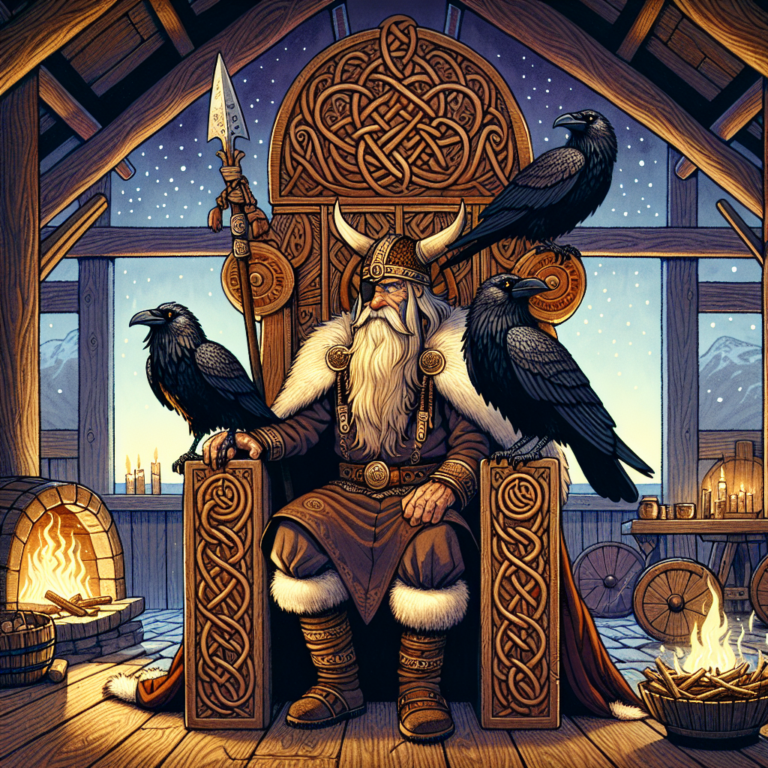
This bedtime story for kids, ‘Odin’s Wisdom: A Courageous Quest Through the Enchanted North’, teaches children ages 6-12 about important moral values.
In the time before time was counted, when the world was young and magic filled every breath of wind, there stood a realm of breathtaking beauty called Asgard.
Imagine a place where golden halls rose toward a sky that was bluer than any sky you have seen, where rainbow bridges arched across impossible distances, and where beings of tremendous power made their homes among towers of silver and bronze.
This was Asgard, home of the Aesir—the warrior gods of the Norse people.
At the center of Asgard grew Yggdrasil, the World Tree, whose branches stretched into the heavens and whose roots reached into the depths of existence. This ash tree, ancient beyond measure, held together the Nine Worlds like pearls on a necklace.
And high upon his throne in the hall called Valaskjalf sat Odin, the Allfather, wisest and most powerful of all the gods.
Though Odin was the king of the gods, he did not rule through force alone. His greatest weapon was knowledge—knowing what happened throughout the Nine Worlds, knowing what enemies plotted, knowing what the future held.
For this, he relied on Huginn and Muninn—his two ravens.
Their names meant “Thought” and “Memory,” for these were no ordinary birds. Every morning, as the sun rose over Asgard, the two ravens would launch themselves from Odin’s shoulders and fly out across the worlds.
Huginn soared over the realm of the living, watching the deeds of gods, giants, humans, dwarves, and elves. His sharp eyes missed nothing—not the treachery of a giant hiding in the mountains, not the bravery of a mortal facing death with courage, not the secret alliances being formed in distant halls.
Muninn flew to different places, visiting the borders of the realms, the edges of memory itself. He gathered what had been, what was being forgotten, what the living tried to hide.
By evening, both ravens returned to Odin’s side. They perched upon his shoulders and whispered into his ears everything they had seen and heard. Through them, the Allfather knew more than any other being in existence.
“I fear for Huginn,” Odin once admitted, “that he will not return. But I fear even more for Muninn.”
For to lose Thought was troubling, but to lose Memory was to lose oneself entirely.
But not all of Asgard’s protection came from wisdom. Sometimes, threats required a more direct response.
This is where Thor came in.
Thor was the god of thunder, the mightiest warrior among the Aesir. He was the son of Odin and the earth goddess Jord, and in him was combined the strength of the sky and the power of the earth itself.
He was not as subtle as his father. Where Odin gathered information and planned complex strategies, Thor charged headfirst into battle, his mighty hammer Mjolnir blazing with lightning.
Mjolnir was no ordinary weapon. It had been forged by the dwarven brothers Sindri and Brokkr, and it possessed three extraordinary powers: it would never miss its target, it would always return to Thor’s hand after being thrown, and only Thor himself could lift it.
When Thor threw Mjolnir, thunder rolled across the heavens.
Among the Nine Worlds, one held special importance to Thor. It was called Midgard—the realm of humans, the world we live in today.
The Norse believed that Midgard sat in the center of the cosmic structure, protected from the realms of giants and monsters by a vast ocean. But the barriers were not perfect, and dark creatures sometimes slipped through to threaten the humans who lived there.
One day, Thor stood upon the rainbow bridge called Bifrost and looked down at Midgard far below. He saw villages and farms, families working and children playing, people living their brief mortal lives under the same sky where the gods waged their eternal battles.
“Father,” Thor said to Odin, “the humans are vulnerable. They cannot fight the giants as we do. They cannot wield magic against the monsters that creep from the darkness. Who protects them?”
Odin smiled. “You ask the right question. And the answer is: you do. That is your purpose among the gods.”
From that day forward, Thor became the special protector of humankind. When giants threatened the borders of Midgard, Thor was there. When terrible creatures rose from the deep, Thor fought them back. When winter storms raged too long and farmers feared for their crops, Thor would ride through the clouds, his chariot pulled by his magical goats, and he would break the hold of winter with the coming of spring thunder.
The people of Midgard learned to love the sound of thunder. To them, it was not a thing to fear but a sign that Thor was watching, that Thor was fighting for them, that they were not alone.
While Thor protected the living, Odin prepared for a war that would not come until the end of time.
This war was called Ragnarok—the Twilight of the Gods—and the prophecies said that in the final battle, the gods would fight against the forces of chaos, led by the giants and the great monsters of the world.
Odin knew this battle was coming, though he did not know exactly when. So he gathered an army—not of gods, but of fallen human warriors.
When a brave warrior died in battle on Midgard, something remarkable happened. Half of these fallen heroes were chosen by the Valkyries, Odin’s warrior maidens, and carried across the sky to Valhalla—the Hall of the Slain.
Valhalla was magnificent beyond imagining. Its walls were made of golden shields. Its roof beams were spears. Five hundred and forty doors opened into the hall, each wide enough for eight hundred warriors to march through side by side.
Every day in Valhalla, the fallen warriors—called Einherjar—would rise and fight each other in glorious combat, training for the final battle. Every wound they received would heal instantly, and every warrior who fell would rise again for the evening feast.
At that feast, they ate the meat of the boar Saehrimnir, which was magically restored each day, and drank mead that flowed from the udders of the goat Heidrun, who fed on the leaves of Yggdrasil.
To understand Valhalla, you must understand how the Norse warriors thought.
They believed that a death in bed from old age or illness was shameful. Only death in battle was honorable, because it showed courage and devotion to one’s comrades.
A warrior who died bravely on the battlefield had proved his worth. He had shown that he would stand and fight rather than run. He had demonstrated the supreme virtue of the Norse: courage in the face of death.
Such a warrior deserved the highest reward: eternal life in Odin’s hall, fighting and feasting with the greatest heroes who had ever lived, waiting for the final battle when he would fight alongside the gods themselves.
“But why prepare for a battle they know they will lose?” you might ask. The prophecies said that at Ragnarok, many of the gods would fall. Even mighty Thor would die after killing the serpent Jormungandr.
The answer reveals something deep about Norse beliefs. The Vikings did not measure worth by winning or losing. They measured worth by how you faced your fate.
If the gods themselves could meet their doom with courage and defiance, surely mortals could do the same. The point was not to live forever but to live well—and to die bravely when the time came.
Not all who died went to Valhalla. Those who died of sickness or old age went to Hel, the realm of the dead, ruled by the goddess of the same name. Those who drowned at sea went to the hall of the sea goddess Ran. And half of the battle-slain were chosen by the goddess Freyja for her own hall, Sessrumnir.
But whatever the destination, the Norse believed that death was not an ending but a transformation. The souls of the dead remained connected to the living through memory, through the retelling of their deeds, through the continuing bond between generations.
This is why Thor’s protection of Midgard mattered so deeply. He was not just protecting human bodies—he was protecting the chain of ancestors and descendants, the stories passed from grandparent to grandchild, the traditions that made a people who they were.
And this is why Odin’s ravens mattered. Huginn and Muninn—Thought and Memory—represented the core of what makes us human. To think, to remember, to learn from the past and plan for the future—these are the gifts that separate us from the animals.
As the centuries turned and the Viking Age came and went, the old gods retreated from the world. The people of the north adopted new beliefs, and the thunderstorms were explained by natural causes rather than divine battles.
But the stories remained.
Every time a thunderstorm rolls across the sky, you might remember Thor—the loyal son, the fierce protector, the god who loved humanity and fought for it without asking anything in return.
Every time you learn something new or remember something important, you might think of Huginn and Muninn—the power of thought and memory that lets us grow beyond our animal natures.
Every time you hear of someone who faced a challenge with courage, even knowing they might fail, you might think of the Einherjar and their Norse warrior spirit—the belief that how you face your fate matters more than whether you win or lose.
These are the gifts the Norse gave us: not just exciting stories of gods and monsters, but a way of thinking about courage, loyalty, memory, and what it means to face the unknown with dignity.
The old gods may be gone, but their wisdom endures.
This ancient Norse mythology teaches several important lessons.
*First, protection of others is a noble calling. Thor devoted himself to protecting Midgard, not for reward or glory, but because it was the right thing to do. True strength is used to help others, not to dominate them.
Second, wisdom requires both thought and memory. Huginn and Muninn remind us that knowledge comes from both thinking about the present and remembering the past. We need both to navigate the future.
Third, courage is measured by how we face challenges, not by whether we win. The Norse warriors knew they would face Ragnarok and possibly fall, but they trained anyway. What matters is facing our challenges with courage, not avoiding them.
Finally, the bonds between generations matter. The Norse believed that memory connected the living and the dead. When we remember those who came before us and tell their stories, we keep something of them alive.
This retelling faithfully preserves authentic Norse mythology:
The Prose Edda (written c. 1220 CE by Snorri Sturluson) and the Poetic Edda (compiled c. 1270 CE from older materials) are the primary sources for Norse mythology.
Thor was indeed the primary protector of both Asgard and Midgard. His association with thunder, his hammer Mjolnir, and his role as the enemy of giants are well documented.
Odin’s ravens are described in the Poetic Edda. The passage quoted about Odin fearing for their return comes directly from the Grimnismal.
The concept of Valhalla as a hall where fallen warriors feast and fight until Ragnarok is central to Norse mythology and is described in detail in the Eddas.
– Asgard: The realm of the Aesir gods, connected to other worlds by the rainbow bridge Bifrost
– Thor: The god of thunder, protector of Midgard, wielder of the hammer Mjolnir
– Mjolnir: Thor’s magical hammer, which always returns when thrown and can only be lifted by Thor
– Odin: The Allfather, chief of the Aesir, associated with wisdom, war, death, and poetry
– Huginn and Muninn: Odin’s ravens whose names mean “Thought” and “Memory”
– Midgard: The realm of humans, located at the center of the Nine Worlds
– Valhalla: The Hall of the Slain, where fallen warriors feast and train for Ragnarok
– Einherjar: The chosen warriors who dwell in Valhalla, preparing for the final battle
– Ragnarok: The prophesied final battle between gods and giants, the “Twilight of the Gods”
– Valkyries: Odin’s warrior maidens who choose the worthy dead and carry them to Valhalla
1. Thor dedicated himself to protecting humans even though they could never repay him. Who in our world protects others without expecting rewards? (Service, selflessness, duty)
2. The Norse believed that Memory (Muninn) was even more important than Thought (Huginn). Why might remembering the past be so important? (Memory, learning from history)
3. The Vikings believed that how you face challenges matters more than whether you win. Do you agree? Can you think of examples? (Character, courage, attitude)
4. Why might telling stories about ancestors and heroes have been so important to the Norse people? (Tradition, legacy, cultural identity)
5. What sounds in nature remind you of something powerful or magical, the way thunder reminded the Norse of Thor? (Imagination, connection to nature)
– Sturluson, Snorri, “Prose Edda” (c. 1220 CE)
– “Poetic Edda” (compiled c. 1270 CE)
– Grimnismal – Source for Huginn and Muninn
– Voluspa and Gylfaginning – Sources for Ragnarok and Valhalla
– Lindow, John, “Norse Mythology: A Guide to the Gods, Heroes, Rituals, and Beliefs”
This story preserves the essence of Norse mythology, exploring the protective role of Thor, the wisdom-gathering of Odin’s ravens, and the warrior culture that valued courage above all else, helping children understand why these stories have endured for over a thousand years.*
Test Your Understanding
1Who was the king of Asgard?
Frequently Asked Questions
What is the moral lesson of Odin’s Wisdom: A Courageous Quest Through the Enchanted North?
What age is this story appropriate for?
How long does it take to read Odin’s Wisdom: A Courageous Quest Through the Enchanted North?
What culture does this story come from?
Can I use this story for teaching?
Frequently Asked Questions
What is Odin’s Wisdom: A Courageous Quest Through the Enchanted North about?
It’s a bedtime story for kids ages 6-12 set in the Norse mythological realm of Asgard. The story follows Odin on a courageous quest and teaches children important moral values like bravery, perseverance, and the importance of seeking wisdom, all wrapped in a magical adventure through the Enchanted North.
What age group is this Odin’s Wisdom story best suited for?
This story is ideal for children ages 6 to 12. The language is engaging and imaginative enough to captivate younger readers, while the moral lessons and Norse mythology themes offer enough depth to keep older kids in that range interested and thinking.
What moral lessons does Odin’s Wisdom teach children?
The story teaches kids that true wisdom requires courage and sacrifice. Through Odin’s quest, children learn values like determination, humility, and the willingness to go on a difficult journey in pursuit of knowledge — lessons that apply to everyday challenges kids face at school and home.
📚 Recommended Books
Handpicked for readers like you
As an Amazon Associate, we earn from qualifying purchases. These recommendations are personalized based on this story's themes and your reading history.
Who is Odin in Norse mythology, and why is he important in this story?
Odin is the Allfather — the king and wisest of the Norse gods who rules from Asgard. Despite his great power, he constantly seeks more wisdom. This makes him a relatable and inspiring hero for children, showing them that even the greatest leaders never stop learning and growing.
Is this bedtime story based on real Norse mythology?
Yes, the story draws from authentic Norse mythology, featuring real elements like Asgard, Yggdrasil the World Tree, and the Nine Worlds. While adapted to be child-friendly and focused on moral values, it gives kids a genuine introduction to the rich world of Norse legends and their timeless lessons.