Share this engaging bedtime story with kids ages 6-12 to teach valuable life lessons.
Chapter 1: The Library Between Worlds
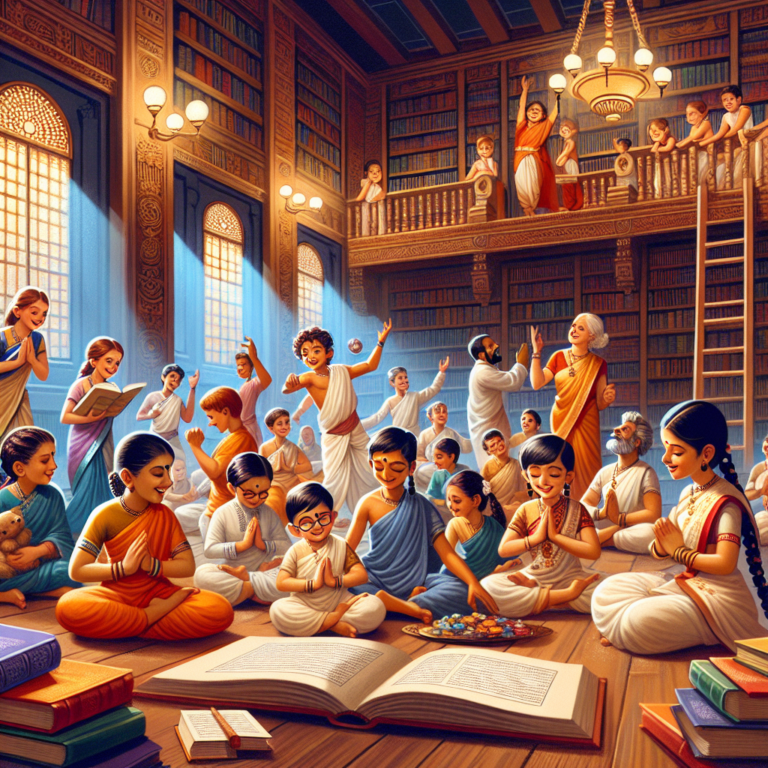
Far away, in a land where ancient banyan trees whispered secrets to the wind and rivers flowed with memories of a thousand generations, there existed a most extraordinary library. It was not a library that could be found on any map. It could not be reached by any road. Yet somehow, seekers who needed it always found their way there.
This was the Library of Bharat – a magical repository containing the wisdom of India since the very beginning of time.
The library’s keeper was a woman named Saraswati, named after the goddess of knowledge herself. She had silver hair that flowed like moonlight and eyes that seemed to contain entire universes. Though she appeared to be an elderly woman, something about her suggested she had existed for longer than anyone could imagine.
One morning, the library received three very unusual visitors.
The first was Priya, a girl of fourteen who suffered from nightmares so terrible she had barely slept in months.
The second was Amar, a boy of twelve who had been so angry since his parents’ divorce that he couldn’t control his temper.
The third was Dia, a girl of ten who felt so anxious about everything that she could barely leave her house.
None of them knew how they had arrived at the library. One moment they had been in their own beds, struggling with their own troubles. The next moment, they found themselves standing before its golden doors.
“Welcome,” Saraswati said, her voice like music. “You have been brought here because each of you carries a burden that ordinary remedies cannot heal. Come inside. The books have been waiting for you.”
Chapter 2: The Hall of a Thousand Shelves
The inside of the library was impossible. It stretched farther than eyes could see – shelf upon shelf of books, scrolls, and palm-leaf manuscripts reaching into misty heights. Golden light filtered through windows that seemed to look out onto a dozen different landscapes at once.
“How can there be so many books?” Priya breathed.
“India has been gathering wisdom for over five thousand years,” Saraswati replied. “The Vedas, the Upanishads, the Puranas, the great epics, the sutras on yoga and philosophy and medicine – all are here. And more books arrive every day, as new wisdom is discovered.”
She led them through winding corridors, past sections labeled in Sanskrit script.
“Each of you has come seeking help,” Saraswati continued. “And the library will provide. But not in the way you might expect. You will not simply read about solutions to your problems. You will experience them.”
She stopped before a door that shimmered like water. “Through here lies the first section that calls to you. Priya, this one is for you.”
Chapter 3: Priya and the Dreams
Priya stepped through the shimmering door and found herself in a peaceful garden. Fragrant flowers bloomed everywhere, and a gentle stream murmured nearby. Sitting on a flat stone was a serene man with closed eyes – but he opened them as she approached.
“I am a teacher of Yoga Nidra – the yoga of sleep,” he said. “You have nightmares?”
Priya nodded miserably. “Every night. Terrible dreams I can’t control. I’m afraid to close my eyes.”
“Come, sit beside me. Let me teach you something.”
Over the hours that followed – though time seemed to move strangely in this place – the teacher showed Priya the ancient art of conscious relaxation. He taught her how to scan her body, releasing tension she didn’t know she carried. He taught her how to set an intention before sleep, planting seeds of peace in her subconscious mind.
“Your nightmares have power because you feel powerless against them,” the teacher explained. “But the dreaming mind and the waking mind are not so different. When you learn to be aware and relaxed at the same time, you carry that awareness into your dreams. You become the author of your own sleep.”
“But how? The dreams feel so real, so overwhelming.”
“Because you believe you are trapped in them. Let me show you.”
He guided her through a practice that felt like falling asleep while staying awake – a delicious twilight state where she could feel her body heavy and relaxed while her mind remained gently alert.
“In this state,” the teacher said, his voice soft, “notice that you can choose what to think about. Think of a safe place. A place of beauty and peace.”
Priya thought of her grandmother’s garden, where she had spent happy summers as a child.
“Now, hold that image. Feel it. You are there now. This is your sanctuary. In your dreams tonight, remember this place. When the nightmares come, you need only think of this sanctuary, and you will go there instead.”
That night – whether in the library or back in her own bed, Priya couldn’t quite tell – she slept without nightmares for the first time in months.
Chapter 4: Amar and the Fire
Amar found himself in a different part of the library – a room that looked like a gymnasium, but unlike any he had ever seen. Instead of weights and machines, there were mats for sitting, ropes hanging from the ceiling, and illustrations on the walls showing people in various postures.
A strong, calm man greeted him. “You carry fire inside you,” the man observed. “Anger that burns.”
“I can’t help it,” Amar said defensively. “Things make me angry and I just… explode.”
“There is nothing wrong with anger,” the man said, surprising him. “Anger is energy. Energy is neither good nor bad – it simply is. The problem is not that you have anger. The problem is that you do not know how to use it.”
He gestured to the mats. “This is the practice of Hatha Yoga – the yoga of physical discipline. Let me teach you something about your body.”
Over the following hours, the teacher led Amar through challenging poses that required all his strength and concentration. When frustration arose, the teacher had him hold the pose longer. When anger flared, the teacher had him breathe more deeply.
“Feel the energy moving through you,” the teacher said. “This is the same energy as your anger – but transformed. When you move your body with intention, when you breathe with awareness, the fire inside you becomes fuel instead of destruction.”
By the end, Amar was exhausted – but it was a good exhaustion, a clean exhaustion. The fire inside him was not gone, but it felt different. Like a flame in a lantern instead of a wildfire.
“The anger will still come,” the teacher told him. “But now you have tools. When you feel it rising, move your body. Breathe deeply. The energy will still be there, but you will be its master instead of its slave.”
Chapter 5: Dia and the Breath
Dia’s door led to a garden at twilight, where fireflies danced and the air smelled of jasmine. A woman with kind eyes sat waiting for her.
“You are afraid,” the woman said gently. “Afraid of everything.”
Dia felt tears prick her eyes. “I don’t know why. I know it’s silly. I know most of the things I’m scared of will never happen. But I can’t stop the feeling.”
“It is not silly,” the woman said. “Your mind is trying to protect you. But it has become too vigilant, seeing danger everywhere. Let me teach you about Pranayama – the control of breath.”
She had Dia sit beside her and place one hand on her chest, one on her belly.
“When we are anxious, we breathe shallowly, from the chest. This tells our body we are in danger. The body responds with more fear. It is a cycle. But we can break it.”
She taught Dia to breathe deeply into her belly, letting it rise and fall like a gentle wave. She taught her to breathe in slowly, hold briefly, breathe out even more slowly.
“When you breathe this way,” the woman explained, “you are sending a message to your whole body: ‘I am safe. There is no emergency. I can relax.’ The body believes the breath more than it believes the worried thoughts.”
They practiced together as the fireflies danced. Dia learned counting breaths – four counts in, four counts hold, six counts out. She learned alternate nostril breathing, which seemed strange at first but left her feeling remarkably calm.
“Anxiety lives in the future,” the woman said. “It worries about what might happen. But the breath is always in the present. When you focus on your breath, you bring yourself back to now. And in this moment, right now, you are safe.”
Dia realized she was smiling – something she hadn’t done freely in a long time.
Chapter 6: The Great Hall of Systems
After their individual lessons, the three children found themselves together again in a great hall where Saraswati waited.
“You have each tasted one drop from the ocean of Indian wisdom,” she said. “But let me show you how vast that ocean truly is.”
She led them past alcoves containing different traditions:
“Here is the Bhagavad Gita,” she said, indicating shelves of ornate manuscripts, “which teaches that we should do our duty without attachment to results. When you do your best and let go of worrying about the outcome, you find peace.”
“Here are the Upanishads, which ask the deepest questions: Who am I? What is consciousness? What connects all living things?”
“Here is Ayurveda, the science of life, which teaches that health comes from balance – in what we eat, how we live, and how we think.”
“Here is Jnana Yoga, the path of knowledge, for those who seek truth through understanding.”
“Here is Bhakti Yoga, the path of devotion, for those who seek truth through love.”
“Here is Karma Yoga, the path of action, for those who seek truth through selfless service.”
The children looked around in wonder at the endless shelves, each one holding another tradition, another perspective, another piece of the great puzzle.
“How can anyone learn all of this?” Amar asked.
Saraswati smiled. “No one person can. That is why India teaches that we are all connected. Each person learns what they need, and together, we hold the complete wisdom. Your grandmother may know herbal healing. Your neighbor may know meditation. Your teacher may know the philosophical texts. Together, the community carries the knowledge.”
Chapter 7: The Gift of the Library
Before they left, Saraswati gave each child a small book, beautifully bound.
“These are blank,” Dia observed.
“For now. They will fill with the wisdom you need as you need it. When you are troubled, open the book and read. The library will send you what you require.”
Priya looked at her book with hope in her eyes. “So we can come back?”
“The library is always here – though you may not always visit in body. Some come in dreams. Some come through deep meditation. Some simply find the wisdom appearing in their lives at just the right moment.” Saraswati’s eyes twinkled. “India has been sharing her secrets with the world for thousands of years. She will not stop now.”
She touched each child’s forehead gently. “Remember what you have learned: Priya, that peace can be cultivated even in sleep. Amar, that your fire can be fuel instead of destruction. Dia, that the breath is an anchor to the present moment where you are always safe.”
“Will the lessons work?” Priya asked. “In the real world, I mean?”
“They have worked for thousands of years,” Saraswati replied. “They work for those who practice. Wisdom is not magic that changes you instantly. It is a practice that changes you gradually. Be patient with yourselves. Return to what you have learned again and again. The changes will come.”
Chapter 8: The Morning After
The three children woke in their own beds, in their own homes, uncertain whether any of it had been real.
But Priya found that she remembered the teacher’s voice, and when she practiced the relaxation technique, her nightmares began to fade.
Amar found that when anger rose in him, he could feel it coming now – and instead of exploding, he could choose to move, to breathe, to channel the fire.
Dia found that when anxiety gripped her, focusing on her breath truly did calm her body and bring her back to the present moment.
And in each of their rooms, on their bedside tables, lay a small beautiful book. When they opened it, they found the first few pages now filled with writing – reminders of what they had learned, encouragement to keep practicing, and promises of more wisdom to come.
Years later, when they were grown, each of them would tell others about the magical library – some believed, some didn’t. But they all agreed on one thing: India’s ancient wisdom, whether accessed through a mystical library or through the many books, teachers, and practices available in the ordinary world, had real power to heal, to transform, and to bring peace.
The door to that library remains open to anyone who truly seeks. Perhaps, if you need it enough, you will find your way there too.
Moral Lessons
- Ancient wisdom from India offers practical tools for managing life’s challenges – from sleep troubles to anger to anxiety. These are not just ideas to understand but practices to experience. With patience and consistency, the techniques of yoga, breathing, and mindfulness that have helped people for thousands of years can help us too. The knowledge exists; we need only seek it and practice it.
Test Your Understanding
1What were the children trying to mimic from the book ‘Yoga for Relaxation’?
Frequently Asked Questions
What is the moral lesson of The Magical Library and the Secrets of Ancient India?
What age is this story appropriate for?
How long does it take to read The Magical Library and the Secrets of Ancient India?
What culture does this story come from?
Can I use this story for teaching?
Frequently Asked Questions
What is The Magical Library and the Secrets of Ancient India about?
It’s a bedtime story for kids ages 6-12 set in a mystical Library of Bharat, a magical place holding the wisdom of Ancient India. Three young visitors — Priya, Amar, and a third child — each arrive with personal struggles and discover life lessons guided by the library’s keeper, Saraswati.
What age group is this Ancient India bedtime story suitable for?
This story is designed for children ages 6 to 12. It blends magical storytelling with cultural wisdom from Ancient India, making it engaging for young readers while naturally introducing valuable life lessons and moral themes in a way kids can understand and enjoy.
What life lessons does The Magical Library teach children?
The story teaches lessons around knowledge, courage, and inner wisdom. Through the characters’ journeys inside the magical library, children explore themes like facing fears, finding strength, and the value of ancient wisdom — all wrapped in an imaginative adventure rooted in Indian culture and mythology.
📚 Recommended Books
Handpicked for readers like you
As an Amazon Associate, we earn from qualifying purchases. These recommendations are personalized based on this story's themes and your reading history.
Who is Saraswati in The Magical Library story?
Saraswati is the keeper of the magical Library of Bharat. Named after the Hindu goddess of knowledge, she has silver hair, all-knowing eyes, and seems to have existed since the beginning of time. She serves as a wise guide who helps the young visitors navigate the library’s secrets and their own personal challenges.
Is The Magical Library and the Secrets of Ancient India based on Hindu mythology?
The story is inspired by Hindu culture and mythology rather than being a direct retelling. It draws on figures like Saraswati and imagery from Ancient India — such as banyan trees and sacred rivers — to create an original, morally rich fantasy adventure that introduces kids to Indian heritage in a gentle, accessible way.