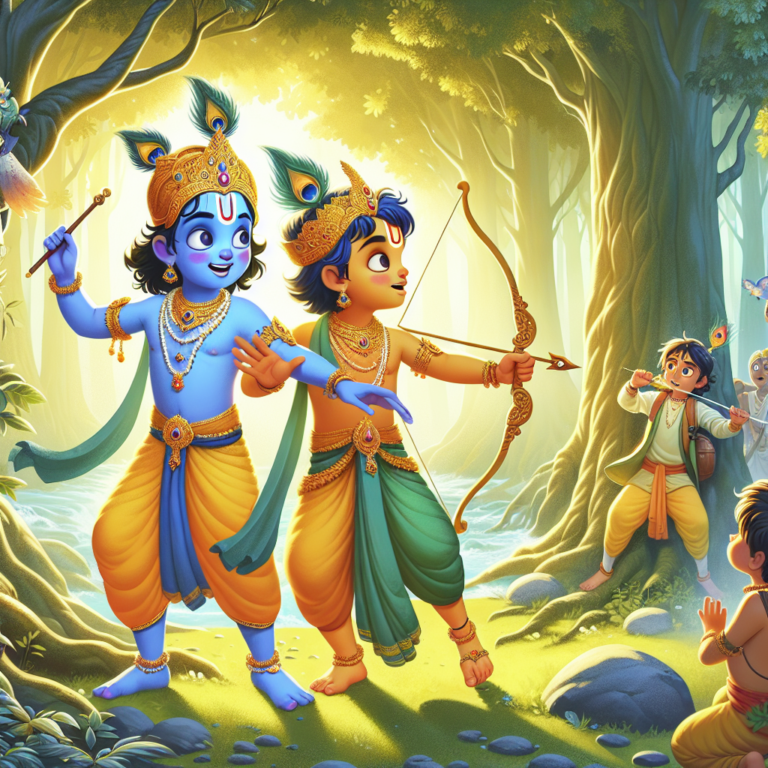
This moral story for children ages 6-12 combines entertainment with important values.
Chapter 1: The Library Beyond the Mountains
High in the misty peaks of the Himalayas, where eagles soared above clouds and the air itself seemed to shimmer with ancient magic, there stood a temple that few mortals had ever seen. This was the Temple of Eternal Wisdom, and within its walls lay the most precious treasure in all the world – the sacred Puranas.
In a small village at the foot of these great mountains lived a curious young girl named Priya. She had dark eyes that sparkled with questions and wild black hair that refused to stay in its braids. Unlike the other children who were content to play in the meadows, Priya was always asking: “Why does the sun rise in the east? How did the rivers know where to flow? Who painted the colors on the butterflies’ wings?”
Her grandfather, a kind old scholar named Pandit Krishnadas, would laugh warmly at her endless questions. “You have the mind of a seeker, little one. Perhaps one day, you will find the Puranas themselves and read the answers written by the great sages.”
“What are the Puranas, Dadaji?” Priya asked, using the loving term for grandfather.
The old man’s eyes grew distant, as if looking at something far away. “They are the memories of the universe itself, Priya. Scrolls that contain stories of how everything began, tales of gods and heroes, wisdom that has guided our people for thousands of years.”
Chapter 2: The Call of Destiny
On the night of her twelfth birthday, Priya had a dream unlike any other. She found herself standing in a great hall where the walls seemed to be made of starlight. Before her floated an ancient sage with a long white beard, his body glowing with soft golden light.
“Priya,” the sage spoke, his voice echoing as if coming from everywhere at once, “I am Vyasa, compiler of the Puranas. The wisdom of the ages calls to you. Will you answer?”
When Priya woke, she found a single peacock feather on her pillow – the symbol of Lord Krishna. She knew this was no ordinary dream.
She ran to her grandfather and told him everything. Pandit Krishnadas listened carefully, his old hands trembling slightly.
“The sage Vyasa himself,” he whispered with reverence. “Priya, you have been chosen. The Temple of Eternal Wisdom has been lost to most seekers for centuries. But perhaps… perhaps you are meant to find it.”
“Will you come with me, Dadaji?”
The old man shook his head sadly. “My traveling days are behind me. But I can give you something to help on your journey.” He reached into an old wooden chest and pulled out a yellowed map. “This belonged to my teacher’s teacher. It shows the path to the temple – for those with the wisdom to read it.”
Chapter 3: The Three Guardians
Priya’s journey led her high into the mountains, past villages where kind strangers offered her food and shelter, through forests where monkeys chattered warnings of dangers ahead. The path on the map was not a straight line but a puzzle, requiring her to solve riddles left by ancient sages.
The first guardian she encountered was a massive stone statue of a four-headed being that suddenly came to life as she approached a narrow mountain pass.
“I am Brahma, the Creator,” the statue spoke with four voices at once. “To pass my gate, you must answer: What exists before anything else is created?”
Priya remembered her grandfather’s teachings. “Before creation, there is thought. Before thought, there is consciousness. And consciousness is eternal – it has no beginning and no end.”
The statue smiled with all four faces. “You have wisdom beyond your years, young seeker. The Puranas dedicated to me tell of creation itself – how the universe emerges, exists, and returns to the source, again and again in endless cycles. Pass, and remember: everything you see was once a dream in the mind of the divine.”
The second guardian appeared at a rushing river – a beautiful blue-skinned figure playing a flute, his music so enchanting that the water itself seemed to dance.
“I am Vishnu, the Preserver,” he said, his dark eyes kind. “My Puranas speak of dharma – the right way to live. Tell me, young one: what is the highest duty?”
Priya thought of all the stories her grandfather had told her about Lord Rama’s honor and Lord Krishna’s love. “The highest duty is to act with love and righteousness, to protect those who cannot protect themselves, and to do what is right even when it is difficult.”
Vishnu’s smile was like sunrise over the mountains. “Well spoken. The Vishnu Purana and Bhagavata Purana contain tales of my avatars – Rama, who showed the world the meaning of honor, and Krishna, who taught that love is the greatest power. Remember their stories, and you will never lose your way.”
The third guardian was the most fearsome – a wild figure with matted hair and serpents coiled around his neck, sitting perfectly still in meditation on a mountain peak.
“I am Shiva, the Transformer,” he spoke without opening his eyes. “My Puranas reveal the deepest mysteries. Answer this: Why do things end?”
This question made Priya pause. She thought about the autumn leaves falling, about her grandmother who had passed away two winters ago, about how even mountains eventually crumble to dust.
“Things end,” she said slowly, “so that new things can begin. Endings are not truly endings – they are transformations. Without the old making way for the new, nothing could grow. Nothing could become better than it was.”
Shiva’s eyes opened, revealing depths that seemed to contain entire universes. “You understand what many spend lifetimes trying to learn. Transformation is not something to fear – it is the dance of existence itself. Go now. The temple awaits.”
Chapter 4: The Hall of Infinite Stories
At last, Priya reached the Temple of Eternal Wisdom. Its spires touched the clouds, and its walls were carved with countless images – scenes from a thousand stories, heroes and gods, demons and sages, all frozen in stone yet somehow seeming to move when she wasn’t looking directly at them.
Inside, she found herself in a vast library. Scrolls and palm-leaf manuscripts lined the walls from floor to ceiling, reaching up so high she couldn’t see where they ended. And there, sitting cross-legged on a simple mat, was Vyasa himself – just as he had appeared in her dream.
“Welcome, seeker,” Vyasa said. “You have passed the guardians’ tests. Now, you may ask one question, and I will guide you to the Purana that holds your answer.”
Priya had so many questions. How was the universe created? What happens after we die? Who were all the gods and heroes of ancient times? But standing there in that infinite library, surrounded by more knowledge than she could read in a thousand lifetimes, one question rose above all others.
“Revered sage,” she asked, “how should I live my life?”
Vyasa’s ancient face broke into a gentle smile. “Of all the questions you could ask, you have asked the wisest. Come, let me show you.”
He led her to a particular shelf and pulled down a scroll that seemed to glow with inner light. “This is from the Bhagavata Purana. It contains the story of a young cowherd named Krishna, who taught that the secret to living well is simple: act with love, do your duty without attachment to results, and see the divine in everyone you meet.”
Chapter 5: The Stories Come Alive
As Vyasa unrolled the scroll, something magical happened. The words lifted off the page and swirled around them, transforming into living scenes.
Priya watched, amazed, as the young Krishna appeared before her – a mischievous boy stealing butter from the village women, a brave child defeating the serpent demon Kaliya, a wise friend counseling the warrior Arjuna before a great battle.
“The Puranas are not just stories,” Vyasa explained as scenes shifted around them. “They are mirrors. In them, we see ourselves – our struggles, our choices, our potential for greatness.”
Now they were watching Lord Rama, the ideal prince, choosing honor and duty over comfort and power, spending fourteen years in forest exile without complaint because he had given his word.
“From Rama we learn that our word is our bond,” Vyasa said. “That true nobility comes from character, not from crowns.”
The scenes changed again, showing the goddess Parvati practicing fierce discipline for thousands of years to win Lord Shiva’s love.
“From Parvati we learn that anything worth having requires patience and dedication.”
They watched the demon-king Hiranyakashipu, so proud of his power that he demanded everyone worship him instead of the gods – and his own son, Prahlad, who refused, choosing truth over safety.
“From Prahlad we learn that courage is not the absence of fear, but doing what is right despite fear.”
Chapter 6: The Gift of Wisdom
After hours that felt like minutes, Vyasa rolled up the scroll. The magical visions faded, but their lessons remained bright in Priya’s heart.
“You cannot take the Puranas with you,” Vyasa said. “Their scrolls must remain here. But the wisdom you have received – that is yours forever. Share it with others, as I have shared it with you.”
“But how can I remember everything?” Priya asked. “There is so much!”
Vyasa touched her forehead gently. “The stories are now planted in your heart like seeds. When you need them, they will bloom. When you meet someone struggling with honor, the tales of Rama will rise within you. When you encounter someone who needs courage, Prahlad’s story will speak through you. The Puranas live in those who carry them.”
He handed her the peacock feather she had found on her pillow. “This is your symbol now. You are a keeper of stories. Go, and help others find the wisdom they seek.”
Chapter 7: The Return Home
Priya’s journey home seemed shorter than her journey out, as if the mountains themselves were helping her along. When she finally reached her village, her grandfather was waiting at the edge of the settlement, as if he had known exactly when she would return.
“Dadaji!” she ran into his arms. “I found it! I found the temple, and Vyasa himself taught me!”
Pandit Krishnadas held her tight, tears flowing down his weathered cheeks. “I knew you would, my child. I knew you would.”
That evening, Priya sat where her grandfather usually sat, and the village children gathered around her, their eyes wide with anticipation.
“Tell us a story!” they begged.
Priya smiled, feeling the wisdom of the Puranas stir within her heart like a gentle flame.
“Let me tell you about a time before time,” she began, her voice taking on a new quality – one that seemed to contain echoes of ancient sages and eternal truths. “When the universe was just a dream waiting to awaken…”
And as she spoke, the children listened, just as children had listened to these same stories for thousands of years, and just as children would continue to listen for thousands of years to come. For the Puranas are not merely old tales – they are the living heartbeat of wisdom, passed from soul to soul across the ages, forever teaching, forever guiding, forever alive.
Moral Lessons
- True wisdom lies not in accumulating knowledge for oneself, but in understanding how to live well and sharing that understanding with others. The ancient stories of the Puranas teach us that courage, honor, love, and duty are the foundations of a meaningful life.
Test Your Understanding
1Who translated the Vishnu Purana into English?
Frequently Asked Questions
What is the moral lesson of The Magical Scrolls of Wisdom: A Journey Through the Puranas?
What age is this story appropriate for?
How long does it take to read The Magical Scrolls of Wisdom: A Journey Through the Puranas?
What culture does this story come from?
Can I use this story for teaching?
Frequently Asked Questions
What are the Puranas and why are they important?
The Puranas are ancient sacred texts from India that contain stories, wisdom, and teachings passed down by great sages. They are considered the memories of the universe, covering topics like creation, history, and moral values. In this children’s story, they are portrayed as magical scrolls of wisdom kept in a mystical Himalayan temple.
Is this Puranas story suitable for young children?
Yes! This moral story is designed for children ages 6 to 12. It blends adventure, magic, and relatable characters to make ancient wisdom accessible and entertaining. The story follows a curious girl named Priya, making it easy for young readers to connect with the journey.
What moral values does this children’s story teach?
The story encourages curiosity, the love of learning, and the pursuit of wisdom. Through Priya’s character, children learn that asking questions is a strength, not a flaw. It also highlights respect for elders and the value of ancient knowledge passed down through generations.
📚 Recommended Books
Handpicked for readers like you
As an Amazon Associate, we earn from qualifying purchases. These recommendations are personalized based on this story's themes and your reading history.
Who is the main character in The Magical Scrolls of Wisdom?
The main character is Priya, a curious young girl who lives in a village at the foot of the Himalayas. She is known for her endless questions about the world around her. Guided by her grandfather, Pandit Krishnadas, she embarks on a journey to discover the sacred Puranas.
Where does The Magical Scrolls of Wisdom story take place?
The story is set in a small Himalayan village and a mystical Temple of Eternal Wisdom hidden high in the misty mountain peaks. This magical setting blends real cultural geography with fantasy elements, making the exploration of the Puranas feel like an exciting adventure for young readers.