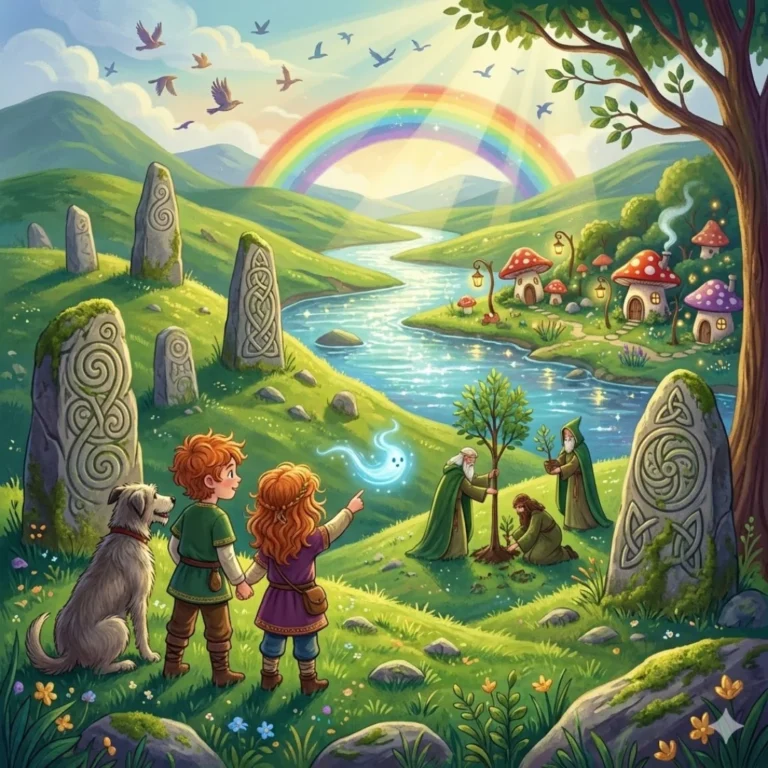
‘The Magical Red Book: Iolo’s Journey to courageous Storytelling’ is an educational moral story perfect for bedtime reading with children ages 6-12.
Chapter One: The Accident
The rain came down in silver sheets as twelve-year-old Carys Davies ran through the cobblestone streets of Aberystwyth, her school bag clutched over her head like a flimsy shield.
She wasn’t watching where she was going. She was thinking about the essay due tomorrow – five hundred words on “What Makes You Proud to Be Welsh” – and how she had absolutely no idea what to write.
That’s when she collided with the old man.
Books flew everywhere. Papers scattered in the rain, immediately beginning to soak. Carys scrambled to help, gathering volumes and manuscripts as fast as she could.
“I’m so sorry!” she gasped. “I wasn’t looking where I was – oh!”
She stopped. In her hands was a book unlike any she had seen before – large, leather-bound, its cover the deep crimson of autumn leaves. Gold lettering gleamed despite the dim light: Llyfr Coch Hergest.
The Red Book of Hergest.
“Give that here, girl,” the old man said, not unkindly. His voice was rich and deep, with the musical lilt of someone who had spent his life among words.
But as Carys handed it over, the book fell open, and her eyes caught a fragment of text – strange words in an old form of Welsh that she could somehow, impossibly, understand:
“Not by conquest, but by story, does a people endure…”
Chapter Two: The Storyteller’s Shop
The old man looked at her sharply. “You read that? The old Welsh?”
“I… I don’t know how. It just… made sense.”
Rain dripped from the old man’s silver beard. He studied her for a long moment, then nodded, as if coming to a decision.
“Come inside. It seems we have things to discuss.”
He led her to a small shop she had walked past a hundred times without ever noticing – a narrow doorway between a bakery and a pharmacy, the sign above it so faded it was nearly invisible: “Siop y Cyfarwydd” – The Storyteller’s Shop.
Inside, candles flickered in brass holders, casting warm light over shelves stuffed with more books than seemed possible for such a small space. A fire crackled in a stone hearth. The smell of old paper and wood smoke wrapped around Carys like a blanket.
“Sit,” the old man said, gesturing to a chair by the fire. “I am Ifor. I keep this shop because someone must, and because the stories need a guardian.”
“What stories?”
He held up the red book.
“These stories. The Mabinogion. The ancient tales of Wales – of Pwyll who ruled the Otherworld, of Branwen whose beauty caused a war, of Math who could hear any whisper on the wind. Of magic and courage and the price of wisdom/” title=”More stories about wisdom”>wisdom.”
Carys felt goosebumps rise on her arms. “They’re real?”
“Real enough to have lasted a thousand years. Real enough that a young girl who claims not to know old Welsh could read them without teaching. Tell me – what brings you running through the rain with such troubled thoughts?”
Chapter Three: The Question That Matters
Carys found herself telling Ifor everything – about the essay, about how she had no idea what made her proud to be Welsh, about how she felt disconnected from a heritage she knew nothing about.
“My family doesn’t do anything traditional,” she said, embarrassed. “We don’t speak Welsh at home. We’ve never been to an Eisteddfod. I don’t know any of the old stories. I don’t even know why Wales matters.”
Ifor nodded slowly. “And that,” he said, “is why the old stories matter most. Not because they are old, but because they answer exactly that question: why do we matter? What makes a people… a people?”
He opened the red book and began to read:
“In the beginning, there was darkness and chaos. Then came the singers, and their songs shaped the world…”
Chapter Four: The Tale of Branwen
“Let me tell you,” Ifor said, “of Branwen, daughter of Llyr, whose story teaches us about the cost of pride and the power of gentleness.”
The fire seemed to dim, and in the dancing shadows, Carys could almost see figures moving.
“Branwen was the most beautiful woman in all Britain. When the King of Ireland sought her hand in marriage, it was meant to bring peace between the two lands. But Branwen’s brother Efnisien, consumed by wounded pride, committed a terrible insult against the Irish – he maimed their horses and rejected the alliance.
“War followed. Terrible, devastating war. Branwen, caught between two nations, watched as armies clashed and heroes died, all because of pride too stubborn to bend.
“At the end, standing on the shores of her homeland after the destruction of both kingdoms, Branwen said these words: ‘Woe is me that I was ever born. Two great kingdoms have been destroyed because of me.’
“And her heart broke with grief.”
Carys felt tears prick her eyes. “That’s so sad.”
“It is. But there is a lesson in the sadness. The tale does not celebrate Efnisien’s pride. It mourns the destruction it caused. The Mabinogion teaches that true strength is not in stubbornness or violence, but in wisdom, kindness, and the courage to seek peace.”
Chapter Five: The Power of Words
Ifor closed the red book and looked at Carys with eyes that seemed to hold centuries of memory.
“There was a man named Iolo Morganwg who lived two hundred years ago. He loved the old ways so much that he spent his life trying to revive them – the Druids, the bards, the traditions that had nearly been forgotten.
“Some say he made things up. Some say he found treasures others had lost. What matters is this: because of him, the Eisteddfod was reborn. Because of him, the bardic traditions continued. Because of him, you and I can sit here today and speak of the Mabinogion.
“Was everything he wrote true in the historical sense? Perhaps not. But was it true in the deeper sense – did it capture the spirit of who we are as a people? I believe so.”
“So stories can be true even if they’re not… factual?”
“The deepest truths often are. When the Mabinogion tells us that Math could hear any whisper on the wind, is it telling us about a real magical power? Or is it telling us that wisdom requires listening – really listening – to the world around us?”
Carys thought about this. “It’s like… a metaphor?”
“It’s like wisdom dressed in wonder. It’s like truth wearing the clothes of magic so that we might remember it.”
Chapter Six: The Gift
Outside, the rain had stopped. Sunset light streamed through the shop’s small windows, turning everything gold.
“I should go,” Carys said reluctantly. “I still have that essay to write.”
“Do you know now what to write?”
Carys paused at the door. “I think… I think I want to write about the stories. About how Wales isn’t just a place on a map – it’s the stories we tell, the songs we sing, the courage of Branwen and the wisdom of Math and all the bards who kept the tales alive.”
Ifor smiled – a broad, warm smile that transformed his weathered face.
“Then take this.”
He pressed a small book into her hands – not the great red book, but a smaller volume, well-worn but carefully preserved.
“Tales from the Mabinogion, translated for young readers. Start here. And when you are ready for more…”
He gestured at the shop around them.
“The stories will be waiting.”
Chapter Seven: The Circle of Story
That night, Carys sat at her desk with the borrowed book open beside her. She wrote:
“What makes me proud to be Welsh?
“I used to think I didn’t know. I don’t speak Welsh at home. I’ve never worn a traditional costume or sung in a choir at an Eisteddfod.
“But today I learned something. Being Welsh isn’t about costumes or ceremonies. It’s about carrying forward a tradition of storytelling that has lasted over a thousand years.
“In the Mabinogion, our ancestors preserved wisdom about pride and humility, courage and compassion, the cost of war and the value of peace. These stories survived invasions and empires, dark ages and industrial revolutions. They survived because people believed they mattered.
“I am proud to be Welsh because I am part of that chain. The bards who sang in the great halls, the monks who copied manuscripts by candlelight, the scholars who translated the old words for new generations – they all kept the fire burning.
“Now it’s my turn.
“I may not speak perfect Welsh. I may not know all the traditions. But I can learn the stories. I can carry them forward. I can make sure that a thousand years from now, someone else will sit by a fire and hear about Branwen and Math and Pwyll and all the heroes who taught us what it means to be human.
“That is what makes me proud to be Welsh: not where I was born, but the stories I choose to remember and share.”
Moral Lessons
- Our cultural heritage lives in the stories we tell and preserve. Pride in one’s identity comes not from costumes or ceremonies, but from carrying forward the wisdom of ancestors and keeping their tales alive for future generations.
Test Your Understanding
1Who was the man who had a vision and brought the Druidic and Bardic tradition back to life?
Frequently Asked Questions
What is the moral lesson of The Magical Red Book: Iolo’s Journey to Courageous Storytelling?
What age is this story appropriate for?
How long does it take to read The Magical Red Book: Iolo’s Journey to Courageous Storytelling?
What culture does this story come from?
Can I use this story for teaching?
Frequently Asked Questions
What is The Magical Red Book about?
The Magical Red Book follows twelve-year-old Carys, who bumps into a mysterious old man on the streets of Aberystwyth and discovers an ancient Welsh manuscript. The story explores her journey to courageous storytelling, helping her find her voice and pride in Welsh heritage — making it a perfect educational bedtime story for children ages 6 to 12.
What age group is The Magical Red Book story suitable for?
This story is designed for children aged 6 to 12. It works well as a bedtime read-aloud or independent reading book, blending adventure, moral lessons, and Welsh history in an engaging, accessible way.
What moral lesson does The Magical Red Book teach children?
The story teaches children about courageous storytelling — finding the bravery to share your own voice, culture, and identity. It encourages kids to take pride in their heritage and overcome self-doubt, showing that stories have the power to inspire confidence and connection.
📚 Recommended Books
Handpicked for readers like you
As an Amazon Associate, we earn from qualifying purchases. These recommendations are personalized based on this story's themes and your reading history.
Is The Magical Red Book based on a real Welsh manuscript?
Yes! The story references the real Llyfr Coch Hergest, known in English as The Red Book of Hergest. It is a genuine medieval Welsh manuscript containing ancient tales and poetry, including the famous Mabinogion legends, giving the story an authentic historical and cultural foundation.
Why is courageous storytelling an important theme for kids?
Courageous storytelling helps children develop confidence, self-expression, and empathy. When kids learn to share their own stories and listen to others, they build emotional resilience and communication skills. Stories like The Magical Red Book show children that their voice matters and that speaking up — even when scary — can be transformative.