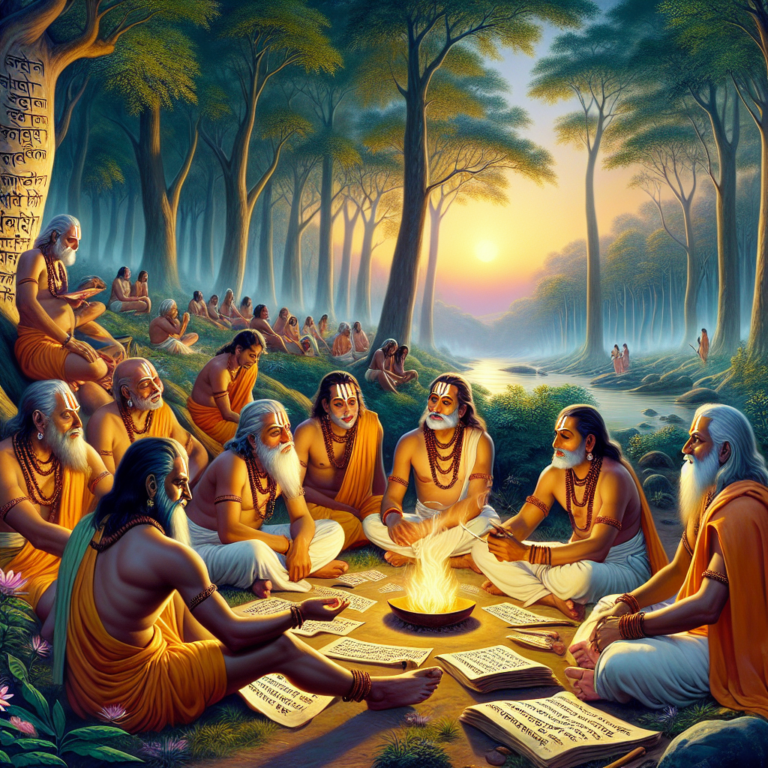
‘The Wise Rishis and the Enchanted Path of Wisdom’ is an educational moral story perfect for bedtime reading with children ages 6-12.
## Chapter One: The Sages of the Mountain
High in the Himalayan mountains, where the peaks touch the clouds and the air is so thin that only the strongest spirits can breathe, there lived a group of extraordinary men and women called Rishis.
These were not ordinary people. They had given up everything – their homes, their families, their comfortable lives in the valleys below – to seek something far more precious than gold or gems. They sought wisdom. Not the kind of wisdom that tells you how to count coins or build houses, but the deep wisdom that answers the greatest questions of all: Who am I? Why am I here? What happens when I die? Is there something greater than myself?
The Rishis lived simply. Their clothes were the bark of trees and the skins of animals who had died naturally. Their food was whatever the forest provided – roots and berries, wild honey and pure mountain water. Their homes were caves or simple huts of leaves and branches.
But in their minds dwelt treasures beyond imagination.
For the Rishis had spent years – some had spent entire lifetimes – sitting in silence, letting their thoughts grow still like a pond without ripples. And in that stillness, they had seen things. They had understood things. the secrets of the universe had opened before them like flowers opening to the sun.
One Rishi, named Yajnavalkya, understood the nature of the Self – how the “I” that each person feels inside is actually a tiny spark of the same great flame that creates and sustains all things.
Another Rishi, named Gargi, had questioned the great teachers so deeply that she was called “the needle,” for her questions pierced through to the heart of every matter.
The Rishi Nachiketa, when he was just a young boy, had traveled to the realm of Death itself and returned with knowledge of what lies beyond this life.
And there were many others, each carrying a piece of the great puzzle of existence within their hearts.
## Chapter Two: The Dream of Sharing
One morning, as the sun rose over the snow-capped peaks and painted them in shades of gold and pink, the Rishis gathered in a clearing.
This was unusual. Normally, each Rishi meditated alone, deep in their own contemplation. But on this morning, an idea had come to several of them at once – an idea so powerful that it pulled them from their caves and their forest glades to speak with one another.
The eldest among them, a woman named Maitreyi who had been seeking wisdom since before any of the others were born, spoke first.
“Friends,” she said, her voice soft but clear like a mountain stream, “I have had a vision. In my meditation, I saw the world below us – the villages and cities, the farmers and merchants, the children and parents. I saw them struggling with questions they cannot answer. I saw them suffering because they do not understand who they truly are.”
The other Rishis nodded. They too had seen these things.
“And I asked myself,” Maitreyi continued, “why should we keep this wisdom only for ourselves? We have spent our lives learning the nature of Dharma – the righteous path. We understand Karma – how every action creates a ripple that spreads through time. We have touched Shakti – the divine energy that powers all creation. Should these teachings die with us? Or should we share them with the world?”
A murmur passed through the gathered sages.
## Chapter Three: The Impossible Task
But then an older Rishi named Angiras raised a concern.
“What you say is noble, Maitreyi,” he said. “But consider the challenge. Our wisdom cannot be captured in simple words. It must be experienced, felt, lived. How can we possibly communicate to ordinary people what we have spent lifetimes learning to understand?”
“And more than that,” added another Rishi named Kapila, “the world is full of distractions. People are busy with their crops, their trades, their families. Even if we could explain our knowledge, would they have the patience to listen? Would they have the ability to understand?”
The Rishis fell silent. These were serious concerns. The wisdom they had gained was like a great ocean – how could they pour it into cups small enough for ordinary people to drink?
It was then that something extraordinary happened.
## Chapter Four: The Divine Visitor
A light appeared in the clearing – not sunlight, but something else entirely. It was as if a piece of the stars had descended to earth and taken human form.
The Rishis instantly recognized what stood before them. This was an Avatar – a manifestation of the Divine, the Supreme Reality itself taking a form that human eyes could see and human minds could comprehend.
The Avatar appeared as a young man, radiantly beautiful, with skin the color of a rain cloud and eyes that seemed to contain all the stars of the universe. He wore simple clothes, like the Rishis themselves, and his smile was full of both joy and profound understanding.
“Wise ones,” the Avatar spoke, and his voice was like music that resonated in the deepest chambers of their hearts, “I have heard your discussion. I have watched your struggles. And I have come to help.”
The Rishis bowed low, touching their foreheads to the ground in reverence.
“Great Lord,” Maitreyi said, “we wish to share our wisdom with the world, but we do not know how. The truths we have learned are too vast, too subtle, too deep for ordinary words.”
The Avatar smiled. “You are right that these truths cannot be captured in simple statements. But consider the lotus flower. Its roots grow in mud at the bottom of a pond. Its stem rises through murky water. But its blossom opens in the sunlight, pure and beautiful, untouched by the mud from which it grew.
“Your teachings must be like the lotus. They must start where people are – in the mud of daily life, with all its struggles and confusions. But they must lead upward, through understanding, toward the light of ultimate truth.
“I will give you a boon,” the Avatar continued. “Whenever you face doubt or difficulty in your sacred task, call upon me in your hearts, and I will guide you. But remember – the power to complete this task already lies within you. I am not giving you something you lack. I am reminding you of what you already possess.”
## Chapter Five: The Work Begins
With renewed purpose and the Avatar’s blessing, the Rishis set to work.
They decided to create a collection of teachings that would be called the Upanishads – a word that means “sitting down near,” for this wisdom was meant to be shared as a teacher sits near a student, passing knowledge from heart to heart.
But creating these teachings was not easy.
Day after day, the Rishis debated and discussed. How should they explain the concept of Brahman – the ultimate reality that underlies all things? It was like trying to describe the sun to someone who had been blind from birth. Words seemed inadequate.
“Perhaps,” suggested the Rishi Uddalaka, “we should use stories and comparisons. We cannot show people Brahman directly, but we can point to things they already know and say, ‘Brahman is something like this, but greater.’”
And so they created the teaching of “Tat tvam asi” – “You are That.” Just as a drop of water is made of the same substance as the ocean, so is each individual soul made of the same essence as the infinite Brahman.
## Chapter Six: Teaching Dharma
Next, the Rishis turned to the concept of Dharma – the righteous path of life.
“How can we explain Dharma,” asked the Rishi Vyasa, “when it means different things for different people? The Dharma of a parent is not the same as the Dharma of a child. The Dharma of a teacher is not the same as the Dharma of a student.”
After much meditation, they found their answer. Dharma, they realized, is not a single set of rules but a principle – the principle of cosmic order, of things in their rightful place, of actions that support the harmony of the universe.
“Think of it like this,” Maitreyi explained to the others. “A river has its Dharma – to flow from mountain to sea, giving life to all it passes. A tree has its Dharma – to grow toward the sun, provide shade and fruit, and return to the earth when its time comes. A person’s Dharma is to discover their true nature and live in accordance with it, contributing to the harmony of all creation.”
They wrote these teachings down, and the words glowed with an inner light, for they carried truth.
## Chapter Seven: Understanding Karma
The concept of Karma – the law of cause and effect – was perhaps the most challenging to explain.


“People think Karma is about punishment and reward,” said the Rishi Nachiketa, who had learned the secrets of death itself. “They think if they do bad things, bad things will happen to them, and if they do good things, good things will happen. But it’s so much deeper than that.”
The Rishis meditated on this for many days. Finally, Angiras spoke.
“Karma is not about punishment or reward. It is simply the natural law of the universe – as natural as gravity or the cycle of seasons. When you throw a stone into a pond, ripples spread outward. The stone does not ‘deserve’ to create ripples; it is simply what happens. When you act in the world, your actions create ripples that spread through time and space. These ripples eventually return to you – not as punishment or reward, but as natural consequence.”
“But here is the deeper truth,” added Kapila. “We are not just affected by our past Karma. We are also creating new Karma with every thought, word, and action. This means we always have the power to shape our future. We are not prisoners of the past – we are sculptors of tomorrow.”
## Chapter Eight: The Power of Shakti
As their work continued, the Rishis tackled the concept of Shakti – the divine energy that powers all creation.
“Shakti is everywhere,” said the Rishi Gargi, whose piercing questions had made her famous throughout the land. “It is the power that makes the seed sprout, the river flow, the stars shine, the child grow. It is not separate from Brahman – it is Brahman in motion, Brahman in action, Brahman creating and sustaining the universe.”
“But how can ordinary people access this power?” asked a younger Rishi.
Maitreyi answered. “They already do. Every breath they take is Shakti. Every beat of their heart is Shakti. Every thought that crosses their mind is Shakti. But most people are like someone who lives beside a great river yet dies of thirst because they do not know the river is there. Through our teachings, we will help them see the river. We will help them drink.”
## Chapter Nine: Moments of Doubt
There were times when the work seemed impossible.
One night, after weeks of struggling to express a particularly subtle concept, Vyasa sat alone by a mountain stream, his head in his hands.
“It cannot be done,” he whispered to the darkness. “The wisdom we carry is infinite. Words are finite. How can the finite contain the infinite?”
In his despair, he remembered the Avatar’s promise. He closed his eyes and called out in his heart, not with words, but with pure longing.
And the Avatar came.
Not in physical form this time, but as a presence, a warmth, a voice that seemed to speak from within Vyasa’s own heart.
“Dear one,” the voice said, “you are thinking about this the wrong way. You are trying to fit the ocean into a cup. But that is not your task. Your task is to give people a cup that can lead them to the ocean.
“The words you write do not need to contain all wisdom. They only need to open a door. Once the door is open, seekers will walk through it and discover the infinite for themselves. You are not building a palace – you are drawing a map. Not capturing the destination – just showing the way.”
Vyasa opened his eyes. The stream beside him sparkled in the moonlight. And he understood.
## Chapter Ten: The Upanishads Are Born
Months passed. Seasons turned. The Rishis worked on, guided by their inner wisdom and the Avatar’s occasional encouragement.
Slowly, the Upanishads took shape – page after page of profound teaching, expressed in poetry and prose, in dialogue and meditation, in direct statement and subtle hint.
There was the Chandogya Upanishad, teaching “Tat tvam asi” – You are That. There was the Brihadaranyaka Upanishad, exploring the nature of the Self. There was the Mundaka Upanishad, describing the two kinds of knowledge – lower knowledge of worldly things and higher knowledge of ultimate truth.
And there were many more – 108 Upanishads in all, though only 10 or 12 would become widely studied in the ages to come.
When the work was finally complete, the Rishis gathered once more in their mountain clearing. They looked at what they had created – scrolls of palm leaf and birch bark, covered in sacred Sanskrit words, glowing with spiritual power.
“We have done it,” Maitreyi said softly. “We have poured our wisdom into vessels that can be shared with the world.”
“But will people understand?” asked Nachiketa.
Vyasa smiled. “Some will. Not everyone, and not right away. These teachings will be passed from teacher to student, generation to generation. Each generation will understand a little more. And those who are ready – those whose hearts are truly seeking – will find in these words the keys that unlock the doors of infinite wisdom.”
## Chapter Eleven: The Legacy Spreads
The Rishis did not keep the Upanishads locked away in their mountain retreat. They traveled down from the peaks, visiting villages and cities, sharing their teachings with anyone who wanted to listen.
Some people scoffed. “Philosophy?” they said. “We have work to do, crops to grow, families to feed. What use is this talk of Brahman and Atman?”
But others listened. Their hearts recognized the truth in the Rishis’ words, the way a lost traveler recognizes the way home.
Young students came to the mountains to learn. They sat at the feet of the Rishis – “sitting down near,” as the word Upanishad suggested – and received the teachings directly. When they had learned enough, they returned to the world and became teachers themselves.
And so the wisdom spread.
It spread across India, carried by wandering sages and devoted students. It spread across centuries, preserved in memory and eventually in written form. It spread across cultures, inspiring seekers in lands the Rishis never knew existed.
The concepts of Dharma, Karma, and Shakti became part of how millions of people understood the world. The insight that “You are That” – that each person carries a spark of the divine within them – became a source of hope and meaning for countless souls.
## Chapter Twelve: The Eternal Teaching
Today, thousands of years after the Rishis completed their sacred work, the Upanishads are still studied and treasured.
Students in India learn them as part of their spiritual heritage. Scholars around the world translate and analyze them. Seekers of all backgrounds find in them wisdom that speaks to the deepest questions of human existence.
And the teachings of Dharma, Karma, and Shakti continue to guide those who seek the righteous path.
Dharma reminds us that there is a right way to live – a way that supports harmony and truth, a way that honors our true nature and contributes to the good of all.
Karma reminds us that our actions matter – that everything we do creates ripples that spread through time and space, shaping both our own future and the future of the world.
Shakti reminds us that divine power flows through all things – including us. We are not separate from the creative force of the universe. We are expressions of it.
And beneath all these teachings lies the greatest truth of all: that within each of us, beneath the surface of our everyday thoughts and feelings, lies something infinite, something eternal, something that is one with the very source of all existence.
The Rishis knew this truth. They devoted their lives to understanding it and sharing it.
And their gift lives on, offered freely to anyone who wishes to receive it.
All you need to do is sit down near. Listen with your heart. And let the ancient wisdom illuminate your path.
Moral Lessons
- Great wisdom is meant to be shared, not hoarded. Through dedication, determination, and guidance, even the most profound truths can be passed from generation to generation. The path of Dharma (righteousness), understanding of Karma (consequences of actions), and awareness of Shakti (divine energy) can help us live meaningful, purposeful lives connected to something greater than ourselves.
Test Your Understanding
1Who were the wise people writing the Upanishads?
Frequently Asked Questions
What is the moral lesson of The Wise Rishis and the Enchanted Path of Wisdom?
What age is this story appropriate for?
How long does it take to read The Wise Rishis and the Enchanted Path of Wisdom?
What culture does this story come from?
Can I use this story for teaching?
Frequently Asked Questions
What is ‘The Wise Rishis and the Enchanted Path of Wisdom’ about?
It’s an educational moral story about ancient sages called Rishis who lived in the Himalayan mountains and devoted their lives to seeking deep wisdom. The story explores big life questions through their journey and is written to be both engaging and meaningful for children ages 6 to 12.
What age group is this wisdom story suitable for?
The Wise Rishis and the Enchanted Path of Wisdom is ideal for children between 6 and 12 years old. It works especially well as a bedtime story, blending adventure and imagination with thoughtful moral lessons that parents and children can explore together.
Who are the Rishis in this story?
Rishis are extraordinary sages who lived high in the Himalayan mountains. They gave up comfortable lives to seek deep wisdom, meditating in silence for years to understand life’s greatest questions, like who we are and why we exist. In the story, they serve as inspiring guides on the path of wisdom.
📚 Recommended Books
Handpicked for readers like you
As an Amazon Associate, we earn from qualifying purchases. These recommendations are personalized based on this story's themes and your reading history.
What moral lessons can children learn from this story?
Children can learn that true wisdom comes from stillness, reflection, and asking meaningful questions rather than chasing material things. The story encourages curiosity, humility, and an appreciation for inner richness over outward wealth — values that are gently woven into the Rishis’ simple but purposeful way of life.
Is this story based on real mythology or culture?
Yes, the story draws inspiration from ancient Indian and Hindu traditions, where Rishis were revered sages and spiritual teachers. While the narrative is fictional, it is rooted in real cultural concepts of meditation, renunciation, and the pursuit of wisdom, giving children a meaningful glimpse into a rich historical tradition.