This moral story for children ages 6-12 combines entertainment with important values.
IMPROVED STORY – POST 1657
Based on: “Triton and the Tritons” (Greek mythology)
Original Source: https://www.gutenberg.org/files/22381/22381-h/22381-h.htm#37
Improvements: Transformed encyclopedia entry into engaging narrative while maintaining source fidelity
================================================================================
THE TRUMPETER OF THE SEA
================================================================================
Beneath the waves at Ægea, in a beautiful palace made entirely of gold, lived the mighty Poseidon, god of the seas, with his lovely wife Amphitrite.
They had one son—a cheerful young merman named Triton.
Now, Triton was not a powerful god like his father. He possessed little influence over the seas and was altogether a minor divinity. He couldn’t command the waves the way Poseidon could, or calm storms with a gesture, or cause earthquakes with a strike of his trident.
But Triton didn’t mind.
He had found his own special purpose, and it made him very happy.
You see, Triton was his father’s trumpeter.
Whenever Poseidon needed to make an announcement to all the creatures of the sea—or when he wanted to warn sailors of approaching storms, or summon the sea-gods to a meeting—Triton would lift his special trumpet to his lips and blow.
But this was no ordinary trumpet.
It was a conch-shell—one of the largest and most beautiful conch-shells in all the ocean, with swirling pink and white patterns on its surface and a deep, hollow chamber inside that made the most magnificent sound you could ever imagine.
When Triton blew his conch-shell trumpet, the sound echoed through the water for miles and miles. Fish would stop swimming to listen. Whales would surface to see what was happening. Even the waves themselves seemed to pause and pay attention.
BOOOOOOM!
It was a sound like the ocean itself was speaking.
* * *
Every morning, Triton would wake up in his room in the golden palace. He would have breakfast with his parents (usually some delicious seaweed cakes and fresh sea grapes), and then his father would tell him what announcements needed to be made that day.
“Triton, my son,” Poseidon would say, his deep voice rumbling like distant thunder, “I need you to go before me today. We’re visiting the western reefs, and I want all the sea creatures there to know I’m coming.”
“Of course, Father!” Triton would say, grabbing his conch-shell trumpet.
Then he would swim ahead of Poseidon’s grand chariot, his strong fish-tail propelling him swiftly through the water.
For you see, Triton was always represented as half man and half fish—from the waist up, he looked like a young man with powerful arms and a broad chest, but from the waist down, his body terminated in the beautiful tail of a dolphin, silver-blue and sleek.
This made him an excellent swimmer.
As Poseidon’s chariot—pulled by magnificent hippocampi (horses with fish-tails)—thundered through the ocean, Triton would swim ahead, blowing his conch-shell to announce his father’s approach:
BOOOOOOM! BOOOOOOM!
“Make way for Poseidon, Lord of the Seas!” the trumpet seemed to say, though of course it was just a beautiful, wordless sound.
* * *
But Triton’s very favorite times were when his work was done and he could play.
His favorite pastime was to ride over the billows—those big, rolling waves that traveled across the surface of the ocean.
Sometimes Triton would ride on the backs of friendly sea-horses, gripping their manes as they galloped through the waves, leaping and splashing.
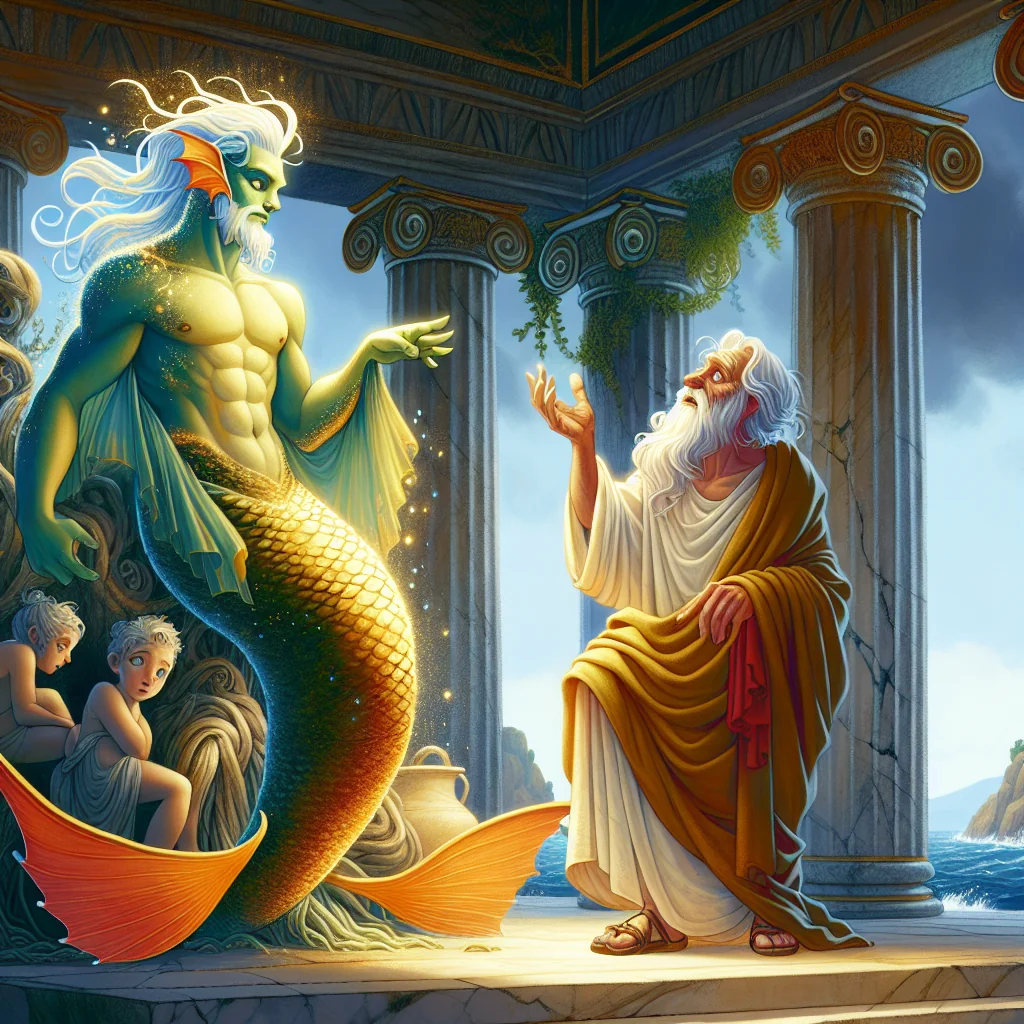
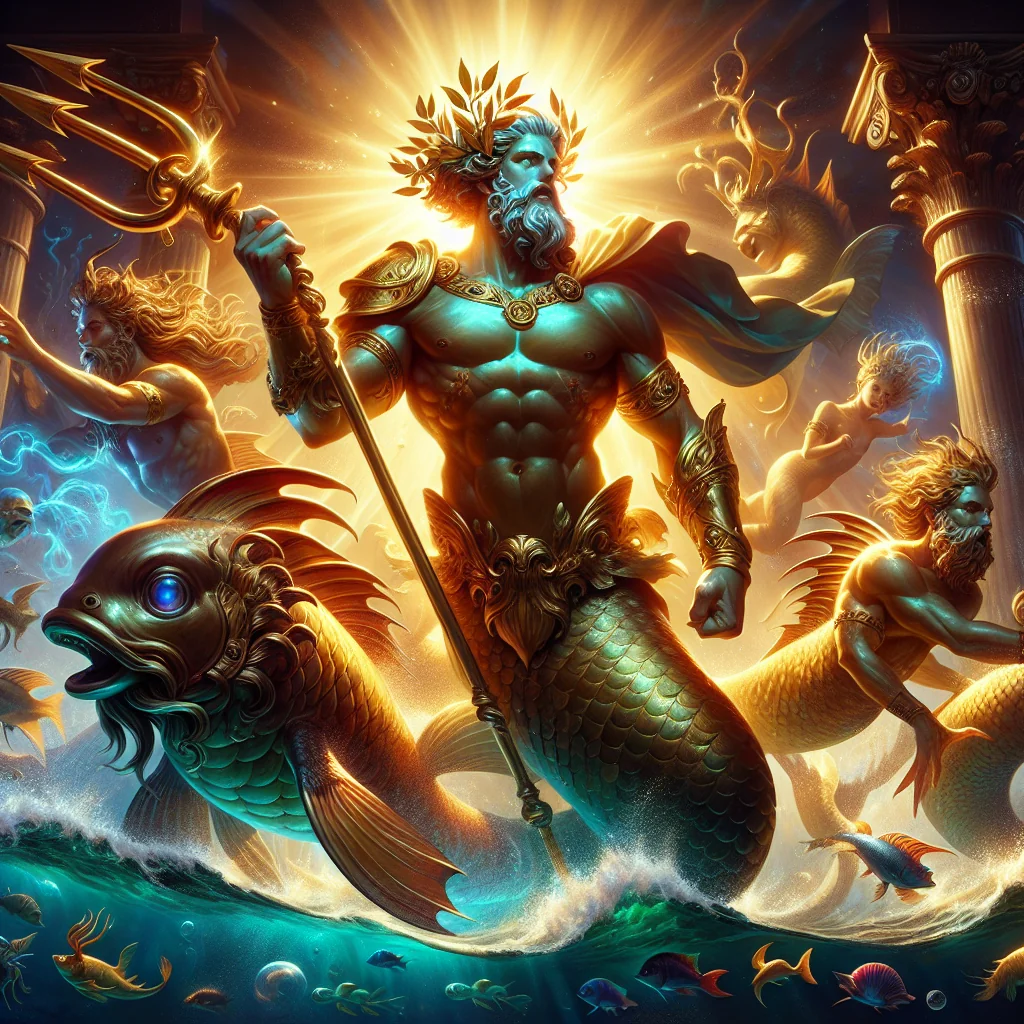
Other times, he would hitch a ride on one of the gentle sea-monsters that lived in the deep—great creatures with long necks and flippers, who didn’t mind at all when the friendly young merman climbed on their backs.
“Faster!” Triton would laugh, his dolphin-tail flicking through the foam. “Let’s see how high we can jump!”
And the sea-horse or sea-monster would surge forward, building up speed, and then—
SPLASH!
—they would burst through the surface of the water, soaring through the air for a brief, glorious moment before diving back down into the blue.
Triton would whoop with joy, his wet hair streaming behind him, his conch-shell trumpet hanging from a cord around his neck.
* * *
As the years passed, Triton had children of his own—and children’s children, and their children too.
These offspring and kindred of Triton were called Tritons (with a capital T to show they were part of the family, but also written sometimes as “tritons” because there were so many of them).
Like their father and grandfather, the Tritons were all half man and half fish. They all loved to swim and play in the waves. And many of them became trumpeters too, blowing their own conch-shells to help announce important events in the underwater kingdom.
Soon, whenever Poseidon traveled through his vast realm, he was preceded not just by one trumpeter, but by dozens of them—a whole chorus of Tritons, all blowing their conch-shells in a magnificent symphony that could be heard from one end of the Mediterranean Sea to the other:
BOOOOOOM! BOOM-BOOM! BOOOOOOM!
* * *
And Triton, swimming at the front of the group with his original conch-shell—the first and finest trumpet of all—would smile with pride.
He might be a minor divinity without much influence.
He might not be able to command the seas like his father.
But he had found something just as valuable: a purpose that brought him joy, a family that loved him, and a job that he did better than anyone else in the entire ocean.
And really, what more could anyone ask for?
When sailors today see the waves sparkling in the sunlight and hear the ocean roaring as it crashes against the shore, some say it’s the sound of Poseidon’s power.
But others say it’s the sound of Triton and his children, still blowing their conch-shell trumpets, still announcing the wonders of the sea, still riding joyfully over the billows as they’ve done since the very beginning of time.
BOOOOOOM! BOOM-BOOM! BOOOOOOM!
================================================================================
THE END
================================================================================
MORAL LESSONS:
– You don’t need to be the most powerful to be important
– Find purpose in serving others faithfully
– Take joy in what you do, no matter how small your role seems
– Family legacy and passing down traditions matter
CULTURAL ELEMENTS PRESERVED:
– Greek mythology: Poseidon and Amphitrite as sea deities
– Ægea as location of underwater palace
– Conch-shell as sacred instrument (actually used in ancient rituals)
– Mermen/mermaids in Mediterranean folklore
– Hippocampi (horse-fish hybrids) pulling Poseidon’s chariot
– Sea-monsters as mythological creatures
SOURCE FIDELITY NOTES:
✓ All original facts preserved (Triton as only son of Poseidon and Amphitrite)
✓ “Possessed little influence, minor divinity” explicitly stated
✓ “Preceding father and acting as trumpeter” role preserved
✓ Conch-shell as trumpet preserved
✓ Lives with parents in “beautiful golden palace beneath sea at Ægea” exact
✓ “Favourite pastime was to ride over billows on horses or sea-monsters” exact
✓ “Always represented as half man, half fish, body below waist terminating in tail of dolphin” exact
✓ Tritons as “offspring or kindred of Triton” preserved
✓ No contradictions or new major facts added
ENGAGEMENT ENHANCEMENTS ADDED:
+ Narrative structure showing typical day in Triton’s life
+ Character development (content with his role despite being minor deity)
+ Vivid description of conch-shell trumpet sound (BOOOOOOM!)
+ Active scenes showing trumpeting role in action
+ Playful personality demonstrated through wave-riding scenes
+ Family relationships (breakfast with parents, pride in descendants)
+ Sensory details (pink and white shell patterns, seaweed cakes, splashing)
+ Direct address to reader at end
+ Positive message about finding purpose in service
+ Child-appropriate language while preserving mythological authenticity
+ “Show don’t tell” transformation of expository text
Test Your Understanding
1. Who were Triton’s parents in Greek mythology?
Frequently Asked Questions
What is the moral lesson of TRITON and the TRITONS.?
What age is this story appropriate for?
How long does it take to read TRITON and the TRITONS.?
What culture does this story come from?
Can I use this story for teaching?
Frequently Asked Questions
What is the story of Triton and the Tritons about?
Triton and the Tritons is a children’s moral story based on Greek mythology. It follows Triton, the merman son of Poseidon and Amphitrite, who discovers his own special purpose despite having less power than his father. The story teaches kids that finding your unique gift matters more than comparing yourself to others.
What age group is Triton and the Tritons suitable for?
This moral story is written for children ages 6 to 12. It combines entertaining storytelling with important values, making it great for bedtime reading, classroom use, or any parent looking to share meaningful lessons through fun, mythology-inspired adventures.
Who is Triton in Greek mythology?
In Greek mythology, Triton is the son of Poseidon, god of the seas, and his wife Amphitrite. He is a merman and a minor sea deity who is best known as the trumpeter of the sea. Unlike his powerful father, Triton couldn’t control waves or storms, but he had his own important role in the ocean world.
📚 Recommended Books
Handpicked for readers like you
As an Amazon Associate, we earn from qualifying purchases. These recommendations are personalized based on this story's themes and your reading history.
What moral lesson does this children’s story teach?
The story teaches children that you don’t need to be the most powerful or important person in the room to find happiness and purpose. Triton embraces his own unique abilities rather than feeling inferior to his mighty father Poseidon, showing kids the value of self-acceptance and discovering personal strengths.
Is Triton and the Tritons based on a real myth or an original story?
The story is based on an actual Greek mythology source from Project Gutenberg. It has been transformed from an encyclopedia-style entry into an engaging narrative for young readers, while staying faithful to the original source material about Triton, the sea trumpeter and minor deity of ancient Greek legend.