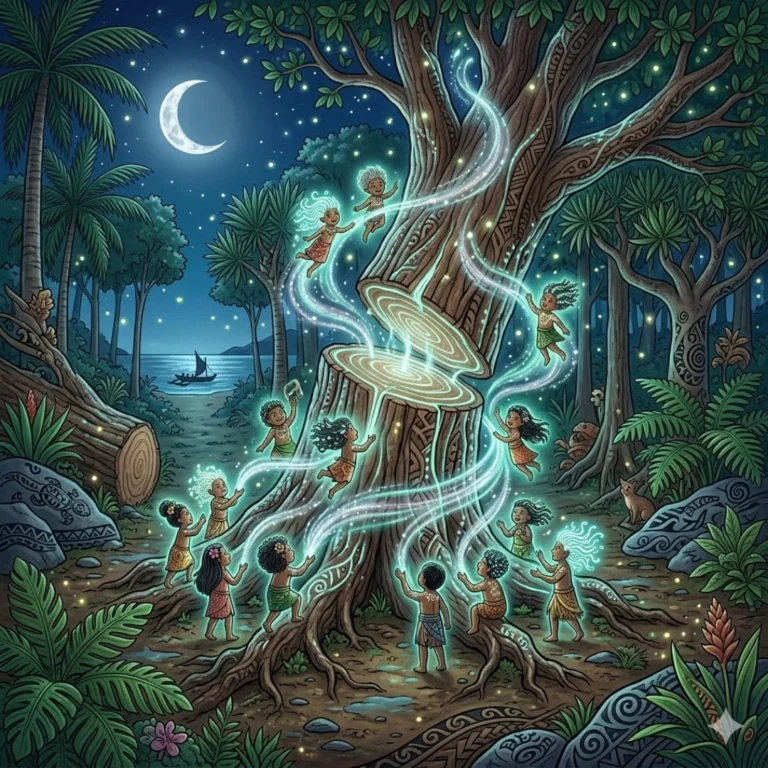
A warrior tries to build a canoe but the forest spirits keep rebuilding what he cuts down—until he learns to ask permission first.
In the islands of Polynesia, a young chief named Rata decided to sail across the great ocean to find the island where his father had disappeared. He would need the mightiest canoe ever built.
He walked into the forest and found the tallest tree he had ever seen. Without a word to anyone, he took his adze and began to cut.
He worked all day. The tree fell. He shaped the hull. He worked until dark.
The next morning, he returned to the clearing.
The tree was standing again.
He stared. He cut it down again. He shaped. He worked until dark.
The third morning: the tree stood. The clearing was as if untouched.
That night, Rata hid at the forest edge. He watched.
And he saw them—the forest spirits, working in moonlight. They were singing the tree back together, chanting its rings into place, coaxing the roots back into the earth.
Rata stepped forward. “Why do you undo my work?”
The spirit chief turned. “Because you did not ask. This forest belongs to everyone and to itself. You may not take without asking.”
Rata sat down in the wet grass. He had never thought to ask. He had been a chief his whole life. Things were provided for him.
“May I,” he said carefully, “use this tree to build a canoe so I can sail to find my father?”
The spirit chief was quiet. Then: “Yes. We will help you.”
The forest spirits helped Rata build the greatest canoe ever seen—smooth as a dolphin’s back, light as air, strong enough for any ocean. They sang the wood into shape overnight.
When Rata sailed away, the birds came to the shore to watch. The trees bent toward the water.
The forest had helped him willingly.
There is a difference between taking and receiving. The difference is a single word: please.
Moral of the Story
Respect for nature—and for others—begins with asking permission. Taking without asking is not strength; it is thoughtlessness.
Learn These Words
- adze
- a cutting tool used to shape wood, similar to an axe
- hull
- the body or frame of a boat or ship
- chanting
- singing or saying something in a rhythmic, repetitive way
- coaxing
- gently persuading or encouraging
- willingly
- done without being forced; with a glad spirit
Test Your Understanding
1Why did Rata need a canoe?
2What happened every morning after Rata cut the tree?
3Who was rebuilding the tree?
4What did Rata need to do before cutting the tree?
5What lesson does this story teach?
Frequently Asked Questions
What is the story of Rata and the Forest Canoe about?
Rata and the Forest Canoe is a traditional Polynesian legend about a young chief named Rata who chops down a tree to build a canoe for a voyage. Each night, forest spirits magically restore the tree because Rata never asked permission. He only succeeds after learning to respect the forest and request its help, teaching children the importance of consent and respect for nature.
Why do the forest spirits keep rebuilding the tree Rata cuts down?
The forest spirits rebuild the tree each night because Rata took it without asking permission. In Polynesian culture, the natural world is considered sacred and inhabited by spiritual guardians. The spirits aren’t punishing Rata—they’re teaching him that taking from nature requires respectful communication and gratitude, not just force or entitlement.
What is the moral lesson in Rata and the Forest Canoe?
The central moral is that we should always ask permission before taking what isn’t ours, especially from the natural world. The story also teaches that persistence alone isn’t enough—approaching others with humility and respect accomplishes far more than force. It’s a powerful lesson about consent, environmental stewardship, and the value of cooperation.
📚 Recommended Books
Handpicked for readers like you
As an Amazon Associate, we earn from qualifying purchases. These recommendations are personalized based on this story's themes and your reading history.
Where does the legend of Rata originally come from?
The legend of Rata originates from Polynesia and is told across multiple Pacific Island cultures, including Māori, Tahitian, and Cook Islands traditions. While details vary between versions, the core story of a hero who must learn respect for the forest before building his canoe remains consistent, reflecting deep Polynesian values around harmony with nature.
Is the Rata canoe story suitable for young children?
Yes, Rata and the Forest Canoe is excellent for young children. It features gentle conflict with no violence, magical elements like singing spirits who rebuild a tree by moonlight, and a clear, easy-to-understand moral about asking permission. It’s ideal for ages four and up and works well as a bedtime story or classroom read-aloud about respect and nature.