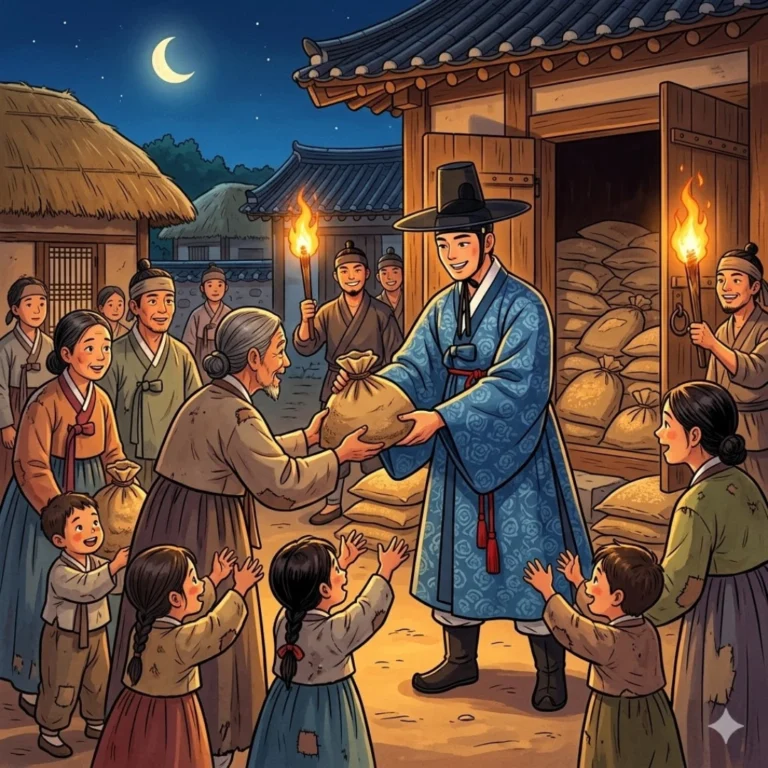
A boy born outside the rules of society becomes a hero by fighting for those the rules have forgotten.
In old Korea, a great minister had a son born to a concubine—a woman of low social rank. The boy’s name was Hong Gil-dong, and by law he could not call his own father “Father” or his half-brothers “Brothers.” No matter how clever or strong he was, the rules said he was less.
Hong Gil-dong studied anyway. He rose before dawn, read by lamplight, trained in martial arts until his hands bled. He mastered skills that men with ten times his privileges could not match.
But every door was closed.
“A man of your birth cannot serve in government,” said the officials.
“A man of your birth cannot carry a sword,” said the soldiers.
So Hong Gil-dong made his own path.
He went into the mountains and gathered men who had also been cast aside by the same unfair rules—farmers taxed into hunger, merchants cheated by corrupt officials, young men without names or prospects.
Together they called themselves the Hwalbindang—the Society of the Living Poor.
They did not rob ordinary people. They robbed corrupt officials and provincial lords who had grown rich by squeezing the poor. They took the grain locked in storehouses while people starved and distributed it to the villages.
When the king sent soldiers, Hong Gil-dong and his band vanished like morning mist.
The people left food and gifts on mountain paths for the Hwalbindang. “He is not a criminal,” the old women said. “He is the justice we asked for and never received.”
Eventually, Hong Gil-dong sailed to a distant island where all who came were equal—where birth did not determine worth. He became its governor and made the laws he had always wished existed.
He never forgot the village children who had watched him from hungry doorways.
Moral of the Story
Justice means speaking up for those who have been forgotten by the rules. One person who refuses to accept unfairness can change the lives of many.
Learn These Words
- concubine
- in historical East Asia, a secondary wife of lower social rank
- corrupt
- willing to act dishonestly in return for money or personal gain
- provincial
- relating to a region or province outside the capital
- prospects
- possibilities for success in the future
- distribute
- to give things out to a number of people
Test Your Understanding
1Why was Hong Gil-dong treated unfairly?
2What did the Hwalbindang do with stolen goods?
3Who did the Hwalbindang rob?
4What did Hong Gil-dong do at the end of the story?
5What lesson does this story teach?
Frequently Asked Questions
Who is Hong Gil-dong in Korean folklore?
Hong Gil-dong is a legendary Korean folk hero, often compared to Robin Hood. He was the son of a nobleman and a concubine, which meant he was denied basic rights like calling his father ‘Father.’ Despite his talents, social rules blocked his advancement, so he formed a band called the Hwalbindang to fight corruption and help the poor.
What is the moral of the Hong Gil-dong story for kids?
The story teaches children that a person’s worth is not determined by their birth or social status. It highlights the values of perseverance, justice, and standing up for people who are treated unfairly. Hong Gil-dong shows that true heroism means using your abilities to help others, especially those forgotten by an unjust system.
What was the Hwalbindang in the Hong Gil-dong legend?
The Hwalbindang, meaning the Society of the Living Poor, was a group formed by Hong Gil-dong in the mountains. Its members were people cast aside by unfair social rules—overtaxed farmers, cheated merchants, and young men without prospects. They specifically targeted corrupt officials rather than ordinary people, redistributing stolen wealth to struggling communities.
📚 Recommended Books
Handpicked for readers like you
As an Amazon Associate, we earn from qualifying purchases. These recommendations are personalized based on this story's themes and your reading history.
Why couldn’t Hong Gil-dong call his father ‘Father’ in old Korea?
In Korea’s old class system, children born to concubines—women of lower social rank—were legally denied full family status. Even though Hong Gil-dong’s father was a powerful minister, the law forbade Gil-dong from using the titles ‘Father’ or ‘Brother.’ This rigid social hierarchy limited his rights regardless of his intelligence or abilities.
Is the story of Hong Gil-dong based on a real person or a novel?
Hong Gil-dong originates from a famous Korean novel called ‘The Tale of Hong Gil-dong,’ written by Heo Gyun during the Joseon Dynasty. While some historians debate whether a real outlaw inspired the character, the story is primarily a work of fiction that critiques social inequality and Korea’s rigid class system of that era.