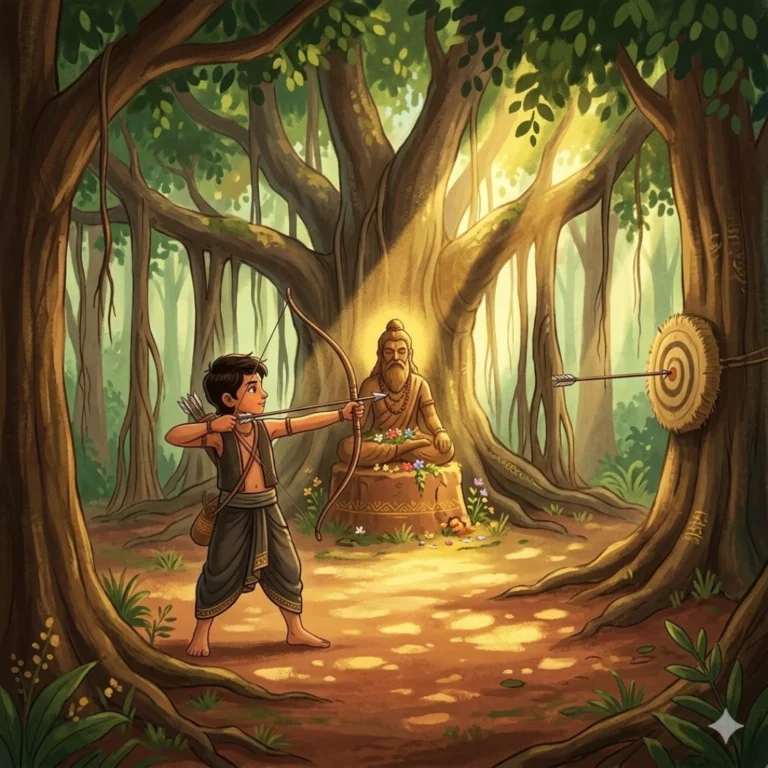
A young archer teaches himself—without a teacher—and shows that dedication can surpass every obstacle.
In ancient India, there was a young boy named Ekalavya who wanted more than anything to learn the art of archery from the great teacher Drona.
Drona was teacher to the princes of the Kuru dynasty—princes who wore gold and rode elephants. Ekalavya was the son of a tribal chief. When he came to Drona and asked to be his student, Drona refused.
“I teach only the princes,” said Drona.
Ekalavya bowed respectfully and left.
He went into the forest and fashioned a clay statue of Drona. He placed it in the shade of a great tree and every day he stood before it, bowed as a student bows to his teacher, and practised.
He practised alone, but he practised as if Drona were watching. He practised as if each arrow had to be perfect. He practised through rain and heat, in good moods and bad, when his fingers bled and when his aim was off.
Years passed.
One day, the royal princes were hunting in that forest. Their dog began barking—and suddenly went quiet. The princes found the dog’s mouth had been sealed with arrows—seven of them, perfectly placed, without injuring the animal.
Drona was astonished. “Who did this?”
They found Ekalavya in the forest, bow in hand.
Drona examined the young man’s form. It was extraordinary. “Who taught you?”
“You did, teacher,” said Ekalavya, and showed him the clay statue.
The story continues in painful ways—there are tests and demands that were unjust. But what remained, through all of it, was this image: a boy who was refused a teacher, who made a teacher from clay and devotion, and who became extraordinary anyway.
What you cannot receive from others, you can sometimes build from within. The dedication was always his own.
Moral of the Story
Dedication means committing fully to your goal even without recognition, encouragement, or ideal conditions. What you practice in private shapes who you become in public.
Learn These Words
- devotion
- great love or loyalty, especially to a person or practice
- archery
- the skill of shooting with a bow and arrow
- dynasty
- a series of rulers from the same family
- astonished
- very surprised
- extraordinary
- very unusual or remarkable; beyond what is ordinary
Test Your Understanding
1Why did Drona refuse to teach Ekalavya?
2What did Ekalavya use as his teacher?
3How did the princes discover Ekalavya’s skill?
4What was astonishing about Ekalavya’s seven arrows?
5What lesson does this story teach?
Frequently Asked Questions
Who was Ekalavya and why is his story famous?
Ekalavya was the son of a tribal chief in ancient India who dreamed of learning archery from the legendary teacher Drona. When Drona refused to teach him because he only instructed royal princes, Ekalavya taught himself in the forest using a clay statue of Drona as inspiration. His story is famous as a powerful example of self-motivated devotion and perseverance.
Why did Drona refuse to teach Ekalavya?
Drona was the appointed archery teacher for the princes of the Kuru dynasty—elite royals who wore gold and rode elephants. Because Ekalavya came from a tribal background and was not a prince, Drona turned him away, saying he only taught royalty. This rejection became the catalyst for Ekalavya’s remarkable journey of self-taught mastery.
How did Ekalavya learn archery without a teacher?
Ekalavya carved a clay statue of Drona and placed it beneath a great tree in the forest. Every day he bowed before it as a student would bow to a real teacher, then practised relentlessly. He trained through rain, heat, bleeding fingers, and missed shots for years, treating each session as though Drona himself were watching and judging every arrow.
📚 Recommended Books
Handpicked for readers like you
As an Amazon Associate, we earn from qualifying purchases. These recommendations are personalized based on this story's themes and your reading history.
What is the moral of Ekalavya’s devotion story for kids?
The story teaches children that true dedication can overcome even the biggest obstacles. You don’t always need perfect circumstances or the best resources to succeed—what matters most is discipline, respect, and the willingness to keep practising even when no one is watching. Ekalavya’s self-driven commitment turned him into an archer who rivalled trained princes.
How did the princes discover Ekalavya’s incredible archery skill?
While hunting in the forest, the royal princes found their barking dog suddenly silenced—its mouth had been sealed shut with seven perfectly placed arrows, without a single injury to the animal. This astonishing feat of precision revealed Ekalavya’s presence and demonstrated that his self-taught skill had surpassed what even Drona’s royal students could achieve.