

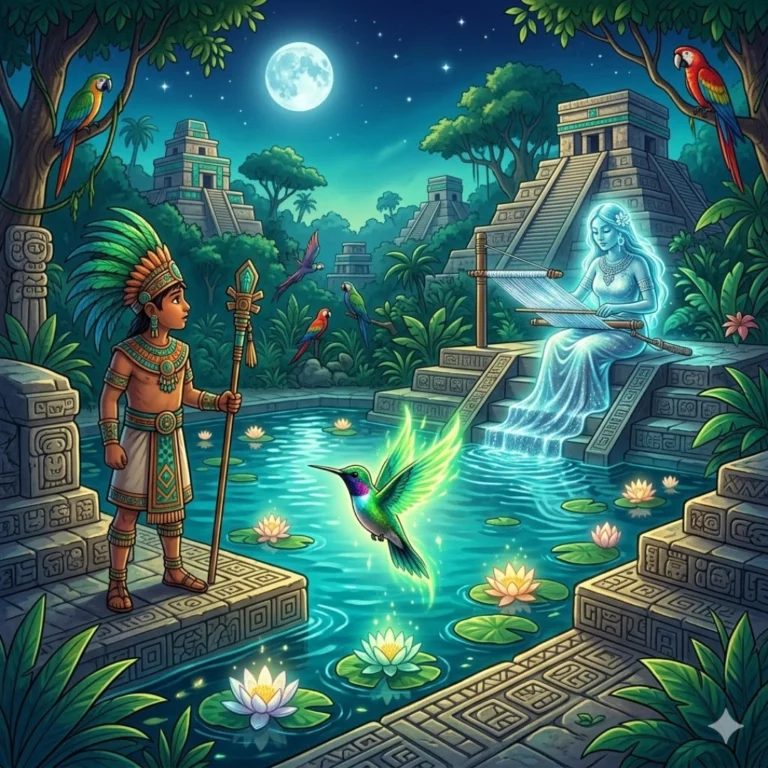
The Moon Goddess teaches a wounded warrior that true healing begins inside, not outside.
Long before the cities of the Maya rose above the jungle, there was a warrior named Balam who feared nothing. He hunted jaguars, swam rivers in flood, and climbed the temple steps in storms. The other warriors admired him.
One day, Balam was injured in a hunt—a jaguar claw left a deep wound in his arm. The wound healed on the outside, but inside, something did not heal. He became afraid. He stopped hunting. He stopped swimming. He sat in his hammock and would not look anyone in the eye.
His mother prayed to Ixchel, the Moon Goddess of weaving and healing.
One night, a small hummingbird appeared at Balam’s window—impossibly tiny, with wings like green flame.
“Follow me,” said the hummingbird.
Half asleep, Balam followed. The bird led him through the jungle to a pool lit by moonlight. Ixchel was there, weaving a cloth of moonlight and water.
“Your arm has healed,” she said without looking up.
“I know,” said Balam.
“Then why are you still in your hammock?”
Balam was quiet for a long time. “Because when the jaguar hurt me, I understood for the first time that I could die. And now everything frightens me.”
Ixchel set down her weaving. “The jaguar taught you the truth every warrior needs to know. Courage is not the absence of fear. It is weaving your fear into your strength, the way I weave darkness into the cloth to make the light shine brighter.”
She pressed her hand to his chest. A warmth spread through him.
“The jaguar gave you a wound,” she said. “Now you know what it is to be hurt. That knowing is a gift. Use it to understand the pain of others. That is what heals a spirit.”
Balam returned home before sunrise. That morning, he walked to his neighbour’s house—an old woman who had been ill for weeks—and sat with her. He didn’t have medicine. He had only time and understanding.
She called it the best medicine she had received.
Moral of the Story
Healing is not just physical. True healing means using what hurt you to become someone with more understanding and compassion for others.
Learn These Words
- absence
- the state of not being there or not existing
- spirit
- the inner part of a person—emotions, character, and soul
- jaguar
- a large wild cat found in Central and South America
- temple
- a building used for worship or religious ceremonies
- hammock
- a swinging bed made of cloth or rope, hung between two supports
Test Your Understanding
1What happened to Balam after his wound healed?
2Who led Balam to Ixchel?
3What did Ixchel say courage really is?
4What did Balam do when he returned home?
5What lesson does this story teach?
Frequently Asked Questions
Who is Ixchel in Mayan mythology?
Ixchel is the ancient Maya Moon Goddess associated with weaving, healing, and medicine. In many Mayan stories she guides people toward wholeness—both physical and emotional. In this tale, Ixchel appears at a moonlit pool to help a warrior named Balam understand that his deepest wound is not on his body but inside his spirit.
What is the moral of the Ixchel and the Hummingbird story?
The central lesson is that true healing begins on the inside, not the outside. A physical wound may close, but fear, trauma, and emotional pain need their own attention. The story teaches children that bravery isn’t the absence of fear—it’s acknowledging inner struggles and seeking the courage to face them honestly.
Why does the hummingbird appear in the story?
The hummingbird acts as a sacred messenger sent by Ixchel to guide the warrior Balam to her moonlit pool. In Mayan culture, hummingbirds are often considered spiritual symbols of resilience and hope. Its tiny size contrasts with Balam’s great strength, reminding readers that healing can arrive through the smallest, most unexpected sources.
📚 Recommended Books
Handpicked for readers like you
As an Amazon Associate, we earn from qualifying purchases. These recommendations are personalized based on this story's themes and your reading history.
Is the Ixchel and the Hummingbird story suitable for young children?
Yes, it’s well suited for children roughly ages five and up. The language is simple and the imagery—jungle, moonlight, a magical hummingbird—is vivid without being frightening. The story gently introduces the concept of emotional healing, making it a helpful conversation starter about feelings, fear, and asking for help.
What age group can learn from stories about Mayan gods like Ixchel?
Children as young as five can enjoy these myths for their adventure and magic, while kids aged eight to twelve begin to grasp deeper themes like inner strength and cultural heritage. Mayan mythology offers rich storytelling that sparks curiosity about ancient civilisations, making it valuable across a wide range of ages.
