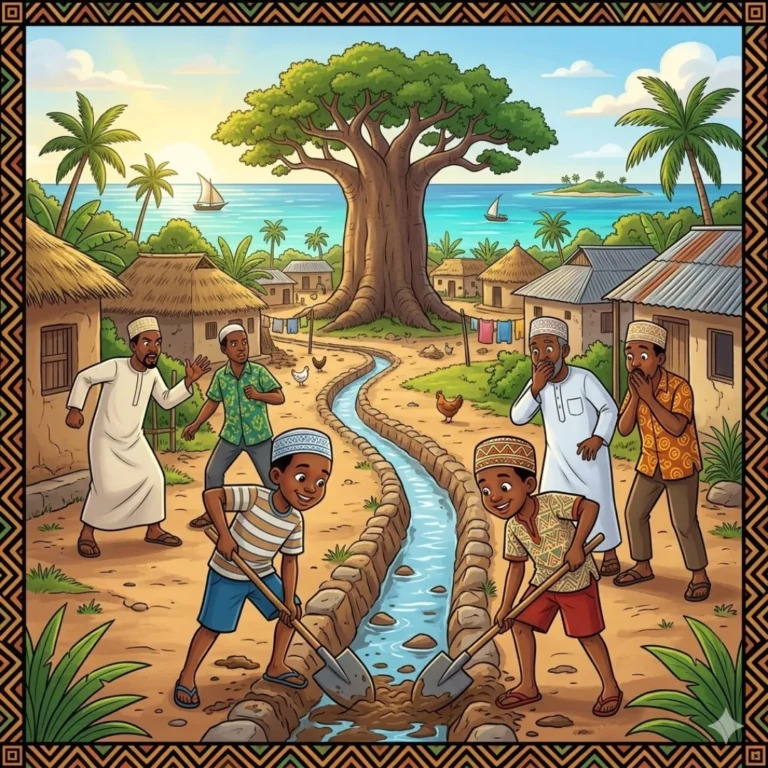
Now, the baobab tree at the center of Juma’s village had been there so long that nobody could remember the planting of it, and the village elders had a theory that the tree had actually been there first and the village had grown up around it, which would explain certain things about the way the village was arranged.
Juma was nine years old and he had climbed the baobab approximately four hundred times, which is a conservative estimate. It was an easy tree to climb – its trunk was smooth and enormous and the lower branches were thick as platforms, and from the highest comfortable branch you could see the Indian Ocean glittering at the edge of the world, which seemed to Juma like a very good reason to climb anything.
He was up there on a Saturday morning when the argument started below.
The argument was between his father and the family next door, the Othmans, and it was about a water channel. The water channel ran between their two properties and had run there for forty years and which family owned the maintenance of it had never been written down anywhere and had been argued about approximately once per generation, and it was apparently the generation’s turn.
“This is very dull,” Juma told the baobab, which did not disagree.
He climbed down to find out what specifically they were arguing about this time.
The water channel had silted up on the Othman side, which meant the flow was slow, which meant the Jumas’ kitchen garden was getting less water than it needed, which meant the tomatoes were suffering, which meant Juma’s mother was not pleased, which meant the argument had been inevitable since the rains.
“It is your channel to clear,” said Juma’s father.
“It is a shared channel and the problem is the silt from your side upstream,” said Mr. Othman.
Juma looked at the water channel. He looked at it for a while. Then he went and got a shovel.
He was in the channel clearing silt for about twenty minutes before anyone noticed him.
“Juma,” said his father, with the specific uncertainty of a parent confronted with a child who has taken constructive action during an argument.
“The tomatoes need water,” said Juma. “The silt is here. I have a shovel.”
“That side of the channel is -” his father started.
“Baba,” said Juma. “The water does not know whose side it is on. The tomatoes do not know either. But I know that if neither of you clears it, the tomatoes die and the channel stays silted and next year we have the same argument with worse tomatoes.”
Mr. Othman’s son Hamid, who was ten and had been watching from his family’s side of the wall, appeared with his own shovel.
“I’ll help from this end,” he said.
The two boys cleared the silt in an hour, which was faster than one boy would have managed alone and considerably faster than two arguing adults would have managed at all.
By the time they were done, the water was moving well. The tomatoes would be fine.
Juma’s mother brought tea for everyone – the children, the fathers, even Mr. Othman’s wife who had come to see what the noise was about. They sat in the shade of the baobab tree and drank it.
“There is a word,” said Juma’s grandmother, who appeared because grandmothers always appear when tea is being served and wisdom is available, “that applies to this situation.”
Everyone waited.
“Ubuntu,” she said. “I am because we are. What this means is not just that we are connected – though we are – but that each of us is only as good as the community we live in, and the community is only as good as what each of us puts into it.” She looked at the cleared channel. “Your tomatoes grow because of the rain, and the rain because of the trees that hold the water in the hills, and the hills because of the soil that the grandparents’ grandparents did not strip away, and the grandparents because someone planted the food that fed them.” She looked at the baobab. “That tree was a seed once. Someone planted it. We benefit from their patience today.”
“Who planted it?” Juma asked.
“Nobody remembers,” said his grandmother. “Which is the point. They planted it for people they would never meet. This is the old way: you plant for those who come after, and you benefit from those who came before, and the channel in between is what we call community.”
Mr. Othman was quiet for a moment, looking at the cleared channel.
“We should write down who does the maintenance,” he said. “So there is no argument next generation.”
“We should,” agreed Juma’s father.
They did write it down, and the document was kept by both families and at the village hall, and the water channel was maintained on a rotating schedule that anyone could check.
Juma went back up the baobab after tea, because the view was still excellent and he still had not finished his Saturday. From up there, he could see the whole village laid out like something drawn carefully by someone who wanted to show how things were connected: the channel running between properties, the road connecting compounds, the market where families met, and at the center of it all the great baobab spreading its arms in every direction, holding the arrangement together, as it had always done.
I am because we are.
He looked at the tree. The tree, in its way, looked back.
“Yes,” said Juma. “I think that’s right.”
The Moral of This Story
I am because we are – no one stands truly tall alone
About This Story’s Culture
Ubuntu is a Nguni Bantu philosophical concept (umuntu ngumuntu ngabantu – ‘a person is a person through other persons’) that is foundational to many East and southern African cultures. Though the term comes from southern African Nguni languages (Zulu, Xhosa), the concept is widespread across sub-Saharan Africa including East African Swahili culture. The baobab (Adansonia digitata) is one of Africa’s most iconic trees, often called the ‘Tree of Life’ – baobabs can live for over 1,000 years and have traditionally served as community meeting places, water sources, and social centers across Africa. The Swahili coast of East Africa (Kenya, Tanzania, Zanzibar) has a rich mixed cultural heritage combining Bantu, Arab, Indian, and Persian influences. The name Juma is authentic Swahili, meaning ‘born on Friday.’ Hamid is an authentic Swahili/Arabic name common on the East African coast.
Key Story Elements
- Juma – a nine-year-old Swahili boy who solves the argument by simply picking up a shovel
- The ancient baobab at the village center – older than memory, the gathering place of community
- The water channel dispute – a small but genuine conflict between two families over shared resource
- Hamid appearing with his own shovel – the next generation choosing cooperation over argument
- Grandmother’s Ubuntu lesson: I am because we are, the community as interconnected chain of giving
- Milne’s warm oral narrator: ‘the tree had been there first and the village had grown up around it’
- The written maintenance agreement: wisdom made practical, for the next generation’s benefit
Frequently Asked Questions
What is The Baobab Council story about?
The Baobab Council is a Swahili-inspired children’s story about a nine-year-old boy named Juma who witnesses a community dispute from his favourite climbing spot high in an ancient baobab tree. The story explores themes of Ubuntu — the idea that we are stronger together — and how communities can resolve conflict through listening and cooperation.
What age group is The Baobab Council suitable for?
This story is written for children aged 6 to 12 and takes around 8 to 10 minutes to read aloud. It works well as a bedtime story or a classroom read, and its themes of fairness and community give younger and older children alike plenty to think about and discuss.
What does the baobab tree represent in this story?
The baobab tree is the heart of the village — so old it may have existed before the village itself. It serves as Juma’s lookout and a symbol of deep-rooted community life. In many African traditions, the baobab represents wisdom, longevity, and gathering, making it the perfect setting for a story about resolving community conflict.
📚 Recommended Books
Handpicked for readers like you
As an Amazon Associate, we earn from qualifying purchases. These recommendations are personalized based on this story's themes and your reading history.
What is Ubuntu and how does it connect to The Baobab Council?
Ubuntu is a Southern and East African philosophy meaning ‘I am because we are’ — the belief that individuals thrive through their connections to community. The Baobab Council uses this theme to show children that disagreements between neighbours can be solved when people prioritise shared wellbeing over personal interests.
What lesson do children learn from The Baobab Council?
Children learn that community disputes, like the one over the water channel in Juma’s village, rarely have a simple winner and loser. The story encourages empathy, active listening, and collective problem-solving — showing young readers that looking out for one another, the Ubuntu spirit, leads to better outcomes for everyone involved.