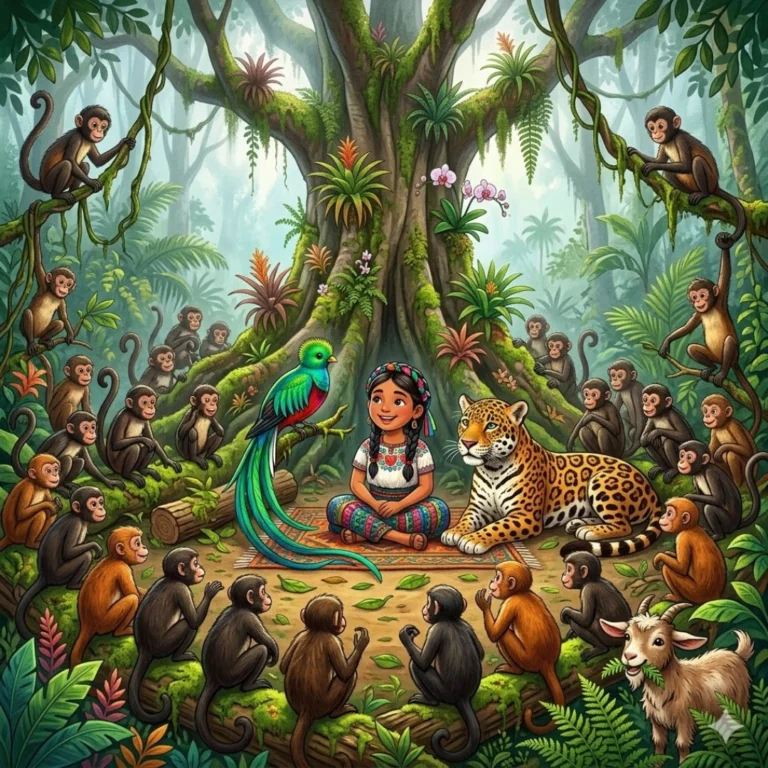
The council of the cloud forest had been meeting for four hundred years, which is nothing to a ceiba tree but quite a lot for everyone else involved.
The council consisted of: three quetzal birds (who handled matters of color and beauty and also, controversially, held veto power over anything they found ugly), a jaguar who served as security and also offered unsolicited opinions, the ceiba tree itself (who voted once per century, which made counting difficult), forty-seven spider monkeys who were nominally one vote but could never agree to cast it in the same direction, and a girl called Ixchel who had stumbled into the cloud forest three days ago looking for her grandmother’s lost goat.
The goat, it should be noted, was also present. It had found some excellent ferns and appeared entirely comfortable with its situation, which was more than could be said for Ixchel.
“Why am I in this council?” she asked the chief quetzal, who was the size of a parrot and wearing his own tail feathers with remarkable dignity.
“Because you need to be a witness,” said the chief quetzal, “and because you are the first human who has walked into our council without immediately trying to catch one of us, which shows unusual restraint or possibly deficient reflexes, and either quality is useful.”
“What am I witnessing?”
“The matter of the cornfield boundary,” said the jaguar, who had been waiting to say this. “Which has been moving for three growing seasons in the direction of the cloud forest in a way that the cloud forest council finds most irregular.”
Ixchel was ten years old, from the village of Uaxactún at the forest’s edge, and she understood about cornfields because she had worked in them since she was old enough to drop seeds into holes. She also understood that the cloud forest produced the rain that fed the cornfields, and the cornfields fed her village, and these two things were connected in a way that some people knew and some people had begun to forget.
“The cornfield belongs to my uncle Chac,” she said.
All the spider monkeys made a collective noise.
“He is not invited to the council,” said the chief quetzal firmly. “He would try to catch us. However, you are here, and you know him. Can you explain the boundary movement?”
Ixchel thought about it. “He has a new son. He wants more land to feed the family.”
“Does he know,” said the ceiba tree, in the slow way of trees contributing to conversations, “that the cloud forest makes the rain?”
“He knows it rains in the rainy season,” said Ixchel carefully.
“Does he know why it rains in the rainy season?”
She thought about this. Did anyone know why the rainy season worked? It just did. The forest was there, the rain came, the corn grew. She had never thought about the middle part.
“Tell her the middle part,” the jaguar said to the ceiba tree.
The ceiba tree explained: slowly, in the way of something that has been watching the same thing happen for a very long time. The cloud forest held water in its leaves and bark and roots. It released it slowly into the air. The clouds formed from this moisture. The clouds produced rain. The rain went to the cornfields. Without the forest’s water-holding, the clouds were less reliable, the rain less certain, and eventually the cornfields would receive erratic water in the wrong seasons, which is worse than no water because it is unpredictable.
“This has been happening,” said the chief quetzal, “in the mountains east of here, for two generations. The cloud forest there is smaller than it was. The rain in those villages comes at the wrong time now. The corn grows poorly.”
Ixchel was quiet for a while.
“My uncle doesn’t know this,” she said finally.
“Most people don’t know the middle part,” said the jaguar. “This is the problem with the middle part. It is invisible. You only see the corn and the rain and you do not see the part in between.”
“If he knew, would he stop?” asked the chief quetzal.
Ixchel thought about her uncle Chac, who was stubborn but not foolish, and who grew corn because he loved his family, and who would not willingly ruin the rain for the sake of a few extra rows of corn if he understood that this was what he was doing.
“Yes,” she said. “I think he would.”
“Then you will tell him,” said the council, which since it included forty-seven spider monkeys all speaking simultaneously sounded like a waterfall of opinion.
“I don’t know enough to explain it,” said Ixchel.
“You know the middle part now,” said the ceiba tree. “That is usually enough to start.”
The bargain they struck was this: Ixchel would explain the middle part to her uncle. In return, the cloud forest would provide, the following season, particularly reliable rain on Wednesdays, which was when her uncle’s corner of the cornfield needed it most. The quetzal birds would also agree not to eat his peppers, which they had been doing apparently out of spite, though they denied it.
Ixchel went home. She found her uncle in the field.
She explained the middle part as the ceiba tree had explained it to her: the water-holding, the slow release, the clouds that depended on the forest’s breathing, the rain that depended on the clouds.
Her uncle listened. He was silent for a long time after, looking at the tree line.
“My grandfather told me something like this,” he said. “I thought it was a story for children.”
“Maybe,” said Ixchel, “stories for children are also information for adults.”
Her uncle moved the cornfield boundary back thirty feet, which was not a great sacrifice and which, he was told later by the eldest woman in the village who remembered these things, was actually the old boundary and always had been.
The rain that season came reliably on Wednesdays. The peppers were not touched.
The goat came home by itself two days after Ixchel did, looking well-fed and entirely uninterested in explaining where it had been, which is simply how goats are.
The Moral of This Story
When we live in harmony with the world around us, the world sustains us in return
About This Story’s Culture
This story draws on Mayan cosmology and ecology. Uaxactún is a real ancient Mayan archaeological site in Guatemala. The quetzal bird (quetzal) is the national bird of Guatemala and was sacred to the Mayan and Aztec civilizations, representing liberty and precious things – its long tail feathers were used in royal headdresses. The ceiba tree (Ceiba pentandra) is the sacred world tree (Wakah-Chan) in Maya cosmology, connecting the underworld, earth, and sky. The Cloud Forest (bosque nuboso) of the Guatemalan highlands is a real ecosystem critical to the region’s hydrology. The relationship between cloud forest preservation and agricultural water supply described in the story is scientifically accurate – cloud forests in Central America produce significant amounts of water through fog interception. The name Ixchel is authentic Mayan, belonging to the moon goddess of medicine and weaving.
Key Story Elements
- Ixchel – a ten-year-old Mayan girl from Uaxactún who accidentally joins the Cloud Forest council
- The council: three quetzal birds (veto power), a jaguar (security and opinions), the ancient ceiba tree (votes once per century), forty-seven spider monkeys (one vote, never agreeing)
- Carroll’s absurdist logic: veto power over ugliness, goat with excellent fern situation, Wednesday rain as negotiated settlement
- The middle part: the invisible cloud-forest-to-rain-to-corn water cycle that humans have forgotten
- Uncle Chac as the well-intentioned human who doesn’t know the middle part
- Ixchel’s insight: stories for children are also information for adults
- The goat returning well-fed and unexplained – Carroll’s final touch
Frequently Asked Questions
What is The Quetzal Bird’s Bargain story about?
The Quetzal Bird’s Bargain is a Mayan-inspired children’s story about a girl named Ixchel who accidentally joins a magical cloud forest council made up of quetzal birds, a jaguar, a ceiba tree, and spider monkeys. The story explores themes of harmony, belonging, and unexpected responsibilities through humor and adventure.
What age group is The Quetzal Bird’s Bargain suitable for?
This story is written for children aged 6 to 12 and takes about 8 to 10 minutes to read aloud. It works well as a bedtime story, a classroom read, or an independent read for confident younger readers who enjoy fantasy and folklore.
What is the quetzal bird’s significance in Mayan tradition?
In Mayan culture, the quetzal bird is a sacred symbol of beauty, freedom, and divine power. Its brilliant green and red feathers made it precious to ancient Maya, who associated it with the feathered serpent god Quetzalcoatl. In this story, quetzals hold real authority, even wielding veto power over anything they find ugly.
📚 Recommended Books
Handpicked for readers like you
As an Amazon Associate, we earn from qualifying purchases. These recommendations are personalized based on this story's themes and your reading history.
What moral or lesson does this story teach kids?
The story’s central theme is harmony — learning to work alongside others who are very different from you. Ixchel must navigate a council that can’t agree on anything, teaching children about cooperation, finding your voice in confusing situations, and the idea that even unexpected participants can make a meaningful difference.
Is this quetzal bird story based on real Mayan folklore?
The story draws inspiration from Mayan tradition, including sacred symbols like the quetzal bird, the ceiba tree, and names like Ixchel, which is a real Mayan goddess. While the plot itself is an original, imaginative tale, it is rooted in authentic cultural elements to give young readers a meaningful connection to Mayan heritage.