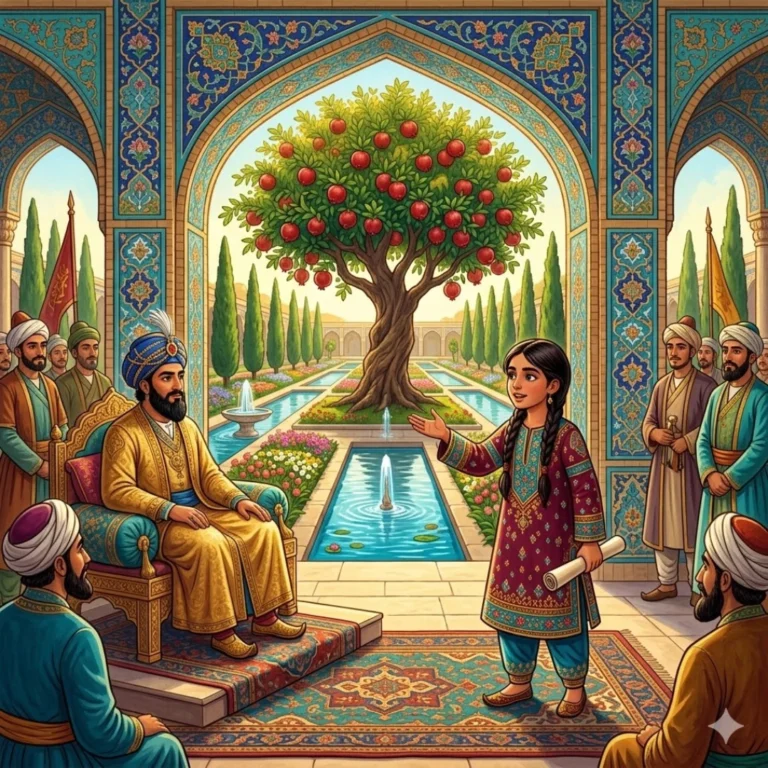
Hear now the old tale of Shiraz, city of poets and roses and the particular kind of argument that only justice can settle – and hear the story of a girl called Farida, who had a grievance, and the Shah who had a garden, and the day the two came face to face across a pomegranate tree.
In the great city of Shiraz, where the nightingales sing to the roses in the public gardens and the bazaar smells of saffron and old leather and the best flatbread in the world is baked in clay ovens by women who have been doing it since before any law was written, there was a Shah who prided himself on justice. He had an open court three mornings a week. Anyone could come. Anyone could speak. This was the rule his father had kept and his grandfather before that, and he kept it because a Shah who could not be approached is a Shah who does not know what is happening in his own kingdom, and that is a Shah who will one day be surprised.
Farida was twelve years old and her father was the Shah’s head gardener, and the garden was the reason for the dispute.
The Shah’s garden was famous across Persia. It had four sections in the classical chahar bagh design – four quarters divided by channels of water – with roses and cypresses and pomegranate trees and the sound of fountains that could put you to sleep on an afternoon if you sat too long under them. Farida’s father had maintained it for twenty years, and Farida herself had learned every plant’s name and habit, had helped prune and water and graft since she could walk.
The trouble was the pomegranate tree in the northeastern quarter.
It was the oldest tree in the garden – planted, according to family story, by Farida’s great-grandmother’s great-grandmother, who had been a gardener before there was a palace on the land. When the Shah’s family built the palace, they kept the gardeners, and the gardeners kept the tree, and the tree was now very old and very large and produced pomegranates whose seeds were redder than rubies and sweeter than anything Farida had tasted from any other tree.
The new head of the palace household – a man called Mirza Behrooz, who had arrived six months ago and immediately began reorganizing things to show his authority – had ordered the pomegranate tree cut down. It was, he said, blocking light from the reflecting pool. He wanted the pool clear for the evening entertainments.
Farida’s father had protested through the appropriate channels, politely, twice. Mirza Behrooz had overruled him, politely, twice. The tree was to come down on Thursday.
This was Wednesday morning.
Farida went to the open court.
She went alone, which meant she arrived as a twelve-year-old girl in a gardener’s family’s clothes among nobles and merchants and officials, and several people looked at her with the expression of those who are wondering if a twelve-year-old girl knows she is in the wrong place.
She did not leave.
When her turn came – she had waited three hours, which she had spent composing what she wanted to say – she stood before the Shah and said, clearly and without rushing:
“Your Majesty. I have come about the pomegranate tree in the northeastern quarter of your garden. I would like to make the argument that it should not be cut down, and I would like you to hear it.”
The Shah – who was not an unkind man, and who was also somewhat surprised – said: “Speak.”
She spoke.
She did not appeal to sentiment, though she had sentiment. She did not cry, though she had cried the previous night. She made the argument on its merits: the tree was older than the palace, its removal would change the soil composition of the quarter in ways that would affect three other species for at least a decade, the reflecting pool’s light problem could be solved by pruning the upper branches rather than removing the tree, and furthermore the tradition of the gardening family who had maintained this garden for generations deserved consideration as a form of institutional knowledge that was not easily replaced.
She had prepared all of this. She had thought about it very carefully and spoken to her father and checked the gardening records and asked an older cousin who knew about soil.
The Shah listened to all of it.
When she finished, he was quiet for a moment. Then he asked three questions – about the soil, about the pruning, about the records – and she answered all three from what she knew.
He summoned Mirza Behrooz.
Mirza Behrooz came, saw Farida, and had the specific expression of someone who has been outmaneuvered and is trying to decide how to feel about it.
The Shah said: “The child has made an argument. The tree will be pruned, not cut. The reflecting pool can be repositioned eight feet south, which should address the light concern. Adjust accordingly.”
Mirza Behrooz adjusted accordingly.
The Shah looked at Farida as she bowed to leave. “You prepared well,” he said.
“My father taught me that if you want to win an argument you must understand what the other side actually wants,” she said. “Mirza Behrooz wants the pool clear. A pool moved eight feet is as clear as a tree removed.”
“And where did your father learn this?”
“From the pomegranate tree,” she said. “If you know what a plant needs, you can give it what it needs without losing what you need. It’s the same with people.”
The Shah looked at her for a moment longer than courtesy required. Then he looked at his advisors with the particular look of a ruler who has just been given a lesson by someone thirty years younger than any of his councilors.
“Send word to the gardener’s family,” he said. “I would hear more about the garden from someone who knows it as they do.”
Bear this in your heart, then: justice is not the loudest voice in the room. It is the clearest argument, spoken by whoever has the courage to make it – noble or gardener’s child, old or twelve years old, powerful or simply right.
The Moral of This Story
Justice requires both the courage to speak and the wisdom to listen
About This Story’s Culture
This story is set in Shiraz, the historic cultural capital of Persia (modern Iran), known as the city of poets, roses, and nightingales. It was home to the poets Hafez and Saadi. The chahar bagh (four-garden) garden design is an authentic Persian garden form, divided by water channels into four quadrants, which became the template for gardens across the Islamic world including the Taj Mahal gardens. Persian garden design has a 3,000-year history and was recognized by UNESCO. The open court tradition (mazalim) where rulers heard public complaints was an authentic institution of Persian governance, explicitly instituted to provide justice to those who couldn’t access it otherwise. The name Farida means ‘unique/precious’ in Persian, and Mirza is an authentic Persian honorific for an educated official. Pomegranate trees are deeply symbolic in Persian culture – representing fertility, prosperity, and long life.
Key Story Elements
- Farida – a twelve-year-old Persian girl with a gardener father who uses logic not sentiment to argue
- The ancient pomegranate tree – older than the palace, planted by her ancestors, facing demolition
- The Shah’s open court – authentic Persian tradition of accessible justice
- Mirza Behrooz – the new official whose authority is the obstacle
- Farida’s preparation: soil science, pruning, records, understanding what the other side actually wants
- Kipling’s bardic frame: ‘Hear now the tale’ opening, ‘Bear this in your heart’ closing
- The Shah’s final invitation: institutional knowledge from people who actually know, regardless of rank
Frequently Asked Questions
What is The Shah’s Garden and the Gardener’s Daughter about?
It’s a Persian folktale set in the city of Shiraz about a twelve-year-old girl named Farida, the daughter of the Shah’s head gardener, who brings a grievance before a powerful ruler. The story explores themes of justice, courage, and what happens when an ordinary child speaks truth to power.
What age group is this Persian justice story suitable for?
The story is recommended for children aged 6 to 12 and takes around 8 to 10 minutes to read. Its themes of fairness and standing up for what’s right make it a great read-aloud choice for families, classrooms, or bedtime stories.
What lesson does The Shah’s Garden and the Gardener’s Daughter teach kids?
The central theme is justice. The story shows children that fairness matters regardless of a person’s rank or power, and that even a young girl can seek and deserve justice. It encourages kids to speak up when something is wrong, no matter how intimidating the situation feels.
📚 Recommended Books
Handpicked for readers like you
As an Amazon Associate, we earn from qualifying purchases. These recommendations are personalized based on this story's themes and your reading history.
Is The Shah’s Garden and the Gardener’s Daughter based on a real Persian folktale?
The story draws on the rich Persian storytelling tradition rooted in Shiraz, a city historically celebrated for poetry, roses, and culture. While the specific characters are fictional, the tale reflects authentic Persian values around justice, open courts, and the moral duties of rulers toward their people.
What makes this Persian story good for voice search and reading aloud?
The storytelling uses warm, natural language filled with vivid sensory details like saffron, nightingales, and clay ovens. Its conversational rhythm makes it ideal for reading aloud to younger children, while the justice-driven plot keeps older kids engaged from beginning to end.