

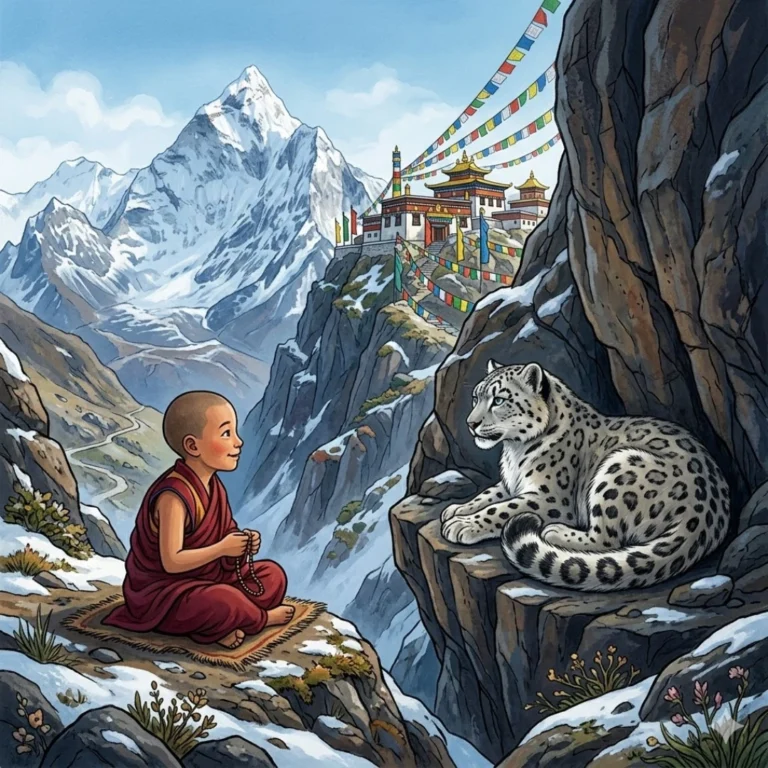
The monastery of Tashi Choling sat at the height where clouds come to rest before continuing upward, and this made it a place between things: between earth and sky, between the settled world below and the high silence above, between what could be explained and what could only be witnessed.
A boy called Tenzin had lived there since he was five years old, which meant he had spent six years learning, among other things, to meditate, to recite sutras, to carry water without spilling, and to sit very still in rooms that were very cold. He was eleven now and he was good at these things. He was also, though he would not have said this himself, beginning to feel that his goodness at these things was making him a little proud, which is one of the traps that practice sets for the practitioner.
The snow leopard appeared on a Tuesday in the month of wind.
Tenzin found it below the monastery, in the rocky ground between the main gate and the cliff face that dropped to the valley. It was lying against the cliff, which was unusual because snow leopards in the open meant something was wrong. Its breathing was visible in the cold air – rapid, shallow, not the breathing of a healthy animal.
Tenzin stopped at a safe distance and looked at it.
He had been taught that all living beings deserve compassion – karuna, the wish that others be free from suffering. He had recited this teaching many times. He had thought about it carefully and concluded that he understood it.
Now he was standing in the wind-cold air looking at an animal that was clearly suffering, and he found that understanding a teaching and being in the presence of the suffering it describes are very different things.
The snow leopard’s eyes were open. They were the color of winter ice, pale and direct and completely without the fear that a sick wild animal should probably have had. It looked at Tenzin and he looked at it and something passed between them that had no name in any language he knew.
He went to find the senior monk, Rinpoche Karma.
Rinpoche Karma came and looked at the leopard with the calm of someone who has seen many difficult things and has learned to look at them without flinching away or rushing forward.
“It has a wound on the left foreleg,” he said. “Something caught in it. A wire, perhaps, or a trap.” He looked at Tenzin. “What do you feel?”
“I feel -” Tenzin started. He stopped. The careful answer, the correct answer, formed itself readily. But the correct answer wasn’t quite what he was feeling.
“It hurts to look at,” he said instead. “My chest feels tight. I want it to stop suffering.”
“Good,” said Rinpoche Karma, which surprised him.
“Good?”
“You are feeling karuna rather than thinking it. This is different. When you only think about compassion, you can remain comfortable. When you feel it, the feeling asks something of you.” He turned back to the leopard. “What is it asking?”
“To do something,” said Tenzin. “Even if I’m afraid.”
The doing something was complicated. A snow leopard, even a sick one, is still a snow leopard. Rinpoche Karma organized three monks, a rope barrier, careful positioning. He told Tenzin to stay back. Tenzin started to obey and then found himself unable to, entirely, because there was something about the leopard’s pale eyes on him that held him in the situation.
“I can help hold the barrier,” he said.
Rinpoche Karma looked at him for a long moment. “Yes,” he said. “You can.”
They worked carefully and slowly, the monks and the boy, speaking quietly to the animal in the way that the old books recommended for wild creatures in distress: not commanding, not frightening, simply present and steady. The wire had dug deep into the foreleg above the paw. It took thirty careful minutes to cut it free.
The leopard did not attack. It lay still throughout, breathing hard, the ice-pale eyes watching. When the wire came free and the monk pulled back, it breathed differently – slower, deeper.
It lay against the cliff for two more hours. The monastery went about its afternoon. Tenzin sat at a respectful distance and kept it company, which seemed like the right thing to do even though he could not have explained exactly why.
At dusk, it stood. It tested the freed leg carefully, the way animals assess themselves after injury, all precise and unhurried self-knowledge. Then it looked at Tenzin once more.
What happened then was not dramatic. It did not speak, or bow, or leave a gift. It simply looked at him with those ice-water eyes for a long enough moment that he felt it somewhere below his ribs – the acknowledgment, or what felt like acknowledgment – and then it turned and walked into the rocks and was gone, the way snow leopards go: there, then not there, with nothing between.
Rinpoche Karma was behind him. “What did you learn today?”
Tenzin thought carefully. “The difference between reciting karuna and feeling it.” He paused. “And that feeling it is the uncomfortable part, and that’s also the useful part.”
“Yes,” said the monk. “Compassion without discomfort is only sentiment. Sentiment is kind but it changes nothing. Compassion that moves through the body and asks something of you – that is the thing the teachings are pointing toward.” He looked where the leopard had gone. “You stayed.”
“It seemed wrong to leave.”
“That wrongness you felt was your heart knowing before your mind did.” He put a hand briefly on Tenzin’s shoulder. “The teachings go in through the mind. But they have to come out through the body. Today some of them did.”
The snow leopard was not seen again that winter. In the spring, far up the mountain, someone found tracks: a leopard’s paw prints, four of them, walking upward into the high places where the snow holds the outline of things long after the things themselves have gone.
The Moral of This Story
Compassion is the courage to feel another’s pain and let it change what you do
About This Story’s Culture
This story draws on Tibetan Buddhist practice and philosophy. The monastery of Tashi Choling (tashi means auspicious, choling means spiritual place) is a fictional but authentic-sounding Tibetan monastery name following the tashi-named-place convention. Karuna (compassion, the wish for others to be free from suffering) is one of the four immeasurables (brahmaviharas) in Tibetan Buddhism. Rinpoche is an authentic Tibetan honorific meaning ‘precious one,’ used for respected teachers. Snow leopards (shan) have spiritual significance in Tibetan culture and are associated with the mountain deities. The story reflects the genuine tension in contemplative traditions between intellectual understanding of teachings and their embodied realization – a theme central to all Tibetan Buddhist practice.
Key Story Elements
- Tenzin – an eleven-year-old monk at a Himalayan monastery, good at practice but beginning to be proud
- The snow leopard with a wire wound – the teaching made embodied and urgent
- Rinpoche Karma – the senior monk who asks ‘what do you feel?’ and accepts the honest answer
- The distinction between thinking karuna (compassion) and feeling it – the trap of competence
- Lagerlöf’s journey structure: a spiritual pilgrimage within a small physical space
- Tenzin’s inability to fully obey the instruction to stay back – the body knowing before the mind
- The leopard’s final look: acknowledgment, or what feels like it – enough to change something
Frequently Asked Questions
What is The Snow Leopard’s Gift story about?
The Snow Leopard’s Gift is a Tibetan-inspired children’s story about an eleven-year-old monk named Tenzin who discovers an injured snow leopard near his mountain monastery. The story explores themes of compassion, humility, and what we can learn when we move beyond pride in our own abilities.
What age group is The Snow Leopard’s Gift suitable for?
This story is written for children aged 6 to 12 and takes around 8 to 10 minutes to read. It works well as a bedtime story or classroom read-aloud, and its themes of compassion and mindfulness make it a meaningful choice for children at both ends of that age range.
What tradition or culture does this snow leopard story come from?
The story is rooted in Tibetan tradition, set in a high-altitude Buddhist monastery called Tashi Choling. It draws on Tibetan Buddhist values like meditation, humility, and compassion, making it a gentle introduction to that cultural and spiritual tradition for young readers.
📚 Recommended Books
Handpicked for readers like you
As an Amazon Associate, we earn from qualifying purchases. These recommendations are personalized based on this story's themes and your reading history.
What lesson does the story teach children about compassion?
The story shows that true compassion means acting with care even when we are uncertain or afraid. Through Tenzin’s encounter with the injured snow leopard, children learn that genuine kindness goes beyond following rules or being skilled — it requires courage, empathy, and letting go of pride.
Is this a good story to read to kids who are learning about mindfulness?
Yes, absolutely. The snow leopard story naturally weaves in mindfulness themes through Tenzin’s life as a young monk — sitting still, breathing, paying attention, and noticing his own pride. It’s a gentle, narrative way to introduce children to mindfulness concepts without feeling like a lesson.
