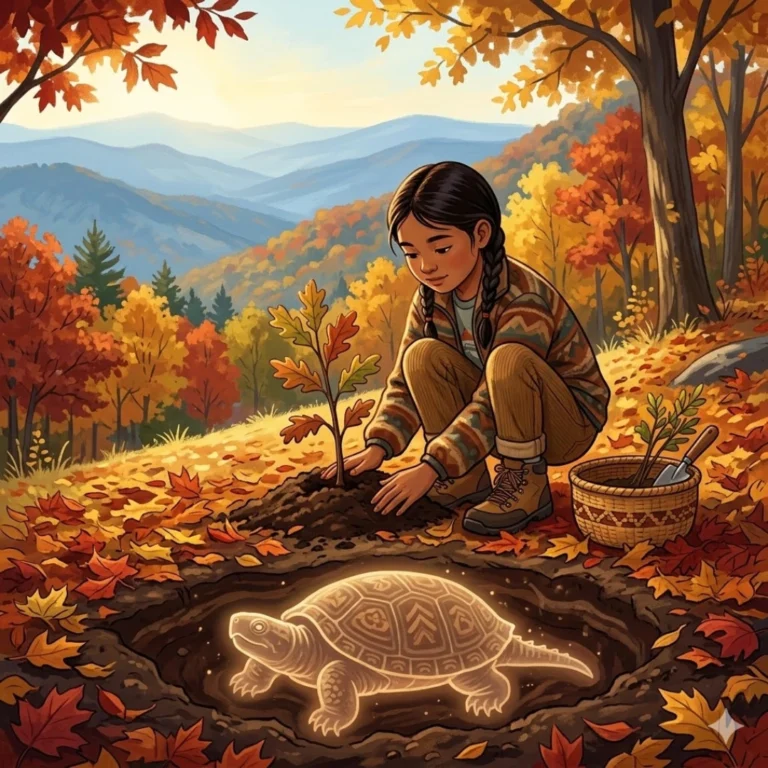
The first thing you should know is that the world rests on Turtle’s back.
This is not a metaphor, or not only a metaphor. It is simply true, the way it is true that water runs downhill and cedar trees smell like prayers. Long ago, when all was water and the animals needed somewhere to stand, it was Turtle who dove deepest and came up with mud on her shell, and from that mud the world grew. If you sit very still beside a river and put your ear close to the ground, you can sometimes feel, very faint and far away, the slow breathing of the one who carries everything.
This is important to remember for the story of Selu-ni, which begins on a morning in early autumn when the sourwood trees had gone red and the air smelled of wood smoke and ripe pawpaw, which is the smell of home if home is a valley in the Blue Ridge Mountains and you are nine years old.
Selu-ni was named for Selu, the Corn Mother, because she had been born during corn harvest, and also because her grandmother Edoda said she had been shouting enthusiastically from the moment she arrived in the world, which was very like corn. She had thick dark hair and muddy knees and a deep and serious interest in every living thing that moved, flew, crawled, or grew.
She loved the forest the way you love something you are part of, not something you look at from outside.
Her trouble began with the Spring.
Not the season – the Spring, the one that rose from the hillside above the village, cold and clear and tasked since before anyone could remember with feeding the village’s drinking water. It had never failed, not in Edoda’s memory nor in her mother’s memory before that.
But this autumn, it was failing.
The trickle that ran down to the catch-pool had gone thin and yellow-brown and strange-smelling, and the adults were meeting in serious voices and looking at each other with the look that meant something was wrong in a way they hadn’t seen before.
Selu-ni watched and listened and thought.
Then she went to find Edoda.
Edoda was very old. She had white hair and hands that knew how to make baskets, medicines, and, Selu-ni suspected, thunder. She was sitting in her chair in the doorway doing the careful nothing that old people do when they are actually doing a great deal of thinking.
“The Spring is sick,” said Selu-ni.
“The Spring is being crowded,” said Edoda. “Come. I’ll show you.”
They walked up the hill together, Edoda with her stick and Selu-ni with her bare feet reading the ground. At the top, Edoda showed her: the hillside above the spring had been cleared the previous year – trees taken for lumber, the ground left bare and beaten down. Without roots to hold it, the autumn rains had dragged the soil in layers, clouding the water. Without the forest’s sponge to slow the rain, the water ran off instead of soaking in, and the spring’s deep source was going dry.
“The trees were holding the water in the hill,” said Selu-ni, slowly.
“The trees were holding everything,” said Edoda. “The soil, the water, the shade that kept the smaller plants cool, the roots that gave the small animals their roads. everything was connected to everything. When one thing is taken without asking – without thinking about what it holds up – many things fall.”
Selu-ni stood and looked at the bare, beaten hillside, and felt something she couldn’t immediately name. It was not just sadness. It was the feeling of seeing that something had been done wrong – not by evil, but by not paying attention. By forgetting to ask.
“What do we do?” she said.
“We ask,” said Edoda. “We give thanks that we understand the problem. And then we do the work.”
They asked. Edoda explained the hillside to the village council with the patience of someone who has explained difficult true things many times. The council listened. Some remembered what the hillside had looked like twenty years before and nodded. Some had not thought about the connection before, and sat with it quietly, turning it over.
And then they began the work.
Selu-ni spent that autumn on her knees in the hillside mud with everyone else, planting seedlings. Tulip poplar. Sourwood. Red oak. Dogwood. Her hands learned the specific weight of a sapling root ball, the depth the hole needed to be, the way you settled soil around new roots – firm but not crushing, like the care you give to something that is not yet sure it wants to stay.
The seedlings were small. They would not fix the spring this season, or next season. They would not even be tall trees when Selu-ni was grown. Some of them, planted that autumn by her nine-year-old hands, would outlive her grandchildren.
This was, she discovered, not a discouraging thought. It was an astonishing one.
“I am planting trees,” she said to Edoda one afternoon, rain starting to mist over the hillside, “that people I will never meet will sit under.”
“Yes,” said Edoda.
“So someone else planted the trees I sit under.”
“Yes.”
Selu-ni sat with this. A wood thrush sang from somewhere in the forest below, the liquid, spiraling song that sounds like it is asking a beautiful question.
“That’s like a conversation across time,” she said.
“That is exactly what it is,” said Edoda. “The old people spoke to us through what they planted and protected. We speak to the ones who aren’t born yet. This is what it means to be a good guest. You leave the house better than you found it.”
By spring, the hillside had the first thin look of green beginning. By the following autumn, the seedlings were knee-high, and the spring ran a little clearer. By the time Selu-ni’s own daughter was nine years old, there were trees on that hill that had begun to hold the soil again, and the spring ran cold and clear and strong.
But all of that is later.
For now: a nine-year-old girl kneeling in the rain on a hillside, pressing the root of a small tulip poplar into the cold earth with careful hands, thinking about the people she would never meet who would one day stand in its shade.
Below her, the valley breathed. The creek ran. A deer paused at the forest’s edge and looked up the hill, and Selu-ni looked back, and for a moment they simply regarded each other – two guests on Turtle’s back, both knowing themselves to be exactly that.
The deer moved on. The rain kept coming. The roots went down into the dark earth, quietly, the way hope goes when it is serious about staying.
Give thanks. Pay attention. Leave it better than you found it.
That is the oldest conversation there is, and it is still going.
The Moral of This Story
We do not own the earth – we are guests, and guests must honor their hosts
About This Story’s Culture
This story draws on authentic Cherokee cultural traditions and cosmology. The Turtle’s back creation story is a foundational narrative across many Southeastern and Woodlands Native American traditions. Selu is the authentic Cherokee Corn Mother figure who sacrifices herself so corn can grow, making the name Selu-ni (little Selu) culturally appropriate. The Blue Ridge Mountains are the historical homeland of the Cherokee Nation. Cherokee traditional ecological knowledge (TEK) includes sophisticated understanding of forest-water relationships, watershed management, and the seven-generation principle – the idea that decisions should consider their impact seven generations forward. This principle is represented in the tree-planting scene. The story avoids appropriating spiritual practices while honoring the ecological wisdom tradition.
Key Story Elements
- Selu-ni – a Cherokee girl named for Selu the Corn Mother, deeply connected to her forest valley
- Edoda the grandmother – keeper of traditional ecological knowledge
- The Spring as the center of community life, failing due to hillside deforestation
- Tree planting as an intergenerational act – a conversation across time
- Turtle carrying the world: authentic Cherokee cosmological opening
- The wood thrush as a natural voice in Miyazawa’s nature-communion style
- The deer and Selu-ni’s mutual gaze – recognition of shared guest-hood on the Earth
Frequently Asked Questions
What is the story ‘When Turtle Carried the World’ about?
It’s a children’s story rooted in Cherokee tradition about a young girl named Selu-ni and the ancient belief that the world rests on Turtle’s back. The tale explores themes of respect for nature, drawing on real Cherokee mythology about how Turtle brought mud from the water to create the earth.
What age group is ‘When Turtle Carried the World’ best suited for?
The story is written for children aged 6 to 12, with a reading time of about 8 to 10 minutes. Its gentle language and vivid nature imagery make it accessible for younger readers, while older children can appreciate the deeper themes of respect and Indigenous storytelling tradition.
Is the Turtle carrying the world a real Cherokee belief?
Yes, Turtle Island is a genuine concept found in several Native American traditions, including Cherokee storytelling. The idea that a great turtle dove underwater, surfaced with mud on her shell, and that land grew from it is a creation story passed down through generations, not simply a fictional invention.
📚 Recommended Books
Handpicked for readers like you
As an Amazon Associate, we earn from qualifying purchases. These recommendations are personalized based on this story's themes and your reading history.
What lessons does this Cherokee nature story teach kids?
The story teaches children to respect the natural world and recognise that everything around them is connected and alive. By presenting the earth as something carried and cared for, it encourages a sense of gratitude and responsibility toward nature, animals, and the environment.
Who is Selu-ni and why is she named that?
Selu-ni is the nine-year-old main character, named after Selu, the Cherokee Corn Mother, because she was born during corn harvest. Her grandmother chose the name, suggesting she arrived into the world with great energy and purpose, connecting her identity directly to Cherokee cultural heritage from birth.