

There was once a river that remembered everything.
All rivers remember, to some degree – they carry silt from mountains they have never seen, and cold from glaciers long melted, and somewhere in their deep currents the memory of the first rain that ever fell. But the Padma, which runs wide and brown through the flat green heart of Bengal, remembered with particular patience and tenderness, the way grandmothers remember.
On a village on the Padma’s bank lived a girl called Maloti, which means jasmine flower in the way that names in that place often meant beautiful things, as though the people who made the names hoped the world would arrange itself accordingly.
Maloti was nine years old, with quick dark eyes and bare feet that were very good at finding the exact softest mud at the river’s edge, which is where she spent most of her mornings. She was not the richest girl in the village, or the most important. Her family had a small house and a small boat and a large supply of the kind of happiness that doesn’t depend on having much.
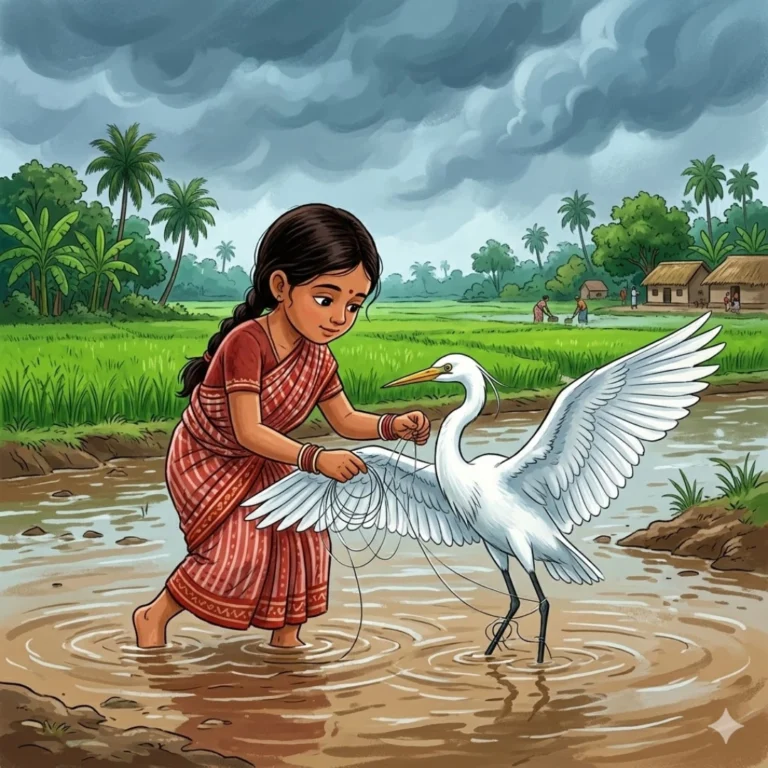
One monsoon morning, when the river was high and brown and magnificent with all the rain it had gathered from the hills, Maloti went to the bank and found something caught in the roots of the great old banyan tree that trailed its feet in the water.
It was a bird. A white crane, one wing hanging wrong, tangled in a loop of old fishing line that the river had drifted down on its back. The crane was alive – she could see the bright dark eye watching her – but its struggles had only tightened the line, and it had given up struggling and was simply waiting, which is a terrible position to be in.
“Oh,” said Maloti.
She waded in to her knees – the river warm and silted between her toes – and she worked the line loose with careful fingers. It took a long time. The crane held very still, as though it understood that stillness was required, and Maloti talked to it softly while she worked, about nothing in particular – about the river, and what the rice fields looked like when the monsoon first arrived, and how she liked the way thunder sounded when it was far away.
When the last loop came free, the crane stood in the shallows for a moment, looking at her. Then it dipped its long neck – a gesture that seemed, to Maloti, remarkably like a bow – spread its wings, and rose into the monsoon sky, and was gone.
Maloti watched it go until it was a white comma against the grey clouds.
“You are welcome,” she said, to the empty air.
She thought nothing more of it.
The following week, however, a man came to the village who changed everything.
His name was Adinath, and he was a merchant of iron – tools and hinges and anchors and the heavy, useful things that the river villages needed. He was not a kind man. He was not an unkind man, exactly, either. He was a man who had decided, some years ago, that the world was simply a transaction, and that people who did not have things he wanted were not particularly interesting to him.
He had a boat full of iron goods and a book full of numbers and a heart that had become, over the years, rather like his iron: heavy, useful, and cold.
Adinath arrived in Maloti’s village looking for the family of a man who owed him money – a debt from years ago, recorded carefully in the book of numbers. The family was poor. The father had died. The mother had three small children and a leaky roof and nothing to pay with.
Adinath stood in their yard with his account book and looked at the mother’s face, which was the face of someone who had been afraid for a very long time and had gotten very tired of it.
He should, by the arithmetic of his ledger, take what he could – the boat, perhaps, or the loom.
He was just opening his mouth to say so when a white crane landed on the roof of the house.
It stood there, wings folded, looking at him with a bright dark eye. It looked at him the way very old things sometimes look at people – as if it can see more than you’d like.
Adinath stopped.
He did not know why he stopped. He was a practical man who did not believe in signs or portents. He believed in iron and numbers and the orderly satisfaction of debts.
But the crane looked at him, and something in his chest – in the place where his heart had been before it became heavy and useful – gave a small, unfamiliar tug.
He thought, suddenly and without meaning to, about his own mother. About a debt she had once owed that a neighbor had forgiven, long ago, when he was small. About what that forgiveness had meant – not just for her, but for him, for the boy he had been, watching his mother breathe freely again for the first time in months.
He had forgotten that. He had, very carefully, over very many years, forgotten that.
The crane tilted its head.
Adinath closed his account book.
“The debt,” he said, to the mother, “is forgiven. All of it.”
The mother looked at him as though he had said something in a language she hadn’t expected him to speak.
“Why?” she whispered.
Adinath looked at the crane on the roof. “I don’t quite know,” he said honestly. “It seemed the right thing to do.”
He walked back to his boat. He was lighter than he had been walking up, which made no sense, because he had given something away, and giving things away was supposed to make you have less. He had always believed this.
He turned at the river to look back.
The crane was gone. But in the yard, the mother was holding her youngest child, and the child was laughing at something – a butterfly, a passing bird, something small and bright in the monsoon morning – and the sound carried all the way to the river.
Adinath stood there for a moment, listening.
Then he got into his boat and pushed off into the current of the Padma, which carried him downstream through the flat green country, past the rice fields standing up to their knees in water, past the egrets on the riverbank and the fishing boats going out in the mist, and something in him was different – not fixed, not transformed, not written about in stories as a great change – but different in the small, stubborn way that real changes happen.
Downriver, a girl with quick dark eyes and muddy feet sat at the water’s edge and watched a crane flying north through the grey monsoon sky.
She smiled, though she did not know why.
The Padma ran on, as it always does, carrying everything with it – silt and cold and the memory of a kindness passed from a child’s careful hands through a bird’s bright eyes into a merchant’s locked-away heart, traveling further than any of them could have measured, in the direction that kindness always travels.
Forward. Always forward. And never, never stopping.
The Moral of This Story
The smallest act of kindness can travel further than the greatest act of force
About This Story’s Culture
This story is set in the Bengali-speaking Ganges delta region of Bengal (present-day Bangladesh and West Bengal, India), drawing on the rich tradition of Bengali folk tales featuring the Padma River. White cranes and egrets are deeply symbolic in Bengali culture and appear frequently in Rabindranath Tagore’s poetry and folk tradition as symbols of purity and divine message-bearing. The story alludes to the folk tale tradition of the crane-wife or gratitude stories common across South and East Asian traditions. The name Maloti (jasmine/a type of flower) and Adinath (first lord) are authentic Bengali names. The monsoon season is central to Bengali cultural identity and agricultural life. The concept of the Padma as a living, remembering presence reflects animistic elements in Bengali folk belief.
Key Story Elements
- Maloti – a nine-year-old Bengali girl living beside the wide Padma river
- The white crane tangled in fishing line – freed through patient, gentle kindness
- Adinath the iron merchant – a man whose heart has become as heavy as his trade
- The crane appearing on the roof: Andersen-style magical realism where nature carries moral weight
- The forgotten memory of his mother’s forgiven debt unlocking compassion in the merchant
- The Padma river as the connective tissue carrying kindness downstream
- Poetic structure: kindness circles back invisibly, traveling further than force ever could
Frequently Asked Questions
What is The River Girl and the Iron Merchant about?
The River Girl and the Iron Merchant is a Bengali folk-style story about a nine-year-old girl named Maloti who lives on the banks of the Padma river. It explores themes of kindness and compassion through her encounter with an iron merchant, making it a gentle moral tale for children aged 6 to 12.
What age group is The River Girl and the Iron Merchant suitable for?
This story is recommended for children aged 6 to 12. It takes around 8 to 10 minutes to read aloud, making it a great bedtime story or classroom read. The language is warm and imaginative, but simple enough for younger readers to enjoy with a little help.
What moral lesson does this story teach kids?
The story focuses on kindness and compassion as its core themes. Through Maloti’s journey along the Padma river, children learn that treating others with gentleness and empathy matters, even when dealing with someone seemingly hard or difficult, like an iron merchant.
📚 Recommended Books
Handpicked for readers like you
As an Amazon Associate, we earn from qualifying purchases. These recommendations are personalized based on this story's themes and your reading history.
What Bengali tradition does this story come from?
The River Girl and the Iron Merchant draws from Bengali storytelling tradition, rooted in the culture of the Padma river region in Bengal. It carries the feel of an old folk tale, where rivers have memory and names carry meaning, reflecting the rich oral storytelling heritage of that area.
Is this a good bedtime story for young children?
Yes, it is a wonderful bedtime story for children aged 6 and up. The soothing river setting, the lyrical descriptions of the Padma, and the gentle moral about kindness create a calm and meaningful reading experience. At 8 to 10 minutes long, it fits perfectly into a bedtime routine.
