Now, this is a story that belongs to everyone who has ever sat down to share a meal, which means it probably belongs to you.
It begins, as many good stories do, with a garden.
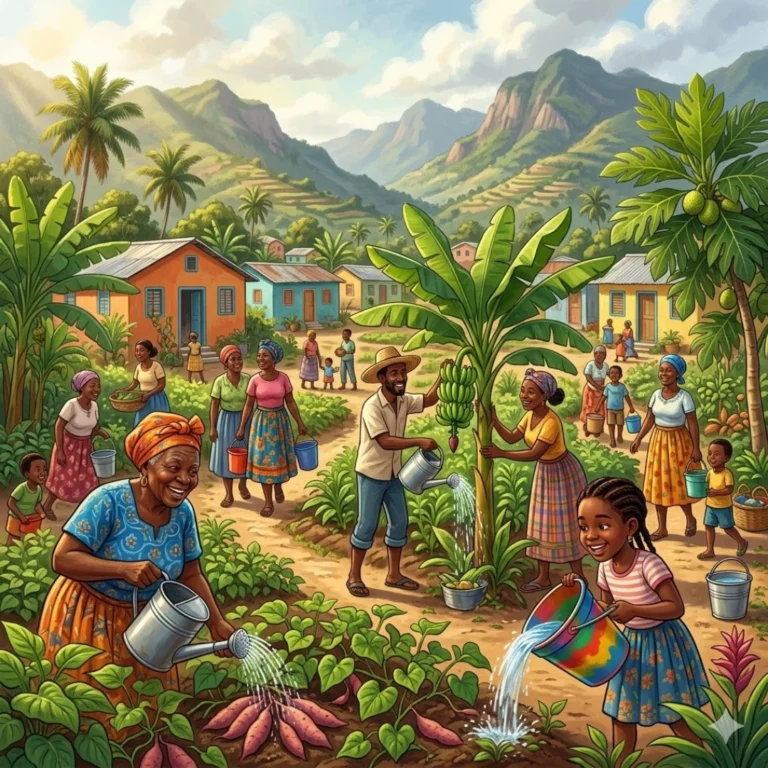
In the valley of Plaine du Nord, where the mountains sit around the farmland like protective uncles and the rain comes in the afternoons with great dramatic intentions, there was a village called Ti-Mache. Ti-Mache was not a grand village – it had one church, one market, one enormous mango tree that served as the village’s general meeting room and opinion-sharing facility – but it had something more valuable than grandness. It had kout men.
Kout men means, more or less, a helping hand. But that translation does not quite carry the weight of the word, the way that saying ‘water’ doesn’t quite carry the weight of an ocean. In Ti-Mache, kout men meant everything. It meant that when old Manman Céleste’s roof blew off in the August storms, thirty people arrived before breakfast with bamboo and palm thatch and their own good arms. It meant that when the Bélizaire twins were born too early and too small, the whole village took turns keeping them warm through the long nights until they decided to stay.
Kout men meant: you are not alone, because you are one of us, and we are one of you.
At the center of all this was a girl called Mireille, who was ten years old and had the kind of laugh that started a room laughing whether they knew why or not. She lived with her Gran-mè Josepha and her father Tonton Pierre, and she helped with the garden every morning before school.
Their garden grew sweet potato and malanga and the most magnificent breadfruit tree in the valley. It was a good garden. Mireille loved it the way you love something you have dug and watered and watched grow.
But one dry season, the rain did not come in the afternoon the way it was supposed to.
It did not come in the afternoon, or the morning, or the evening. The sky stayed white and still and unhelpful, and the river that came down from the mountains went thin as a thread, and the wells got low, and the gardens got thirsty.
This was bad for everyone. But it was worst for old Granpè Domond, who had the smallest plot and the oldest bones and whose family had gone to Port-au-Prince years ago, leaving him to tend his garden alone.
Mireille watched Granpè Domond’s garden from over the fence. She watched the plantain leaves go pale and crinkled at the edges. She watched him carry water from his well in a tin pail, walking slowly, because his knees were the kind of knees that complained loudly on stairs.
“Granpè Domond,” she said one evening, when she had come to return a calabash her grandmother had borrowed, “how is your garden?”
The old man set down his pail and looked at his plants with an expression that was tired in the way that goes all the way to the middle of you. “The garden is struggling, pitit mwen,” he said. My child. “As am I.”
Mireille went home and thought about this.
The next morning, she brought her own watering tin to Granpè Domond’s fence. She also brought her friend Claudette, who brought hers. Claudette’s older brother Antoine came to see what they were doing, and stayed to help. Antoine’s mother came to collect Antoine and ended up bringing a larger bucket. By midmorning, there were seven people watering Granpè Domond’s garden, and Granpè Domond himself was sitting in the shade of his breadfruit tree looking at them all with an expression that was too full of several things at once to be easily described.
“This is too much,” he said. “I cannot repay all this.”
“Granpè,” said Mireille’s Gran-mè Josepha, who had arrived with two more buckets and her sister, “do you remember the year the hurricane took my sweet potato crop? Who came to my garden then?”
The old man was quiet for a moment. “Half the village,” he said.
“And before that, the year I lost my husband. Who came then?”
“All the village,” he said, more quietly still.
“This is not debt,” said Gran-mè Josepha firmly. “This is how water moves. It doesn’t go in one direction only. It goes where it’s needed, and comes back around, and goes again. That is all we are doing.”
The dry season lasted six weeks. For all six weeks, the village watered each other’s gardens before their own.
Not efficiently – it was not an organized system with a schedule and a committee. It was messier than that, and louder, and people sometimes watered the wrong thing, and there were arguments about the best way to save a wilting plantain, and someone’s goat got into someone else’s garden and there was a great deal of shouting about that for an afternoon.
But the gardens survived. All of them.
On the day the rains finally came back – proper, generous, afternoon rain that drummed on the tin roofs and turned the ditches into rivers – Mireille ran out and stood in it with her arms out and her face up.
Granpè Domond came to the fence between their gardens. He had something in his hand: three of his best sweet potatoes, freshly dug, enormous and perfect.
“For your family,” he said. “From my garden that you saved.”
“You don’t have to -” Mireille started.
“I know,” said the old man, smiling in the way of someone who has lived a long time and figured out what matters. “That’s why I want to.”
That evening, Mireille helped Gran-mè Josepha make soup with the sweet potatoes – the kind of thick, good soup that smells like it’s already a memory while you’re cooking it – and they brought bowls of it to Claudette’s family, and to Antoine’s mother, and to three other houses on their street, because the soup was large and the evening was rainy and there is no sense eating something wonderful entirely by yourself when the world is full of people.
“Gran-mè,” said Mireille, as they walked home through the warm rain, “do you think Kouzen Zaka was watching today? From his garden in the sky?”
Kouzen Zaka was the lwa of agriculture – the spirit of farming and gardens and honest work, who wore straw hats and carried a machete and had a deep and abiding love for the land and the people who worked it.
Gran-mè Josepha looked up at the dark, rain-heavy sky, and she smiled.
“Kouzen Zaka,” she said, “is always watching when the gardens are tended well. And I think today he was pleased.”
The rain kept coming. Somewhere down the street, someone had started playing a guitar, softly, under an awning. The village smelled of wet earth and mango and something cooking in someone’s kitchen that was probably very good.
Mireille tucked her hand into her grandmother’s and they walked the rest of the way home together, which is how the best stories end – not with everything fixed and perfect, but with someone warm beside you and dinner waiting and the sound of rain.
Kout men. A helping hand.
It goes where it’s needed, comes back around, and goes again.
Remember that, the next time someone’s garden is struggling.
The Moral of This Story
We grow stronger when we tend each other’s gardens as carefully as our own
About This Story’s Culture
This story draws on authentic Haitian cultural values, particularly the concept of kout men (or travay kombit – collective community labor), which has deep roots in Haitian peasant tradition. Kombit is a traditional form of cooperative farm labor where community members help each other’s fields in rotation. Kouzen Zaka (also Azaka) is an important lwa (spirit) in Haitian Vodou, the spirit of agriculture and peasant farmers, depicted wearing a straw hat and a denim jacket, carrying a makout (woven bag) and machete. The story is set in Plaine du Nord, a real agricultural valley in northern Haiti. Authentic Haitian Creole words are woven in naturally: pitit mwen (my child), gran-mè (grandmother), lwa (spirit).
Key Story Elements
- Mireille – a ten-year-old girl with an infectious laugh in the village of Ti-Mache
- Granpè Domond – elderly neighbor whose garden suffers in the dry season
- The concept of kout men – communal helping hands as the village’s core value
- Gran-mè Josepha’s wisdom: water (and help) doesn’t go one direction only, it circulates
- The dry season as the test that reveals the community’s true strength
- Kouzen Zaka – the Haitian lwa of agriculture watching over hardworking farmers
- Sweet potato soup shared across the neighborhood: community through food
Frequently Asked Questions
What is Kouzen Zaka’s Garden about?
Kouzen Zaka’s Garden is a Haitian folktale-inspired story set in a small village called Ti-Mache, where the spirit of community and mutual aid — called kout men — brings people together. It explores themes of belonging, cooperation, and what it truly means to share with your neighbors.
What does kout men mean in Kouzen Zaka’s Garden?
Kout men is a Haitian Creole term that roughly translates to ‘a helping hand,’ but in the story it carries much deeper meaning. It represents the entire spirit of community cooperation — the unspoken agreement that neighbors show up for each other without being asked.
Who is Kouzen Zaka and why is he connected to gardens?
Kouzen Zaka is a spirit from Haitian Vodou tradition associated with farming, agriculture, and the countryside. He represents the dignity of hard work and the land. A story bearing his name would naturally center on gardens, harvests, and the community bonds that grow from working the earth together.
📚 Recommended Books
Handpicked for readers like you
As an Amazon Associate, we earn from qualifying purchases. These recommendations are personalized based on this story's themes and your reading history.
What age group is this story suitable for?
Kouzen Zaka’s Garden is written for children aged 6 to 12 and takes about 8 to 10 minutes to read aloud. Its themes of community and belonging make it a great choice for family reading or classroom discussions about cooperation and cultural traditions.
What moral lesson does Kouzen Zaka’s Garden teach kids?
The story teaches that true community means showing up for others — not because you have to, but because belonging to a place means caring for the people in it. It gently shows children that small acts of help, like kout men, hold communities together more than wealth or grandness ever could.