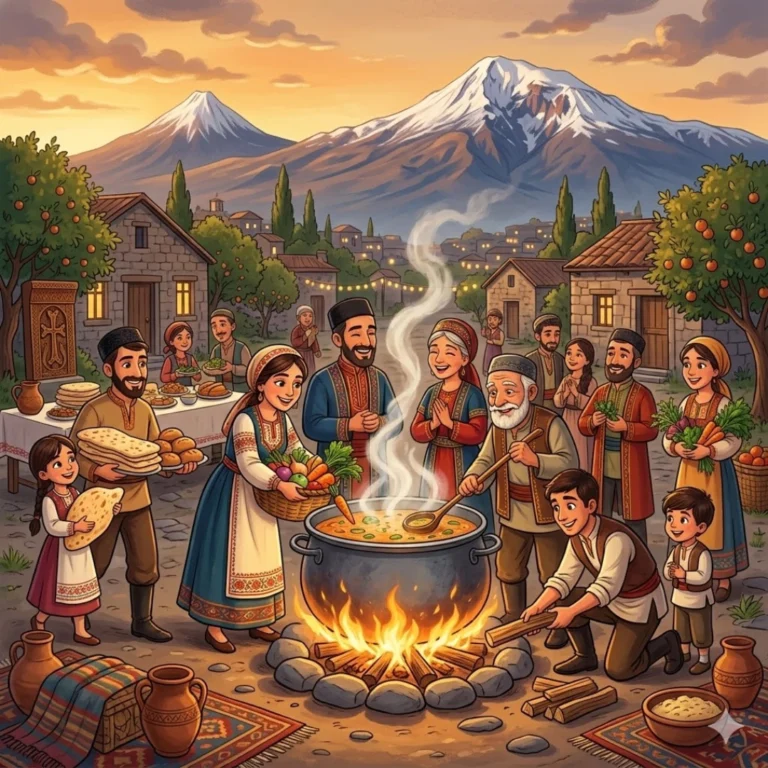
High on the slopes of the Armenian highlands, where the sky sits close enough to touch and the ancient stones remember everything, there was a village called Lusabats — which means, in the old tongue, “the birth of light.”
Every morning the great mountain Ararat rose above the clouds like a promise, its twin white peaks gleaming as though dusted with the stars that hadn’t quite gone home yet. The village children believed, as children will, that if you were very quiet and very still, you could hear the mountain breathe.
Ara believed this more than anyone.
She was nine years old, with dark braids wound tight against her head and eyes the color of the apricot groves that terraced the hillside below her grandmother’s house. Ara spent her mornings helping Grandma Sirun press lavash on the inner walls of the tonir — the clay oven sunk into the earth like a secret — and her evenings listening to stories older than the carved stone crosses that stood at every crossroads in the valley.
But this particular autumn had grown thin and gray.
The harvest had been poor. A dry summer had shriveled the grape vines and stunted the pomegranate trees until their fruits were small and sour as old arguments. The neighbors who usually called to one another across their garden walls had grown quiet, each family counting their stores and finding them wanting. Even the duduk player, old Vartan, had not drawn breath through his instrument in weeks. Without music, the village felt like a house with all its windows shut.
“Grandma,” Ara said one evening, as they sat by the fire and the mountain turned rose-pink and then violet against the darkening sky, “why has everyone become so small inside themselves?”
Grandma Sirun looked at her granddaughter for a long moment. Her face was a map of a full life — every road and river of it written in kind lines.
“When people are afraid,” she said at last, “they close their hands. They think that holding tighter is the same as having more. But it is not the same thing at all, my apricot.”
“Then what is?” Ara asked.
But Grandma Sirun only smiled the particular smile she wore when she believed a child needed to find an answer herself.
That night, Ara had a peculiar dream. She dreamed that Mount Ararat walked down from the clouds on great slow feet and stood in the village square. In the dream it spoke to her — not in words, but in the way mountains speak, which is to say: in a feeling that moves through the bones and settles somewhere near the heart.
She woke before dawn with an idea burning bright as a candle behind her ribs.
She slipped on her wool coat, tucked her braids beneath her cap, and went out into the blue half-dark of early morning. From the streambed at the edge of the village she chose three smooth stones — round and dark and river-washed clean, each one fitting perfectly in her palm. She carried them back to the village square, where the old stone fountain stood, and she set them in the bottom of the largest clay pot she could find: the great communal pot that had not been used since the harvest festival of the year before.
Then she filled the pot with water from the fountain and built a fire beneath it.
By the time the first pale finger of sunlight touched Ararat’s higher peak, the water had begun to murmur.
Mrk the baker was the first to notice. He came shuffling across the square in his flour-dusted apron, squinting with sleep still in his eyes.
“Girl, what are you doing?”
“I’m making stone soup,” Ara said simply.
Mrk scratched his head. “Stone soup.”
“My grandmother says that the best soup in all of Armenia came from three good stones and a willing heart. Would you like some, when it’s done?”
The baker bent over the pot. He sniffed the steam that rose from the plain hot water. He straightened up.
“Stone soup,” he said again. “I suppose — it might be better with a heel of stale bread broken into it. I have some I cannot sell.” He looked almost embarrassed. “Only if it would help the soup, you understand.”
“It would help it enormously,” Ara said gravely.
Mrk disappeared and returned with a round of yesterday’s bread. He crumbled it into the pot, and the water turned golden and fragrant.
Ana the herb-keeper came next, drawn by the smell and the strange sight of a child cooking alone in the square.
“What is that?”
“Stone soup. Would you like some?”
Ana peered into the pot. “It wants something green,” she declared, with the authority of a woman who has grown things all her life. “Dried thyme. Tarragon. I have more than I can use this winter — my stores are fat with herbs this year, even when everything else was poor.” She hurried home and came back with two hands full of dried mountain herbs that she scattered across the surface like green confetti.
The steam that rose now was extraordinary — it smelled of summer, of warm hillsides, of every good afternoon that had ever been.
Old Vartan, the duduk player, was pulled from his house by that smell. He stood at the edge of the square with his coat half-buttoned, staring.
“I have onions,” he said, to no one in particular. “Braided onions. More than I need.” He said it the way a man might confess something.
“Onions would be wonderful,” Ara said.
Vartan went home and came back not only with a braid of onions but with his duduk tucked under his arm. While he peeled and chopped — which is, perhaps, why the duduk player cried without shame, though perhaps not entirely — he began, without quite meaning to, to play. The notes fell into the morning air like water finding its way between stones: low, sweet, aching with something too large for words.
And then the square was full of people.
They came the way people come to music when they have been too long without it: first one, then three, then a river of them, carrying whatever they had thought was only barely enough for themselves and discovering it was, after all, enough to share.
The widow Mariam brought a jar of tomatoes she had put up in late summer. Young Hagop arrived breathless with a handful of dried apricots — the good kind, small and intensely amber, that tasted like concentrated sun. The schoolteacher Nora contributed a bunch of dried pomegranate seeds that stained the soup deep red and made it taste faintly of celebration. The shepherd brought a rind of cheese. The weaver’s daughter brought a fistful of walnuts — because, she said, her mother had always put walnuts in soup, and she did not know why, but she had always loved it.
No one had very much. But everyone had something. And each something was given in the spirit that Armenians call hyurasirut’yun — hospitality that is not obligation but joy, the understanding that a guest at your table, or a neighbor at your pot, makes the food better rather than less.
The soup grew and grew. Ara stirred it with the long wooden spoon her grandmother had given her, the one worn smooth by a hundred years of hands. The steam rose in great white clouds that the morning sunlight turned to gold. Ararat watched from above, patient and enormous, its snows glowing.
At noon, Grandma Sirun arrived at last. She had stayed away on purpose — Ara understood this later — so that the story could happen without her. She stood at the edge of the crowd, which had grown to include nearly every soul in Lusabats, and she watched her granddaughter ladle soup into bowl after bowl after bowl.
“Is there enough?” someone near Sirun whispered.
“There is always enough,” Sirun said quietly, “when there is enough love.”
The soup was magnificent. It was, everyone agreed, the finest soup they had tasted in memory — rich and layered and complex, tasting of mountains and orchards and the particular sweetness of things freely given. The bread was passed in rounds. The cheese was shared in careful slivers. The dried apricots were placed in small piles on a cloth and anyone who wanted one, took one.
Vartan played his duduk until the sun began its descent and the sky turned those impossible Armenian colors — apricot, rose, the deep violet that lives at the edge of dusk. Children who had not played together in weeks chased each other between the adults’ legs. Two old men who had been silently feuding over a fence line found themselves standing side by side, sharing a bowl, and forgot to be angry.
At the end of it all, when the last of the soup had been eaten and the fire had settled to embers, Ara reached into the bottom of the great pot and drew out the three smooth stones, clean as the day she had found them in the stream.
She showed them to Grandma Sirun.
“Were these the real ingredients?” Ara asked.
Grandma Sirun cupped the stones in her palm, turning them over thoughtfully.
“The stones were only an invitation,” she said. “They gave people a reason to show what they already wanted to give. The real soup —” she touched her hand briefly to Ara’s chest, just above her heart “— was always in here, my apricot. It was in all of them. It simply needed one small brave person to begin.”
That winter was still lean, as winters on the Armenian highlands sometimes are. The pomegranates were still small. The grape harvest did not come back until spring.
But every Sunday, the great pot was brought to the village square. Each family brought whatever they could spare — sometimes much, sometimes only a little — and the soup was always, mysteriously, enough.
And high above, Ararat kept watch, as it has always done and always will: ancient, patient, and white with the memory of everything it has seen.
For the mountain knows what the stones know, what the apricot trees and the pomegranates and the duduk’s low, sweet cry all know:
The more you give, the more you find waiting for you — in the pot, in the square, in the shining faces of the people beside you.
That is the oldest recipe of all, and it has never once failed.
The Moral of This Story
The more you give, the more you receive
About This Story’s Culture
This story draws on several pillars of Armenian cultural identity: Mount Ararat, the sacred symbol of the Armenian homeland depicted on the national coat of arms, serves as a silent witness throughout the narrative. The duduk, an ancient double-reed woodwind instrument recognized by UNESCO as intangible cultural heritage, represents the emotional and communal soul of Armenian village life. The concept of hyurasirut’yun — Armenian hospitality rooted not in obligation but in genuine joy at sharing — is central to the story’s moral, expressed through the characters’ instinct to give even from scarce stores. Traditional elements including the tonir (underground clay oven), lavash flatbread, dried apricots (Armenia’s national fruit, known in Latin as Prunus armeniaca), and pomegranates all reflect authentic aspects of Armenian highland village life.
Key Story Elements
- Mount Ararat as sacred, watchful presence throughout the story
- Tonir (clay oven) and lavash bread as authentic Armenian domestic details
- Duduk music as the cultural soul of the village, its silence mirroring community loss
- Hyurasirut’yun (Armenian hospitality) named and embodied through the characters’ actions
- Apricots and pomegranates as national symbols woven into descriptions and character names
- Communal pot as metaphor for the village’s collective spirit and shared abundance
- Grandmother Sirun as the keeper of wisdom who lets the child discover the lesson herself
Frequently Asked Questions
What is The Stone Soup of Mount Ararat about?
The Stone Soup of Mount Ararat is an Armenian folk-inspired story for children aged 6-12 set in a highland village near the famous mountain. It follows a nine-year-old girl named Ara during a difficult harvest season and explores themes of generosity and sharing — reimagining the classic stone soup tale through an Armenian cultural lens.
What age group is The Stone Soup of Mount Ararat suitable for?
The story is written for children aged 6 to 12 and takes around 8 to 10 minutes to read aloud. The language is warm and imaginative, making it a great bedtime read for younger children with a parent and an engaging independent read for older kids in that age range.
What cultural tradition does this stone soup story come from?
The story is rooted in Armenian tradition and is set in the Armenian highlands near Mount Ararat. It weaves in authentic cultural details like lavash bread, the tonir clay oven, and carved stone crosses, giving children a meaningful window into Armenian heritage alongside a universal message about community and generosity.
📚 Recommended Books
Handpicked for readers like you
As an Amazon Associate, we earn from qualifying purchases. These recommendations are personalized based on this story's themes and your reading history.
What moral or lesson does the story teach children?
The central themes are generosity and sharing — the same heart of the classic stone soup folk tale. Children learn that a community working together, with each person contributing even a little, can create something far greater than any one person could manage alone, especially in hard times.
Is this a retelling of the traditional stone soup folktale?
Yes, it draws on the beloved stone soup folktale but retells it through an Armenian setting and characters. Instead of a generic European village, the story unfolds in a place called Lusabats beneath Mount Ararat, giving the familiar lesson a fresh cultural identity and a richly atmospheric new home.