

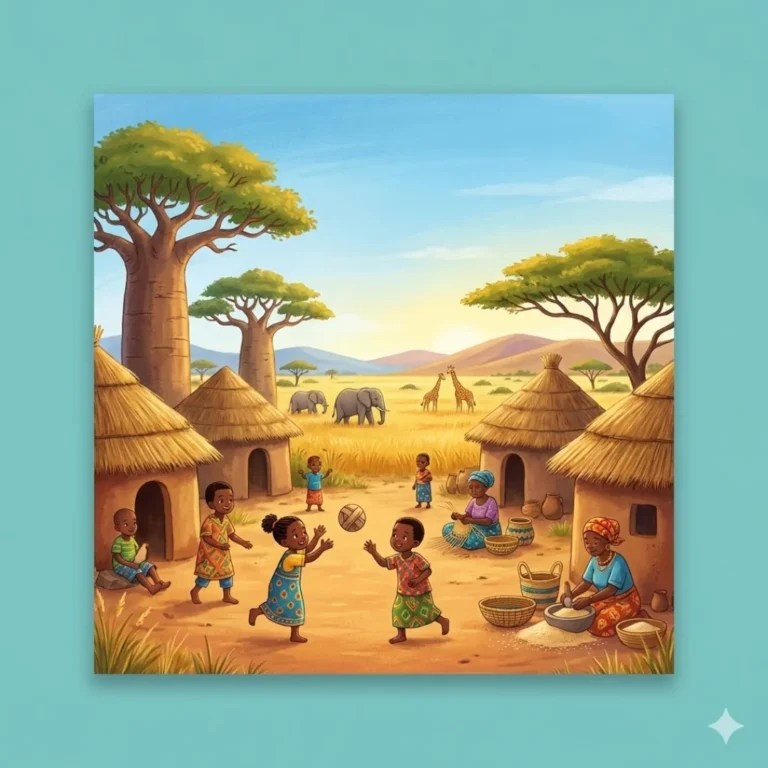
In the bustling village of Ile-Ife, where the red earth meets the green forest and the morning mist rises like smoke from the sacred groves, there lived a young boy named Adebayo. His name meant “the crown meets joy,” given to him by his parents in hopes of a bright future, but lately, there had been little joy in his heart. Adebayo was afraid of many things—the dark nights when the drummers played their mysterious rhythms in honor of the ancestors, the rushing river that separated his village from the next with its swift, dangerous currents, and most of all, the winding forest path where leopards were known to prowl among the ancient trees.
Life in Ile-Ife followed the rhythms that had been established for generations. The women wove beautiful cloth in the compound courtyards, their hands moving swiftly across the looms. The farmers tended fields of yams and cassava, the lifeblood of the community. The elders sat under the baobab tree, settling disputes and passing down wisdom/” title=”More stories about wisdom”>wisdom to those who would listen.
Every morning, Adebayo would walk to the village square where his father, Baba Ojo, carved beautiful masks and statues from iroko wood—the sacred tree that stood firm against storms and time itself. His father’s hands were skilled and sure, transforming rough wood into faces that seemed almost alive, ready to speak. The older boys would often gather there, and they would tease Adebayo mercilessly. “Look! There goes Adebayo, who jumps at his own shadow!” they would laugh, pointing and nudging each other. “Adebayo, the frightened one! Will you run from a butterfly next?” Adebayo’s cheeks would burn with shame, but he said nothing, keeping his eyes down as he hurried past.
His grandmother, Iya Agba, understood his struggle. She was ancient and wise, her face marked with the traditional scarification patterns of their people, her eyes still bright despite her many years. She would pat his shoulder gently when she saw him troubled. “My child,” she would say in her soft, melodious voice, “being afraid does not make you a coward. A coward is someone who knows what is right but refuses to do it out of fear. But you? You have a good heart. It is what you do with your fear that matters, not whether you feel it.”
One terrible day, news swept through Ile-Ife like wildfire: the sacred drum of the ancestors had been stolen! This was no ordinary drum. It was the heartbeat of the village, used in every ceremony, every celebration, every prayer to the orishas. Without it, the village would lose its connection to the spirits who protected them.
The elders gathered under the great baobab tree, their faces grave. Chief Adeyemi spoke in his deep voice, “The tracks lead into the forest, toward the leopard’s path. Someone must retrieve the drum before the moon changes, or our village will face great misfortune.”
The strongest warriors volunteered immediately. But one by one, they returned empty-handed, speaking of strange sounds in the forest, of glowing eyes in the darkness, and a terrible presence that filled them with dread. Even the bravest warrior, Jagun, came back trembling. “There is magic at work,” he said. “Dark magic that turns courage/” title=”More stories about courage”>courage into water.”
Adebayo listened to all this from behind his father’s workshop. His heart pounded like the very drum they had lost. He was terrified, of course. But something else stirred within him—something his grandmother’s words had planted long ago.
That evening, as the sun painted the sky orange and gold, Adebayo made a decision. He didn’t feel brave. His hands shook as he gathered a small cloth bag with some water and the protective amulet his grandmother had given him. His stomach felt like it was full of butterflies trying to escape. But he knew what he had to do.
He found Iya Agba sitting by her cooking fire, stirring a pot of pepper soup. “Grandmother,” he said quietly, “I am going to find the drum.”
Iya Agba looked at him for a long moment, her wise eyes seeming to see into his very soul. “You are afraid,” she stated simply.
“Yes, Grandmother. I am very afraid.”
“Good,” she said, surprising him. “Only a fool feels no fear. But tell me, why do you go if you are afraid?”
Adebayo thought carefully. “Because the village needs the drum. Because it is the right thing to do. Because… because maybe courage is not about not being afraid. Maybe it’s about doing what’s right even when you are afraid.”
Iya Agba smiled, her face crinkling with pride. She reached around her neck and removed a small cowrie shell necklace. “This belonged to your great-grandfather, who faced a real leopard to save his brother. Wear it. And remember—the orishas favor not the fearless, but the faithful.”
Adebayo set out as the first stars appeared, tiny points of light in the deepening blue sky. The forest path was darker than he had imagined, much darker. The canopy of trees blocked out most of the remaining light, and shadows seemed to move and shift around him. The path was full of strange sounds—rustling leaves that might be small animals or something larger, distant calls of night birds that sounded almost human, the whisper of wind through branches that seemed to carry words he couldn’t quite understand.
Every sound made him want to turn back. His legs felt weak, trembling with each step forward. His breathing came fast and shallow, his heart hammering against his ribs like it wanted to escape. Several times, he almost gave up, almost turned around to run back to the safety of the village.
“I can do this,” he whispered to himself, clutching the cowrie shell necklace. “I must do this. For my village. For my grandmother. For myself.”
The words became a rhythm he could walk to, matching his footsteps. One step. Then another. Then another. Each one a small victory over his fear.
Deeper into the forest he went, following the faint tracks the warriors had described, visible only when the moonlight broke through the trees. The air grew cooler, damper. Strange phosphorescent fungi glowed on tree trunks, casting an eerie green light. An owl hooted nearby, making him jump.
And then he heard it—a low, rumbling growl that seemed to come from the earth itself, vibrating through his bones and making his blood freeze in his veins. Yellow eyes appeared in the darkness ahead, catching the moonlight and reflecting it back like twin flames. A leopard! And not just any leopard—this was huge, magnificent, its spotted coat rippling with muscle and power.
But Adebayo noticed something strange. The leopard didn’t attack. It simply sat there, blocking the path, its tail swishing back and forth. And beyond it, Adebayo could see a faint glow—and hear the distant echo of the sacred drum!
“Please,” Adebayo said to the leopard, his voice shaking but respectful. “I must pass. My village needs that drum. I know you are powerful and I am small. I know you could harm me easily. But I must try.”
The leopard’s eyes seemed to soften. And then, to Adebayo’s amazement, it spoke! “Many warriors have come,” the leopard said in a voice like rumbling thunder. “All were strong. All claimed to be brave. But when I appeared, all ran away. You are small. You are afraid. I can smell your fear. Yet you stand here still. Tell me, small one, why do you not run?”
Adebayo’s legs trembled, but he stood his ground. “I am afraid,” he admitted. “But running away would not help my village. Sometimes we must do what is right even when we are afraid. My grandmother taught me that.”
The leopard regarded him silently, then slowly nodded. “Your grandmother is wise. I am no ordinary leopard, young one. I am an emissary of the orisha Ogun, guardian of warriors and truth. The drum was not stolen by thieves. It was taken by the spirits to test your village. To see if anyone possessed true courage—not the absence of fear, but the strength to act despite it. The warriors who came before had physical strength, but when faced with their fears, they fled. You are the first who has stood firm.”
The leopard stepped aside with fluid grace, its movements poetry in the moonlight. “Go and claim your drum, Adebayo. You have proven yourself worthy. Remember this night. Remember that courage is not the absence of fear—it is fear walking forward anyway. This is the lesson your village needed to learn, and you were brave enough to teach it.”
With trembling steps, Adebayo moved forward past the great cat, feeling the warmth radiating from its body, smelling the wild scent of the forest that clung to its fur. There, just ahead in a clearing blessed by moonlight that seemed to fall like silver rain, sat the sacred drum, glowing with spiritual energy—a soft, pulsing light that matched the rhythm of a heartbeat. The drum itself was beautiful, carved from a single piece of wood, decorated with the symbols of the ancestors, its surface worn smooth by generations of hands.
As soon as Adebayo touched it, the glow faded, and the drum became solid and real in his hands—heavy, substantial, proof that his journey had been real and not a dream. He turned to thank the leopard, but the magnificent creature had vanished as silently as smoke, leaving only paw prints in the soft earth that glowed faintly for a moment before fading away.
Adebayo carefully wrapped the drum in his cloth, securing it against his chest. Now came the journey back—and though he was still in the dark forest, though the path was still uncertain, he found that he was not as afraid as before. Something had changed inside him. The fear was still there, yes, but it felt smaller now, more manageable. He had faced it and walked through it, and he was still standing.
The journey back seemed shorter, though Adebayo’s arms ached from carrying the heavy drum. As he emerged from the forest at dawn, the entire village was awake and waiting. They had discovered his absence and feared the worst.
“Adebayo!” his father cried out, running to embrace him. “My son! You have the drum!”
The whole village erupted in celebration. Chief Adeyemi himself came forward. “Tell us, young Adebayo, how did you succeed where our greatest warriors failed?”
Adebayo thought of lying, of making himself sound braver than he felt. But he remembered the leopard’s words about truth. “I was afraid,” he said honestly. “Very afraid. But I went anyway, because it was the right thing to do. A magical leopard told me that is what true courage means—not the absence of fear, but doing what is right despite your fear.”
The warriors who had tried before hung their heads in shame. But Chief Adeyemi nodded approvingly. “The spirits have taught us all a valuable lesson through this young one. Courage is not about being fearless. It is about being faithful to what is right, even when you are afraid.”
From that day forward, Adebayo was known throughout Ile-Ife not as the boy who was afraid, but as the boy who was brave. But Adebayo knew the truth—he was still afraid of many things. The dark nights still made him nervous. The rushing river still seemed dangerous. But now he understood that being afraid was not the same as being a coward.
Years later, when Adebayo had children of his own, he would tell them this story. And he would show them the cowrie shell necklace that his great-grandmother had given him that night. “True courage,” he would say, “is not about never being afraid. It is about doing what is right even when you are afraid. The bravest person is not the one who fears nothing, but the one who fears much yet does what must be done.”
And in the village of Ile-Ife, the sacred drum still beats during ceremonies, its sound a reminder that sometimes the smallest and most frightened among us can teach the greatest lessons about courage.
Moral of the Story
True courage means doing what is right even when afraid
Frequently Asked Questions
What is the moral lesson of Adebayo and the Leopard’s Path – Yoruba Courage Story for Kids?
What age is this story appropriate for?
How long does it take to read Adebayo and the Leopard’s Path – Yoruba Courage Story for Kids?
What culture does this story come from?
Can I use this story for teaching?
Frequently Asked Questions
What is the story of Adebayo and the Leopard’s Path about?
Adebayo and the Leopard’s Path is a children’s moral story set in the Yoruba village of Ile-Ife. It follows a young boy named Adebayo who struggles with fear — of the dark, the river, and a forest path where leopards roam. The story explores how he finds courage and wisdom through his community and cultural traditions.
What does the name Adebayo mean?
The name Adebayo is a Yoruba name meaning ‘the crown meets joy.’ In the story, his parents chose this name hoping for a bright and joyful future for their son, making it especially meaningful as Adebayo works to overcome his fears throughout the tale.
What age group is Adebayo and the Leopard’s Path suitable for?
This story is suitable for children roughly aged 5 to 12. It uses gentle, descriptive language and relatable themes like overcoming fear and finding bravery, making it ideal for bedtime reading, classroom storytelling, or introducing kids to West African Yoruba culture and traditions.
📚 Recommended Books
Handpicked for readers like you
As an Amazon Associate, we earn from qualifying purchases. These recommendations are personalized based on this story's themes and your reading history.
Where is the village of Ile-Ife, and is it a real place?
Yes, Ile-Ife is a real city in Osun State, southwestern Nigeria. It is considered a sacred city in Yoruba culture, believed to be the origin of the Yoruba people. The story uses this authentic setting to ground its characters in rich cultural heritage and real traditions.
What moral lesson does Adebayo and the Leopard’s Path teach children?
The story teaches children that fear is natural but can be overcome with courage, community support, and wisdom passed down through generations. Drawing on Yoruba traditions and values, it encourages young readers to face their challenges rather than avoid them, showing that bravery often means taking that first step despite being afraid.
