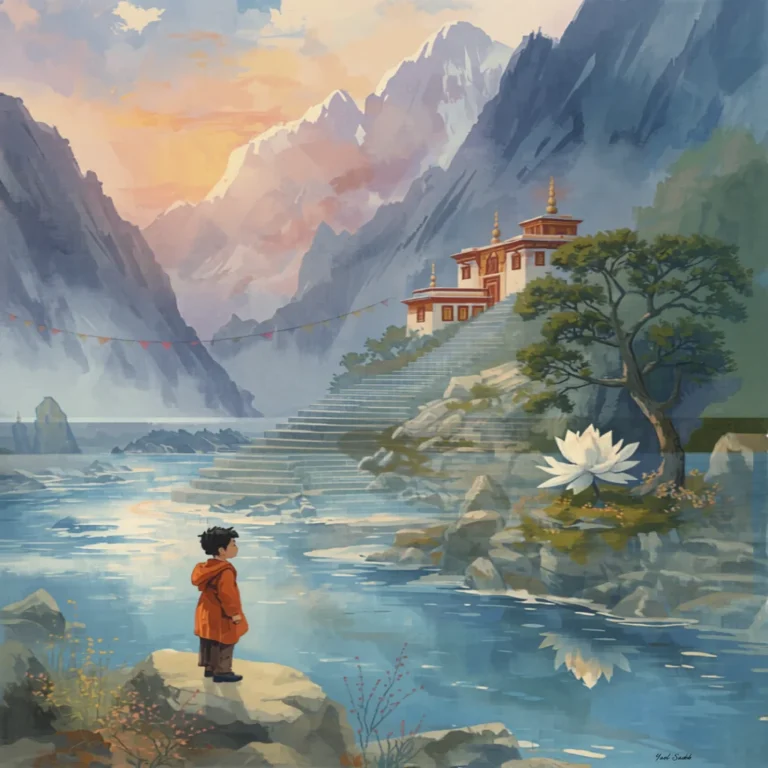
The Boy Who Spoke to Serpents
Every child in the village knew rivers sang — you could hear it at night if you pressed your ear to the cool mud of the bank, a low hum like a lullaby made of water and stones. Grandmothers told this as a bedtime story to settle restless kids: *the river sings because the Naga king sleeps below, and his dreaming makes the water flow.* But for seven days now, the song was gone. The water had slowed to a muddy trickle. The rice paddies cracked like old pottery. And nobody — not the monks in their saffron robes, not the village elders with their grey beards, not even the bravest farmer — would walk to the river's deep bend where the Naga was said to live.
Nobody except Tenzin.
He was nine years old and smaller than most kids his age. His sandals had a hole in the left one that let in pebbles. But he carried a bowl of rice and a single white lotus he'd found floating at the river's edge, still perfect, still alive, though everything around it was dying.
"You can't go," his older sister Pema said, grabbing his wrist. "The Naga will swallow you whole. He's angry. You can *feel* it."
She was right. The air near the river smelled sharp and electric, like lightning before it strikes — a smell that made your teeth ache and your legs want to run the other way.
"I know he's angry," Tenzin said. "That's exactly why someone should go."
He walked into the smell.
—
The deep bend of the river was a strange, still place. Willows trailed their fingers in the last of the water. Dragonflies hovered without moving, like they'd been painted on the air. And the river bottom — Tenzin could see it now, exposed and muddy where the water had pulled away — was scattered with something that made his stomach drop.
Small scales. Hundreds of them. Pale as moonlight.
Then the water exploded upward.
The Naga king rose like a thundercloud given shape — vast and dark, his hood spreading wide as the shadow of a storm, his scales shifting from green to black to deep, stormy purple. His eyes were twin lamps of gold. He smelled of rain and deep earth and something old, older than the mountain. The ground shook when he breathed.
Every part of Tenzin's body screamed *run.*
He stayed. His knees were shaking. He stayed anyway.
He set the rice bowl and the white lotus on a flat stone at the river's edge, pressed his palms together, and bowed.
The Naga was silent for a long moment.
"You are very small," the Naga said at last. His voice was like rocks rolling down a mountain, slow and enormous. "And you brought me *rice.*"
"And a lotus," Tenzin said. His voice only cracked a little. "I thought — you must be very tired. Being angry for seven days is exhausting. I know because I was angry once for three days and I could barely eat."
Another silence. This one felt different — softer around the edges.
"You're not afraid of me," the Naga said.
"I am," Tenzin admitted. "My knees are basically made of water right now. But I wanted to ask — what happened? The river elders say the Naga king only seals the water when something has been broken. Something true."
The great serpent lowered his hood, slowly, like a wave settling. When he spoke again, his golden eyes were not angry. They were something much harder to look at.
They were sad.
"A merchant came," the Naga said. "Three moons ago. He poured his waste — his dyes, his poisons — into my river. My children, my young ones, the little nagas who swam in the shallows near those very stones…" He looked at the pale scales on the riverbed. "They are gone. Changed. I cannot bring them back."
The air crackled. Tenzin felt it against his skin, hot and trembling.
"And no one came," the Naga continued. "Not one person from your village came to say — *this was wrong. We are sorry. We see what was lost.* So I closed the river. If you will not see my children, you will see nothing."
Tenzin looked at the pale scales scattered in the mud. He thought about how they must have caught the light once, flashing like tiny suns under the water.
"I see them now," he said quietly.
He walked carefully down to the riverbed — his left sandal immediately filled with mud, cold and squelching — and he picked up one of the pale scales. He held it carefully in both hands. It was light as a breath.
"I can't bring them back either," he said. "I'm just a kid with a holey sandal. But I can remember them. I can tell everyone in my village what happened here. The merchant was wrong. Your children mattered. They *matter.*"
This is the kind of story that mothers across that valley still tell for kids ages 6-12, tucking them in on hot summer nights when the river outside is singing again — *this is why we take care of what we're given.*
The Naga was very still.
Then he made a sound Tenzin had never heard from something so enormous — a sound like wind through a cracked door, or the last note of a song.
"You came alone," the Naga said.
"Yes."
"You were afraid."
"Yes."
"But you looked anyway. At the scales. At the truth." The great golden eyes blinked slowly, the way cats blink when they trust you. "That is rarer than you know, small one."
The ground rumbled. Deep beneath the mud, something shifted — something enormous turning over in its sleep. The trickle at the river's bend began to widen. The water darkened from brown to clear. The smell of lightning faded, replaced by something cool and green and alive.
The river began to sing again.
Tenzin stood in the middle of it, water rushing past his ankles, cold and perfect. He was still holding the small pale scale. He didn't put it down.
He carried it home in his pocket, and for the rest of his life it stayed on the shelf beside his sleeping mat — a small, pale, moonlight thing that reminded him of the difference between *seeing* something and truly *looking* at it, and of the enormous courage it sometimes takes to do nothing but stay, and speak the truth, and bow.
📚 Recommended Books
Handpicked for readers like you
As an Amazon Associate, we earn from qualifying purchases. These recommendations are personalized based on this story's themes and your reading history.