What Slept Beneath the Great River
The river had always sung. Every morning it gurgled and chattered over the smooth brown stones, and the fishermen cast their nets into its silver shimmer, and children splashed and shrieked at its edges. But on this morning — a Tuesday, which was already a suspicious sort of day — the river had gone quiet. Not just quiet. *Still.* As flat and silent as a sleeping eye.
"Something is Wrong," said Elder Kweku, who was very old and had seen many things, but had never seen *this.* He pressed his ear to the wet ground and shook his head slowly.
"What do you hear?" asked Amara.
"Nothing," said Elder Kweku. "And that is the loudest thing I have ever heard."
The elders argued all morning about who should go upstream to find out what had happened. They agreed it must be someone Brave. They agreed it must be someone Smart. They went on agreeing-without-doing until Amara, who was eight years old and had grown rather tired of all that, picked up her calabash and her father's old walking stick and simply walked north along the riverbank.
"Amara!" called her mother.
"I'll be back before the stars come out," said Amara, which was a Very Confident Thing to say for someone who had absolutely no idea what she was walking into.
—
The riverbank was strange without its sounds. Normally, frogs shouted opinions at each other from the reeds, and kingfishers dove like small blue arrows. Now the reeds stood still. The mud smelled rich and dark, like secrets. A lone egret watched Amara walk past with one yellow eye, as if it had been expecting her.
She walked until she found Old Senu.
Old Senu was the village's most famous fisherman, and right now he was sitting on a rock looking extremely embarrassed, which was unusual for someone so famous.
"What's wrong?" asked Amara.
"Nothing," said Old Senu.
"Then why are you sitting by a river that isn't moving, looking like you swallowed a fish sideways?"
Old Senu was quiet for a long time. Then, very quietly, he said, "I dropped the Ritual Drum. The one we play for Osun every planting season. It sank to the bottom right there." He pointed at a deep, dark pool in the bend of the river. "I was afraid to tell anyone."
Amara looked at the pool. It was very deep. It was also very dark. But the kinds of stories worth telling — the real ones, the ones that matter for kids ages 6-12 — always know that the things most worth doing are almost always the slightly scary ones.
She handed Old Senu her walking stick.
"Hold this," she said.
Then she took three deep breaths, ran three steps, and jumped.
The water was cold — the kind of cold that grabs you everywhere at once and shouts. It tasted of clay and green, living things. She opened her eyes and the world turned murky brown, with shafts of weak gold light filtering down like long, curious fingers. And there, at the very bottom, half-buried in silt, was the drum. Its carvings glowed faintly — the spiral patterns of Osun's sacred waters, made by hands far older than anyone alive.
Amara grabbed it and kicked hard for the surface.
She came up gasping and triumphant.
Old Senu helped pull her out, and when she placed the drum in his hands, he held it like something precious and broken. His eyes were wet. "Thank you," he said, in the smallest voice a famous fisherman had ever used.
"You should tell the truth next time," said Amara, wringing river water from her braids. "It's much lighter than carrying a secret."
—
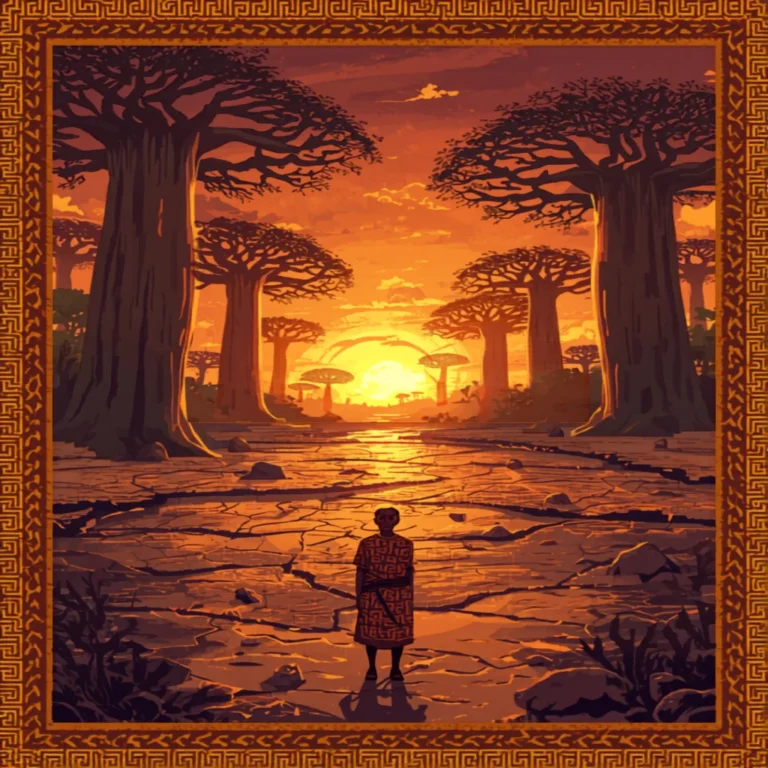
She walked further north, where the forest crowded close to the bank, until she found a woman resting in the shade of a great baobab tree. The baobab was enormous — its trunk as wide as three houses side by side, its branches twisted up toward the sky like arms asking questions. Everyone knew the baobab held the old wisdom in its roots, the kind that had been growing for a thousand years.
The woman was thin and very tired, and she was trying to crack a nut with a stone that was clearly too small for the job.
Amara sat down beside her without being asked. She found a better stone. She helped.
They worked quietly together until the nut opened and gave up its sweet, oily insides. The woman offered Amara half. Amara took only a small piece, though she was quite hungry from all the walking and the jumping and the river.
"You are generous," said the woman.
"The nut is yours," said Amara simply.
"Everything given in kindness," said the woman, "comes back to the giver like water returning to the river."
She smiled then, and her smile was — well. It was the kind of smile you only see once in your whole life, if you're lucky. Like sunlight moving on deep water. Amara had a Strong Feeling, then, that this woman was not entirely what she appeared to be.
—
The pool at the very top of the river's source was perfectly circular and ringed with white flowering reeds that swayed even though there was no wind. When Amara stepped to its edge, something rose up from the center. Not frightening — more like the feeling just before rain, when the air goes heavy and sweet and full of Expectation.
A voice said: "Why have you come?"
Amara thought carefully. She could say: *To fix the river.* She could say: *Because the village needs water.* Both were true. But they weren't the Truest Thing.
"Because it felt wrong to stay home," she said.
The water rippled. Warm. The sound of it — that old familiar gurgling song — started first at the edges, then moved inward, then rushed and chattered and laughed all the way downstream, past the baobab tree, past the dark pool, past the reeds where the frogs immediately began shouting their opinions again.
The River Osun was flowing.
—
Amara made it back before the stars came out. Just barely. Elder Kweku was waiting at the edge of the village, his old eyes bright.
"What did you find?" he asked.
"A fisherman who needed help," said Amara. "An old woman who needed company. And a very good reason to jump into cold water."
Elder Kweku laughed — a big, genuine laugh that rattled all his beads. "That," he said, "is exactly the sort of answer that changes things."
And the river sang all night.
📚 Recommended Books
Handpicked for readers like you
As an Amazon Associate, we earn from qualifying purchases. These recommendations are personalized based on this story's themes and your reading history.