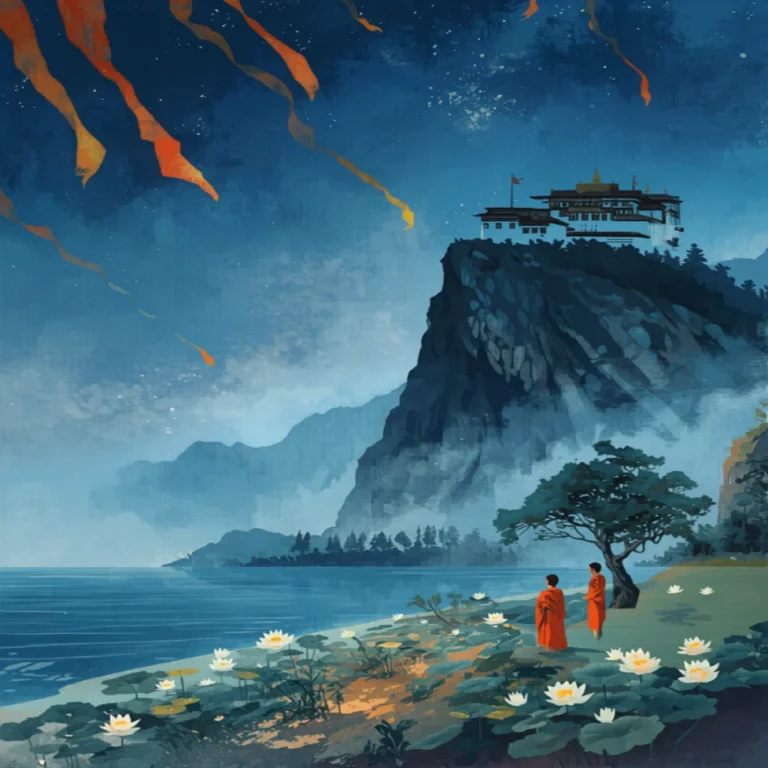
The Boy Who Woke the Sleeping River
—
In the village of Varana, the river Kalinda had sung to the hills for a thousand years. Its water smelled of cold stones and rain and something else — something old and green that nobody had a word for. Children played in its shallows. Rice farmers guided its flow through channels in the mud. Old grandmothers said the river was alive, truly alive, the way mountains are alive — slowly, deeply, and with a long memory.
Then one morning, the singing stopped.
Siddha was eight years old when he came to fill his jar before sunrise and found only cracked mud and silence where the river had been. The air still smelled of jasmine. A heron stood in the empty riverbed, looking just as confused as Siddha felt.
"Where did you go?" he whispered to the air.
The heron blinked at him, then flew away.
By noon, the elders of Varana had gathered under the great fig tree at the center of the village. They argued in the heat, their voices tangling like rope.
"We must make offerings," said one. "We must dig deeper wells," said another. "It is a curse," said a third, and people murmured and nodded.
Siddha sat at the edge of the group and listened. He was small enough that adults often forgot he was there. He was also, his teacher at the monastery once told him, the best listener in the village — which is a rarer gift than most people realize.
That night, Siddha lay on his sleeping mat and stared at the stars through his window. He thought about water. He thought about where rivers come from. And just before he fell asleep, he remembered something the old monk Ananda had told him once: *When something precious disappears, look for what was hurt.*
He got up, lit a small candle, and walked toward the riverbed in the dark.
—
The dried river looked strange by candlelight — a long silver scar of mud cutting through the black earth. Siddha followed it upstream, past the mango trees, past the stone shrine draped in orange marigolds. The smell of flowers mixed with the dry smell of dust. His feet were cold. His shadow stretched long and wobbly behind him.
He walked for a long time.
Then he heard it — a sound like a very large creature breathing. Slow. Unhappy. Almost like crying.
At the source of the Kalinda, where smooth boulders stood at the foot of the hills, something enormous lay coiled in the shadows. Siddha held up his candle.
It was a naga.
In the old stories — the ones monks told in the cool halls of the monastery, the ones that this story belongs to, for kids who love a mystery that goes all the way down to the roots of things — nagas were serpent spirits older than memory. They guarded rivers and lakes, moved between the human world and the hidden world beneath the water. This one was immense, its scales the color of deep water at night, shimmering faintly even in darkness. It was coiled around the mouth of the spring where the Kalinda was born, blocking the water completely.
And it was wounded.
One of its great coils was twisted up in a tangle of broken rope and rusted metal — a trap someone had set. The more it had struggled, the tighter it had become.
Siddha's heart beat very fast. He could run. Any sensible child would run.
The naga's eyes opened — two golden lamps in the dark — and looked directly at him.
"Child," the naga said. Its voice was like water moving over smooth stones. "Why are you here?"
"I followed the river," Siddha said. "Or — where the river used to be."
"And you are not afraid?"
Siddha thought about this honestly. "I'm afraid," he admitted. "But you're in pain. I can see it."
The naga was quiet for a moment. Around them, the night hummed with crickets and the smell of cool earth.
"Many have come to this place," the naga said slowly. "Some threw stones. Some ran. None have stayed."
"Can I help?" Siddha asked.
He set his candle on a rock and moved toward the tangle of rope and metal. Up close, he could smell something sharp and old, and feel the warmth rising off the naga's enormous body — warm as sun-baked stone. His fingers were small, which turned out to be exactly the right size for this kind of work. He loosened one knot, then another, then another, trying not to pull too hard or move too fast, talking softly the whole time.
"My teacher says every living thing wants to be free from pain," Siddha murmured as he worked. "He says that's the thing we all share."
"Your teacher is wise," the naga said.
"He also snores very loudly," Siddha said, "which I don't think is very wise."
The naga made a sound that might have been laughter — like water tumbling over a small waterfall.
Then the last piece of metal came free.
The naga uncoiled slowly, stretching its vast length across the boulders with a sound like a long, deep sigh. It lifted its great head and looked at Siddha — *really* looked at him, the way very old beings sometimes look at very young ones, like they're seeing something small and bright and impossibly valuable.
"What is your name?" it asked.
"Siddha."
"Siddha." The naga let the name sit in the air for a moment. "You came into the dark with only a candle. You spoke the truth about your fear. You used your hands for kindness. These are the three things the Bodhi tree was rooted in, once, long ago, when the whole world changed."
Siddha didn't fully understand this. But he *felt* it — somewhere underneath his ribs, warm and solid, like a stone that has been sitting in sunlight all day.
The naga slid silently beneath the rocks at the spring's mouth. And a moment later, Siddha heard the most wonderful sound in the world.
Water.
It came first as a trickle, then a gurgle, then a rushing, laughing rush of cold clean river — smelling of stones and rain and that old green thing no one had ever found a word for. The Kalinda was back, tumbling over his feet, cold and singing and alive.
Siddha sat on a rock until the sky turned pink. Then he picked up his candle — burnt down to almost nothing — and walked home through the waking village, past the mango trees, past the marigold shrine.
He never told anyone what he'd seen.
Some things, he thought, belong to the river.
📚 Recommended Books
Handpicked for readers like you
As an Amazon Associate, we earn from qualifying purchases. These recommendations are personalized based on this story's themes and your reading history.