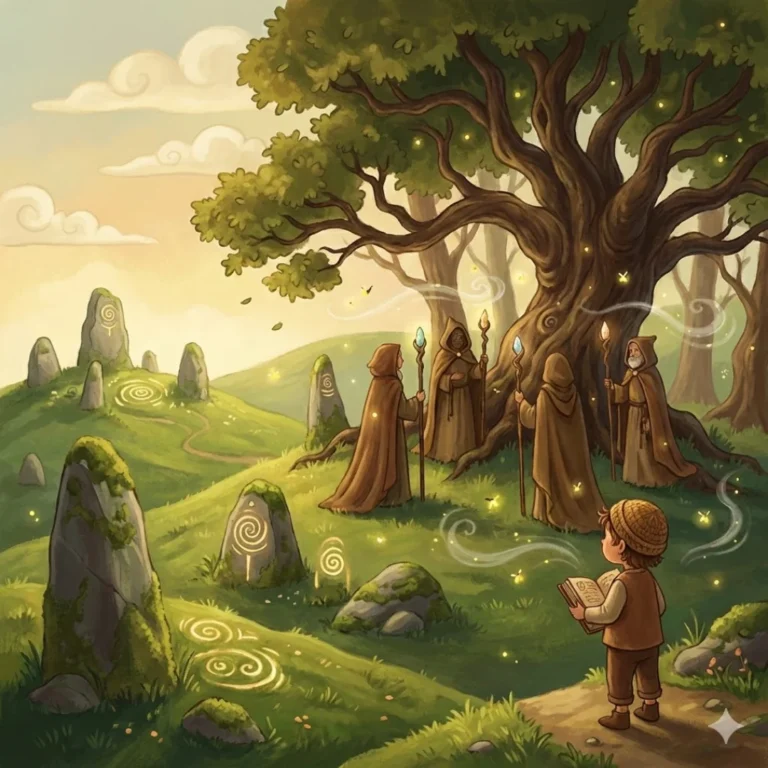
In the green hills of Ireland, where the hawthorn blooms white and the streams run silver over ancient stones, there lived a young harpist named Finn. His music was so beautiful that when he played, the birds would stop their singing to listen, the wind would pause in the trees, and even the rain would fall more gently, as if not to disturb the melody.
Finn lived in a small cottage at the edge of a forest with his mother, who had been ill for many years. Though they had little in the way of worldly goods, they had each other, and they had Finn’s music, which filled their humble home with beauty and hope.
Every day, Finn would play his harp beside his mother’s bed, and the music would ease her pain and bring color to her pale cheeks. “Your music is the light in my darkness,” she would say. “It keeps me going when all else fails.”
Finn’s harp was his most precious possession. It had belonged to his father, who had died when Finn was just a baby, and it was said to have been carved from the wood of a rowan tree that grew near a sacred well. The harp had a voice unlike any other instrument – clear as a mountain stream, warm as a hearth fire, and sweet as the first flowers of spring.
One day, a traveling merchant came through the village and heard Finn playing in the market square, where he sometimes performed for pennies. The merchant was so moved by the music that he stood transfixed, tears streaming down his weathered face.
“Young man,” the merchant said when the song ended, “I have traveled the length and breadth of Ireland, and I have never heard music like yours. Your harp is extraordinary. I will give you one hundred gold pieces for it – more money than you’ve likely seen in your lifetime.”
One hundred gold pieces! It was a fortune. With that money, Finn could hire the best physicians for his mother. He could buy medicine, good food, a warm new cottage. He could give his mother comfort in her last years.
But the thought of parting with his father’s harp, the instrument that brought his mother such joy, made Finn’s heart ache. He shook his head. “I’m sorry, sir. The harp is not for sale.”
The merchant shrugged and went on his way, but Finn stood in the market square for a long time after, thinking.
That evening, as Finn played for his mother, he watched her face relax into peaceful sleep. The music was medicine to her, he knew. But it was also all he could give her. What good was beautiful music when she needed real medicine? What good was his father’s harp when his mother was suffering?
In the days that followed, his mother grew worse. The village healer came and shook her head gravely. “There is a physician in the city who might be able to help her,” she said, “but his services are expensive. I fear it is beyond your means.”
Finn inquired and learned that the physician would charge… one hundred gold pieces.
The exact amount the merchant had offered for the harp.
That night, Finn sat by the dying fire and faced the hardest decision of his young life. His harp was not just an instrument – it was his connection to the father he’d never known, his livelihood, his joy, his very voice in the world. Without it, he would be like a bird without wings, a river without water.
But his mother needed him. She who had raised him alone, worked her fingers raw to feed him, sang to him when he was frightened, and loved him with every breath she took.
True love, Finn realized, means putting others first, even when it costs you everything.
Before dawn, Finn took his father’s harp in his arms. He played one last song, pouring all his love and sorrow into the music. The melody drifted through the cottage like morning mist, gentle and bittersweet.
Then he kissed his sleeping mother’s forehead, wrapped the harp carefully in cloth, and set out to find the merchant.
It took three days of walking before Finn caught up with the merchant’s caravan on the road to Cork. When he explained why he had come, the merchant examined the harp carefully and counted out one hundred gold pieces.
“Are you certain?” the merchant asked, seeing the tears in Finn’s eyes. “I can see what this instrument means to you.”
“I’m certain,” Finn said, though his voice shook. “My mother’s life means more to me than anything in this world.”
The merchant nodded with respect and gave Finn a blessing for his journey home.
Finn used the gold to bring the physician from the city. The learned doctor examined Finn’s mother, provided her with medicine and treatment, and within weeks, her health began to improve. Color returned to her cheeks. Strength returned to her limbs. The terrible cough that had plagued her eased.
But though Finn rejoiced to see his mother recovering, there was a sadness in him that wouldn’t lift. He had no harp now. He couldn’t play the music that had always been his solace and his gift. His hands felt empty. His heart felt silent.
His mother noticed, of course. “Where is your father’s harp, my son?” she asked one day when she was well enough to sit up.
Finn couldn’t lie to her. He told her everything: about the merchant’s offer, about selling the harp to pay for her treatment, about the choice he had made.
His mother wept when she heard the story. “Oh, my dear boy,” she said, holding him close. “You should not have done this. The harp was your father’s legacy to you. It was your future, your joy.”
“You are my joy,” Finn said simply. “Music is beautiful, Mother, but love is more beautiful still. I would give up a thousand harps to see you well.”
His mother held him tighter, and they cried together – she for the sacrifice he had made, and he for the love that had made the sacrifice worthwhile.
Weeks passed. Finn’s mother continued to grow stronger, and Finn found work helping the village blacksmith. The work was honest but hard, and his hands that had once created music now hammered iron. He tried not to think about what he had lost, tried to be content with what he had saved.
One evening, as the sun was setting and painting the hills gold, there came a knock at the cottage door. When Finn opened it, he found a stranger standing there – a tall man with silver hair and eyes like deep forest pools.
“Are you Finn, the harpist?” the stranger asked.
“I was,” Finn said quietly. “I have no harp now.”
“I know,” the stranger said. “I am Oran, harper to the High King. I bought your father’s harp from a merchant, thinking to add it to my collection. But when I tried to play it, it would not sing for me. The strings made sound, but they made no music. It was as if the harp itself was mourning.”
He held out a cloth-wrapped bundle. “I have traveled a long way to return this to you. A harp like this belongs with someone who understands true sacrifice and True love. It should belong to someone worthy of its magic.”
Finn unwrapped the bundle with shaking hands. There was his father’s harp, as beautiful as ever. He plucked a string gently, and the note that rang out was so pure, so perfect, so filled with joy that it seemed to make the very air shimmer.
“I can’t accept this,” Finn said, though everything in him yearned to take the harp back into his arms. “I sold it fairly. The merchant paid me for it.”
“The merchant sold it to me,” Oran said with a smile. “And I am giving it to you. But I offer more than just the return of your harp. The High King is looking for a harper to play in his hall. If you wish it, the position is yours. It comes with a fine salary, a cottage for you and your mother near the castle, and the honor of playing for the greatest court in all of Ireland.”
Finn could scarcely believe what he was hearing. “But why? Why would you do this for me?”
Oran’s eyes were kind. “Because true love is rare in this world, and when we find it, we should honor it. You gave up what you loved most to save your mother. That act of sacrifice has made you worthy of gifts beyond measure. The Sidhe themselves have taken notice of you, Finn. They whisper that you have a heart of gold, and such hearts should never go unrewarded.”
He placed the harp in Finn’s hands. “Take it. Play for your mother. Then, when she is fully recovered, come to the High King’s hall and play for all of Ireland. Let your music remind people that love and sacrifice are the most beautiful melodies of all.”
And with that, the silver-haired stranger bowed and disappeared into the twilight, leaving Finn standing in the doorway with tears streaming down his face and his father’s harp cradled in his arms.
Finn ran to his mother’s bedside and played for her. The music that poured from the harp that evening was the most beautiful he had ever created, for it was music born of sacrifice, tempered by loss, and returned through grace. It spoke of love deeper than any ocean, of devotion stronger than any steel, of the truth that giving up what we treasure most for those we love is the greatest magic in the world.
His mother wept as she listened, and when the song ended, she said, “Your father would be so proud of you, my son. You have learned the lesson that took him a lifetime to understand: that true love means putting others first, that the greatest gift we can give is ourselves, that sacrifice made with an open heart is never truly loss.”
In time, Finn and his mother moved to the cottage near the High King’s hall, and Finn became the most celebrated harper in all of Ireland. But he never forgot the lesson he had learned. And whenever he played, his music carried the story of the choice he had made: to put love before possession, others before self, sacrifice before comfort.
People would come from miles around to hear him play, and they would leave changed, carrying in their hearts the reminder that true love – whether for family, friends, or even strangers – asks us to give, not to take; to serve, not to be served; to put others’ needs before our own desires.
And on quiet evenings, when Finn played alone in the cottage with his mother resting peacefully nearby, he would sometimes see, just at the edge of his vision, a figure with silver hair standing in the shadows, listening with a smile. The Sidhe had blessed him for his sacrifice, and that blessing would remain with him all his days.
For this is the truth that Finn’s music taught to all who heard it: True love means putting others first, even when it costs us what we treasure most. And when we make such sacrifices with willing hearts, we discover that we haven’t lost anything at all – we’ve simply transformed it into something greater: the unbreakable bond of love that connects all generous souls, the music that plays on long after the last note has faded into silence.
Frequently Asked Questions
What is the moral lesson of The Harpist’s Gift – A Celtic Love and Sacrifice Story for Kids?
What age is this story appropriate for?
How long does it take to read The Harpist’s Gift – A Celtic Love and Sacrifice Story for Kids?
What culture does this story come from?
Can I use this story for teaching?
Frequently Asked Questions
What is The Harpist’s Gift story about?
The Harpist’s Gift is an Irish folk-style story about a young harpist named Finn who cares for his ill mother using the power of his music. Set in the green hills of Ireland, it explores themes of love, sacrifice, generosity, and the healing power of art and music.
What is the moral lesson in The Harpist’s Gift?
The Harpist’s Gift teaches children that true generosity means sharing your most precious gifts with others, even at personal cost. It also shows how music and kindness can heal and bring hope to people who are suffering, making it a powerful story about selflessness and compassion.
Is The Harpist’s Gift a good story for kids?
Yes, The Harpist’s Gift is ideal for children of all ages. It uses gentle, imaginative language rooted in Irish folklore tradition, making it easy to understand and emotionally engaging. Parents and teachers can use it to spark conversations about kindness, family love, and the value of sharing your talents.
📚 Recommended Books
Handpicked for readers like you
As an Amazon Associate, we earn from qualifying purchases. These recommendations are personalized based on this story's themes and your reading history.
Where does The Harpist’s Gift take place?
The story is set in the green hills of Ireland, featuring classic Irish countryside imagery like blooming hawthorn, silver streams, and ancient stones. This rich Celtic backdrop gives the tale a timeless, magical quality rooted in Irish folklore and storytelling tradition.
What is special about Finn’s harp in The Harpist’s Gift?
Finn’s harp is carved from rowan wood grown near a sacred well, giving it a uniquely beautiful voice described as clear as a mountain stream and warm as a hearth fire. It belonged to his late father, making it both emotionally and spiritually precious — central to the story’s meaning.