

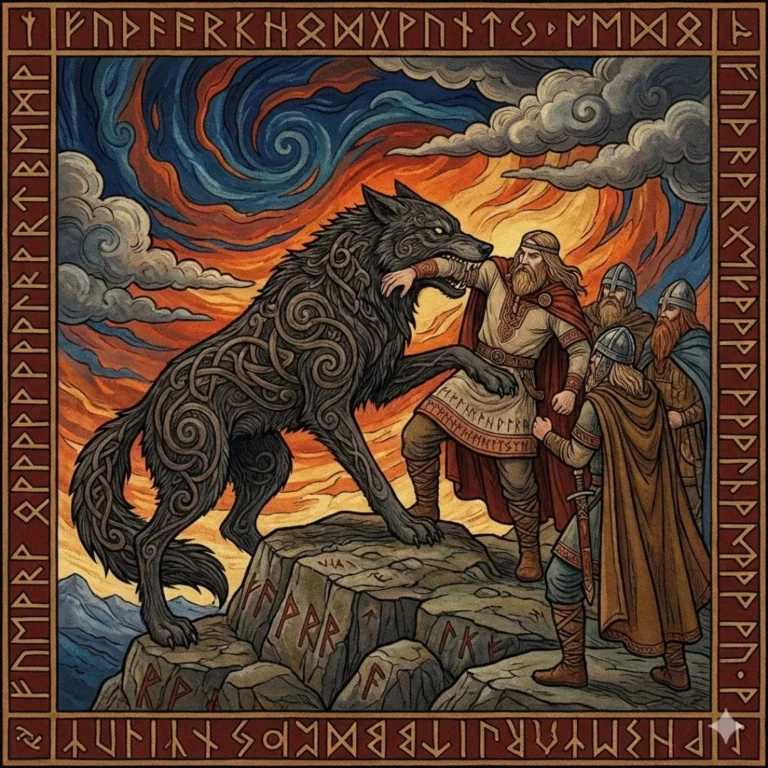
Long ago, in the frozen lands where the Northern Lights dance and the winter lasts half the year, there lived a girl named Sigrid. She was the youngest daughter of a fisherman in a small village on the edge of a great fjord, where the mountains rose like giants from the sea and the ice glittered under the pale sun.
Sigrid had a dream that everyone told her was impossible.
She wanted to sail beyond the edge of the known world, to discover what lay in the far western sea where the sun set each evening. The skalds sang of a land across the ocean, a place of green valleys and plentiful fish, but no one from her village had ever found it. Many had tried. None had returned.
“It’s a story for children,” her eldest brother Bjorn would say, laughing. “There is no land beyond the western sea. Only ice and death.”
“You’re too young,” her mother would add, stroking Sigrid’s golden hair. “Too small. Too weak to survive such a journey.”
“You’re a girl,” the village men would say dismissively. “Women don’t sail to the edge of the world. They stay home and weave and tend the fires.”
But Sigrid’s dream burned brighter than any fire. At night, she would climb to the highest point of the village and look westward, imagining the green land that might lie beyond the horizon. She could see it in her mind as clearly as if she’d already been there: valleys filled with grass, rivers teeming with salmon, forests where deer grazed peacefully.
“I know it’s there,” she would whisper to the stars. “I can feel it in my bones. I will find it.”
But knowing in your heart and making others believe are two different things entirely.
One winter evening, as the aurora painted the sky in ribbons of green and purple, an old woman came to the village. She was a völva, a seer, one who walked between the worlds and spoke with the spirits. The villagers welcomed her with feasts and gifts, for it was a great honor to host such a wise one.
During the feast, the völva looked across the hall and her eyes met Sigrid’s. “You,” she said, her voice cutting through the din of conversation. “Child with the westward eyes. Come here.”
Sigrid approached nervously. The völva took her hand and studied her palm, her face, her eyes. She was silent for a long moment.
“You carry a dream that others call impossible,” the völva said finally. “I see it burning in you like a coal that will not go cold.”
“Yes,” Sigrid whispered. “But everyone says I’m foolish. Everyone says it cannot be done.”
The völva smiled, her ancient face creasing like old leather. “Sigrid, daughter of fishermen, listen well. In my long life, I have learned this truth: every great deed was once called impossible. Every hero was once called a fool. The difference between the heroes and the fools is simple – the heroes believed when no one else did, and they kept walking their path even when everyone else turned back.”
She released Sigrid’s hand. “The land you dream of exists. I have seen it in my visions. But the journey to reach it will test you in ways you cannot imagine. You will face ice and storm, doubt and fear, hunger and exhaustion. The voyage will demand everything you have and more. Many will try to stop you. Your greatest enemy will not be the sea or the cold, but the voice inside yourself that whispers, ‘They were right. I cannot do this. I should turn back.’”
The völva’s eyes burned into Sigrid’s. “Do you have the faith to continue when all evidence says you should quit? Do you have the belief in yourself to sail on when the entire world tells you to turn around?”
Sigrid felt something crystallize inside her, like water freezing into ice. “I do,” she said firmly. “I will find the western land. I will prove it exists.”
“Then I will give you this,” the völva said, and she placed around Sigrid’s neck a small pendant carved from whale bone. It was shaped like a ship with a bird flying above it. “This is not magic that will protect you from storms or calm the seas. This is magic of a different kind: it is a reminder. When you doubt, when you fear, when you want to give up, hold this and remember that you believed in yourself when no one else did. Let that belief be your North Star.”
From that night on, Sigrid began preparing for her journey. She learned everything she could about sailing and navigation. She watched the stars and memorized their patterns. She learned which birds flew far from land and which stayed near shore. She studied the color of the water, the shape of the waves, the smell of the wind.
Her family thought she would grow out of this obsession, but Sigrid’s dedication never wavered. For three years, she prepared.
When Sigrid was fifteen, she announced she was ready to sail.
Her family tried to stop her. The villagers said she was mad. Even the jarl who ruled the region told her, “You will die in the western sea, girl. Don’t throw your life away on a child’s dream.”
But Sigrid had learned to believe in herself more than she believed in others’ doubts.
She found a small boat, one that others had discarded as too damaged to be useful. She repaired it with her own hands, caulking every seam, checking every plank. She gathered provisions: dried fish, water, warm furs. She prepared for every contingency she could imagine.
On a morning when the ice was just beginning to break up, Sigrid loaded her boat and prepared to sail. The entire village came to watch, some to say goodbye, others to see what they were certain would be her foolish death.
Her mother wept. Her brothers begged her to stay. But Sigrid climbed into her small boat, raised her small sail, and pushed off from the shore.
“I believe in the dream!” she called back to them. “And I believe in myself! That is enough!”
The journey that followed was harder than anything Sigrid had imagined. For days, she sailed west across empty ocean, seeing nothing but water in all directions. Storms battered her tiny boat. Waves taller than houses threatened to swallow her whole. Ice formed on her rigging, making the boat heavy and slow.
And always, there was the voice of doubt.
When the storms raged, the voice said, “Turn back. You’ll die out here alone.”
When the provisions ran low, the voice said, “There is no land ahead. Only more empty ocean.”
When the cold bit through her furs and made her fingers numb, the voice said, “Your family was right. You were a fool to come.”
Each time, Sigrid would touch the whale-bone pendant around her neck and remember the völva’s words: “Your greatest enemy will be the voice inside yourself that whispers, ‘I cannot do this.’”
And each time, she would say aloud, into the wind and the waves, “I believe in the dream. I believe in myself. I will continue.”
On the fourteenth day, when her water was nearly gone and her strength was failing, Sigrid saw birds. Not the gulls that stayed near shore, but land birds – a type she’d never seen before – flying from the west.
“Land,” she whispered, hardly daring to hope. “There must be land ahead.”
She sailed on, and the next day, through the morning mist, she saw it: a coastline. Green hills rising from the sea. Trees – actual trees, not just the scraggly pines of her frozen homeland, but lush forests. Rivers emptying into bays filled with fish.
The western land. The impossible dream. The place everyone said didn’t exist.
Sigrid laughed and cried at the same time, so overcome with joy and relief that she could barely steer her boat to shore.
When she landed on the beach, her legs shook so badly she could barely stand. But she knelt and placed her hands on the earth – the real, solid, green earth of the land she had sailed across the world to find.
“I believed,” she whispered. “When no one else did, I believed. And belief was enough.”
Sigrid explored the new land for many weeks, mapping its coasts, discovering its resources, meeting the people who lived there. Then she loaded her boat with samples – plants, wood, even a small animal – and sailed home.
The return journey was easier. She knew the way now. She knew the currents and the landmarks. She knew she could do it because she had already done it.
When Sigrid’s small boat appeared in the fjord, the villagers could hardly believe their eyes. Many had held funeral rites for her, certain she had died.
But here she was, alive and triumphant, carrying proof of the land beyond the western sea.
Her brothers stared in amazement. The jarl bowed his head in respect. Her mother embraced her with tears of joy and relief.
“You were right,” they said. “The land exists. You found it.”
But Sigrid shook her head. “No. I didn’t find the land. I found something more important. I found faith in myself. The land was always there, waiting. But I had to believe I could reach it before I could actually do so. Belief came first. Discovery came second.”
The völva, who had waited in the village for Sigrid’s return, smiled knowingly. “And now others will follow your path,” she said. “Because you believed when no one else did, you have made the impossible into the possible.”
And it was true. Following Sigrid’s maps and instructions, other boats sailed west and founded settlements in the new land. Within a generation, there was a thriving community in the place that had once been called impossible.
But Sigrid’s greatest legacy was not the discovery itself. It was the lesson she taught: that belief in yourself is the first step to achieving any dream, no matter how impossible it seems.
Years later, when Sigrid was old and famous, young people would come to her and ask, “How did you do it? How did you accomplish the impossible?”
And Sigrid would touch the whale-bone pendant she still wore around her neck and say, “The journey of a thousand miles begins with a single step. But before that step comes belief. You must believe the journey is possible. You must believe you are capable of making it. You must believe in your dream strongly enough to sustain you when everyone else calls you a fool.”
She would look into their young, hopeful faces and add, “You will face storms. You will face doubt. You will face people who tell you to turn back, to give up, to accept that your dream is impossible. Your greatest test will not come from the outside world but from inside yourself, from the voice that says, ‘I cannot do this.’”
“But if you hold tight to your belief, if you keep your faith in yourself and your dream, if you take one more stroke of the oar, one more step forward, one more breath of courage when all seems lost – then you will discover what I discovered: that impossible is just a word people use to describe things they don’t have the faith to attempt.”
“Believe in yourself,” Sigrid would tell them, “and your dreams will guide you to shores you never imagined existed.”
And that, dear children, is the truth that Sigrid sailed across the ocean to prove: Faith in yourself can carry you across any sea, through any storm, to any shore. Believe in your dreams, and they will become as real as the land beneath your feet.
Moral of the Story
Believe in yourself and your dreams
Frequently Asked Questions
What is the moral lesson of Sigrid’s Impossible Dream – A Norse Faith Story for Kids?
What age is this story appropriate for?
How long does it take to read Sigrid’s Impossible Dream – A Norse Faith Story for Kids?
What culture does this story come from?
Can I use this story for teaching?
Frequently Asked Questions
What is Sigrid’s Impossible Dream about?
Sigrid’s Impossible Dream is a Norse-inspired story about a young fisherman’s daughter named Sigrid who dreams of sailing beyond the known world to discover a legendary land across the western sea. Despite being told her dream is impossible because of her age, size, and gender, Sigrid refuses to give up on her extraordinary goal.
What is the moral lesson in Sigrid’s Impossible Dream?
The story teaches children that so-called impossible dreams are worth pursuing despite doubt and discouragement from others. It encourages resilience, self-belief, and courage — especially when society’s expectations try to limit what you can achieve based on who you are.
Is Sigrid’s Impossible Dream suitable for young kids?
Yes, Sigrid’s Impossible Dream is written for children and uses simple, engaging language. Its Norse setting, adventurous plot, and relatable underdog heroine make it enjoyable for kids aged roughly 6 to 12, while its themes of perseverance also resonate with older readers.
📚 Recommended Books
Handpicked for readers like you
As an Amazon Associate, we earn from qualifying purchases. These recommendations are personalized based on this story's themes and your reading history.
Where does Sigrid’s story take place?
Sigrid’s story is set in a fictional frozen Norse landscape featuring fjords, mountains, and the Northern Lights. The setting draws heavily from Scandinavian mythology and Viking-age culture, giving the tale an epic, wintry atmosphere reminiscent of classic Norse folk stories.
What challenges does Sigrid face in pursuing her impossible dream?
Sigrid faces discouragement from nearly everyone around her — her brother dismisses her dream as a children’s tale, her mother calls her too young and weak, and village men tell her women don’t sail. Her biggest challenge is pushing past these social barriers and self-doubt to chase her vision.
