

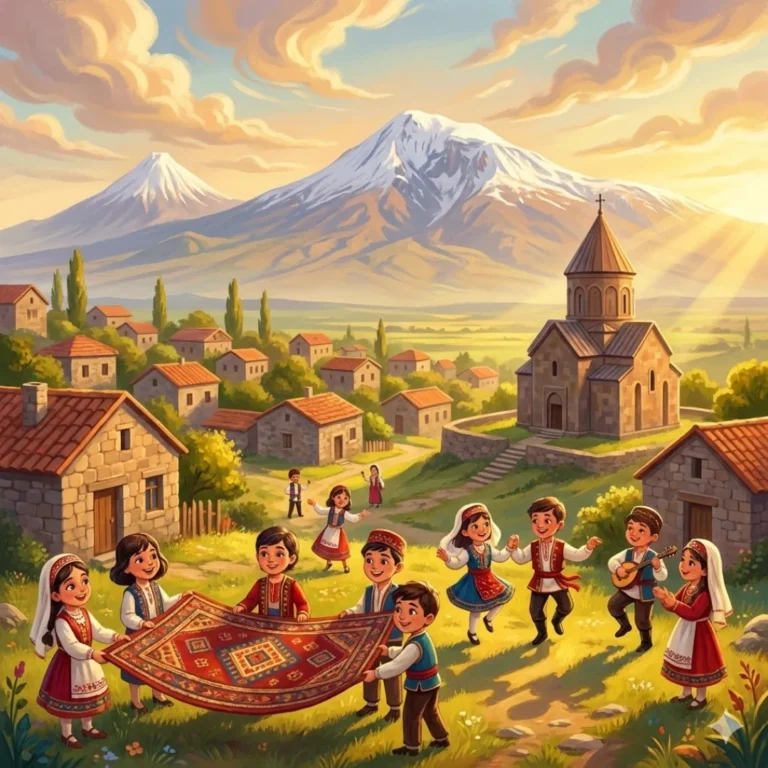
Far, far away, where the Pacific Ocean spreads like a vast blue blanket sewn with silver stars, where islands rise from the water like green jewels scattered by the gods, there lived a girl named Kaia. Her island home was so beautiful that even the clouds paused in their journey to admire it: white beaches soft as whispers, palm trees that danced with every breeze, flowers so bright they seemed to hold pieces of the rainbow.
Yet despite all this beauty, despite the warm sun that kissed her skin and the gentle waves that sang her to sleep each night, Kaia was not happy. For Kaia had learned a terrible habit: she saw only what she did not have, never what she possessed.
“Why don’t we have a bigger house like Chief Makoa?” she would complain to her mother, who wove beautiful mats from pandanus leaves.
“Why must I help with the fishing nets?” she would grumble to her father, who was the finest navigator in all the islands. “Other children get to play all day.”
“Why do I have only three shell necklaces?” she would sigh to her grandmother. “Leilani has five, and hers have prettier shells.”
Her family tried to teach her gratitude/” title=”More stories about gratitude”>gratitude. “Look around you, little one,” her grandmother would say gently. “See the gifts the ocean gives us each day. See the love of your family. See the food that fills your belly and the stars that light your night. These are blessings beyond measure.”
But Kaia would turn away, her eyes already searching for the next thing she lacked, the next reason to feel sorry for herself.
The people of the island began to whisper. “Poor child,” they said, shaking their heads. “She cannot see the treasure she stands upon. She is rich in everything except gratitude, and that makes her poorer than the poorest person who counts their blessings.”
One day, as Kaia sat on the beach pouting because she had no new dress for the festival, something strange happened. The ocean, which had been calm and blue as a summer sky, began to ripple and change. The water drew back, back, back, farther than anyone had ever seen.
Kaia stood up in amazement. Where waves had lapped just moments before, now there was exposed reef, wet sand, and pools full of colorful fish. And walking toward her across the revealed ocean floor came the most beautiful woman Kaia had ever seen.
She was made of water and light, of seafoam and starshine. Her hair flowed like currents, her eyes were deep as the ocean trench, and her dress was woven from waves that never stopped moving. She was one of the ocean spirits, the ones the elders spoke of in their stories.
“Kaia,” the spirit said, and her voice was like water over smooth stones, like the whisper of the tide. “I am Moana-nui-o-Kiva, keeper of the giving waves. I have watched you all your life, and I have seen how you turn your back on the ocean’s gifts. I have seen how you forget to give thanks.”
Kaia’s heart beat fast with fear and wonder. “I… I didn’t mean…”
“Hush, child,” the spirit said, not unkindly. “I have not come to punish you, but to teach you. The ocean gives and gives and gives, asking nothing in return. But when no one appreciates the gifts, when no one counts their blessings, the gifts lose their meaning and their magic. So I am going to show you what it means to have nothing, so that you may learn what it means to be grateful for something.”
Before Kaia could speak, the spirit waved her hand, and everything changed.
Kaia found herself standing on a different island, one with no palm trees, no flowers, no white beaches. The ground was hard and rocky. The sky was gray. The air was cold. She wore only a rough cloth, and her stomach ached with hunger.
For three days, Kaia lived on this barren island. She had no food except what she could find: a few bitter roots, some small crabs. She had no fresh water except what she could collect in leaves when a brief rain fell. She had no shelter except a small cave that barely kept out the wind. She had no family, no friends, no one to talk to or hug her when she cried.
On the fourth day, the ocean spirit appeared again. “Have you learned yet, child?”
Kaia fell to her knees, tears streaming down her face. “Yes! Oh yes! I had no idea what I had before. My mother’s woven mats that kept our floor soft and beautiful – I took them for granted. My father’s skill at fishing that kept us fed – I never thanked him. My grandmother’s stories – I thought they were boring, but now I would give anything to hear her voice! The warm sun, the sweet fruit, the gentle waves – I complained about everything when I should have been grateful for it all!”
The spirit’s face softened like water finding its level. “Come, child. Let me show you something else.”
She waved her hand again, and suddenly Kaia could see her island, her home, but as if through a magical window. She saw her mother weeping as she wove, her tears falling on the mats. She saw her father staring out at the ocean, his strong shoulders bent with worry. She saw her grandmother sitting by the shore, calling Kaia’s name to the waves.
“They think I’ve drowned,” Kaia whispered in horror. “They think the ocean took me away. Oh, how they must hurt! And I… I never appreciated them when I was there. I never told them how much they meant to me. I was always complaining, always wanting more, never seeing the treasure they were.”
More tears fell from her eyes, but these were different tears: tears of understanding, tears of regret, tears of newfound gratitude.
“Please,” Kaia begged the spirit. “Please let me go home. Not because this place is hard, but because I want to tell my family I love them. I want to thank them for every little thing they’ve done for me. I want to count my blessings instead of my complaints. Please, I’ve learned. I truly have.”
Moana-nui-o-Kiva smiled, and it was like the sun breaking through clouds after a storm. “Yes,” she said softly. “I believe you have. But remember, Kaia: gratitude is not a lesson you learn once and then forget. It is a practice, like dancing or navigating. Every day, you must choose to see the gifts around you. Every day, you must count your blessings. Will you do this?”
“I will,” Kaia promised. “Every single day.”
The spirit touched Kaia’s forehead gently, and in an instant, she was back on her own beach. Her family, who had been searching frantically, cried out with joy and ran to embrace her.
“Oh, Mama!” Kaia sobbed, holding her mother tight. “I’m so sorry for every time I complained about your mats. They’re the most beautiful mats in the world, and I never appreciated them!”
“Papa!” she said, throwing her arms around her father. “Thank you for working so hard to feed us. I never thanked you properly. You’re the best father anyone could have!”
“Grandmother!” she said, kneeling before the old woman. “Your stories are the most precious things I own. They’re better than any necklace or dress. Please forgive me for not listening better.”
Her family was amazed at the change in her, though they didn’t fully understand what had happened. Kaia tried to explain about the ocean spirit, but it seemed like a dream even to her. Had it been real? Or had she simply fallen asleep on the beach and dreamed a powerful dream?
It didn’t matter. What mattered was that something had changed inside her, like a locked door finally opening to let in light.
From that day forward, Kaia kept her promise. Every morning when she woke, she counted her blessings: “I have a soft mat to sleep on. I have a family who loves me. I have food to eat and clean water to drink. I have the warm sun and the beautiful ocean. I have flowers and stars and songs and stories. I am blessed beyond measure.”
And every evening before sleep, she thanked the ocean, the land, and her family for the gifts of the day: “Thank you for the fish we caught. Thank you for the rain that cooled us. Thank you for my friend’s laughter. Thank you for my grandmother’s story. Thank you for being with me another day.”
The change in Kaia changed others too. When her friends complained about their chores, she would say gently, “But isn’t it wonderful that we’re strong enough to do these chores? That we have nets to mend and gardens to tend?”
When someone grumbled about the rain, she would smile and say, “The rain is a gift! It fills our water gourds and makes the taro grow.”
Soon, gratitude began to spread through the island like a sweet fragrance. People started noticing the good things they had instead of the things they lacked. They thanked each other more. They smiled more. The whole island seemed brighter, happier, more blessed.
Years later, when Kaia had grown into a wise woman with children of her own, she would tell them the story of the ocean spirit and the barren island. “I don’t know if it was real or a dream,” she would say. “But the lesson was real. The lesson changed my life.”
She taught her children to count their blessings every day, to give thanks for the gifts they received, to appreciate the people who loved them. And when her children grew up, they taught their children the same lesson.
To this day, on that island in the Pacific, people practice the art of gratitude. Before every meal, they thank the ocean for its fish and the land for its crops. Before every journey, they thank their ancestors for guidance. Before every sleep, they count at least three blessings from the day.
And sometimes, on very calm evenings when the water is like glass and the stars are bright, people say you can see Moana-nui-o-Kiva walking on the waves. She moves from island to island, searching for children who have forgotten to be grateful, ready to teach them the same lesson she taught Kaia: that gratitude is the key that unlocks all other happiness, that counting your blessings is the way to multiply them, that a thankful heart is the richest treasure you can own.
The ocean gives and gives and gives, asking nothing in return except this: that we notice the gifts, that we appreciate the blessings, that we count what we have instead of what we lack.
And that, dear children, is the greatest gift of all: the gift of seeing clearly the treasures you already possess, the wisdom to be grateful for each wave, each breath, each moment of this beautiful life.
Count your blessings, and they will multiply like stars in the sky. Give thanks, and you will find more reasons to be thankful. This is the way of the ocean, the way of the islands, the way of a life well lived.
Moral of the Story
Count your blessings and be thankful
Frequently Asked Questions
What is the moral lesson of Kaia and the Giving Wave – A Polynesian Gratitude Story for Kids?
What age is this story appropriate for?
How long does it take to read Kaia and the Giving Wave – A Polynesian Gratitude Story for Kids?
What culture does this story come from?
Can I use this story for teaching?
Frequently Asked Questions
What is the story Kaia and the Giving Wave about?
Kaia and the Giving Wave is a children’s moral story set in the Pacific Islands about a girl named Kaia who only focuses on what she doesn’t have. Through a magical encounter with the ocean, she learns the importance of gratitude, generosity, and appreciating the blessings already in her life.
What is the main lesson or moral in Kaia and the Giving Wave?
The main moral of Kaia and the Giving Wave is that true happiness comes from gratitude and recognising what you already have, rather than constantly comparing yourself to others. It teaches children that a generous, thankful heart brings more joy than any material possession ever could.
Is Kaia and the Giving Wave suitable for young children?
Yes, Kaia and the Giving Wave is written for young children, typically ages 4 to 10. The story uses beautiful, vivid language set in a Polynesian island world, making it engaging for bedtime reading or classroom use while gently teaching values like gratitude and contentment.
📚 Recommended Books
Handpicked for readers like you
As an Amazon Associate, we earn from qualifying purchases. These recommendations are personalized based on this story's themes and your reading history.
What culture or tradition does this story draw from?
The story draws inspiration from Polynesian Pacific Island culture, featuring elements like navigation by stars, pandanus weaving, shell necklaces, and island chiefs. These details give children a rich, authentic cultural backdrop while exploring universal themes of thankfulness and giving.
Why does Kaia feel unhappy at the beginning of the story?
At the start of the story, Kaia feels unhappy because she constantly compares herself to others. She complains about her house, her chores, and her shell necklaces, always wanting more than she has. Despite living in a beautiful island paradise, her habit of focusing on what she lacks prevents her from feeling joy.
