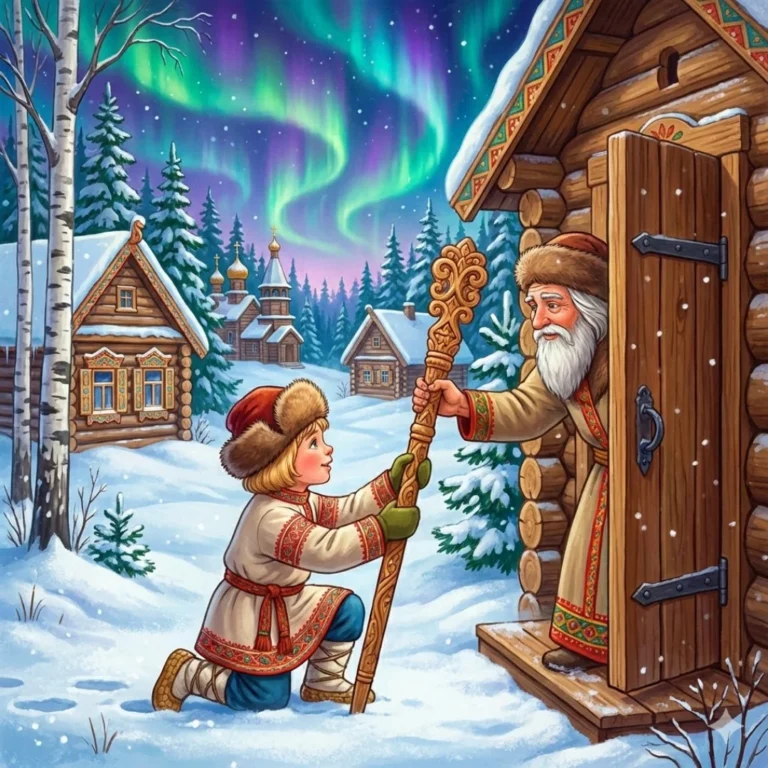
Orphaned Vasilisa faces a cruel stepmother who sends her to the fearsome witch Baba Yaga. With her mother’s magical doll, she survives impossible tasks, earns enchanted fire, and transforms from a suffering servant into a beloved Tsarina. Her journey proves that courage/” title=”More stories about courage”>courage, wisdom, and a mother’s love can light even the darkest path.
In a small wooden house at the edge of a vast Russian forest, there lived a girl named Vasilisa whose mother was dying. The autumn wind rattled the shutters, and the candle by the bedside flickered as if it too was afraid of what was coming.
Vasilisa’s mother held her daughter’s hand with fingers that had grown cold and thin. “My darling,” she whispered, her voice barely louder than the whisper of falling leaves. “I don’t have much time, but I have something precious to give you.”
From beneath her pillow, she pulled out a small wooden doll, no bigger than Vasilisa’s hand. Its painted face was simple but kind, with bright eyes that seemed almost alive.
“This doll carries my love for you,” her mother said, tears sliding down her pale cheeks. “When you face troubles—and you will, my sweet one—give the doll a bit of food and ask for help. It will guide you. Promise me you’ll keep it with you always.”
“I promise, Mama,” Vasilisa sobbed, clutching both the doll and her mother’s hand.
That night, as the first snow began to fall, Vasilisa’s mother closed her eyes for the last time. The house felt emptier than winter itself.
The year that followed was hard but bearable. Vasilisa’s father did his best, but grief had made him quiet and distant. He worked his merchant trade in faraway towns, leaving Vasilisa alone more often than she liked. The little doll became her constant companion. She would feed it bits of bread and cheese, and somehow, the loneliness didn’t hurt quite so much.
But then her father remarried.
The new stepmother arrived with two daughters of her own, and from the moment they stepped through the door, Vasilisa felt the warmth drain from her home. The stepmother’s smile was sharp as broken glass. Her daughters, sour-faced and lazy, looked at Vasilisa with eyes full of jealousy.
“Why does SHE get to be so pretty?” the eldest stepsister hissed when their mother wasn’t listening.
“And so kind,” the younger added bitterly. “Everyone likes her better. It’s not fair.”
The stepmother saw Vasilisa’s beauty and gentle nature as a threat. “You’ll do all the cooking and cleaning,” she announced coldly. “My daughters are delicate. Hard work would ruin their hands.”
Every morning before dawn, Vasilisa hauled water from the well until her arms ached. She scrubbed floors until her knees were red and raw. She washed clothes in the icy river until her fingers went numb. The stepmother kept adding more tasks, hoping to make Vasilisa ugly with exhaustion.
But each night, in the privacy of her tiny room, Vasilisa would feed her doll a crust of bread and a sip of milk.
“Please help me,” she would whisper.
And somehow, in the morning, the work would be finished. The bread would be baked. The floors would shine. The clothes would hang clean on the line. Vasilisa never saw how it happened—she would wake to find it done, as if her mother’s love still watched over her through the little doll.
This only made the stepmother angrier.
One gray autumn evening, when Vasilisa’s father was away on a long journey, the stepmother blew out every candle and lamp in the house. Darkness swallowed the rooms whole.
“Oh no!” the stepmother cried with fake concern. “We have no light! No fire! How will we cook? How will we see? We’ll freeze in the dark!”
The stepsisters huddled together, pretending to shiver.
“Vasilisa,” the stepmother said, her voice dripping with false sweetness, “you must go to Baba Yaga and ask for fire.”
Vasilisa’s blood turned cold. Everyone in Russia knew of Baba Yaga—the fearsome witch who lived deep in the forest, in a hut that walked on giant chicken legs. They said she had iron teeth that could crunch bones like kindling. They said a fence of human skulls surrounded her clearing, their empty eyes glowing with ghostly fire.
“Please,” Vasilisa begged, her voice trembling. “Isn’t there another way?”
“No,” her stepmother said firmly, pushing her toward the door. “Go now, before we all freeze to death. Unless you don’t care about your family?”
So Vasilisa wrapped herself in her mother’s old shawl, tucked the doll into her pocket, and stepped into the dark forest.
The trees towered above her like giants, their bare branches reaching toward the sky like grasping fingers. Every shadow seemed to hide something dangerous. The wind moaned through the pines, sounding almost like voices warning her to turn back. Vasilisa’s heart hammered against her ribs.
She walked for what felt like hours, her feet crunching through frost-covered leaves. Then, through the trees ahead, she saw something that made her freeze.
A rider galloped past on a white horse, dressed all in white, and suddenly the darkness lifted—dawn broke across the forest in shades of silver and pearl. Birds began to sing.
Vasilisa kept walking.
Later, a second rider thundered by on a red horse, dressed all in red, and the sun rose fully, painting the forest gold and amber. Warmth touched her face for the first time.
Still Vasilisa walked.
As evening approached, a third rider appeared—this one on a coal-black horse, dressed all in black. The moment he passed, night fell like a curtain. Darkness pressed in from all sides.
But ahead, Vasilisa saw lights—dozens of them, flickering with an eerie blue-white glow.
She pushed through the last tangle of bushes and stopped, her breath catching in her throat.
A clearing opened before her, surrounded by a fence made entirely of bones—leg bones for posts, arm bones for crossbars, and skulls perched on top. Each skull’s empty eye sockets glowed with an unnatural fire, casting dancing shadows across the ground. The clearing smelled of old smoke and something else—something wild and ancient.
In the center stood a hut unlike any Vasilisa had ever seen. It sat on two enormous chicken legs that scratched at the ground restlessly. The hut would turn this way and that, as if watching for intruders. Smoke curled from its chimney, and warm light spilled from its windows.
“Baba Yaga,” Vasilisa called out, her voice surprisingly steady despite her fear. “Grandmother, I need to speak with you.”
The door of the hut burst open with a bang.
Out stepped Baba Yaga.
She was old beyond measure, her face as wrinkled as tree bark. Her nose was long and hooked. When she smiled, Vasilisa saw teeth of gleaming iron. But her eyes—they were sharp and bright, missing nothing.
“A visitor,” Baba Yaga said, her voice like wind through a canyon. “A living girl in my clearing. How delicious. What do you want, child?”
Vasilisa forced herself to stand tall. “My family has no fire. I came to ask if you might share yours, grandmother.”
Baba Yaga’s eyes narrowed. “Nothing is free in this world, girl. If you want fire, you must earn it. Work for me for three days and complete every task I give you. If you succeed, you’ll have your fire. If you fail…”
She clicked her iron teeth together with a sound like a knife being sharpened.
“I’ll eat you for my dinner.”
Vasilisa’s knees shook, but she nodded. “I agree.”
“Then come inside,” Baba Yaga said. “And prepare my supper. I’m hungry from riding all day.”
Baba Yaga ate enough for ten people—platters of roasted meat, whole loaves of bread, basins of soup. Vasilisa served her quietly, watching and learning. When the witch finally pushed her plate away, she gave Vasilisa her first task.
“See that huge pile of wheat mixed with wild seeds and dirt by the barn?” Baba Yaga pointed a bony finger. “By tomorrow morning, I want the good wheat separated from everything else. Every single grain must be sorted. And tomorrow while I’m gone, you’ll wash all my laundry, scrub my floors, cook my dinner, and tend my garden. Do you understand?”
“Yes, grandmother,” Vasilisa said.
Baba Yaga cackled and went to her bed. Soon her snores rattled the windows.
Vasilisa went outside and stared at the mountain of grain. It was impossible. There must have been millions of seeds, all jumbled together in a pile as tall as she was. It would take a hundred people a month to sort it all.
Her eyes filled with tears. “I’m going to die here,” she whispered.
Then she remembered the doll.
She pulled it from her pocket and fed it a piece of bread she’d saved from dinner. “Please,” she begged. “I don’t know how to do this. Help me.”
The doll’s eyes seemed to brighten. “Don’t cry, Vasilisa. Go to sleep. Morning is wiser than evening.”
Exhausted and terrified, Vasilisa curled up on a pile of straw in the barn and somehow fell asleep.
When she woke to the white rider’s dawn, she gasped.
The wheat was sorted. Mountains of clean grain sat in neat piles, separated perfectly from the wild seeds and dirt. Every single kernel accounted for.
Baba Yaga inspected the work with narrowed eyes. “Hmm,” was all she said. Then she pointed to enormous piles of dirty laundry, shelves thick with dust, an overgrown garden full of weeds.
“Finish it all before I return,” she commanded. Then she climbed into her mortar—a giant bowl that flew through the air—used her pestle to steer, and swept her tracks away with a broom made of birch twigs. She rose into the sky and vanished over the treetops.
Vasilisa stared at the impossible amount of work and felt panic rising in her chest. But again, she fed the doll and asked for help. Again, it told her to rest.
When Baba Yaga returned at nightfall, every task was completed. The laundry hung clean and bright. The floors gleamed. A delicious stew bubbled over the fire. The garden stood neat and orderly.
The witch’s iron teeth ground together. “How did you do this?” she demanded.
“With my mother’s blessing,” Vasilisa answered truthfully. It wasn’t a lie—the doll carried her mother’s love, after all.
Baba Yaga actually stepped backward, as if the words had pushed her. “A blessing,” she muttered. “A mother’s blessing. I see.”
She gave Vasilisa even harder tasks the third day—separating millions of poppy seeds from sand, organizing every herb in her vast collection, preparing a feast fit for a king. But again, with the doll’s help, Vasilisa completed everything.
On the third night, as Baba Yaga ate the feast Vasilisa had prepared, the old witch studied the girl with eyes that seemed to see into her very soul.
“You may ask me three questions,” Baba Yaga said suddenly. “Choose them wisely.”
Vasilisa thought carefully. She wanted to ask about the riders, about the magic, about so many mysteries. But she remembered her mother’s wisdom—some knowledge was dangerous.
“Who was the white rider?” she asked.
“That was my Day,” Baba Yaga replied. “He brings the dawn.”
“Who was the red rider?”
“My Sun. He lights the world.”
“And the black rider?”
“My Night. He brings darkness and rest.”
Baba Yaga leaned forward. “Don’t you want to ask how your work gets done? Don’t you want to know about your doll?”
“No, grandmother,” Vasilisa said quietly. “Some magic is meant to be accepted, not questioned. My mother gave me what I needed. That’s enough.”
For the first time, Baba Yaga smiled—really smiled, not with cruelty but with something almost like approval.
“Wise girl,” she said. “Too wise to stay here. One who carries a mother’s blessing has no place in a house of bone and shadow. Take your fire and GO.”
She pulled a skull from her fence. Its eyes blazed with bright fire. She thrust it at Vasilisa on a stick.
“Here. This will light your way home and provide all the fire you need. Now leave, before I remember how hungry I am.”
Vasilisa ran.
She ran through the dark forest, the skull-lantern lighting her path with its fierce glow. The light was so bright that shadows fled before it. The forest seemed to part for her, trees bending aside to let her pass.
When she finally stumbled home, exhausted and dirty, she expected her stepmother and stepsisters to be relieved.
Instead, they looked terrified.
“Where did you get that?” her stepmother gasped, staring at the skull.
“From Baba Yaga,” Vasilisa said simply. “You sent me for fire. Here it is.”
She set the skull on the table. Its fiery eyes swept across the room, seeming to see everything—every cruel word, every mean trick, every bit of jealousy and hatred that had festered in that house.
The stepmother and stepsisters screamed.
The skull’s gaze found them and wouldn’t look away. Wherever they ran, it followed them with those burning eyes. They felt the weight of their own cruelty reflected back at them, magnified a hundred times.
By morning, they were gone. Nothing remained but three small piles of ash, swept clean by an unfelt wind.
Vasilisa should have felt triumphant. But she only felt sad. She buried the ashes in the garden and planted flowers over them. Even cruel hearts deserved that much kindness.
When her father returned from his travels, he found the house peaceful and quiet. Vasilisa never told him exactly what happened. Some truths were too heavy for others to carry.
The skull, its job finished, had stopped glowing. Vasilisa buried it respectfully at the edge of the forest, thanking it for protecting her.
After that, Vasilisa went to live with a kind old woman in the village. To support them both, she spun and wove the most beautiful cloth anyone had ever seen. Her fingers seemed to know exactly how to create patterns that caught the light like water, like leaves, like morning mist.
One day, she wove a cloth so extraordinary that the old woman insisted on taking it to the Tsar himself. The Tsar held the fabric up to the light and gasped. He had never seen such beauty—every thread seemed alive, telling stories of forests and magic and love that wouldn’t die.
“Who made this?” he demanded. “I must meet this weaver.”
When the Tsar met Vasilisa, he saw not just a beautiful girl, but a wise and kind soul who had suffered and grown strong. He saw someone who had faced darkness and carried light within her. He saw courage wrapped in gentleness.
He fell in love with her immediately.
Vasilisa, who had spent so long being unloved in her stepmother’s house, was overwhelmed by his kindness and respect. Slowly, carefully, she let herself love him back.
They married in the spring, when flowers bloomed across the kingdom. Vasilisa became Tsarina, beloved by all who knew her. She ruled with wisdom and compassion, never forgetting the lessons she’d learned—that true strength came from kindness, that a mother’s love could protect you even after death, and that the darkest forests sometimes led to the brightest futures.
The little wooden doll, she kept in a special place of honor. Sometimes, late at night when the weight of ruling felt heavy, she would hold it and remember her mother’s voice: “This carries my love for you.”
And she would feel strong enough to face another day.
Years later, when she had children of her own, Vasilisa would tell them her story. Not to frighten them, but to teach them that life would bring darkness and difficulty, witches with iron teeth and stepmothers with cold hearts. But if they carried love within them—the love of those who believed in them—they could survive anything. They could walk through the darkest forest and come out the other side, not just alive but transformed into something stronger, wiser, and more beautiful than they’d been before.
Suffering, she taught them, wasn’t the end of the story. It was only the middle. And the middle, however dark, could lead to a beginning full of light.
Test Your Understanding
1What special gift did Vasilisa’s mother give her before she died?
2Why did the stepmother send Vasilisa to Baba Yaga?
3What did the three riders represent?
4How did Vasilisa complete all of Baba Yaga’s impossible tasks?
5What important lesson does Vasilisa’s story teach us?
Frequently Asked Questions
What is the moral lesson of Vasilisa the Wise and Baba Yaga?
What age is this story appropriate for?
How long does it take to read Vasilisa the Wise and Baba Yaga?
What culture does this story come from?
Can I use this story for teaching?
Frequently Asked Questions
What is the story of Vasilisa the Wise and Baba Yaga about?
Vasilisa the Wise and Baba Yaga is a Russian fairy tale about an orphaned girl sent by her cruel stepmother to the terrifying witch Baba Yaga. Using a magical doll left by her dying mother, Vasilisa completes impossible tasks, earns enchanted fire, and eventually becomes a Tsarina. It’s a story about courage, wisdom, and a mother’s enduring love.
Who is Baba Yaga in Russian folklore?
Baba Yaga is a famous witch from Russian folklore, often depicted as a fearsome old woman who lives deep in the forest. She can be terrifying and dangerous, but in many stories she also tests heroes and rewards those who show courage, wisdom, and good manners. In Vasilisa’s story, she plays a key role in the heroine’s transformation.
What is the magical doll in the Vasilisa the Wise story?
The magical doll is a gift from Vasilisa’s dying mother. It acts as a protective guide, helping Vasilisa complete the impossible chores Baba Yaga sets for her. The doll represents a mother’s love continuing to protect her child even after death, and it’s the key reason Vasilisa survives her terrifying ordeal in the forest.
📚 Recommended Books
Handpicked for readers like you
As an Amazon Associate, we earn from qualifying purchases. These recommendations are personalized based on this story's themes and your reading history.
What is the moral lesson of Vasilisa the Wise and Baba Yaga?
The main moral of Vasilisa the Wise and Baba Yaga is that courage, wisdom, and love can guide you through even the darkest times. The story also shows that kindness and inner strength matter more than wealth or power. It encourages children to trust in those who love them and to face challenges with bravery.
Is Vasilisa the Wise suitable for young children to read?
Vasilisa the Wise and Baba Yaga is generally suitable for children aged 6 and up, though younger children may find Baba Yaga mildly scary. The story has dark themes like loss and cruelty, but these are balanced with warmth, magic, and a hopeful ending. It’s a wonderful way to introduce kids to classic Russian folklore and timeless values.